Kung Pow Kara beat me to it but here are some extra thoughts...
Pecha Kucha night came back to Shanghai for its 5th installment last Thursday, March 8. The event took place at Kong Gallery located on the top floor of The Source on Xinle lu, a streetwear clothing store. This particular location seemed quite fitting considering the large focus on street art and culture in Shanghai as presented by gallery curator and photographer Rodney Evans and his partner Nick Barham.
Pecha Kucha, which literally translates to “Sound of Conversation,” in Japanese was conceived by Tokyo based architects Astrid Klein and Mark Dytham. The event is meant to serve as a forum for young artists to meet and show their artwork on a public platform. Conceived only in 2003, Pecha Kucha nights have spread to venues across the globe due to such an overwhelmingly positive response.
The really clever thing about Pecha Kucha, though, is the abbreviated format. Each artist has the stage for exactly 6 minutes and 40 seconds, allowing them to show 20 pieces of their work in 20-second snippets, keeping the material concise and the interest level up at all times. Pecha Kucha Shanghai (which began less than a year ago in May, 2006) seems to have a way of attracting an especially wide variety of artists and art lovers from all over the world to discuss any and all types of media. At the most recent installment at Kong gallery, 14 artists presented their work in realms ranging from photography, architecture, graffiti and music just to name a few.
Admittedly, the collective works were a bit contrived, allowing a few presenters to wax philosophical on flowery issues like the meaning of true art. Some of the misses included (but were not limited to) photo sets of various rooms in their natural lighting and some rehearsed prose on street art and all of its connotations. On the other hand, there were a handful of artists who came prepared with really innovative and thoughtful presentations. They ranged from fresh web designs, computer graphics and streetwear design made by quirky design duo Lin Lin and Sam Jacobs, to a fascinating thesis discussing a hybrid of architecture and fashion design as inspired by a mythical fairytale presented by architecture student from Canada, Andrea Lin.
Pecha Kucha nights give all of the artists a chance to talk about their vision and put themselves out there, making the experience perhaps a little fluffier than I would have liked it to be, but also inviting some pretty interesting open-ended discussions. Not to mention the vibe was overall quite friendly and surprisingly un-pretentious, although the cheap drinks certainly helped to lighten the mood. If anything, who can deny a 30 yuan entrance fee and some prime people watching?
Showing posts with label reviews/responses. Show all posts
Showing posts with label reviews/responses. Show all posts
Wednesday, March 14, 2007


Problematic Propaganda and Fretting for the Future...
I made my way last Friday (9/March/2007) down the twists and turns of Huashan Lu towards the Shanghai Propaganda Poster Art Center.
And I have wisdom to pass down to any unsuspecting pilgrims interested in walking down Huashan Lu: the road curves at one point even though there's no sign to warn you. So keep an eye out for the cross streets and, well, you won't wind up getting Shanghai'd (haha).
The museum entrance is is ominously placed in an inconspicuous looking apartment complex - the perfect setting for either a horror movie or soap opera. After some gesturing the guard showed me THE WAY...which was on a business card/map. The actual museum is in a basement complex - again the perfect setting for a horror movie. But aside from some very interesting propaganda posters, you need have no fear.
Though I could have sworn I saw one of the Mao poster figures blink at me.
Anyway, I chose two particular pieces to review/critique because I felt they could be connected by virtue of both being visions into China's future. It is obvious that the intended vision to be disseminated among the people changes over time and as I'll explain.

Ok so I would give the Chinese name for this first poster but I'm slightly embarrassed to admit that I don't know all the characters. Sorry folks. I can tell you the English name though: "Hail for Over-fulfilling Steel Production of 10.7 Million Tons". This was published in 1958 by an anonymous artist. The version you're looking at now was cropped by yours truly but if you feel so inclined you can find the original image here.
My first impression of it was striking: the dark colors of the factories in the lower background are contrasted by the illumination from what appear to be crowds of people and fireworks. Though if you look carefully, you will notice smokestacks all with fires ablaze, a telltale sign of continuous work and continuous progress. The question I would raise to the viewer is to imagine exactly what kind of progress is taking place. The China depicted in the picture is undoubtedly industrialized, but at the price of mechanization and a sort of sterility - apart from the working masses 'celebrating' their work there is no sign of life. And surely no sign of individuality which reinforces the mechanization that has undergone the workforce, ironically one of the problems of industrialization that communism in a pure form is supposed to address. If this is the intended future of China then it surely comes at a high price of the sacrifice of the individual. It is minor and probably in consequential in light of cultural differences, but notice that there are no stars to wish on and no faces in the crowd. I would say this detail alone is the icing on the cake as far as sacrifice of the individual for the sake of the state is concerned.

I actually know all the characters for this next image so you're in luck. Or maybe not if you don't care for Chinese. It is called "中华人民共和国千岁"(zhong1 hua2 ren2 min2 gong1 he2 guo2 qian1 sui4) or in English "Long Live the Chinese Republic". Again I have cropped the version you're seeing but you can find the original here.
This poster was made in 1979 and again presents a future vision of China, but one that is arguably both more confident and more positive overall. If you look carefully you will notice that we have yet another industrialized future (and this is an amusing 70s rendition in which I can't help but feel that all the technology depicted looks somewhat outdated nowadays - the helicopter is hilarious). Yet this future is much more service oriented with all the forms of transportation and seemingly more accessible to the people. You can see suggested Chinese superiority in terms of trains, cars, boats, airplanes, satellites, and even spacecraft. This last spacecraft is especially interesting as it suggests the inevitability of the expansion and success of the Chinese nation beyond its borders, carrying the country and its ideals into a new beyond. In the center lower foreground there is a tractor as if to remind the viewer where the People's Republic has come from and how the long history of China is inevitably interconnected with its presumably rich future. The sky is literally not even the limit as these seemingly highly industrialized ideals are starting to reach much beyond the sky. The city is again sterile in comparison to the previous picture, but not in such a bleak fashion. And it is surprisingly clean looking as compared to the previous picture. I would argue that the city is void of people because it has developed exponentially beyond the real life scenario where people must walk on the street - people are using highly developed transportation.
Overall I very much enjoyed my visit to the propaganda museum and would highly recommend it to anyone. This is a rare chance for both Chinese and Foreigners to see important contemporary history artifacts concerning the development of Chinese culture. The two pictures I mentioned especially strike a chord for me as I watch Shanghai be developed. Are we finally getting a glimpse into unfulfilled past Chinese dreams? If you take a look at the skyline on the Bund, it doesn't seem so far away from the second picture. The question I would again raise is not whether this is development is going to happen because it undoubtedly already is and will continue to do so - but rather, what kind of future will Shanghai and the rest of China ultimately have? Personally, I feel like Shanghai is destined for the second picture right now...and we'll have to wait and see as far as the rest of China is concerned!
I welcome any other analysis from anyone. Feel free to agree or disagree and write a comment ;]
And I have wisdom to pass down to any unsuspecting pilgrims interested in walking down Huashan Lu: the road curves at one point even though there's no sign to warn you. So keep an eye out for the cross streets and, well, you won't wind up getting Shanghai'd (haha).
The museum entrance is is ominously placed in an inconspicuous looking apartment complex - the perfect setting for either a horror movie or soap opera. After some gesturing the guard showed me THE WAY...which was on a business card/map. The actual museum is in a basement complex - again the perfect setting for a horror movie. But aside from some very interesting propaganda posters, you need have no fear.
Though I could have sworn I saw one of the Mao poster figures blink at me.
Anyway, I chose two particular pieces to review/critique because I felt they could be connected by virtue of both being visions into China's future. It is obvious that the intended vision to be disseminated among the people changes over time and as I'll explain.
Ok so I would give the Chinese name for this first poster but I'm slightly embarrassed to admit that I don't know all the characters. Sorry folks. I can tell you the English name though: "Hail for Over-fulfilling Steel Production of 10.7 Million Tons". This was published in 1958 by an anonymous artist. The version you're looking at now was cropped by yours truly but if you feel so inclined you can find the original image here.

My first impression of it was striking: the dark colors of the factories in the lower background are contrasted by the illumination from what appear to be crowds of people and fireworks. Though if you look carefully, you will notice smokestacks all with fires ablaze, a telltale sign of continuous work and continuous progress. The question I would raise to the viewer is to imagine exactly what kind of progress is taking place. The China depicted in the picture is undoubtedly industrialized, but at the price of mechanization and a sort of sterility - apart from the working masses 'celebrating' their work there is no sign of life. And surely no sign of individuality which reinforces the mechanization that has undergone the workforce, ironically one of the problems of industrialization that communism in a pure form is supposed to address. If this is the intended future of China then it surely comes at a high price of the sacrifice of the individual. It is minor and probably in consequential in light of cultural differences, but notice that there are no stars to wish on and no faces in the crowd. I would say this detail alone is the icing on the cake as far as sacrifice of the individual for the sake of the state is concerned.
I actually know all the characters for this next image so you're in luck. Or maybe not if you don't care for Chinese. It is called "中华人民共和国千岁"(zhong1 hua2 ren2 min2 gong1 he2 guo2 qian1 sui4) or in English "Long Live the Chinese Republic". Again I have cropped the version you're seeing but you can find the original here.

This poster was made in 1979 and again presents a future vision of China, but one that is arguably both more confident and more positive overall. If you look carefully you will notice that we have yet another industrialized future (and this is an amusing 70s rendition in which I can't help but feel that all the technology depicted looks somewhat outdated nowadays - the helicopter is hilarious). Yet this future is much more service oriented with all the forms of transportation and seemingly more accessible to the people. You can see suggested Chinese superiority in terms of trains, cars, boats, airplanes, satellites, and even spacecraft. This last spacecraft is especially interesting as it suggests the inevitability of the expansion and success of the Chinese nation beyond its borders, carrying the country and its ideals into a new beyond. In the center lower foreground there is a tractor as if to remind the viewer where the People's Republic has come from and how the long history of China is inevitably interconnected with its presumably rich future. The sky is literally not even the limit as these seemingly highly industrialized ideals are starting to reach much beyond the sky. The city is again sterile in comparison to the previous picture, but not in such a bleak fashion. And it is surprisingly clean looking as compared to the previous picture. I would argue that the city is void of people because it has developed exponentially beyond the real life scenario where people must walk on the street - people are using highly developed transportation.
Overall I very much enjoyed my visit to the propaganda museum and would highly recommend it to anyone. This is a rare chance for both Chinese and Foreigners to see important contemporary history artifacts concerning the development of Chinese culture. The two pictures I mentioned especially strike a chord for me as I watch Shanghai be developed. Are we finally getting a glimpse into unfulfilled past Chinese dreams? If you take a look at the skyline on the Bund, it doesn't seem so far away from the second picture. The question I would again raise is not whether this is development is going to happen because it undoubtedly already is and will continue to do so - but rather, what kind of future will Shanghai and the rest of China ultimately have? Personally, I feel like Shanghai is destined for the second picture right now...and we'll have to wait and see as far as the rest of China is concerned!
I welcome any other analysis from anyone. Feel free to agree or disagree and write a comment ;]
Thursday, November 23, 2006
Museums vs. Chinese Art Market
The current state of contemporary museums in Shanghai is a complex web of funding and weaving of resources to attempt to provide a feasible museum to the public. With the emerging interest in the collection of Asian art, galleries and collectors have often times made quick assertions about the perceived value of contemporary Chinese art. In Shanghai alone, dozens of museums and galleries have emerged with the goal of not only advancing artistic ideas, but pushing, and literally selling these ideas to the rest of the world. In this new emerging world of Asian art questions begin to arise as to whether or not contemporary museums and galleries in Shanghai are taking the ethical steps necessary to provide the proper reciprocal benefits to the artistic community, as well as valuing art for its creativity, and not simply its capitalistic market worth.
Currently in China today, the government lacks a cohesive plan that would allow for non-profit organizations to feasibly exist. As a result, this situation makes the various museums and galleries come up with creative means to sustain and fund their artistic ventures. Unlike in the United States, where a system of donations allows a tax benefit and unlike in Europe, where the governments provide cultural budgets to stimulate the arts, a void exists in China to the extent that neither of these two forces are present. With the lack of government support and philanthropic tradition, Chinese galleries and museums have resorted to various means of raising capital, such as finding corporate sponsors, selling the art being displayed, providing professional services like graphic and concept design, and in some cases receiving donations from private individuals.
As a result, many galleries have been forced to find a business solution to allow for the continued existence of their organization. In the case of BizArt, which opened in 1996, an innovative solution had to be found. According to the director of BizArt, David Quadrio, “BizArt is a self-supported and not-for-profit art center that combines artistic and commercial pursuits with the ultimate goal of advancing contemporary art in Shanghai and beyond. The name ‘BizArt’ refers to our straddling the duel roles of business and art, and the ‘bizarre’ nature of our existence.” Although BizArt advocates its non-for-profit status in the pursuit of artistic creativity and development, the harsh reality is that BizArt needs to receive revenue to survive. This gray area, or as BizArt would say, “bizarre” nature of its existence, points to the conflicts that exist within its not-for-profit status and its need to create revenue through business endeavors such as graphic and concept design. Despite this juxtaposition of values, BizArt recognizes the growing imbalance of the cost of Chinese art in relation to funding allocated to artists and creative organizations. BizArt acknowledges this growing hyper-inflation of Chinese art, and strives to reinvest in the artistic community by the creation of Arthub. Arthub supports a process of creative contemporary art free of pressures resulting from the hyper-inflated contemporary Chinese art market.
Another contemporary art space in Shanghai, the Shanghai Museum of Contemporary Art, better known as the Shanghai MoCA, has experienced many of the effects of commercialization due to the lack of a philanthropic tradition. Opened in 2005 from the support of Samuel Kung, who contributed US$1.5 million, the museum quickly needed to find a way to bring in extra revenue that would allow for its continued existence. Endorsed by the Shanghai Municipal Government, the MoCA has become a notable tourist attraction in the heart of Shanghai. Despite its not-for-profit status, the MoCA contains a restaurant, as well as holds private functions. Thus the MoCA’s status of non-for-profit is tainted by its need to bring in income. A perfect example arises from personal experience when we visited the MoCA, the staff members were preparing to move a famous clay pot exhibit by Ai WeiWei to make space for a Ferrari that was to be shown at a private party later that evening. In addition, an AirFrance model for their new first class seating was blocking Miao Xiaochun’s “Last Judgment” exhibit, which already had poor visibility and viewing space. These two examples force us to question what is the priority of the MoCA - is it to make money, or display contemporary art? The MoCA claims to be the first not-for-profit contemporary art museum, but what line is to be drawn between where art ends and profit begins?
Likewise, the Zendai Museum of Contemporary Art brings to mind similar ethical questions. The Zendai is funded by the Zheng Da Property Group, which is the largest single property developer in Pudong. Although the Zendai is willing to take chances and exhibit edgy, more controversial pieces of art, the fact is that Zendai is entirely funded by a single organization, thereby creating a potential conflict of interests. In addition, the future plans are to create a center for contemporary art, called The Himalaya Center, which includes a five-star hotel, commercial space, and office space for creative businesses. The Zendai therefore represents the current commercialization of contemporary art, and the current hyper-inflation that threatens artistic creativity. Despite being free from having to look for outside contributors to fund its space, the relationship between Zendai and the parent corporation is in need of scrutiny. The fact remains that Zheng Da is a developer in Shanghai, and the Zendai may not be free to take truly creative measures in displaying art. It may instead be forced to display art that would appeal to the hyper-inflated art market and bring in tourism money to create a profit for the parent sponsor.
In our examination of these three major players in the Shanghai art world, there is a lack of definite boundaries between art for its intrinsic value, and art for its commercial value. There lacks a sanctity in the use of an art space such as the MoCA or Zendai, as compared to museums in America and Europe, which believe that art should be displayed for intellectual and cultural value. Understandably, the realm that these art spaces exist within is inextricably bound to the need to attain financial viability due to lack of proper societal contributions. However, these museums and galleries should strive to limit the influence of the commercial art market to maintain their integrity as public art spaces. As the Shanghai art scene develops and expands, one can only hope that the true spirit of art will be preserved from an ever growing capitalist influence.
Currently in China today, the government lacks a cohesive plan that would allow for non-profit organizations to feasibly exist. As a result, this situation makes the various museums and galleries come up with creative means to sustain and fund their artistic ventures. Unlike in the United States, where a system of donations allows a tax benefit and unlike in Europe, where the governments provide cultural budgets to stimulate the arts, a void exists in China to the extent that neither of these two forces are present. With the lack of government support and philanthropic tradition, Chinese galleries and museums have resorted to various means of raising capital, such as finding corporate sponsors, selling the art being displayed, providing professional services like graphic and concept design, and in some cases receiving donations from private individuals.
As a result, many galleries have been forced to find a business solution to allow for the continued existence of their organization. In the case of BizArt, which opened in 1996, an innovative solution had to be found. According to the director of BizArt, David Quadrio, “BizArt is a self-supported and not-for-profit art center that combines artistic and commercial pursuits with the ultimate goal of advancing contemporary art in Shanghai and beyond. The name ‘BizArt’ refers to our straddling the duel roles of business and art, and the ‘bizarre’ nature of our existence.” Although BizArt advocates its non-for-profit status in the pursuit of artistic creativity and development, the harsh reality is that BizArt needs to receive revenue to survive. This gray area, or as BizArt would say, “bizarre” nature of its existence, points to the conflicts that exist within its not-for-profit status and its need to create revenue through business endeavors such as graphic and concept design. Despite this juxtaposition of values, BizArt recognizes the growing imbalance of the cost of Chinese art in relation to funding allocated to artists and creative organizations. BizArt acknowledges this growing hyper-inflation of Chinese art, and strives to reinvest in the artistic community by the creation of Arthub. Arthub supports a process of creative contemporary art free of pressures resulting from the hyper-inflated contemporary Chinese art market.
Another contemporary art space in Shanghai, the Shanghai Museum of Contemporary Art, better known as the Shanghai MoCA, has experienced many of the effects of commercialization due to the lack of a philanthropic tradition. Opened in 2005 from the support of Samuel Kung, who contributed US$1.5 million, the museum quickly needed to find a way to bring in extra revenue that would allow for its continued existence. Endorsed by the Shanghai Municipal Government, the MoCA has become a notable tourist attraction in the heart of Shanghai. Despite its not-for-profit status, the MoCA contains a restaurant, as well as holds private functions. Thus the MoCA’s status of non-for-profit is tainted by its need to bring in income. A perfect example arises from personal experience when we visited the MoCA, the staff members were preparing to move a famous clay pot exhibit by Ai WeiWei to make space for a Ferrari that was to be shown at a private party later that evening. In addition, an AirFrance model for their new first class seating was blocking Miao Xiaochun’s “Last Judgment” exhibit, which already had poor visibility and viewing space. These two examples force us to question what is the priority of the MoCA - is it to make money, or display contemporary art? The MoCA claims to be the first not-for-profit contemporary art museum, but what line is to be drawn between where art ends and profit begins?
Likewise, the Zendai Museum of Contemporary Art brings to mind similar ethical questions. The Zendai is funded by the Zheng Da Property Group, which is the largest single property developer in Pudong. Although the Zendai is willing to take chances and exhibit edgy, more controversial pieces of art, the fact is that Zendai is entirely funded by a single organization, thereby creating a potential conflict of interests. In addition, the future plans are to create a center for contemporary art, called The Himalaya Center, which includes a five-star hotel, commercial space, and office space for creative businesses. The Zendai therefore represents the current commercialization of contemporary art, and the current hyper-inflation that threatens artistic creativity. Despite being free from having to look for outside contributors to fund its space, the relationship between Zendai and the parent corporation is in need of scrutiny. The fact remains that Zheng Da is a developer in Shanghai, and the Zendai may not be free to take truly creative measures in displaying art. It may instead be forced to display art that would appeal to the hyper-inflated art market and bring in tourism money to create a profit for the parent sponsor.
In our examination of these three major players in the Shanghai art world, there is a lack of definite boundaries between art for its intrinsic value, and art for its commercial value. There lacks a sanctity in the use of an art space such as the MoCA or Zendai, as compared to museums in America and Europe, which believe that art should be displayed for intellectual and cultural value. Understandably, the realm that these art spaces exist within is inextricably bound to the need to attain financial viability due to lack of proper societal contributions. However, these museums and galleries should strive to limit the influence of the commercial art market to maintain their integrity as public art spaces. As the Shanghai art scene develops and expands, one can only hope that the true spirit of art will be preserved from an ever growing capitalist influence.
Contemporary Chinese Art - Piecing it Together
Last Thursday we were privileged to have three active members of the contemporary Chinese art scene who live in Shanghai arrive and present our small class with a lecture on the emerging and evolving performance art scene in Shanghai and China today.
The first of these specialists was Yang Zhanzhong, who was the curator an exhibition “Art for Sale”, which was compiled over half a year in Beijing, Shanghai, and Guangzhou. The exhibit resembled a supermarket, offering up art in wholesale quantities. One could possibly imagine Wal-Mart adding an art arm, as it were. After discussing the “Art for Sale” exhibit for a short while, and presenting a film highlighting his role as an “employee”, he showed a short film entitled “I Will Die”, in which people are recorded saying, “I Will Die”. This work, like the rest of Yang Zhanzhong’s work is rather lighthearted, and simply asks us to examine death from a less morbid sensibility.
The next speaker was Philip Tinari, a writer living in Shanghai, although he also has extensive experience living in Beijing. Philip’s lecture highlighted “The Long March Project” (www.longmarchspace.com), in which various artists retraced the stops during Mao’s own Long March. These artists often created site-specific pieces along the way. In an exampled that remembered the violence that occurred in one stop, knives were used to highlight the events at that locale. The key element for the artist involved has been to keep a unique Chinese social tradition as an intrinsic part of their works, going back to the Chinese countryside to find “roots”. Lastly Philip brought up the Yan’An Project, which has set out to help future artists in China, as an adequate art education system is something that has been seriously lacking in China today. This education system will become increasingly important as China moves towards a goal of creating one thousand museums by 2015.
The last speaker, Liu Ying Mei, is another curator who has lived both in Shanghai and Beijing, and is well known for working with artists who push the limits of what is to be tolerated in modern China. Liu began by presenting us with a history of modern art in China, starting in 1750 with an Italian priest, moving towards the 1979 Stars Exhibition, the 1989 Modern Art Exhibition, and finally into the 1990s with the beginning of solo exhibitions as a way to present contemporary Chinese art. After giving us a general history of art in China, she moved on to discuss the creation of Shanghai’s first art school, an oil painting school in Xu Jia Hui. The Catholic Church can be attributed to the creation of the school, which was founded in 1860 as an orphanage, but was converted to an art school in 1864 by Juan Ferrerra. Shanghai’s first art school lasted around ninety years, from 1864 – 1949, ending with the accession of Mao.
Interspersed between illuminating us with the fascinating history of contemporary art in China, Liu presented us with pictures from the various art exhibits she has been associated with. Her most fascinating story comes from 2002, when during one of her works at a library, eight artists had to removed their works and offer less “offensive” creations, due to disapproval from the organizer.
Although these three speakers touched on different topics, all wove together to give an underlying presentation of what is happening today in contemporary Chinese art. Liu Ying Mei highlighted the history of the contemporary art movement, as well as serious issues facing the Chinese gallery scene, where an organizer has too much power over their sponsored artists. This strangulation of artistic creativity is a worrisome possibility in some of Shanghai’s new museums, such as the Zendai. This new building spree is also worrisome because of an acute lack of art education in China, upon which Philip touched upon, as well as the attempt by contemporary Chinese artists to find their own, indigenous inspiration with his discussion of the Long March Project. Finally Yang Zhanzhong highlights issues of China’s inflated contemporary art market with his work “Art for Sale”, which while being shut down shortly, also highlights the still restrictive nature of China in relation to allowing artist freedoms. These three artists brought together all of the critical issues facing Chinese art through their own personal experiences of working in China in a thoroughly thought provoking manner.
The first of these specialists was Yang Zhanzhong, who was the curator an exhibition “Art for Sale”, which was compiled over half a year in Beijing, Shanghai, and Guangzhou. The exhibit resembled a supermarket, offering up art in wholesale quantities. One could possibly imagine Wal-Mart adding an art arm, as it were. After discussing the “Art for Sale” exhibit for a short while, and presenting a film highlighting his role as an “employee”, he showed a short film entitled “I Will Die”, in which people are recorded saying, “I Will Die”. This work, like the rest of Yang Zhanzhong’s work is rather lighthearted, and simply asks us to examine death from a less morbid sensibility.
The next speaker was Philip Tinari, a writer living in Shanghai, although he also has extensive experience living in Beijing. Philip’s lecture highlighted “The Long March Project” (www.longmarchspace.com), in which various artists retraced the stops during Mao’s own Long March. These artists often created site-specific pieces along the way. In an exampled that remembered the violence that occurred in one stop, knives were used to highlight the events at that locale. The key element for the artist involved has been to keep a unique Chinese social tradition as an intrinsic part of their works, going back to the Chinese countryside to find “roots”. Lastly Philip brought up the Yan’An Project, which has set out to help future artists in China, as an adequate art education system is something that has been seriously lacking in China today. This education system will become increasingly important as China moves towards a goal of creating one thousand museums by 2015.
The last speaker, Liu Ying Mei, is another curator who has lived both in Shanghai and Beijing, and is well known for working with artists who push the limits of what is to be tolerated in modern China. Liu began by presenting us with a history of modern art in China, starting in 1750 with an Italian priest, moving towards the 1979 Stars Exhibition, the 1989 Modern Art Exhibition, and finally into the 1990s with the beginning of solo exhibitions as a way to present contemporary Chinese art. After giving us a general history of art in China, she moved on to discuss the creation of Shanghai’s first art school, an oil painting school in Xu Jia Hui. The Catholic Church can be attributed to the creation of the school, which was founded in 1860 as an orphanage, but was converted to an art school in 1864 by Juan Ferrerra. Shanghai’s first art school lasted around ninety years, from 1864 – 1949, ending with the accession of Mao.
Interspersed between illuminating us with the fascinating history of contemporary art in China, Liu presented us with pictures from the various art exhibits she has been associated with. Her most fascinating story comes from 2002, when during one of her works at a library, eight artists had to removed their works and offer less “offensive” creations, due to disapproval from the organizer.
Although these three speakers touched on different topics, all wove together to give an underlying presentation of what is happening today in contemporary Chinese art. Liu Ying Mei highlighted the history of the contemporary art movement, as well as serious issues facing the Chinese gallery scene, where an organizer has too much power over their sponsored artists. This strangulation of artistic creativity is a worrisome possibility in some of Shanghai’s new museums, such as the Zendai. This new building spree is also worrisome because of an acute lack of art education in China, upon which Philip touched upon, as well as the attempt by contemporary Chinese artists to find their own, indigenous inspiration with his discussion of the Long March Project. Finally Yang Zhanzhong highlights issues of China’s inflated contemporary art market with his work “Art for Sale”, which while being shut down shortly, also highlights the still restrictive nature of China in relation to allowing artist freedoms. These three artists brought together all of the critical issues facing Chinese art through their own personal experiences of working in China in a thoroughly thought provoking manner.
Wednesday, November 22, 2006
Yang Zhenzhong Review

Yang Zhenzhong uses the video, and goes through a lot of experiments, putting his personal special view on the simple object in the daily life to present a different meaning in order to gradually become the avant-courier in the visual art field in
Museum Review
As we utter the word “Shanghai,” images of 88 story glass towers penetrating the hazy gray sky and stretching shadows across many bustling streets filled with rushing cars and shuffling pedestrians flash in our minds. Or perhaps it is the dazzling gold lights on the colonial Bund constructions fusing with the sparkling rainbow brilliance of the Pearl Tower in the Huangpu River to radiate an entrancing symphony of colors.
If we shift our attention away from the surreal beauty of Shanghai’s modern architecture towards the developing modern art community, we can proudly affirm that we bear witness to the growth of contemporary Chinese art scene in Shanghai. Since the turning of the millennium, an intense passion and desire for modern Chinese art spread across Shanghai. Spanning the city, reaching from corner to corner, museums, galleries, and exhibitions increasingly become an essential evidence of Shanghai’s progression into modernity. Even though the increase in art institutions justifies Shanghai’s success and promise of further growth—to more than 300 art museums—current museums still face various problems that challenge their aesthetics, authenticity, and subsistence.
Money. Like any institution or individual in a modern society, museums also require financing to maintain their establishment. Museums in Shanghai have various methods to acquire financial support to continue museum operation. Through our inquiry with some of the directors and curators of museums in Shanghai they informed us that they gather funding through donations and patronage. For nonprofit museums such as the Shanghai MOMA and MOCA—both conveniently and fittingly located in People’s Park—in order for them to finance exhibitions they seek funding through donations. There are often individuals and groups that willingly finance exhibitions in order to exhibit contemporary Chinese art to a wider domestic and foreign audience. With patronage and support, nonprofit museums in Shanghai such as MOMA and MOCA can then allocate resources to invite artists and host exhibitions. However, when budgets are tight, these museums often face pressures and the unease of not being able to host an exhibition. Ironically, the Shanghai government proposes adamantly for Shanghai to establish a high number of museums to portray the city as a modern Chinese equivalent of developed Western cities such as New York and Paris but does not support Shanghai museums with sufficient funding. With inadequate government funding and weak government sponsorship, nonprofit museums often struggle to successfully open an exhibit through sheer determination. On the bright side, nonprofit museums have gradually developed a larger audience of both foreign and Chinese backgrounds even with lethargic government support. Private museums such as Zendai in Pudong face similar concerns. However, because of Zendai and other private museums’ privately owned nature, they have more flexibility and deeper financial resources than nonprofit museums. For privately owned museums such as Zendai, they may distribute earnings from exhibited work into construction and preparation for future exhibitions. A basic system to recycle appropriated funds is the foundation for privately owned museum operation.
Museum locations in Shanghai formulate an intricate part of the city’s restructuring to correspond with international standards of a modern developed city. As with any modern city, tourists are always attracted to alluring landmarks and sites. Shanghai museums—such as MOMA, MOCA and Zendai—are all located in accessible and tourist-friendly locations. For example, the MOMA and MOCA are both located in People’s Park. People’s Park is the central hub of Shanghai that links the busy subway lines 1 and 2 together. Along either line, an array of tourist sites awaits visitors; as the centrally located People’s Park, the flux of tourists—local and foreign—provide museums with a steady financial income. Museum sites not only act as tourist attractions, they also integrate Shanghai into a structurally modern city. As the MOMA and MOCA are constructed in People’s Park to exude serenity and culture in the modern city, Zendai in Pudong reflects economic success and improved living standards. Part of the Zendai Shopping Plaza in Pudong, Zendai museum of modern art is conveniently and thoughtfully located near boutique upscale restaurants and the large Carrefour mall. Whereas MOMA and MOCA illustrate intellectual development and aesthetic appreciation, Zendai portrays aesthetic accentuation within economic prosperity. Both types confirm Shanghai as a representative modern Chinese city with characteristic Chinese culture complimenting globalization.
When we visit museums as observers we wish to discover or understand emotions and intellect hidden from our daily routines. That is why museums and the art work they exhibit should be aesthetic or creative. However, as China has only recently begun to develop art in a continuous and contemporary context, many of the artworks exhibited are experimental. Similarly, museums in Shanghai are also in a trial stage to establish their existence in the modernizing city. From a present perspective, the effort of museums to host exhibits in short intervals and the city government’s oath to construct hundreds of museums both seem like exaggerated efforts to portray Shanghai as a rapidly modernizing city. However, I believe that this extravagant endeavor is a phase for Shanghai to find its own identity in the artistic world and in the global community. Museums in Shanghai are coursing through a necessary series of events and activities to find and evolve their presence as an integral part of the artistic community and also as a part of the city. By first establishing museums in easily accessible and widely visited areas, their presence would slowly but surely fuse with the city and the populace. And through these museums, art in China—whether it is contemporary or classical art—would root itself in the population and mature.
Even though museums and the art scene in Shanghai are evolving like the city, there are still obstacles and flaws that need to be overcome before museums will be able to fully embrace art. Government censorship and control still has a tight hold on contemporary Chinese art. Explicit or politically sensitive material or art would often and swiftly be censored by the government, preventing complete and open growth for the museum and art. A select audience also prevents museums from developing fully. As the current museum audience in Shanghai is erudite local intellectuals, young white collars, or Western influenced individuals, museums and their respective art have not reached the masses. This prevents museums from branching out and finding their identity. Hopefully with the gradual relaxing of government censorship on art and an increase and expansion of audience, museums in Shanghai would be able to flourish and join Shanghai with the modern world.
If we shift our attention away from the surreal beauty of Shanghai’s modern architecture towards the developing modern art community, we can proudly affirm that we bear witness to the growth of contemporary Chinese art scene in Shanghai. Since the turning of the millennium, an intense passion and desire for modern Chinese art spread across Shanghai. Spanning the city, reaching from corner to corner, museums, galleries, and exhibitions increasingly become an essential evidence of Shanghai’s progression into modernity. Even though the increase in art institutions justifies Shanghai’s success and promise of further growth—to more than 300 art museums—current museums still face various problems that challenge their aesthetics, authenticity, and subsistence.
Money. Like any institution or individual in a modern society, museums also require financing to maintain their establishment. Museums in Shanghai have various methods to acquire financial support to continue museum operation. Through our inquiry with some of the directors and curators of museums in Shanghai they informed us that they gather funding through donations and patronage. For nonprofit museums such as the Shanghai MOMA and MOCA—both conveniently and fittingly located in People’s Park—in order for them to finance exhibitions they seek funding through donations. There are often individuals and groups that willingly finance exhibitions in order to exhibit contemporary Chinese art to a wider domestic and foreign audience. With patronage and support, nonprofit museums in Shanghai such as MOMA and MOCA can then allocate resources to invite artists and host exhibitions. However, when budgets are tight, these museums often face pressures and the unease of not being able to host an exhibition. Ironically, the Shanghai government proposes adamantly for Shanghai to establish a high number of museums to portray the city as a modern Chinese equivalent of developed Western cities such as New York and Paris but does not support Shanghai museums with sufficient funding. With inadequate government funding and weak government sponsorship, nonprofit museums often struggle to successfully open an exhibit through sheer determination. On the bright side, nonprofit museums have gradually developed a larger audience of both foreign and Chinese backgrounds even with lethargic government support. Private museums such as Zendai in Pudong face similar concerns. However, because of Zendai and other private museums’ privately owned nature, they have more flexibility and deeper financial resources than nonprofit museums. For privately owned museums such as Zendai, they may distribute earnings from exhibited work into construction and preparation for future exhibitions. A basic system to recycle appropriated funds is the foundation for privately owned museum operation.
Museum locations in Shanghai formulate an intricate part of the city’s restructuring to correspond with international standards of a modern developed city. As with any modern city, tourists are always attracted to alluring landmarks and sites. Shanghai museums—such as MOMA, MOCA and Zendai—are all located in accessible and tourist-friendly locations. For example, the MOMA and MOCA are both located in People’s Park. People’s Park is the central hub of Shanghai that links the busy subway lines 1 and 2 together. Along either line, an array of tourist sites awaits visitors; as the centrally located People’s Park, the flux of tourists—local and foreign—provide museums with a steady financial income. Museum sites not only act as tourist attractions, they also integrate Shanghai into a structurally modern city. As the MOMA and MOCA are constructed in People’s Park to exude serenity and culture in the modern city, Zendai in Pudong reflects economic success and improved living standards. Part of the Zendai Shopping Plaza in Pudong, Zendai museum of modern art is conveniently and thoughtfully located near boutique upscale restaurants and the large Carrefour mall. Whereas MOMA and MOCA illustrate intellectual development and aesthetic appreciation, Zendai portrays aesthetic accentuation within economic prosperity. Both types confirm Shanghai as a representative modern Chinese city with characteristic Chinese culture complimenting globalization.
When we visit museums as observers we wish to discover or understand emotions and intellect hidden from our daily routines. That is why museums and the art work they exhibit should be aesthetic or creative. However, as China has only recently begun to develop art in a continuous and contemporary context, many of the artworks exhibited are experimental. Similarly, museums in Shanghai are also in a trial stage to establish their existence in the modernizing city. From a present perspective, the effort of museums to host exhibits in short intervals and the city government’s oath to construct hundreds of museums both seem like exaggerated efforts to portray Shanghai as a rapidly modernizing city. However, I believe that this extravagant endeavor is a phase for Shanghai to find its own identity in the artistic world and in the global community. Museums in Shanghai are coursing through a necessary series of events and activities to find and evolve their presence as an integral part of the artistic community and also as a part of the city. By first establishing museums in easily accessible and widely visited areas, their presence would slowly but surely fuse with the city and the populace. And through these museums, art in China—whether it is contemporary or classical art—would root itself in the population and mature.
Even though museums and the art scene in Shanghai are evolving like the city, there are still obstacles and flaws that need to be overcome before museums will be able to fully embrace art. Government censorship and control still has a tight hold on contemporary Chinese art. Explicit or politically sensitive material or art would often and swiftly be censored by the government, preventing complete and open growth for the museum and art. A select audience also prevents museums from developing fully. As the current museum audience in Shanghai is erudite local intellectuals, young white collars, or Western influenced individuals, museums and their respective art have not reached the masses. This prevents museums from branching out and finding their identity. Hopefully with the gradual relaxing of government censorship on art and an increase and expansion of audience, museums in Shanghai would be able to flourish and join Shanghai with the modern world.
Monday, November 20, 2006
Modern Chinese Art: A Prism of Perspective
First thing’s first: Thursday’s class was definitely a challenge for a giddy college student like me. The extended 5 hour class stretched my patience and focus beyond its average academic capacity. However, naked Chinese male artists locked in cages grasping bottles of beer and drunkenly designating prices on a female mannequin a few feet across and oblivious chickens ravenously but rhythmically thrusting their heads towards the rice in a duel for rice can be considered some of the most entertaining art I have observed ever. But to have seen these works in class with the artist and other elite members of China’s contemporary art community, I felt honored.
Aside from the humor, cheerfulness, and cordiality exuded by each of the speakers, the concepts and concerns that they expressed have significant value and insight into Chinese contemporary art. The speakers possessed different backgrounds such as artist, critic and curator respectively, but each of them voiced concerns and beliefs on the same topic. Chinese contemporary art and contemporary art in China have reached the intersection in which artists deviate from the same origins as some pursue art as passionate expression and some as profitable marketing.
Our first speaker is renown contemporary artist Yang Zhenzhong (the very person that reflected curious irony in his work “Light and Easy”). During his lecture segment he showed video clips of his past work as a collaborator with other artists or as a solo performance artist. Through his media presentations and his speech, Yang expresses his inclination towards art as a means of communication. In his films “Art for Sale,” Yang collaborates with other artists and strangers alike to accentuate the jovial atmosphere of his performance art as well as convey to the larger community the existence and evolution of art in modern Chinese society. Even though the exhibition was shut down 3 days after opening, the impact and symbolism that it represented of modern Chinese society and contemporary Chinese art both had great influence on the broader populace. Yang believes that art is a form of expression and communication that may be broadcasted to the larger community through exhibits or purchases. Profit is not his primary motivation.
Philip Tinari solidifies Yang’s position by showing and explaining to us the artists’ Long March. Participating artists in this event travel the original route of the famous communist Long March and visit significant stops. At each stop, artists contribute works or performances to the community as a gesture of goodwill and introduction to modern Chinese art.
In her speech, Liu Ying Mei explains in detail the historic course of contemporary Chinese art from the 1970’s Stars Movements to present day contemporary Chinese art. She confirms the beliefs and impressions that Yang and Philip suggested when she remarked that in 2001 Beijing held its first public contemporary Chinese art exhibition in the Xinhua Book Store.
Even though artists such as Yang Zhenzhong, members of the Long March event, and members of the Beijing Bookstore exhibit create art as a means to bond with the larger population, many other artists produce art for the sake of profit. Attracted to returns of material wealth and fame that an auctioned painting at Sotheby’s may offer, many artists produce works driven by material rewards. However, monetary benefits may only rise to a certain amount as an inflated and speculated market loses its steam and infatuation of contemporary Chinese art. On the other hand, spiritual and cultural understanding and exhibition of contemporary Chinese art shall flourish as an increased population comes into contact with art and artists develop more insightful and ingenious works.
Aside from the humor, cheerfulness, and cordiality exuded by each of the speakers, the concepts and concerns that they expressed have significant value and insight into Chinese contemporary art. The speakers possessed different backgrounds such as artist, critic and curator respectively, but each of them voiced concerns and beliefs on the same topic. Chinese contemporary art and contemporary art in China have reached the intersection in which artists deviate from the same origins as some pursue art as passionate expression and some as profitable marketing.
Our first speaker is renown contemporary artist Yang Zhenzhong (the very person that reflected curious irony in his work “Light and Easy”). During his lecture segment he showed video clips of his past work as a collaborator with other artists or as a solo performance artist. Through his media presentations and his speech, Yang expresses his inclination towards art as a means of communication. In his films “Art for Sale,” Yang collaborates with other artists and strangers alike to accentuate the jovial atmosphere of his performance art as well as convey to the larger community the existence and evolution of art in modern Chinese society. Even though the exhibition was shut down 3 days after opening, the impact and symbolism that it represented of modern Chinese society and contemporary Chinese art both had great influence on the broader populace. Yang believes that art is a form of expression and communication that may be broadcasted to the larger community through exhibits or purchases. Profit is not his primary motivation.
Philip Tinari solidifies Yang’s position by showing and explaining to us the artists’ Long March. Participating artists in this event travel the original route of the famous communist Long March and visit significant stops. At each stop, artists contribute works or performances to the community as a gesture of goodwill and introduction to modern Chinese art.
In her speech, Liu Ying Mei explains in detail the historic course of contemporary Chinese art from the 1970’s Stars Movements to present day contemporary Chinese art. She confirms the beliefs and impressions that Yang and Philip suggested when she remarked that in 2001 Beijing held its first public contemporary Chinese art exhibition in the Xinhua Book Store.
Even though artists such as Yang Zhenzhong, members of the Long March event, and members of the Beijing Bookstore exhibit create art as a means to bond with the larger population, many other artists produce art for the sake of profit. Attracted to returns of material wealth and fame that an auctioned painting at Sotheby’s may offer, many artists produce works driven by material rewards. However, monetary benefits may only rise to a certain amount as an inflated and speculated market loses its steam and infatuation of contemporary Chinese art. On the other hand, spiritual and cultural understanding and exhibition of contemporary Chinese art shall flourish as an increased population comes into contact with art and artists develop more insightful and ingenious works.
Wednesday, November 15, 2006
Dialoges with Death: Chinese Performance Art
In the recent decades when Chinese contemporary art shed the cultural and political chains binding it and stretched forth to voice itself among the resonance of Western and Asian art, there is a group of artists that distance themselves from the norms and conventions of artistic creativity, aesthetics, and expression. These artists that challenge traditional social and cultural acceptance in their own national boundaries had their passionate pursuit exemplified on a global platform. Performance art, or Xingwei Yishu, is the radical artistic expression developing in China that confronts the social constrictions placed on individuals by rigid government authority and restrictive social and cultural traditions. Dealing with themes of death and sculptural/visual dimensions, these live performances redefine perception and shock reality into the viewer’s accepted awareness. The categorization and condemnation of performance art as a “violent trend” propels its fame in a wide context. The extremity of performance art may be found in the intense responses—ranging from fascination through ambivalence, suspicion and resistance, to condemnation and censorship—the performance and its illustrative and resulting art form has received from a vast audience directly and indirectly exposed to yishu.
Two primary groups define Chinese performance art. One group utilizes the resources and establishment of the exhibition to capture the attention of the audience as intimate third party observers and orchestrate responses to exemplify recognition. Artists of this genre include Qin Ga, Sun Yuan and Peng Yu. These three artists are noticeable examples of Chinese performance artists that use human corpses as the instrument and product of their performance. The other group focuses on actual artist performances to incite and intertwine audiences as part of the medium to accentuate their beliefs. A definitive example of a performance artist is He Yunchang. Through unusual assemblage of ordinary components in one setting for a planned sequence of behaviors, displacing them into a startling new context and by allowing death into his calculation, he frees himself from any inhibition that may prevent him from pursuing his live artworks to their predetermined conclusions. His repeated sites of performances transformed from extreme life experiences include The General’s Command and A Rock in Niagara Falls where he risks physical and mental endurance to battle normally overwhelming obstruction. In such performances He Yunchang tests human fortitude and gauges human perseverance.
Regardless whether it is performance art through installations or live performances, whether these performance arts are held in artificial settings or natural backdrops, these performance art and artists all intend to incorporate the audience in their artworks. Although the audience do not always act as the artist plans but it is their presence at the site and the truthful expression of their emotions—shock, fear, disgust, ambivalence, etc.—that expands the intensity and awareness of the art. Photos and videos are only records. Without the infusion of the art’s appeal and the audience’s response enacting and impacting in the present tense, the performance art would not surpass normal contemporary new media and permeate human pathos. As the quickest method to influence human psyche is to contact Death, it is these performance arts and artists who gamble their lives in search of deeper meaning and clearer understanding of their individual physical and psychological limitations and compositions that tightly grip our hearts and influence our understanding.
Two primary groups define Chinese performance art. One group utilizes the resources and establishment of the exhibition to capture the attention of the audience as intimate third party observers and orchestrate responses to exemplify recognition. Artists of this genre include Qin Ga, Sun Yuan and Peng Yu. These three artists are noticeable examples of Chinese performance artists that use human corpses as the instrument and product of their performance. The other group focuses on actual artist performances to incite and intertwine audiences as part of the medium to accentuate their beliefs. A definitive example of a performance artist is He Yunchang. Through unusual assemblage of ordinary components in one setting for a planned sequence of behaviors, displacing them into a startling new context and by allowing death into his calculation, he frees himself from any inhibition that may prevent him from pursuing his live artworks to their predetermined conclusions. His repeated sites of performances transformed from extreme life experiences include The General’s Command and A Rock in Niagara Falls where he risks physical and mental endurance to battle normally overwhelming obstruction. In such performances He Yunchang tests human fortitude and gauges human perseverance.
Regardless whether it is performance art through installations or live performances, whether these performance arts are held in artificial settings or natural backdrops, these performance art and artists all intend to incorporate the audience in their artworks. Although the audience do not always act as the artist plans but it is their presence at the site and the truthful expression of their emotions—shock, fear, disgust, ambivalence, etc.—that expands the intensity and awareness of the art. Photos and videos are only records. Without the infusion of the art’s appeal and the audience’s response enacting and impacting in the present tense, the performance art would not surpass normal contemporary new media and permeate human pathos. As the quickest method to influence human psyche is to contact Death, it is these performance arts and artists who gamble their lives in search of deeper meaning and clearer understanding of their individual physical and psychological limitations and compositions that tightly grip our hearts and influence our understanding.
Thursday, November 09, 2006
“Mantis City” at Doland Museum
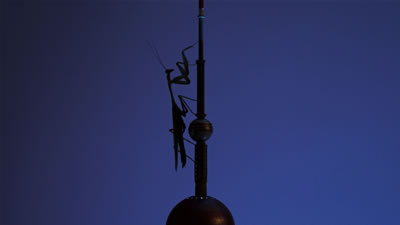
The current exhibit (October 27, 2006 – November 25, 2006) at the Doland Museum of Modern Art in China features the works of Swedish performance artist Tobias Bernstrap, highlighting his current work, “Mantis City”. “Mantis City” is his new exhibit, which becomes available to the viewer upon their immediate entrance into the “museum”, or in the Doland’s case, is really more of a gallery space. The first floor is generally dark, although you can make your way over to a seating area to watch Bernstrap’s “Mantis City”, produced in 2006, projected on a 16:9 screen from a HDV DVD, running on a 12 minutes and 50 seconds loop. “Mantis City” itself focuses the city of Shanghai itself, in which Bernstrap presents the audience with a replica of the Pudong skyline at 1:1000th scale. Two preying mantises climb the Oriental Pearl TV Tower and the Jin Mao Tower, and eventually slowly descend, have a fight, and the winner climbs to the top of the Oriental Pearl once again. The video itself often features only shadows of the mantises, and often blurs out the background. According to the Doland’s statement, “The dramatic lighting recalls the atmosphere of Fritz Lang’s Metropolis (1927) and Carol Reed’s “The Third Man” (1949)”.
The nearly 13 minutes of watching “Mantis City” pass by easily enough, and one is free to head up to the second floor of the Doland. Surprisingly, it is even darker here, and reading plates for works can be quite difficult. Moreover, a large main room is supplied with projections on two of the walls, with a large space in between. On the first wall that comes into view upon arrival on the second floor is Bernstrap’s work, “Freidrich Passage”, made in 2001, running on a 6 minutes and 30 seconds loop. This work entails going through a tunnel, to the mood of gothic music. The work is rather reminiscent of a horror videogame, which is what seems to be the inspiration.
On the opposite side is a projection of “Walking Ego”; a soundless, continually looping girl that walks that was finished in 2003. Passing by, one ventures into a side room featuring another work, “Killing Spree”, a video completed in 2006. In the video, a man, perhaps the artist, is dressed as a character from a modern video game, while performing rock music in front of gothic fans. This video is the longest running of the group at 14 minutes and 36 seconds. One can easily decide to move into the last room, entitled “XSeed 4000”, completed in 2004 as a modification of a computer game. Although it is the most interactive of the exhibits, you are still limited in your explorations to a green space inside of what is presumably the inside of a modern building. Most intriguing is the ability to control the character with a mouse, and listen to random comments that reflect upon a totalitarian society. Yet the inside of the building is apparently gorgeous, with green grass and a fountain surrounded by water.
In all of his works, Bernstrap is presenting a contrast between virtual space and real space, the physical representation of body and architecture in fiction and reality, and the blurred borders between fiction and reality that result as a consequence. Or perhaps a quote by the artist himself, "Today I see a lot of paradoxes in our concepts of reality, such as when looking at architecture in computer games and in real life. The software developers keep pushing limits to achieve more and more realism in the games; at the same time, architecture and design moves towards fiction, i.e. the skyline of Shanghai's Pudong district looks like a scene from an early Sci-Fi movie... There's no clear border or difference anymore - fiction or reality, virtual space or real space, it's all blurred."
The current exhibit “Mantis City” is not to be missed. Bernstrap presents a unique blend of gothic and special effects, producing work that is very much his own. The space is also well suited for the works, with the darkness allowing full visibility of all five. Although not many pieces are on display, it does make it much easier to sit back and fully take in all the pieces – and play around with “XSeed 4000”.
No. 27, Duolun Road, Shanghai, China www.duolunart.com
Monday, November 06, 2006
Shanghart on Moganshan

For this week, I visited Shanghart on Moganshan Road for the solo exhibition by contemporary Chinese performance artist Yang Zhenzhong. Revisiting this elusive gallery again brings back memories of the first time. The distasteful cappuccino with drops of hardening black goo, the rumbling and cumbersome warehouse elevators, the cordial and welcoming foreign gallery owners and the storage and exhibition of many impressive works of modern art all return to my memory.
I arrived at Shanghart after striding through the familiar alleys lined with art galleries and walked into the spacious solo exhibition gallery to witness the photos and videos made by Yang Zhenzhong. Born in Xiaoshan in 1968, Yang Zhenzhong now lives and works in Shanghai. He graduated from the oil painting department of the China Fine Arts Academy in Hangzhou in 1993, and started working with video and photography in 1995. Yang Zhenzhong’s works have shown in all major biennales and triennials such as Venice (2003), Shanghai (2002), Guangzhou (2002), and Gwangju (2002). Yang’s solo exhibition in Shanghart is his first cooperation with the gallery.
Different artists have different preferences and perception. Yang emphasizes the focus and compliment of the subject in his artwork with the background. Using photography, Yang manipulates the background and the subject to portray ordinary people and daily life. Vibrant colors and entrancing settings enrich and accentuate the central characters in the photography and animation. Through the implementation of the environment and present objects and subjects, Yang illustrates contemporary China through a snapshot. As if fusing culture, modernity, psychology and existence in a single image, Yang reveals our world in one picture. As one of the audience, I felt perplexed but captivated by his photos. In his series titled Light and Easy, Yang has his characters upholding the immeasurable weight of urban and material society.
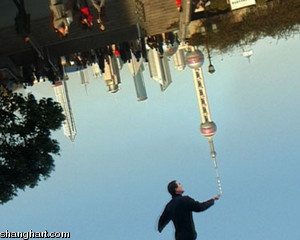 Fascinated by the photograph of a man lifting a reversed Pearl Tower and Pudong Financial District, my eyes refused to leave the picture. The complex combination of building colors contrast with the simple but effective dark sweater of the man. Visual contrast strengthens the contrast of the subject and setting. As if holding a feather, the man easily lifts the urban structure with his palm. Yang employs photography to scrutinize contemporary Chinese society. Yang emphasizes individuality over the intricate urban composition. As if the contemporary material and urban growth is a mere façade and holds little weight and impact, Yang accentuates the merit of the individual. Such an emphasis shows both his contemporary deviation from communist ideals and also his criticism of current modern Chinese dependence on material wealth and gain.
Using metaphorical imagery, Yang challenges contemporary normality through the splendor of contorted reality. As a picture is worth a thousand words, each viewer will no doubt interpret the images differently. Let us join our thoughts and share our experience to divulge our world beneath contemporary materialistic desires.
Monday, October 30, 2006
Doland, One Step Forward

Curvy and serene, Duolun Road exudes a memorable cuteness as it elusively hides in between large buildings and wide roads. Strategically placed at the center, surrounded by a public park, a stadium, a commercial area, and bustling city highways and railways, Duolun Road completes the urban design of this surrounding area with intricate contemporary perfection. Walking on Duolun Road, I return to a similar district I visited only a short while ago: Moganshan Road. Comparable to Moganshan road, Duolun Road also hides itself amongst the bustle of city life and urban architecture.
7 floors tall, Doland Museum of Modern Art stands huddled together with a combination of small buildings lined on both sides of the road. Like the central jewel embellished with smaller adornments, Doland MOMA attracts the attention of tourists and locals with its solitary beauty. In comparison, the single presence of Doland as a representative of contemporary aesthetics surrounded by city urban architecture and infrastructure on Duolun Road contrasts with the small gathering of art galleries in an abandoned industrial corner of Shanghai. While Doland emanates distinction and favor as a significant achievement of the Shanghai government to support and propel Chinese contemporary art to an international level, it segregates itself from other proponents of contemporary art in Shanghai. Unlike other museums in Shanghai that host exhibitions to encourage appreciation and interest in contemporary art, to develop strong relationships between the Chinese and foreign art communities, and to pave way for the aesthetic and intellectual creativity of future generations, Doland conveys an intense political agenda to accompany the encouragement of contemporary art. Although a political agenda does not prevent the growth of contemporary art, Doland does prevent itself from completely accepting, exchanging, and experiencing contemporary art, unlike the MOMA or MOCA.
 Upon first glance, Doland MOMA looks like a rectangular brick standing tall among the jagged houses that surround it. From a distance, the Doland MOMA shines a smooth layer of gray with a small section at the top of the building made of bright red steel and transparent glass. As we close in, the structured and quadrangle pattern compose and construct the Doland. The entrance is designed with the combination of black and red and only the black and red letters spelling Doland Shanghai Museum of Modern Art and a red street light compliment the connecting red and black design of the entrance. Simplicity is beauty, and Doland MOMA accentuates this exquisite aesthetic simplicity with its architectural sincerity. I favor the design of Doland over such other museums such as the Shanghai MOMA, the MOCA, and Zendai. The MOMA and MOCA are buildings refurbished and converted into modern art museums from their original architectural designs and purposes and this wanes their aesthetic and cultural objective. And although arguably MOCA and Zendai, with their attractive glass structure, I believe that art is not transparent, and the buildings should not illustrate this. Contemporary art is simple yet complex, a fusion of experience and imagination. It tries to portray truth through beauty and beauty within truth. The glass design of MOCA and Zendai do not convey the sense of this complex simplicity as well as Doland. From the architectural design of Doland’s combination of gray, red, black, and glass, the conveyance of contemporary art is much stronger. Doland’s gray tiles represent the intricate and complex composition of the materials to create the artwork. As we have seen, many contemporary artworks have a finalized product that we perceive to be a simple and candid reflection of life and truth; the earnest colors composing Doland’s structure accentuate these characteristics of contemporary art in its architecture.
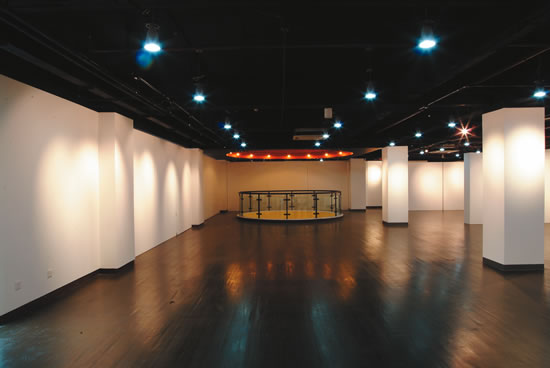 In terms of the exterior architectural design, the entrance made from a combination of red and black epitomizes a multitude of meaning. It is this complex simplicity that I felt most impressed with. At first glance, one will only see the contrast between red and black; nothing special. However, after contemplation and examination, the basic design of the entrance symbolizes the cultural reference to Chinese cosmological belief. The strong belief that everything in this world is made of yin and yang, of a balance and integration of light and darkness symbolizes the inclusive and integrative nature of contemporary art. Like yin and yang, modern art is a representation between the balances of existential aspects in and around humanity that search and define truth. Also through the illustration of a modern cosmological reference, the museum seeks to indicate the cultural aspect.
The spacious interior of the Doland MOMA has a construction area of 4800 square meters, of which 1500 square meters (the first 3 floors) are used for art exhibitions. The black ceiling and white walls also support the principle of yin and yang and the brown wooden floor solidifies our relationship with nature as a unified entity. Each floor has sufficient exhibition space for artworks small and large. The two video rooms provide the space necessary for motion picture art. Overall the interior design of Doland has put into consideration the flexibility, modernity, and creativity of contemporary art. The circular stairways that lead to the floor above inject the audience with a sense of blissful search for enlightenment. By climbing the circular stairway, one feels as if it is a trial in search for the experiences in life. Instead of progressing in a diagonally linear movement but circling directly upwards, one feels as if the pursuit of truth is an ordeal that requires patience and determination as there will be moments of redundancy challenging one’s faith and intellect.
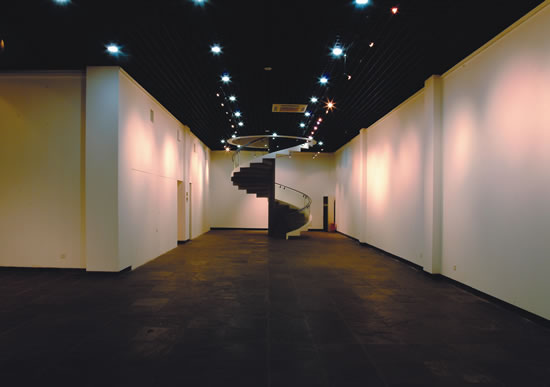 In terms of architectural design, Doland proudly exhibits many merits that place it at the forefront of Shanghai modern art and culture. It is the fruit of the effort, experience, and desire of the Chinese people to modernize and integrate themselves into the modern art world and exchange culture and individuality with the rest of the world for mutual progression. The one aspect that could be improved upon is the interaction and interconnection between the interior of Doland and the exterior environment. Doland’s walls completely seal and separate the interior with the exterior world. If instead of using concrete material to create the walls the designers used glass that is transparent from the inside but not observable from the outside, it would give contemporary art and the museum a mystic aura and allure audience in. Once inside, the audience may see and interpret the paintings as well as witness the world outside, which would symbolize an interpretative fusion of modern art and life: an experience of truth.
Sunday, October 29, 2006
Bund 3


This exhibition is located at Bund 3, named ‘City in Progress / Live from Zhang Jiang’, a nonprofit Gallery. The size of the gallery is kind of small, embracing numerable art works; however, it is so decorated in details, even the identities on the wall or the simplified map painted on the floor from original map of Zhang Jiang. 
 The not commodious room nevertheless conveys to people a sense of void, as if the feeling generated from the developing industrial area of Zhang Jiang according to the topic. From the topic and the atmosphere emanated from the artists, we can conclude this exhibition is at the root of analysis of the conformation of the high-tech industrial area of Zhang Jiang, as a epitome of the industry area of China, relying on many kinds of expression, like TV, projector, or live imitation, interactively and artistically depicts the contemporary and future direction of the industry area of China.
 It can be said that it is a successful attempt to organically combine the area construction with creative mode of contemporary art. Zhangjiang is a special representative industry area in


Sunday, October 22, 2006
Mantis City
Mantis City
Opening reception: October 27th, 2006, 19:00
Live Performance at the opening night starts at 20:00 featuring special guest Sky Water Town Cosplay
Dates: October 27th to November 25th
Venue: Shanghai Duolun MoMA 1st and 2nd floor
Presented by: Shanghai Duolun MoMA
With support from: General Consulate of Sweden, IASPIS, The Arts Grants Committee and Swedish Institute
Opening reception: October 27th, 2006, 19:00
Live Performance at the opening night starts at 20:00 featuring special guest Sky Water Town Cosplay
Dates: October 27th to November 25th
Venue: Shanghai Duolun MoMA 1st and 2nd floor
Presented by: Shanghai Duolun MoMA
With support from: General Consulate of Sweden, IASPIS, The Arts Grants Committee and Swedish Institute
Thursday, October 19, 2006
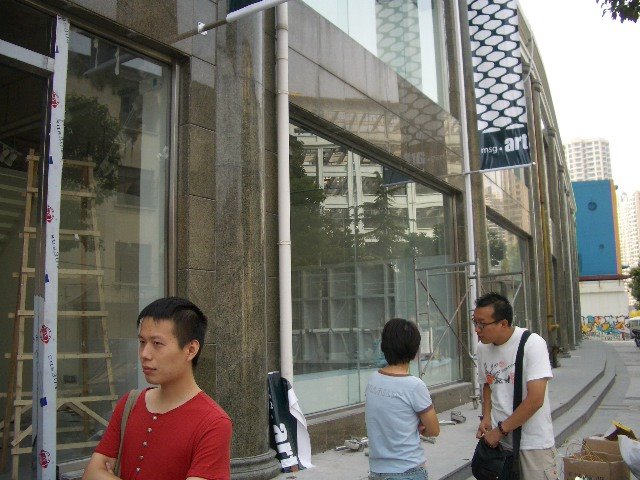
Moganshan Lu (Road in English) is situated next to Suzhou Creek in north-central PuXi, Shanghai. A collection of art galleries featuring contemporary painters, Moganshan Road calls to mind a unique artistic vibe, something akin to Chelsea in New York. Of course, one is unable to not feel that it remains a bit peculiar, an artistic enclave among a sea of skyscrapers that tower in the distance. Of course, one has to come to expect these odd juxtapositions in Shanghai, and in terms of art, the galleries of Moganshan Road do not disappoint.
MSG Art, a gallery operating out of Los Angeles, has recently opened its doors at 87 Moganshan Road, featuring the works of Chi Peng, He Jie, and Zhong Shan. Perhaps the most exciting feature about the gallery is its hopes to open a cultural exchange among its artists, allowing for American and international artists to spend a month on site at the gallery exchanging ideas with local Chinese artists. http://www.msgart.com/
Another important gallery is that of BizArt, which is located on the fourth floor of 50 Moganshan Road, Building No. 7. Opening in 1998, BizArt is one of the only truly non-profit galleries in Shanghai. As China does not currently have a system in place for non-profit galleries, BizArt has to engage in a rather complicated system to move money around. The director is committed, however, to ensuring that BizArt remain untainted from cashing in on artists, or being supported by large real estate developers, as is Zendai. Although recently having run into some problems (which remain sensitive), the gallery continues to forge ahead with new artist exhibitions. The current exhibition, running from October 13th until October 20th, is ElectriCITY, featuring the work of Shi Qing. For more information, visit http://www.bizart.com/.
 Yet another important gallery is that of Eastlink, located at 50 Moganshan Road, Building No. 6, fifth floor. Having opened in 1999, the gallery boasts 900 square meters of space, and is currently exhibiting “Extension Turn 2”, with works by a collection of international contemporary artists. One of the most striking currently on display is that of Johannes Speder, entitled “Mountain”. This work lies near the entrance to Eastlink, and occupies most of the front of the gallery. This captivating work lies across from another piece by He Yunchang entitled, “Beyond Mountains and the Sky”, a series of photographs detailing the artists attempt to use his own strength to push against the strength of an explosion. Eastlink is also featuring articles by seventeen different scientists in its catalogue, along with the twenty-seven participating artists. Eastlink also sells various antiques and past artwork in side rooms, to raise capital for its artistic endeavors. http://www.eastlinkgallery.cn/
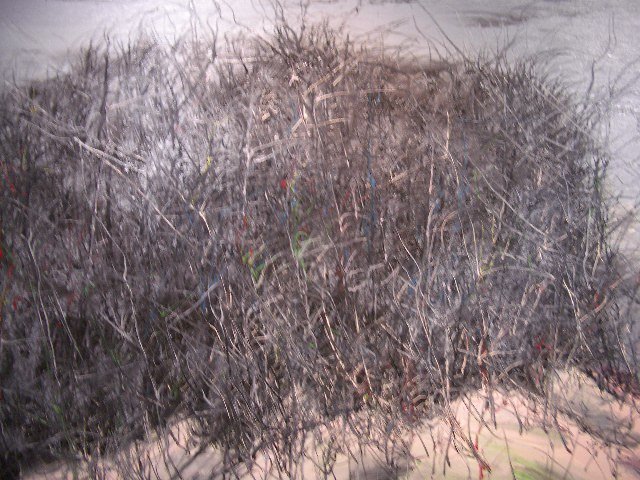 Finally, one should not finish their visit to Moganshan without stopping at ShanghART, located on 50 Moganshan Road, Buildings 16 & 18. Currently, the works of Zeng Fanzhi were on display, displaying his completely unique approach to art, with various works on display. The new exhibit, by Pu Jie, has been set to open on October 18th, and runs until October 31st. One can find more at http://www.shanghart.com/.Although some might feel that Moganshan has a feel of a slightly contrived space, especially in high-rise Shanghai, there is no disputing that the galleries there have no qualms about taking risks and pushing boundaries in China. A visit to Moganshan will not disappoint, and with around 100 galleries that are constantly changing exhibits, the scene here is never static. Moganshan sets the pace for the rest of the Shanghai art scene, and for those who want to see things before the move to the Shanghai MoCA or Zendai, Moganshan is the place to be.
Tuesday, October 17, 2006
Diamond in the Rough?
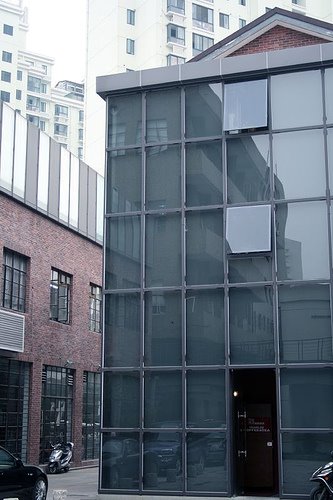
When I think of Shanghai, I think of colossal buildings that pierce into the sky as if Man desires to connect the sky and the earth once again. I think of waves of bustling people, trailing bicycles, rampaging cars, and fuming buses all clashing in the same environment to orchestrate a symphony of chaos. I think of immeasurable gaps between the wealthy and the impoverished. I did not think of art. When I see China, each time I only see the structural change of the city or the change and division in the living standard of the people. I never see art. However, this experience to M50 changed my impression of Shanghai. Hidden in the cusp of Moganshan Road, old factories that seem to have lost the care and favor of the city, old and broken, stand adjacent to traditional 2-floor Chinese buildings made from rotting wood and fragile brick. Decay and abandonment are all that reminds a passing pedestrian of this elusively small district.
However, the peculiar gathering of fashionable youths and foreigners to this seemingly desolate district arouses suspicion and interest, and the open coffe shop also seems misplaced. Stepping out of the cumbersome old warehouse lifts, the world opened up by the rusty old elevator door presents us with an entirely different atmosphere. Aesthetic works created by Chinese or foreign artists alike adorn the walls, branch across the floor, or cluster in rooms and corners of the warehouse. As a visitor I didn’t know if I felt more surprised by the hidden secrets of the warehouses or by each individual art piece present in the warehouses. To find contemporary art pieces that reflect emotional and intellectual struggle, understanding, and portrayal hidden in this quiet neighborhood is nothing short of finding lost treasure.
 Of the artworks that we witnessed, none astonished me more than the works produced by Zeng Fanzhi. With strong brushstrokes and dark colors, Zeng Fanzhi collides colors and canvas. Each stroke he slashes onto the canvas tears another wound of ghastly beauty that pulls the audience into the aesthetic turmoil. Beyond the individual chaos of every stroke, a ghoulish image emerges from the dark colors and rugged outlines.
 The picture of a female walking beside branching bushes and stretching grass forms from the depths and solidify into finality. Unlike other pictures that combine and contrast human and surrounding, the colors in this work create a hopeless darkness. Instead of a natural background of transcendence, in Zeng’s art piece, only abysmal darkness extends to the edges of the canvas. If the canvas does not trap the darkness, it would possibly shroud the audience with treacherous dismay. The grassy brush intensifies the despair of the piece and specifically of the female. Complimenting the darkness beyond, the bushes present only an agonizing sense of decay. As if each grass has a soul, they scream and rip at the canvas in desperation. Seemingly trying to escape inevitable suffering, Zeng masterfully slices the darkness with lone strokes of putrefied grass. As if trepidation caused by darkness is not enough to satisfy his apocalyptic presentation, the grass accentuates and extends this horrific sensation. The illustration of the lone female contrasts immensely with the rest of the picture. Dressed in a silky white dress with youthful pink flesh, the female is the only focus in the artwork that pacifies the tension of the environment. However, as the female is the only subject in the entire painting, her calm is only complimented by her solitude. Hiding her face from the audience, Zeng conveys to us the suffering and gloom that this female has endured and the faith and optimism that she represents by the lightening darkness left in her wake and the rigid darkness ahead.
Tragedy is beauty. Without knowing pain, suffering, sorrow, or grief, it would be hard to understand the struggles of others. Perhaps Zeng is trying to show the destructive history of China on the land and the people, to foretell of their persevering spirit. Or perhaps he wishes to exceed national and cultural borders and resonate his personal experience among humanity. Only Zeng Fanzhi himself knows. As a witness of his aesthetic despondency, I may only yearn for happiness and grip faith tightly.
Saturday, October 14, 2006
Moganshan Art District
---- a secret place in the city
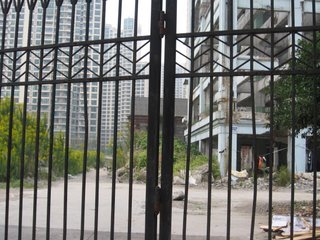
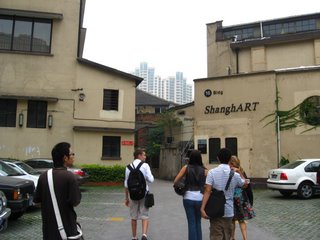 I think the Shanghart Gallery can be a representive of this art district. It is a typical warehouse with high ceilings, shabby walls. There are also many documentations of artists.
high ceilling, interesting floor:
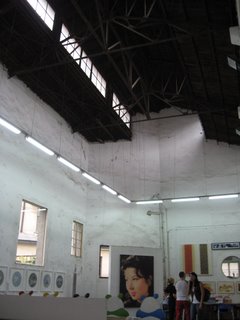
Three pieces of work:
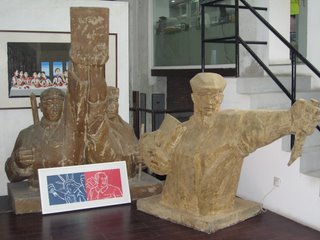
very interesting works
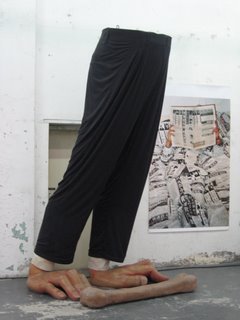
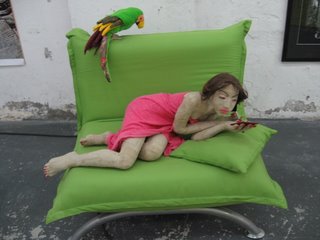
M50, a secret place, produces a large quatity of art works. There are no noises, but quiet and full of art spirit. I enjoy the visits as well as the lectures very much.
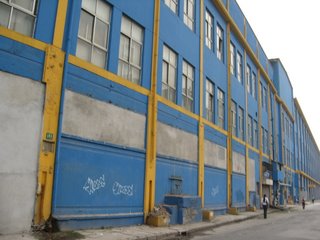
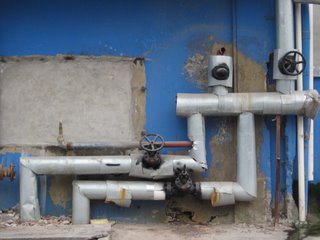
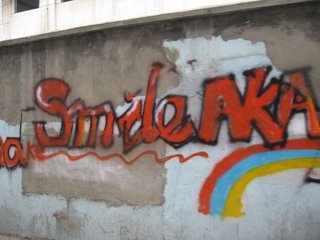
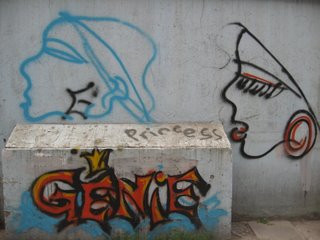
Nobody seems to know the place, even the cab driver. It's like a secret place in the city and this appeals to me very much. When we arrived at Moganshan Lu, this mysterious place begin to unveil itself: empty street, graffiti,wasted warehouse. But instead of being inanimate, it gives forth the smell of art. As we got closer, many art studioes and galleries appears.
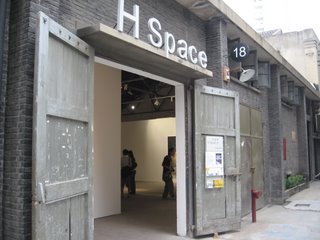


Bizart
I like the name of "Bizart" very much. Davide gave us a very insightful lecture and explained the complication and something we don't know about art, like the forces of the government they have to face when organizing an exhibition. The following work is "a world can't be without electricity".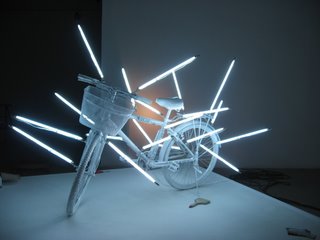
East link
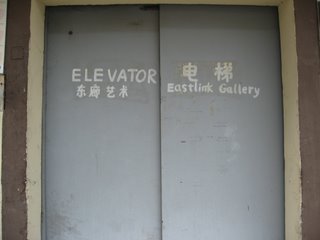
East Link is a spacious place, and there are three rooms inside. They are pictures of experimental art of modern life, works reflected the Cultural Revolution, and a collection of wood furniture antiques respectively.


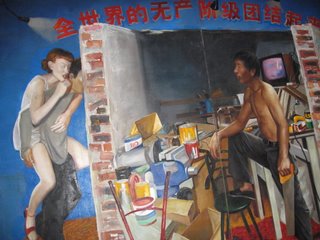

Shanghart Gallery
I think the Shanghart Gallery can be a representive of this art district. It is a typical warehouse with high ceilings, shabby walls. There are also many documentations of artists.high ceilling, interesting floor:
Three pieces of work:
very interesting works
M50, a secret place, produces a large quatity of art works. There are no noises, but quiet and full of art spirit. I enjoy the visits as well as the lectures very much.
Friday, October 13, 2006
M50 review

M50 is a very special art district where massed with many galleries and artists locating in large groups of depots. Regardless of the rubbishy street (old, dirty street, even the cab driver has not heard about)
 and the letter written by some person who used to live in the neighborhood to appeal that some land agent forced to occupied his house,
 M50 is a unique product of the new attitude and policy of the local government which reveals the contemporary art gradually blooming and merging into the culture and economy. Simple and crude houses can not conceal the gorgeous art works in them.
 The whole area permeates the breath of art and the ropey wall better stand out the solemn and quiet atmosphere.
 Modern signs, logos and old depots and all kinds of arts, numerous inconsonant things form the entire M50,
 just like you haven’t stop memorizing the works in one gallery and then step into another art world. Outside the M50, more and more galleries and workshops are under construction, as MSG gallery. In the lecture given by Davide, I fundamentally understand the association between the art gallery, exhibition, museum and the government. The conversation totally breaks up my view of foreign artists in
 From the introduction book I learned that this gallery more focus on the association between science and art. Some of them are through accurate calculated, like the chair above, and this remind me the aim of MIT media lab, use kinds of modern technique to perform art. And the manager there is also big collector. There are so many interesting collections.Like this one
 Zeng Fanzhi is a very talent oil painter, from his works we can see he is pretty good at manifest lines, these clutter and delicate lines give us great imagination.Those are two pieces of his works.

Subscribe to:
Posts (Atom)