Showing posts with label shanghai art museum. Show all posts

Thursday, May 29, 2008

Shanghai Art Museum: Power-Thonik's Design


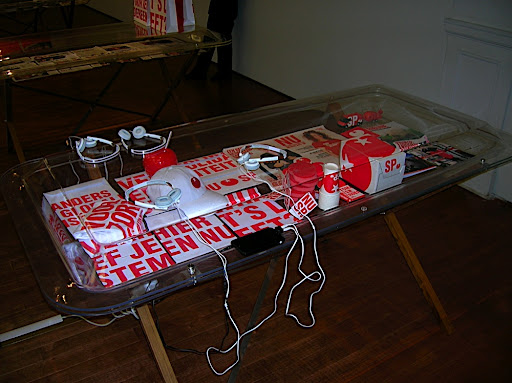
I was pleasantly surprised with the exhibition at the Shanghai Art Museum. It had work that was well done and displayed well and there was definitely thought put behind it. I can't say that it entirely felt coherent throughout the whole piece and that I came away with a message after it, but I was definitely impressed by what I saw and individually the works were well done - they all did share the common theme of appearing modern though. I did like the short video about the advertisement that had been created against a health care issue in the Netherlands and how that effectively reversed the policy. I also liked the portraits that were created using the other faces of individuals, I tried to notice a pattern there and it seemed that most of the faces used to create a portrait were from the photo directly to the left or right of the one it was creating but that only held true for most of the faces, not all of them on the picture (I hope that makes sense :P)


The carpets were neat, and like I said I was generally impressed by the works - but I didn't seem to get a overarching theme or really a lot of the purpose behind creating the works themselves - but then again maybe that's my own fault for not thinking about them long enough.


For this little area there was an iPod Touch look-a-like that would play a short video that composed mostly of sounds that were universal so it was easy to understand. But I didn't really get the point, maybe that's the running theme =P (Maybe I'm getting too used to looking for one certain type of influence in a work).

More pictures can be found at: http://picasaweb.google.com/mnolin/NYUInShanghaiShanghaiArtMuseum

Wednesday, May 28, 2008

Power Thonik’s Design


This time went to the Shanghai Art Museum, it was more interesting since there were 3 worth seeing exhibitions.

Thonik’s Design really attracted our eyes. I found three pieces especially attractive. One is the portraits of the leaders all over the world both past and now. Seeing from the distance it looks like sketch, but closer, you can find the hiding secret. Each of the giant person is composed of the big figure from other countries. I do not know if there is any special range among those pictures with regard to the political reason or just put them automatically. It made me think of a similar piece in the 2006 Biennale. It is a series of the logos of big brands in the world. Surprisingly , for each company, their original logo design was recreated and made by that of their rival company. Such as Adidas vs Nike, Mcdonald’s with KFC, Coca cola vs Pepsi etc. Many people appreciated these creations at that time. From my point of view , it represents the fact that the integration of various cultures , values and competition are inevitable. It is common for us to find similar element . And ,for these series of the portraits, it arose a question also, that is , if we can totally be independent in facing with other countries since we always hear different voices. To be harmonious or to be opposite, this is a question both to individual and to the country no matter if it concerns about political issues or not .

Second is a piece “untitled”, which is made by chocolate and put on the wall. The moment I got close, I found the atmosphere there is amazing, which arose my appetite. And the scene it depicted was two people enjoying the eating ,so it just put more imagination to the work itself. Lots of designers are always looking for some more expressive ways to arouse the audiences’ excitement or other physical resonance. It is not bad to use chocolate to awake our sense of taste. Though we can also find similar creation relevant to the chocolate in other design field, such like dress design and cuisine design etc, the wall picture is still a good idea since it brings us more imagination.

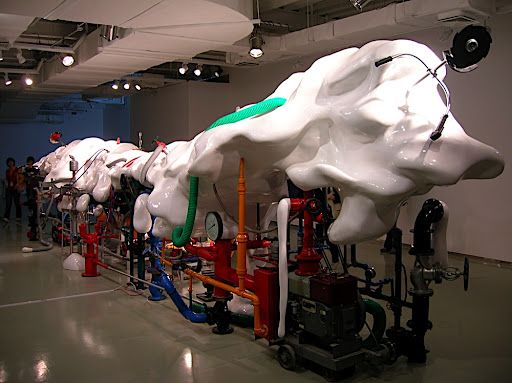
Third piece is an installation like the suspension bridge with balloons to support it on both sides. The artist developed the idea of freedom since the suspension bridge no longer relies on the physical condition and exists independently. Meanwhile , the function of the balloons and the bridge changes also, which lead us to think more about the concept “passing through”and “moving”.

Finally , I just mention a little about the carpet in the exhibition hall. I like them but I am a bit lost in the comment of the curator. Personally, I just think more about the alphabet design in these works. I though most of the works were done because of the various changeable form of the alphabet or the combination form of the words. I just wonder how we Chinese can do to make our characters also multivariant and easily understood.

Thursday, May 01, 2008

Shanghai & Museums

Alright so after taking a look at what people had posted here before going at this myself - I came across a lot of thoughts that threw some basic questions at me that I'll go on to respond to here.

To begin, I'm going to talk about some foundational questions that would apply to art and museums anywhere. The first real important question isn't even what should a museum do but whether a museum is a good place for art to be exhibited. This is something that Helena talks about, which is one of those foundational things that I just assumed and hadn't really thought about questioning. I happen to agree that art is in its most "pure" form when it is out in the "wild" so to say. If art can touch you in a very powerful way, when you're in your daily life - I think that shows just how great the art is. Also museums are restricting in many ways, besides sometimes cost, it is always in one location and people have to go out of their way to view this art and when they do so - I think people have a different mind set then they would if they simply had come across that art. At least I know that for myself, engaging with art in a museum drastically changes how I interact with it and how I think about it. This can both be a good thing and a bad thing.

Does that mean we should not have museums because they are not the best portrayal of art possible? Certainly not, museums can go on to serve a valuable purpose. I think that museums should try to exhibit art with a low barrier to entry, so most anyone in the public can view it (for that, location and cost come into play) - although I think that museums can also have a very important role in bringing about thoughtful discussion about the arts and many other subjects as well and they should try to do this, as the Zendai museum did when we attended its exhibition and workshop. I will disagree with Yvon though, she said that "I think that we need more art museums in Shanghai, bigger and multifunctional.", Its probably not what you meant - but this sounds like throwing quantity over quality. If it's not what you meant, that's okay :P - I'll just use it as a stepping stone anyway. I certainly think that multifunction is a great thing, as is having a lot of space to show art - but I think that a smaller museum can also be much more productive than something like the Shanghai Art Museum simply by toning its catalogue properly and working with its space correctly. For example, I think the 140sqm exhibition area is great - the location is great for a lot of people, it's not exactly large - but I think that it can exhibit art quite well.

Going back to the point of what museums should be doing but here I'll relate to the Shanghai museum. I think that you can see that the Shanghai's Art Museum is to say "Art Museum" in the title of the building, and a public face for China to be like - "hey! We have art! See, we have a museum that's all nice and such!" Other than that though, it doesn't really follow through with what I would call the mission or mantra of being a museum. If it looks like a museum, is called a museum and show cases "art" it must be a museum - right? Well not so much. The first floor was neat and I'm glad to see them showing off a childrens exhibition and it makes me wonder whether the school had to pay for the space or whether it was given to them. That part was neat and I don't mind that at all. But the upper level where you can see advertisements by Volkswagen among other things, including photoshopped pictures of the sky above Pudong. The whole area didn't have a real feel too it, there was no overall coherance and you could certainly tell that it was simply a hodgepodge of whomever had paid for space on the wall. Don't get me wrong, some of the pictures were cool and pretty well done, but overall it didn't accomplish the goal of what I think a museum should do. However, it did seem to attract the locals - which is a very major plus for any museum. Perhaps, if they were to open up a dialogue and have people talk about why they thought this type of stuff is art, and what it brings to society - and were still able to get the local people to come, I would then call it a museum.

MOCA however is a very interesting place, they had a show about Ferragamo shoes going on which was sponsored by the Ferragamo company. I think that it's alright if a museum has to mix between sponsored shows and regular exhibitions. I do agree (I can't remember who said it) that the entrance room was the best room in the show and the rest was just so so - if they can work to improve the sponsored shows and also have their own great shows then I think it could be a great place. I really like what they are trying to do with the restaurant area and think that would also be extremely cool and a great place to dialogue and discussion to come around in a normal context without making it seem like your going to a museum. "Normalizing" art is a very important thing I think - the more we make it less of an elitist thing to do and more something that people can do while attending other things is key. Breaking down such barriers is great and I think goes with what art should be there for.

Now I've gone on a bit too much but there's so much go to with here - I'll quickly finish by sayying that I think that the Zendai was great and it was intersting to have dialogue and discourse about the possiblities for art. Reading what Sophie says though about none of her friends really knowing about the place makes me realize how difficult it is to balance between getting the locals (Shanghai Art Museum), bringing the educational and intelligent discourse aspect (Zendai) and the contemporary (MOCA) parts of art. All of the museums do serve a positive function to promoting art and for that they are all good - however without visiting all of them you miss out on vital parts of the art experience, perhaps we should be evaluating these museums as part of a whole of Art in Shanghai and not independently.

Wednesday, April 30, 2008

Museum Photos

So since I didn't have internet to post these earlier this week, here are a few of the photos I took from MOCA, SAM and Zendai (I tried not to repeat ones people had already posted) - you can see the others here.

(taken at MOCA - Ferragamo's exhibit)


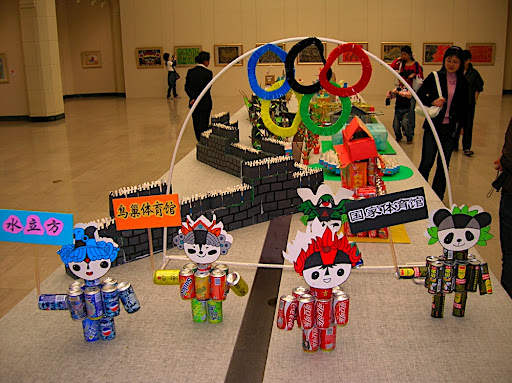
(taken at the Shanghai Art Museum - children's exhibition)


(taken at the Shanghai Art Museum - second floor)


(taken at the Zendai Museum)

Some of My Thoughts on Museums

In terms of the main functions of museums, I think that a museum should be a place in the service of society and of its development; it should open to the public, which conserves, researches, communicates and exhibits, for purpose of study, education and enjoyment. Museums exhibit to provide the objects and information necessary for visitors to learn and also enable them to have an enjoyable experience.

In the early period of its development, museums focused on researches, collection and exhibits, but museums are now experiencing the transition from traditional function to social function, and the idea of museums should serve the society is strengthened. Because of the museum’s unique cultural value, abundant educational and cultural information and special education method, museums take the mission to spread scientific knowledge, patriotism education, and aesthetic education.

Museums can be considered as complementary classrooms for students, meanwhile, they also offer opportunities for people from all walks of life to expand their scope of knowledge.

Education and entertainment can be combined together to enable visitors to attain the satisfaction of cultural life. The educating means can be diversified, varying from all kinds of exhibitions to performances, lectures and academic forums.

Last week we visited MOCA, Shanghai Art Museum and Zendai Museum of Modern Art. Generally speaking, the state-owned museums are bigger than privately-owned ones. Both of them hold forums and lectures, but I think that state-owned museums enjoy some advantages. For example, the latest information of the coming show can be publicized through mass media such as TV and radio, but we seldomly hear about exhibitions in privately-owned ones. Before I took this class, I knew little about private-owned museums in Shanghai. I asked some of my Shanghainese classmates about Zendai Museum, but none of them was familiar with it, so I think there are still a lot to do to expand the public participation.

As the first non-profit, independently-operated contemporary art institution in Shanghai, MOCA is devoted to the promotion of Chinese and international contemporary art. It aims to bring to China high quality international contemporary art and design and to collect and research on Chinese contemporary art and design. Evolving Legend, the Ferragamo show inspires visitors’ creativity by showcasing the innovative materials, creative use of color and fine craftsmanship that make each Ferragamo product a work of art, those elements can also be borrowed into the creation of contemporary art. This reminds me of one of the functions of museums, that is to inspire creativity and contribute to the support of creative industries.

Art is not only an important component of our society and life and an important means of intercultural communication, but also a way of learning and understanding the world around us. Museums are not only the places to display antiques, they should also be able to reflect modernity in China. As one of the most dynamic metropolis in the world, Shanghai has undergone significant changes in recent years. Cultural prosperity has offered museums in Shanghai the opportunity of development and transformation.

In Shanghai Art Museum, I saw the photograph exhibition which shows the current development of Shanghai. Also, Shanghai Biennale takes the city itself and its urban conditions as a starting point for its artistic exploration. The forum in Zendai Art Museum focusing on the current and future directions possible for China’s culture deals with a wide range of issues all pertinent to a broad understanding of Chinese cultural development. Through discussing some main issues about future development of contemporary art, and the role of art in culture, we are able to place China’s cultural progress in the context of its reemergence into the world. Wang Jianwei’s Hostage reminds me that in such a society with rapid scientific development, people are enjoying the comforts brought by material life, however, we are gradually falling into victims of material life even if we haven’t realized that. Although it is strange-looking, the installation art inspires visitors to rethink on current living state. So, art is a reflection of the outside world, a reflection of the globalized reordering of the city.

In February2008, the national department of cultural antiques announced that some of the museums should open to public free of charge. This will create more opportunities for people to go to museums to experience the spiritual education, especially young people. Without any entry fees, museums can be less of corporate spaces, however, it is not impossible to open all the museums to public free. Museums should charge fees according to the quality and standards of the exhibition on display so as to protect the exhibits.

Today, there are millions of bloggers, in order to make better use of the internet, museums representing arts and culture in China can also use blog as a tool. Pictures and videos of some exhibitions that were no longer on display can be put on the blog so that people can review those exhibitions at any time. People can also make any comments on the blog. In this way, blogs can become internet-based virtual museums.

In terms of future development of museums, I think more forums and lectures should be held for visitors of all levels, more opportunities can be offered for art audience to have face-to face conversations with artists.

Museums in Shanghai should open a window for audience, both from home and abroad, to experience the tremendous changes Shanghai is undergoing, and inspire people to think what we everyone can do to further the development of this city.
MoCA vs. Shanghai Art Museum

MoCA vs. Shanghai Art Museum by Amanda Pickens

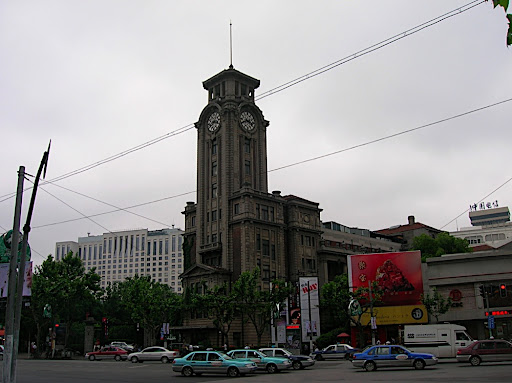
Although in close proximity to one another, Shanghai's MoCA and Shanghai Art Museum share few commonalities. Before class I assumed the two to be fairly similar, yet once stepping into Shanghai Art Museum following our visit to MoCA, I immediately began to compare and contrast them to one another. Due to both ownership (private vs. state) and each museum's chief goals, budget size, projected image, and viewer demographics varied greatly.

Although I enjoyed both the Ferragamo show and Mediengruppe Telekommander's performance at Art Lab, MoCA's feel seems a bit contrived. As we were first introduced to MoCA's upstairs lounge, I could not help but notice the abundance of overly-hip contemporary design. Somewhere amongst the Macaulay Culkin face, giant jellybean chairs, Marimekko-like floor, and repetitiously tiled bathroom, I began to feel lost amid the mishmash of elements. I understand that the museum needs to be somewhat trendy to appeal to a young, contemporary crowd; however, the room felt like a fun house with no particular direction other than drug-induced frenzy.

At the same time, I will admit that the music was a lot of fun and the turn out definitely seemed successful. The crowd, though, was mainly Western, and the night overall had a very hipster, New York feel. I'm not sure if MoCA is concerned about appealing to a more local crowd, yet if the main purpose behind Art Lab is its moneymaking capabilities, they seem to have found the right market thus far.

As for the Ferragamo exhibit, I was both pleased and disappointed. While I have no problems with museums exhibiting such shows (commercial design rather than conceptual art) I did not find that the initial impact felt in the show's first room carried throughout the exhibit. Once exiting the high heel room, I felt bored and confused. Although much of the exhibition was centered around the display of Ferragamo goods, one room featured artwork relating to the designer's shoes. The exhibited work did nothing more than simply depict high heels; there was no concept, originality, or really anything worthwhile about the room as a whole. Rather, it seemed a last minute addition, as well as a place for one to leave his or her child based on the arrangement of miniature tables and chairs that sat off to the side.

After having seen the show, I left wanting more. Viewing one exhibition was not enough. Does the museum not have a permanent collection? Although larger than the average gallery, MoCA's lack of space leaves the institution in somewhat of a middle ground. Without the power and presence of large, more established museums must MoCA rely on its ability to act as a venue rather than exhibitions alone? Perhaps, they feel that playing the role of museum is too conventional. Based on space alone, MoCA's decision to not show permanent works is probably a good idea; the museum is just too small. Frequent visitors would become bored due to lack of variety. Though, if they were able to amass enough works, the establishment would be able to periodically rotate the permanent works collection as does New York's MoMA. Yet, this would involve a large budget, as well as alter MoCA's image. They want to stray from convention; however I question if they are too concerned with their image.

On the other hand, when compared to Shanghai Art Museum, one must appreciate MoCA's freshness and professionalism. Despite being very impressed by the exterior's architecture, I was shocked upon entry. The museum simply felt dark and dated. While the downstairs exhibit was somewhat interesting to view, (despite the teachers having heavy hands in the children's pieces) I could not have been more let down by the photography being shown upstairs. If I had had to buy my own ticket, I would have wanted to demand my money back. None of the pictures could have been more cliché—landscapes, cityscapes, nude women, still lives. After seeing the first set which looked to be nothing more than car advertisements, I wanted to leave. Showing such works challenges the false assumption many people make regarding art shown in professional museums. Many automatically assume that work displayed in such a setting is highly respected and well executed, but exhibitions like this definitely prove that one should question such assumptions. I only hope the main incentive behind exhibitions such as these is money.

Viewer demographics varied, as well, between the two museums. While MoCA attracts a very young, contemporary, and largely Western/Westernized crowd, Shanghai Art Museum pulls in locals. I noticed many in Shanghai Art Museum to be interested in the clothing on display; it almost seemed as if some were seamstresses who wished to pick up some tips. Due to such differences, each museum in return must appeal to fairly opposite visitors. Luckily, MoCA is able to obtain funding through event hosting and their restaurant, while Shanghai Art Museum must look to other options. Unless the museum changes ownership or is able to gather additional funds, I feel its future is not one of growth, which is extremely unfortunate do to the institution's location and sheer size, both of which are currently being underutilized. Sadly, I feel much comes down to money. While funding seems to be preventing Shanghai Art Museum from becoming a highly respected center of art, the prospect of considerable profit has prompted MoCA to invest in more than just art exhibitions.

Monday, April 21, 2008