Showing posts with label davide quadrio. Show all posts

Friday, November 26, 2010

Stephanie and Minji’s Interview with Davide Quadrio (via e-mail)

___________________________________________________________________________________________


1. In "40+4", Li Lei defines the role of critics to be translating the
ideas of artists for the audiences because the audiences cannot
interpret the art by themselves. Gong Yan remarks that critics often
view Chinese art in the context of the international art environment,
which causes their critique of Chinese art to be influenced by
stereotypes and subjective standards. Critics may facilitate the
interactions between producers and consumers of art, but their
critique of an artwork may not reflect the artist's intent. Do you
think critics play a necessary role in raising the general public's
interest towards art and in facilitating dialogue between artists and
the general public?

In the best of the scenarios possible, indeed art critics should be
the key people who can be in between the artist's work and the public
(as not only "people watching the art" but also the ensemble of
"media" that create the basis for knowledge distribution). In fact the
art system is not as pure as ideologists may think, and artists are
not as pure as maybe they should be. In this sense, the relationship
between artists and critics reflect this fact: playing the politics of
power. So if an influential art critic writes about artists in a
certain way, that artist will be "recognized" as valuable, not only in
terms of artistic content, but also at the economic level.

In my opinion though the place of art critics still have a very
important role and should be stimulated: it is the place for
development of new ideas derived by the artists' work, it is the place
to bring the artistic action into the verbal world of communication.

2. During her interview, Gong Yan mentions her concern that Shanghai
has lost its former glorious cultural scene, and is now simply a
cultural pier, witnessing the coming and going of artistic and
cultural phenomena. How you think that artists in Shanghai might be
trying to retrieve Shanghai's former glory? Do you think that many
artists see the Shanghai art scene's increasing international
recognition and expanding art market as helping revive the city's
former thriving cultural scene?

I think that most of the local artists do not think about the
responsibility of making Shanghai anything more than a place to work
and act. Maybe more political artists like Li Lei can say something
about this...but most of their answers on the topic is that they do
not feel responsibility. Anyhow, if any, I found the older generation
especially (Hu Jieming, Shen Fan, Ding Yi etc.) very much connected
via the school system to the next generation. I am working with them
as we speak on a project in Fudan University where I teach, and their
commitment is amazing!

3. It seems undeniable that while many artists chose art because of
their passion for it, they must also see art as a means to earn a
livelihood. Under the pressure of growing international recognition
and media attention, it seems that Chinese contemporary art faces the
risk of becoming increasingly commodified. How do you think most
Shanghai artists are dealing with the influences of the global art
market and the pressure of appealing to the Western art world?

Like they did centuries ago exporting white and blue porcelain for the
West :). Artists of course need an economy, they need to survive and
there is nothing bad about it. The globalized speculation a few years
ago created a weird phenomenon for a couple of years. After the shock,
I see only very strong and valuable artists keeping producing good
work...the over commercialization of Chinese art had a good beneficial
result at the end of the day.

4. In the video, Lu Chunsheng mentions that art has no influence on
ordinary audiences. Do you think that this is especially true in
China, where it seems that many ordinary people are not interested or
even aware of the Chinese contemporary art scene?

What is the contemporary art scene? Does traditional contemporary art
have a position in this? Contemporary art is often a phenomenon for
the few, also in the international contexts. Of course, China is not
so accustomed to the contemporary art in the way we, as Europeans or
Americans, read that. But it is changing exponentially; look at the
Shanghai Biennale and how many young people went to watch it. It is a
sign of a big change.

5. Have you witnessed any major changes in the subject matter of
contemporary art in Shanghai within the past decade? Do you think
there has been a shift from the critique of politics to that of
emerging economic, social, and environmental issues in Chinese
contemporary art? Do you think that Chinese contemporary art's
critique of present issues in China currently plays an important role
in influencing how local and global audiences approach these issues?

I do not see much of the political critic around anymore. It seems to
me more of a manner if any still exist. Few artists of the young
generation I am working with at the moment seem to be exploring
possible sophisticated ways of social critique, but still a bit too
early to say...

Thursday, September 02, 2010

Mandatory: Co-launch of Materials of the Future in Shanghai, Sept 11, 4pm

Arthub Asia is the proud organizer of the co-launch of Materials of
the Future: Documenting Contemporary Chinese Art from 1980-1990and
Contemporary Chinese Art: Primary Documents in co-operation with
Minsheng Art Museum in Shanghai on September 11, 4pm. Speakers include: Doryun Chong, Jane DeBevoise, Wu Shanzhuan (Artist), Shi Yong (Artist), Wu Hung and Yu Youhan (Artist)

Asia Art Archive (AAA) and The Museum of Modern Art (MoMA) celebrate
the completion of two documentary projects that are essential to a
deeper understanding of the history of contemporary Chinese art: AAA's
Materials of the Future: Documenting Contemporary Chinese Art from
1980-1990 and MoMA's publication of Contemporary Chinese Art: Primary
Documents. The two organizations will co-launch both projects in major
cities in China and in New York in the fall of 2010 with a series of
public programs. These milestone projects focus on the dramatic
development and growth of Chinese contemporary art over the last three
decades by documenting, collecting and translating critical
discussions, primary materials and key texts.

Materials of the Future: Documenting Contemporary Chinese Art from 1980-1990


The 1980s was a seminal period in China's recent art history. During
this time, many of China's most celebrated artists attended art
academies, held their first exhibitions, and developed the
intellectual foundation for the art practices that have contributed to
their present success. In order to foster research into this
transformative moment in Chinese history, AAA has undertaken a four
year focused archiving project; collecting, indexing and preserving
rare documentary and primary source materials. As a result, AAA has
collected hundreds of texts published during the 1980s, completed 75
video-taped interviews, produced a documentary film, and digitized the
personal archives of renowned artists and curators, including Fei
Dawei, Zhang Xiaog ang, Zheng Shengtian, Lu Peng, Mao Xuhui and Wu
Shanzhuan, to name a few. With a total of over 70,000 digital
documents, AAA now maintains the world's largest and most
systematically organized archive of documentary material on the
period. This scholarly resource will be freely accessible and open to
the public from AAA's physical premises as well as through a dedicated
web portalwww.china1980s.org starting September 2010.

Contemporary Chinese Art: Primary Documents

Despite the liveliness and creativity of avant-garde Chinese art in
the post-Mao era and its prominence in the world of international
contemporary art, a systematic introduction to this important work in
any Western language is still lacking. Contemporary Chinese Art:
Primary Documentsremedies this situation by bringing together
carefully selected primary texts in English translation. The documents
included range from the manifestos of avant-garde groups, prefaces to
important exhibitions, writings by representative artists, important
critical, and analytical essays andothers. Arranged in chronological
order, the texts guide readers through the development of avant-garde
Chinese art from 1976 until 2006. Edited by Wu Hung, Director of the
Center for the Art of East Asia and Consulting Curator at the Smart
Museum of Art at the University of Chicago, with the assistance of
Peggy Wang, Assistant Professor at Denison University, Contemporary
Chinese Art: Primary Documents is published by The Museum of Modern
Art and will be available at MoMA Stores and online at
www.MoMAStore.org in September 2010. It is distributed to the trade by
Duke University Press, www.dukeupress.edu.


Schedule of Public Program


The co-launch will be accompanied by a series of discussion forums
with artists, curators and scholars:

Hong Kong, 7th September, 6.30 – 8.30pm, Hong Kong Arts Centre
Speakers include: Chen Tong (Artist), Doryun Chong (Associate Curator
of Painting & Sculpture at MoMA), Jane DeBevoise (Chair of Board of
Directors of AAA), Wang Aihe (Associate Professor, School of Chinese,
The University of Hong Kong), Wu Hung (Director of the Center for the
Art of East Asia, and Consulting Curator at the Smart Museum of Art at
the University of Chicago) and Xu Tan (Artist)


Beijing, 9th September, 6.30 – 8.30pm, The Central Academy of Fine Arts

Speakers include: Doryun Chong, Jane DeBevoise, Song Dong (Artist),
Huang Rui (Artist), Wu Hung and Xu Bing (Artist)


Shanghai, 11th September, 4 – 6pm, Minsheng Art Museum in cooperation
with Arthub Asia

Speakers include: Doryun Chong, Jane DeBevoise, Wu Shanzhuan (Artist),
Shi Yong (Artist), Wu Hung and Yu Youhan (Artist)

New York, 15th October, 6:30pm, The Museum of Modern Art, New York


Speakers include: Huang Rui (Artist), Jane DeBevoise, Lin Tianmiao
(Artist), Sarah Suzuki (Assistant Curator of Prints & Illustrated
Books at MoMA), and Wu Hung, among other leading artists and critics
of Contemporary Chinese art. The event will be followed by a
reception, where the book will be available for purchase.

Organizers of co-launch: ArtHub Asia in co-operation with Minsheng Art
Museum (Shanghai), Asia Art Archive (Hong Kong), The Central Academy
of Fine Arts (Beijing), and The Museum of Modern Art (New York)

Organizers:

Asia Art Archive (Hong Kong)

Asia Art Archive is a young and dynamic organisation initiated in 2000
as a direct response to the increasing number of Asian contemporary
art exhibitions and events world wide. Based in Hong Kong, AAA, a
non-profit organisation and registered charity, is dedicated to
documenting the recent history of visual art from the region within an
international context.

The first art education centre and library of its kind, AAA boasts one
of the most comprehensive collections of primary and secondary source
material on contemporary Asian art in the world, with over 26,000
titles accessible to the public, free of charge, via its physical
space andsearchable from its website. From its inception, AAA has
acknowledged its position in the field as more than a static
collection of material waiting to be discovered. Through the regular
initiation of educational and public programs, AAA endeavours to be
pro-active in instigating dialogue and critical thinking, and in
introducing as wide an audience as possible to this rich resource. 11F
Hollywood Centre, 233 Hollywood Road, Hong Kong.www.aaa.org.hk

MoMA (New York)

Founded in 1929 as an educational institution, The Museum of Modern
Art is dedicated to being the foremost museum of modern art in the
world. Central to The Museum of Modern Art's mission is the
encouragement of an ever-deeper understanding and enjoyment of modern
and contemporary art by the diverse local, national, and international
audiences that it serves. www.moma.org

MoMA's International Program, established in 1952, builds and
maintains relationships between the Museum and a diverse network of
modern and contemporary art communities across the globe. Through a
series of international programs and publications, the department
fosters learning, critical discourse, and exchange on international
models of museological, curatorial, and artistic best practices.


The Central Academy of Fine Arts (Beijing)

The Central Academy of Fine Arts (CAFA) is a leading institution for
modern art education in China, and has nurtured many pre-eminent
artists in the past ninety years. In the 1980s, CAFA was the breeding
ground for the first generation of contemporary art critics and
curators who contributed to the development of New Wave art in the
1980s that culimated in the organization of the legendary 1989
China/Avant-garde exhibition.www.cafa.edu.cn/


ArtHub Asia in co-operation with Minsheng Art Museum (Shanghai)
Founded in 2007, ArtHub Asia (link to www.arthubasia.org) is a
multi-disciplinary organization devoted to contemporary art creation
in China and rest of Asia. In collaboration with museums and other
public / private spaces and institutions, it initiates and delivers
ambitious art projects through a sustained dialogue with visual,
performance, and new media artists. Directors: Davide Quadrio, Defne
Ayas, Qiu Zhijie. ArtHub Asia is a Network Partner of the Prince Claus
Fund 2008-2010.

ArtHub Asia is working with Minsheng Art Museum (Shanghai) to organize
this event. Minsheng Art Museum is a non-profit arts organization
established by the China Minsheng Bank in 2008.

Materials of the Future: Documenting Contemporary Chinese Art from
1980-1990 is made possible by the generous support of The Robert H.N.
Ho Family Foundation, The W.L.S. Spencer Foundation, Ilyas and Mara
Khan, and Foundation for Arts Initiatives


Contemporary Chinese Art: Primary Documents is made possible by lead
sponsor The Robert H. N. Ho Family Foundation. Generous support is
provided by The International Council of The Museum of Modern Art.
Additional funding is provided by Budi Tek, Byron A. Meyer, E. Rhodes
& Leona B. Carpenter Foundation, Jerry I. Speyer and Katherine G.
Farley, Blakemore Foundation, Guy and Myriam Ullens, LLWW Foundation,
OCT Contemporary Art Terminal of He Xiangning Art Museum (OCAT), Anne
H. Bass, Jo Carole Lauder, Larry Warsh and AW Asia, Robert Rosenkranz
Foundation, Vicki and Roger Sant, Agnes Gund, Robert E. Meyerhoff, The
Fran and Ray Stark Foundation, H.R.H. Duke Franz of Bavaria, Jack
Shear, Thierry Barbier-Mueller, Mr. Marc Besen AO and Mrs. Eva Besen
AO, Lyn and Jerry Grinstein in honor of Jay Levenson, Sophia Sheng,
Eleanor Ford Sullivan, Migs Wright, Constance Caplan, Uli Sigg, and
Lenore a nd Bernard Greenberg.

The co-launch events are made possible with the generous support of
The International Council of The Museum of Modern Art, The Robert H.
N. Ho Family Foundation, and additional support from Hong Kong Arts
Centre and JIA Boutique Hotels.

For more information about Materials of the Future: Documenting
Contemporary Chinese Art from 1980-1990, please Phoebe Wong
atphoebe@aaa.org.hk
For Contemporary Chinese Art: Primary Documents, please contact
Hannah_Kim@moma.org

Thursday, October 09, 2008

E-arts Festival FInal Cut section

Make sure to see two evenings at Final Cut at E-arts festival 2008. in Xuhui Also try to see as much as you can in other parts of the city such as Pudong!


Shanghai, Xujiahui Public Area (includes LED screens + Greenland for performances)

Arthub, a non profit art organization that promotes contemporary art creation in China and rest of Asia, is delighted to present Final Cut-Processing New Media in Public Space - a five-day programme of live performances, site-specific installations and video screenings in Xuhui District, a flourishing and bustling area of Shanghai. Presented as part of the Shanghai E-arts Festival 2008 with a special focus on the livability of urban space, public sphere, and its transformation through new media, Final Cut has been developed in co-operation with visual artists, musicians, DJs, architects, programmers, dancers, and designers. Featured artists and presenters include Christian Marclay, Elliott Sharp, Wu Na, Bruce Gremo, Wang Li Chuan, 王力川, Ben Houge, Yan Jun 颜峻, Top Floor Circus顶楼马, Aaajiao, Nunu, Ling Xi, B6, Alizia Borsari, Dead J+Chen Xiongwei, Feng Mengbo, Wang Yuyang, Zhou Xiaohu, Michael Bell Smith, Shih Chieh Huang, Terra Bajraghosa, Takeshi Murata, and Eric Siu. On view will also be Hipic.org and 40+4. See map below below for locations. Final Cut is organized by Davide Quadrio and Defne Ayas.

FINAL CUT PROGRAM:

October 18-22- on-going:

// Installations by Wang Yuyang and Zhou Xiaohu.


// Videos by Michael Bell Smith, Shih Chieh Huang, Terra Bajraghosa, Takeshi Murata, and Eric Siu. Plus 40+4 and Hipic.org.


// STAGE PROGRAM (at Hengshan Lu and Wanping Lu- click on the map below):


^
October 18, 7.30pm, Screening of 40+4


Davide Quadrio embarked on an interview project with artists from all streams of art-making, the avant-garde, the traditional, official or academic scene, presenting a cross section of the art scene in Shanghai. Together with Lothar Spree, Zhu Xiaowen, and Xu Jie – the last of whom in the role of professional interviewer – 40+4 probed the relationship between the artists, their work, and the evolution of contemporary art in Shanghai over the last two decades. The presentation of this project for eArt represents an open dialogue of the artistic community to the city, a vis a vis discourse that will bring reflections, happiness and frustration, critical analyses of the cultural development of the city in the last 15 years or so.

^October 19, 7.30pm, Patience for the Man 忍而为人-a work in progress by Aaajiao with Nunu, Ling Xi, B6 and Alizia Borsari

忍而为人 “Patience for the Man” is born, following a number of workshops to explore the possibility of an open creative interdisciplinary production, where the single “actors” could, through the work in progress, know each other and generate new artistic content, meaning and directions. Select visual artists were asked to go beyond their medium and to experience new techniques of expressions more affiliated to what has been defined as “sensorial theatre”. The result is a multi-media presentation, a live performance within a musicscape. Both B6 and Aaajiao perform live together with the dancers on a stage created by the architect duo Wang Zhenfei and Wang Luming- a presentation that still advocates a possible declination of a work in progress, a temporary result that will be further developed in future presentations.

^October 20, 7.30pm, Dead DJ+Chen Xiongwei- live performance


Exploring once again the DJ status as a performance “in travesty”, Deadj presents his music on a multi-layered video screening created by Chen Xiongwei, combining sounds and images both performed live. The minimalist music created by Deadj will be accompanied by Chen’s digitalized and psychedelic images of public spaces in Shanghai.

^October 21, 7.30pm, Q2008 by Feng Mengbo - live performance


Beijing-based new media pioneer Feng Mengbo offers audiences a participatory journey in Q2008, through virtual imagery, metaphorically linking game surfing, and painting-making process. The work allows viewers (public audience, artist, player, curator) to assume several of these roles during the course of his presentation, which implies a reconfiguration of the audiences into a cinematic experience as well as into a process of art-making. The time-based nature of his game software shifts itself out of its usual context, and as it comes off of the screen, allows the game character to interact dynamically without a proscribed outcome.


^October 22, 7.30 pm, Screenplay by Christian Marclay- live performance with musicians Elliott Sharp, Wu Na, Bruce Gremo, Wang Li Chuan, 王力川, Ben Houge, Yan Jun 颜峻 and Top Floor Circus顶楼马)


Screenplay is a video score in which found film footage is combined with computer animation to create a visual projection to be interpreted by musicians. Using video projection to convey instructions to musicians, he composed a silent collage of found film footage partially layered with computer graphics to provide a framework in which live music can develop. Screen Play will be interpreted by three different ensembles comprised of Chinese and international musicians. Marclay’s long-time collaborator Elliott Sharp will join him from the avant-garde experimental music scene in New York City, to play with the award-winning guqin player Wu Na, and Chinese opera percussionist Wang Li Chuan 王力川, both from Beijing. Shanghai-based composer and videogame audio guru Ben Houge will explore the various layers of information present in the video, together with Yan Jun 颜峻, a found-sound spinner and master of ambient soundscapes, and Bruce Gremo, a veteran improviser performing on his custom-made electronic flute controller, the Cilia. The opening act will be performed by Top Floor Circus顶楼的马戏团, a Shanghai-based folk-cum-art-cum-punk band.


November:

http://www.fringeshanghai.com/index.htm

Monday, October 06, 2008

PERFORMA PRESENTS CHRISTIAN MARCLAY’S SCREEN PLAY SHANGHAI ON OCTOBER 22 AND BEIJING ON OCTOBER 24


PERFORMA PRESENTS CHRISTIAN MARCLAY'S SCREEN PLAY SHANGHAI ON OCTOBER 22 AND BEIJING ON OCTOBER 24

Wednesday, October 22, 2008, 7.30 pm, at Xujiahui Park (Metro Line 1)
Performers: Elliott Sharp, Wu Na, Wang Li Chuan, Ben Houge, Yan Jun, Bruce Gremo and Top Floor Circus
Presented as part of the Shanghai E-arts Festival 2008- Final Cut
Curated by Defne Ayas and Davide Quadrio
Shanghai E-Arts Festival Dates: October 18-22, 2008
With generous support from Pro Helvetia and Arthub


Screen Play is a video score by artist Christian Marclay in which found film footage is combined with computer animation to create a visual projection interpreted by live musicians. As Marclay says, "Moving images and graphics give musicians visual cues suggesting emotion, energy, rhythm, pitch, volume, and duration. I believe in the power of images to evoke sound." Screen Play was first presented in New York in 2005 as part of Performa 05, the city's first biennial of new visual art performance. Since then, it has traveled, as part of Performa's international touring program, to Paris, Berlin, Portugal, Denmark, and Mexico City, among other locations.

For its Shanghai premiere, which will also mark the first-ever Performa event in China, Screen Play will be interpreted by three different ensembles comprised of Chinese and international musicians. Elliott Sharp, Marclay's long-time collaborator and fellow member of the New York avant-garde music scene, will join him to play with award-winning guqin player Wu Na and Chinese opera percussionist Wang Li Chuan, both from Beijing. Shanghai-based composer and videogame audio guru Ben Houge will next perform his own interpretation of the score, exploring the various layers of digital information present in the video together with Yan Jun, a found-sound spinner and master of ambient soundscapes, and Bruce Gremo, a veteran improviser performing on his custom-made electronic flute controller, the Cilia. The opening act will be performed by Top Floor Circus, a Shanghai-based folk-cum-art-cum-punk band, which plans to explore the emotional subtexts of the score by sampling from their repertory.

"Having combined excerpts from Hollywood films to cacophonous effect in previous work, Mr. Marclay leapt back in film history, making a demonically spliced silent movie whose visually noisy pulsing black and white sequences were complicated by computer animations of bright, jumpy abstract dots, stripes and shapes reminiscent work by John Baldessari… It was an extraordinary evening of looking and listening." --Roberta Smith on Screen Play, The New York Times, 2005

ABOUT THE ARTIST
As an artist and avant-garde musician, Christian Marclay has continuously explored the process of seeing and hearing music across a wide range of disciplines, including performance, visual art, and music. Since 1979 he has pioneered the use of records and turntables to create an "experimental theater of found sound," collaborating with artists including Sonic Youth, John Zorn, and Otimo Yoshihide. Over the last 20 years, Marclay has also created a variety of mixed media sculptures, often incorporating familiar objects such as stereo speakers, telephone receivers, and magnetic tape. He has had solo exhibitions at the Tate Modern, London (2004), the Museum of Modern Art, San Francisco (2001), and the Whitney Museum of American Art, New York (2001), and has been included in many group exhibitions around the world.

ABOUT PERFORMA
Performa, a non-profit multidisciplinary arts organization established in 2004, is dedicated to exploring the critical role of live performance in the history of twentieth century art and to encouraging new directions in performance for the twenty-first century. Performa launched New York's first performance biennial, Performa 05, in 2005, to tremendous critical and popular acclaim. In 2007, the second biennial, Performa 07, was an even greater success than the first. The next biennial, Performa 09, will take place in New York from November 1-22, 2009, featuring the work of over 100 artists at more than 80 venues across the city.

ABOUT SHANGHAI EARTS FESTIVAL 2008
Launching on 18th October 2008 with a five-day programme of events, performances and installations across the city, the Shanghai eArts Festival will bring together some of the most exciting digital arts talent from China and around the world. Dubbed 'Urbanised Landscape', the Festival promises to build on the tremendous successes of the inaugural 2007 event, and will once again be shaped by a young creative team from Shanghai as well as leading international new media arts organisations. The Festival is set to include exhibitions of specially commissioned work in the city's museums and galleries, as well as electronic music and live performances.  

To see this email on the web, go to http://performa-arts.org/evites/ScreenPlayChina.html


Friday, March 07, 2008

outline for Week II, III, IV

Hi All,

Below is our outline and openings. Any questions, let me know.
// For Cityweekend Internship to write a Reviews, interested parties please send me resumes.
// For Art-ba-ba- English translation opportunities, I will keep you posted.
In the meantime, can one of you pass this email to John or ask him to contact me? Thanks!

Week II
March 6:
50 Moganshan area:

Below are the names of people you met in person yesterday.
// Bizart- run by Davide Quadrio and Xu Zhen
// East Link _ Li Liang, Pippa Dennis
// Shanghart (Lorenz Helbling, Sine Beppler) & Collector Pierre Huber.

These projects were highlighted during these lectures.
// HIPIC.ORG
// www.art-ba-ba.com
// Art For Sale & Fuck off shows

Optional:
Opens March 7/ Old Scriptures -Wei Guangqing Solo Exhibition at Shanghart
Ends on March 9- Lin Yilin at SGA at 3 on the Bund and Yang Hui at Duolun Museum

Also:
March 9: Paul Andreu at Literary Festival at M on the Bund
March 9: A performance by Jian Jun Zhang (as part of 366) -
Details:
11 am this Sunday, March 9, at 48 Ji An Road, near Ji Nan Road and Hu Bing Road. not far from Xin Tian
Di. The second part of the performance is at 1 pm.

Check the link: http://www.intrude366.com/

Week III

March 13: Post up your reviews on 50 Moganshan and/or JJ's performance as part of 366
(and also your reviews of first week if you were unable to this week)

March 13:
Part I: 1 PM Zhao Chuan Lecture
Part II: You are free at this time. But on duty on March 15. Assignment on Safety show opening March 15, 7 pm (Venue of Exhibition: Fei Art Center, 3rd Floor, No.120 Old Humin Rd.(near Binyang Rd.)- Please note this opening is mandatory, and will count towards class time. Reviews need to be up by March 20.

Optional:
March 14 Opening at Bizart (Korean students)
March 15 Opening- Painting Show at Shanghai Gallery of Art

Week IV
March 20: Postings on Safety show
March 20:
Part I: Zhao Chuan Lecture
Part II: Group meeting: Groups get together to discuss the two lectures and prepare for group response of 15-20 minutes each to be presented on March 27. In contrast what you have seen so far. You will receive your assignments by email. Schedule Group Meetings during the following week if needed.

Thursday, November 23, 2006

Museums vs. Chinese Art Market

The current state of contemporary museums in Shanghai is a complex web of funding and weaving of resources to attempt to provide a feasible museum to the public. With the emerging interest in the collection of Asian art, galleries and collectors have often times made quick assertions about the perceived value of contemporary Chinese art. In Shanghai alone, dozens of museums and galleries have emerged with the goal of not only advancing artistic ideas, but pushing, and literally selling these ideas to the rest of the world. In this new emerging world of Asian art questions begin to arise as to whether or not contemporary museums and galleries in Shanghai are taking the ethical steps necessary to provide the proper reciprocal benefits to the artistic community, as well as valuing art for its creativity, and not simply its capitalistic market worth.
Currently in China today, the government lacks a cohesive plan that would allow for non-profit organizations to feasibly exist. As a result, this situation makes the various museums and galleries come up with creative means to sustain and fund their artistic ventures. Unlike in the United States, where a system of donations allows a tax benefit and unlike in Europe, where the governments provide cultural budgets to stimulate the arts, a void exists in China to the extent that neither of these two forces are present. With the lack of government support and philanthropic tradition, Chinese galleries and museums have resorted to various means of raising capital, such as finding corporate sponsors, selling the art being displayed, providing professional services like graphic and concept design, and in some cases receiving donations from private individuals.
As a result, many galleries have been forced to find a business solution to allow for the continued existence of their organization. In the case of BizArt, which opened in 1996, an innovative solution had to be found. According to the director of BizArt, David Quadrio, “BizArt is a self-supported and not-for-profit art center that combines artistic and commercial pursuits with the ultimate goal of advancing contemporary art in Shanghai and beyond. The name ‘BizArt’ refers to our straddling the duel roles of business and art, and the ‘bizarre’ nature of our existence.” Although BizArt advocates its non-for-profit status in the pursuit of artistic creativity and development, the harsh reality is that BizArt needs to receive revenue to survive. This gray area, or as BizArt would say, “bizarre” nature of its existence, points to the conflicts that exist within its not-for-profit status and its need to create revenue through business endeavors such as graphic and concept design. Despite this juxtaposition of values, BizArt recognizes the growing imbalance of the cost of Chinese art in relation to funding allocated to artists and creative organizations. BizArt acknowledges this growing hyper-inflation of Chinese art, and strives to reinvest in the artistic community by the creation of Arthub. Arthub supports a process of creative contemporary art free of pressures resulting from the hyper-inflated contemporary Chinese art market.
Another contemporary art space in Shanghai, the Shanghai Museum of Contemporary Art, better known as the Shanghai MoCA, has experienced many of the effects of commercialization due to the lack of a philanthropic tradition. Opened in 2005 from the support of Samuel Kung, who contributed US$1.5 million, the museum quickly needed to find a way to bring in extra revenue that would allow for its continued existence. Endorsed by the Shanghai Municipal Government, the MoCA has become a notable tourist attraction in the heart of Shanghai. Despite its not-for-profit status, the MoCA contains a restaurant, as well as holds private functions. Thus the MoCA’s status of non-for-profit is tainted by its need to bring in income. A perfect example arises from personal experience when we visited the MoCA, the staff members were preparing to move a famous clay pot exhibit by Ai WeiWei to make space for a Ferrari that was to be shown at a private party later that evening. In addition, an AirFrance model for their new first class seating was blocking Miao Xiaochun’s “Last Judgment” exhibit, which already had poor visibility and viewing space. These two examples force us to question what is the priority of the MoCA - is it to make money, or display contemporary art? The MoCA claims to be the first not-for-profit contemporary art museum, but what line is to be drawn between where art ends and profit begins?
Likewise, the Zendai Museum of Contemporary Art brings to mind similar ethical questions. The Zendai is funded by the Zheng Da Property Group, which is the largest single property developer in Pudong. Although the Zendai is willing to take chances and exhibit edgy, more controversial pieces of art, the fact is that Zendai is entirely funded by a single organization, thereby creating a potential conflict of interests. In addition, the future plans are to create a center for contemporary art, called The Himalaya Center, which includes a five-star hotel, commercial space, and office space for creative businesses. The Zendai therefore represents the current commercialization of contemporary art, and the current hyper-inflation that threatens artistic creativity. Despite being free from having to look for outside contributors to fund its space, the relationship between Zendai and the parent corporation is in need of scrutiny. The fact remains that Zheng Da is a developer in Shanghai, and the Zendai may not be free to take truly creative measures in displaying art. It may instead be forced to display art that would appeal to the hyper-inflated art market and bring in tourism money to create a profit for the parent sponsor.
In our examination of these three major players in the Shanghai art world, there is a lack of definite boundaries between art for its intrinsic value, and art for its commercial value. There lacks a sanctity in the use of an art space such as the MoCA or Zendai, as compared to museums in America and Europe, which believe that art should be displayed for intellectual and cultural value. Understandably, the realm that these art spaces exist within is inextricably bound to the need to attain financial viability due to lack of proper societal contributions. However, these museums and galleries should strive to limit the influence of the commercial art market to maintain their integrity as public art spaces. As the Shanghai art scene develops and expands, one can only hope that the true spirit of art will be preserved from an ever growing capitalist influence.

Saturday, October 14, 2006

Moganshan Art District

---- a secret place in the city


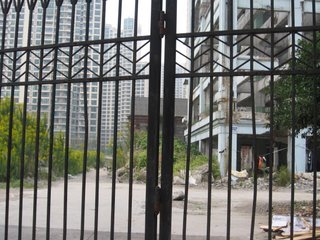
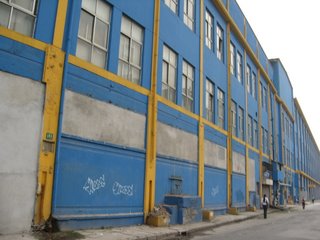
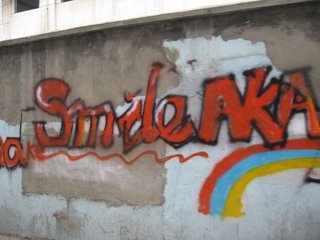
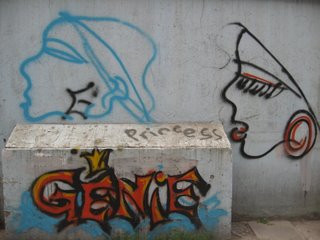
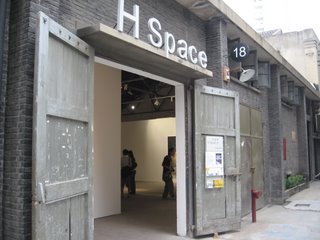
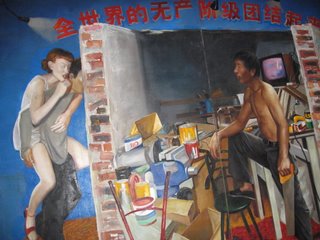
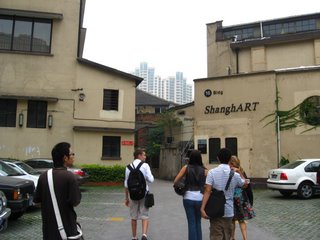
Nobody seems to know the place, even the cab driver. It's like a secret place in the city and this appeals to me very much. When we arrived at Moganshan Lu, this mysterious place begin to unveil itself: empty street, graffiti,wasted warehouse. But instead of being inanimate, it gives forth the smell of art. As we got closer, many art studioes and galleries appears.


Bizart

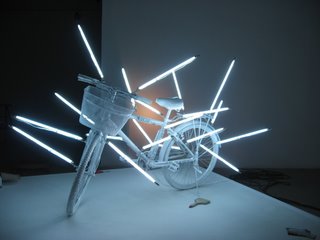
I like the name of "Bizart" very much. Davide gave us a very insightful lecture and explained the complication and something we don't know about art, like the forces of the government they have to face when organizing an exhibition. The following work is "a world can't be without electricity".


East link


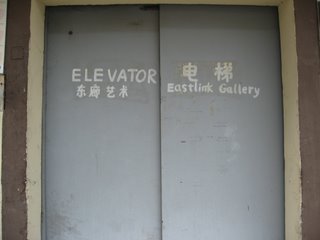
East Link is a spacious place, and there are three rooms inside. They are pictures of experimental art of modern life, works reflected the Cultural Revolution, and a collection of wood furniture antiques respectively.


Shanghart Gallery


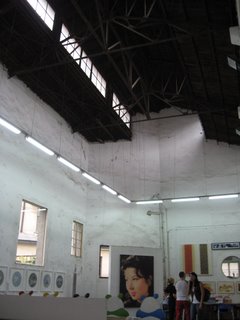
I think the Shanghart Gallery can be a representive of this art district. It is a typical warehouse with high ceilings, shabby walls. There are also many documentations of artists.


high ceilling, interesting floor:


Three pieces of work:


very interesting works


M50, a secret place, produces a large quatity of art works. There are no noises, but quiet and full of art spirit. I enjoy the visits as well as the lectures very much.

Friday, October 13, 2006

M50 review

M50 is a very special art district where massed with many galleries and artists locating in large groups of depots. Regardless of the rubbishy street (old, dirty street, even the cab driver has not heard about) and the letter written by some person who used to live in the neighborhood to appeal that some land agent forced to occupied his house, M50 is a unique product of the new attitude and policy of the local government which reveals the contemporary art gradually blooming and merging into the culture and economy. Simple and crude houses can not conceal the gorgeous art works in them. The whole area permeates the breath of art and the ropey wall better stand out the solemn and quiet atmosphere. Modern signs, logos and old depots and all kinds of arts, numerous inconsonant things form the entire M50, just like you haven’t stop memorizing the works in one gallery and then step into another art world. Outside the M50, more and more galleries and workshops are under construction, as MSG gallery. In the lecture given by Davide, I fundamentally understand the association between the art gallery, exhibition, museum and the government. The conversation totally breaks up my view of foreign artists in China, which I used to think they are oversea communicators to find the connection between different culture background and they must have some privilege as an artist and with a considerable salary. Now I learned that it’s also or even harder than domestic artists to publicize their works or modern ideas and not so easy to make a profit. Now I’ll illustrate some works seen in M50 below.

This is a work from EastLink Gallery, there are losts of great works there, and many of them is photos of perform art. From the introduction book I learned that this gallery more focus on the association between science and art. Some of them are through accurate calculated, like the chair above, and this remind me the aim of MIT media lab, use kinds of modern technique to perform art. And the manager there is also big collector. There are so many interesting collections.Like this oneZeng Fanzhi is a very talent oil painter, from his works we can see he is pretty good at manifest lines, these clutter and delicate lines give us great imagination.Those are two pieces of his works.