Showing posts with label video/film. Show all posts

Wednesday, March 14, 2007

THE POSTMODERN LIFE OF MY AUNT (Yima de Houxiandai Shenghuo)

The Shanghai International Film Club
Chinese films with English subtitles
______________________________
_________________

THE POSTMODERN LIFE OF MY AUNT (Yima de Houxiandai Shenghuo)
directed by Ann Hui
________________________________________________

Friday, 16 March 2007, 8:00 pm
Kodak Super Cinema World (details below)
70 RMB
No RSVP necessary - just come and enjoy!
________________________________________________

[Excerpted from the catalogue of the Toronto International Film Festival
2006.]

In “The Postmodern Life of My Aunt,” renowned director Ann Hui blends
her humanist cinema with the spirit of Chinese opera. She has created
both a humorous look at China today and a new genre of filmmaking: the
post-Cultural Revolution satirical melodrama. Cool and articulate, the
film has a generous heart, a sensitive soul and a clever mind.

Featuring a first-class cast of China's great actors - Siqin Gaowa, Chow
Yun-fat, Vicky Zhao Wei and legendary Lisa Lu – “The Postmodern Life of
My Aunt” tells the story of old-fashioned Ye Rutang (Gaowa), a single
woman in her sixties who struggles to maintain a dignified life amid the
dangers of Shanghai, a city that seems to have become the receptacle for
all kinds of con men. The first to pull a scam on Ye is her
twelve-year-old nephew, Kuan-kuan (Guan Wenshuo). He moves to her
old-fashioned apartment after breaking a leg in an accident, but when he
can't bear her stinginess, he runs away and pretends to have been
kidnapped in order to get the ransom money. Then comes Pan Zhichang
(Chow), an amateur opera singer, who tricks Ye into a relationship and
steals most of her savings with a complicated swindle involving
speculation in the price of cemetery plots.

Focusing the film on the experience of women in her home country and
around the world, Hui sketches a fine portrait of changing values. She
situates her story in a precise cultural moment - a time where the past
seems to carry meaning only in the stubborn memories of individuals.
This charming social tale takes an original approach to issues including
the atrophy of mores in a society that is no longer egalitarian; its
freshness rests in its ironic yet compassionate look at its curious
protagonists.

Beautifully penned by Li Qiang, one of China's greatest scriptwriting
talents, “The Postmodern Life of My Aunt” is endowed with an engaging
refinement. Its bold commentary on contemporary China is as sharp as a
razor blade.


Please join us!
_____________________________________________________________

Kodak Super Cinema World
Metro City, 5th Floor (tell the taxi driver "Mei Luo Cheng")
1111 Zhao Jia Bang Lu (in Xu Jia Hui, across from the Gateway
Shopping Center)
For additional information, call Connie Gao at 1370-191-5733.
______________________________________________________________

Yang Fudong: No Snow on the Broken Bridge(ARTFORUM International, Best of 2006 Film)ShanghART Gallery H-Space

Yang Fudong: No Snow on the Broken Bridge(ARTFORUM International, Best
of 2006 Film)ShanghART Gallery H-Space
March 24 - April 30, 2007

Yang Fudong's film and video work is about the human condition. He
mostly portrays his own generation of individuals in their late 20's
and early 30's, young people who seem confused and appear to hover
between the past and present. Yang Fudong's work epitomizes how the
recent and rapid modernization of China has overthrown traditional
values and culture. He skillfully balances this dichotomy to create
works endowed with classic beauty and timelessness. His works
investigate the structure and formation of identity through myth,
personal memory and lived experience. Each of his films is a dramatic
existential experience and a challenge to take on. His work is
open-ended and inconclusive, therefore open to individual
interpretation. Yang Fudong seeks through multiple vignettes to offer
the poetics of place and existence: Whatever occurs, Yang Fudong's film
work and photography indicate that something remains untouched and
unmoved, and perhaps all the more valuable for that reason.

"Howering between classical Chinese brush-and-ink painting and shanghai
cinema of the 20s, fudong's enveloping eight-screen landscape No Snow
on the Broken Bridge populated by angst-ridden youth, springs eternal."

Yang Fudong was born in 1971 in Beijing. He trained as a painter in
China Academy of Fine Arts in Hangzhou. Starting in the late 1990's
Yang Fudong embarked on a career in the mediums of film and video. He
is among the most successful and influential young Chinese artists
today. Yang Fudong participated in the 50th Venice Biennale (2003),
First Moscow Biennale of Contemporary Art (2005), 1st International
Sharjah Biennale (2005), 1st Prague Biennale (2003) and 5th Shanghai
Biennale (2004), The 5th AsiaPacific Triennial of Contmeporary Art
(2006). He has had solo-shows at most acclaimed institutions such as
Kunsthalle Wien (2005), Stedelijk Museum (Amsterdam, 2005), Castello di
Rivoli (Torino, 2005), The Moore Space (Miami, 2003), and ARC/Musee
d'Art Moderne de la Ville de Paris (2003).
2007-03-13 12:51

Friday, March 02, 2007

The Blood of Yingzhou District

The Blood of Yingzhou District, a film tha follows the lives of childen
in Anhui who have lost their parents to AIDS, won the Oscar for best
documentary short earlier.
YouTube has the trailer.

http://www.youtube.com/watch?v=CJx18Ynuzck

Tuesday, January 30, 2007

Yang Fudong: No Snow on the Broken Bridge

Yang Fudong: No Snow on the Broken Bridge
ShanghART Gallery H-Space
March 2007

Yang Fudong's film and video work is about the human condition. He
mostly portrays his own generation of individuals in their late 20's
and early 30's, young people who seem confused and appear to hover
between the past and present. Yang Fudong's work epitomizes how the
recent and rapid modernization of China has overthrown traditional
values and culture. He skillfully balances this dichotomy to create
works endowed with classic beauty and timelessness. His works
investigate the structure and formation of identity through myth,
personal memory and lived experience. Each of his films is a dramatic
existential experience and a challenge to take on. His work is
open-ended and inconclusive, therefore open to individual
interpretation. Yang Fudong seeks through multiple vignettes to offer
the poetics of place and existence: Whatever occurs, Yang Fudong's film
work and photography indicate that something remains untouched and
unmoved, and perhaps all the more valuable for that reason.

"Howering between classical Chinese brush-and-ink painting and shanghai
cinema of the 20s, fudong's enveloping eight-screen landscape No Snow
on the Broken Bridge populated by angst-ridden youth, springs eternal."
ARTFORUM International, Best of 2006 Film 

Yang Fudong was born in 1971 in Beijing. He trained as a painter in
China Academy of Fine Arts in Hangzhou. Starting in the late 1990's
Yang Fudong embarked on a career in the mediums of film and video. He
is among the most successful and influential young Chinese artists
today. Yang Fudong participated in the 50th Venice Biennale (2003),
First Moscow Biennale of Contemporary Art (2005), 1st International
Sharjah Biennale (2005), 1st Prague Biennale (2003) and 5th Shanghai
Biennale (2004), The 5th AsiaPacific Triennial of Contmeporary Art
(2006). He has had solo-shows at most acclaimed institutions such as
Kunsthalle Wien (2005), Stedelijk Museum (Amsterdam, 2005), Castello di
Rivoli (Torino, 2005), The Moore Space (Miami, 2003), and ARC/Musee
d'Art Moderne de la Ville de Paris (2003).


Saturday, December 09, 2006

Ai Weiwei : Fragments, Voids, Sections and Rings


Ai Weiwei : Fragments, Voids, Sections and Rings
Dec 05, 2006
Adrian Blackwell (interviewer)
Mason White (instigator)

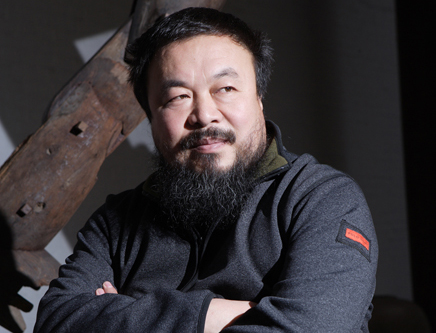
Ai Weiwei (Beijing) is an artist, curator, and architectural designer who has been working in China and the United States since the late 1970's. An original member of "Stars," a group of artists working in Beijing in the late 1970's during the first years of reform, Ai attended film school with directors Chen Kaige and Zhang Yimou. He then traveled to the United States where he made conceptual art focused on the alteration of readymade objects and situations. In the early 1990's Ai returned to China to edit a series of three books on the art a new generation of artists, based in Beijing's Eastern Art Village: "Black Paper," "White Paper," and "Gray Paper." Since that time he has produced work which focuses on China's cultural history, centralized political system, and the contradictions of modernity. His work has shown across Europe, North America, and China.

Ai uses a set of tactics for the production of his work: undermining the meaning of existing artifacts, attacking fixed hierarchies of power, privileging developed vernacular knowledge and simply letting things take their own course. Over the past few years he has moved closer to architecture, beginning with the design of his own studio, the China Art Archives and Warehouse, and the Urs Meile Gallery all in the outskirts of Beijing; the plan for a Park of architectural follies in his family's home town of Jinhua in Zhejiang Province; and a collaboration with Herzog & de Meuron Architects on the Beijing Olympic Stadium.

This interview by Adrian Blackwell took place on June 21, 2006 at Ai Weiwei's studio/home in Cao Chang Di Village on the outskirts of Beijing.

Adrian Blackwell: There are two things we are interested in with your urban work. The first concerns your thoughts about the contemporary city: what's happening right now with Chinese urbanization? The second is the approach you take in your own urban interventions. I thought we could begin by talking about some of your recent projects. You started making art in the late 1970's, architecture in the late 1990's, and then quite recently, just a few years ago, you began to making works that are about urban space, documents of your city. I know of four of them: the Beijing video map, the void photographs, the Chang'an boulevard project and the Ring Road project. They are each fascinating ways of reading Beijing. What made you start making work like that, what made you start documenting the city?

Ai Weiwei: It's not exactly documenting. It has that function, but it has no documentary purpose. It's not being used as evidence or testimony for anything, but rather to materialize our physical life, its condition in the moment. If you are in place A or on line A or line B, then that present there or that movement is simply as it is. We're living in a constantly changing world and everybody sees it and knows it, but as an artist who is also involved in issues of design and urban planning, I always try to find a way to most efficiently capture what I call fragments, or very small pieces which carry the flavor or carry the essential meaning of the city. So it's a very small effort that I have made, even if it looks quite massive in terms of the length of the videos, its just one section of a fact - the concrete world.

AB: So maybe we could talk briefly about each of those pieces. Let's start with the first piece, the video which follows every street in Beijing within the fourth ring road.

AW: "INTERVAL" - From Da Bei Yao to Da Bei Yao, 8.10. - 7.11.2003.

AB: It's about the street network and it makes me think of Zhu Jianfei's book Chinese Spatial Strategies. He talks about the public space of the city of Beijing arguing that in a western city you have squares, public space is organized around openings in the fabric, while in the Chinese city (his example is Ming and Qing dynasty Beijing) public space is in the street, so the public space is not a void, but a network of space, and the active spaces are simply nodes, or widenings in that network. One of the things that I like about this project is that it is an attempt to map this entire network using video, but it also conflates the map and its opposite, which is the experience of simply being lost in the city. What were you thinking about with this network of every street in Beijing?

AW: I think that a city is a three dimensional or multi-dimensional thing, but the work itself is not even two-dimensional, it's just one point to another, to another, to another. So of course in time this weaves a net if you are thinking of the road you have been traveling along or if you join the individual points. It covers the whole city, all the hutongs and streets, but actually it is made at one time, at a moment. Still it follows a line, a line made by a vehicle which has more than a dozen people on it, and from day 1 to day 16 it passes through different parts of the city. So it appears to be a complete view of Beijing, but if you look at any point, it's just dots, because there is no camera movement except the movement of the car. Very little changes, but the attitude or position that drives it is not passive, it's fixed through a very concrete concept. So I think it's quite ironic in that sense: after 150 hours it documents the city, but nobody would watch 150 hours and at any moment you see, you are confined to a single point, or proportionally stretched points form a very short time within this big work. It only works when it is so long, more than six days and nights. It shows how big, how impossible, how crazy this city is, or how meaningless at the same time, because our proportion, our sense of time, and also our visual contact with the city is really limited by where we are and which direction we go. The moment is about a certain period of time, so when you just look at one moment you don't really know what is before or what is next, even if you can pretty much guess.

AB: With the void photographs you are documenting a moment where there is nothing. If you think about Chinese cities as constantly being torn down and rebuilt, then this is a moment of quiet in between. It seems that this is a moment of potential, but I don't know if you are that optimistic about this possibility all the time. What made you take those photographs?

AW: I think that's a special landscape in today's China, you are the largest construction site in the world and each year Beijing has one hundred million square metres of construction which exactly equals the area of the whole city in 1949. Every year you have this total amount of construction, but you only finish a third of it, thirty million square metres. You know these are just numbers, but they really tell you something about the urban condition, especially when you see that China builds 20 times the area built in Beijing. The whole country is building crazily. So you have a kind of landscape that destroys the old, because the old is really garbage I think. It's really shelter in its worst condition, like Harlem. We used to say that Harlem was 100 times better than most ordinary people's houses. Then after you destroy you make it flat - we call this san tong yi ping (three [infrastructural]connections and one leveling).


Pei Zhao: By now its jiu tong yi ping (nine connections and one leveling)

AW: Then all this land will be rebuilt by powerful people, developers. Most of them, are connected to the government. They make big profits from land, which is not constitutional. After 1949 land was taken from the landlords. They killed the landlords, and the land was given to the people, under the control of the state. Now all the land is being auctioned to people in favor or associated with the state, who are profiting from their privileged background. So you have a landscape that is just waiting for this future. Even if it's totally empty, it will soon be built. Soon it will change the whole landscape of Beijing and of China.

It's a very sad condition, you see a nation or a city rip up the past, not to benefit the people, or the situation, but for profit, it's really the idea of all those new rich. It's like a country girl has to be a prostitute, because there is no other way to get out of the village. China's development is so much based in this idea: to let somebody ruthlessly become rich, but they can't become rich unless the party and government also profits, otherwise it's impossible. So who has become rich? Who has become more powerful? Who benefits and who is losing their rights, or their property. This property belongs to everybody, it belongs to somebody who never sees this property, because you know we are a communist country and this of course for the past 10 to 20 years has been a hidden secret (I mean nobody talks about it). It's stealing. I am not criticizing, these are only the facts. I record the condition after things are torn down and before they are built up, you know it's a very short moment, but in that moment nobody wants to look. There's a question mark there, a big, big void. The old is so sad, but the new is also sad. It is a very sad condition, so I think it's interesting to record it. It's a unique situation, a void with many questions, yet people don't want to look, or raise these questions.

AB: If the void project looks at empty moments inside the city, the Chang'an boulevard project moves in a straight line from outside through the city. It's a section. You were interested in the movement from rural space through urban space and back to the rural. How do you see that piece describing the contemporary city?

AW: I think that surprisingly enough when I started to make it, I did not know what it would be. It's not based on very sophisticated thinking, more on an attitude than on careful planning. It started when one of our friends said they had a son who wanted to come to Beijing, but had nothing to do. After he arrived I asked him if he could do this for a while. Then after days of planning what he should do, I found that Chang'an from the 6th ring road to the 6th ring is 45 km. So I made a very simple decision: just take one video shot for one minute every 50m. No technical requirements: push down, count 1 minute, turn it off, move another 50m, push down... Whatever happens in front of the lens is fine. It took months, the whole winter, because in the winter there is no better or worse view. I think in Beijing the winter really reflects northern landscape very well. You know there is a kind of sadness there. So after months he had taken 1000's of shots: from a very rural, primitive village, to the business district, to the political center, to an old town and later on ended up in the Capital Iron Company, which has just been destroyed and moved to another city township. This video was the last possible time to take these shots of the Capital Iron Company, a symbol of socialist industry. They made all the iron for the nation.

AB: When you look at maps of the growth of Beijing from 1949 to the present it is amazing to watch Chang'an Boulevard, it draws the city out, away from the old city. So much of the growth of the city is along that line that it is much longer than the rest of the city. The Last work that I know about that deals with the city is your Ring Road project.

AW: I made two pieces, one about the second ring and the other about the third ring. The video of the second ring is structured through the 33 bridges, taking one minute shots on each side of the bridge. So standing there you see the car traffic moving from overhead. Then I did the third ring, 50 some bridges and the same thing, the only difference is that second ring is taken on cloudy days (in Beijing most days are like that), while the third ring is taken on sunny days. If you look at it immediately you know that one's second ring and one is third ring. One is just grey color, and sometimes snowing. It's very boring and not an exciting thing to do, but nevertheless it records the condition at the time, its very much like a witness passing through: what he would see, his eye, anybody's eye. There is no artistic or aesthetic value, not much judgment there. Its very, very simple situation; it's very much like a monitor actually.

AB: We have talked a little bit about these works you have done about the city. But the other thing I am interested in is the way you live in the city. You live in a village; you don't really live in the city.

AW: Well this city, Beijing, surprisingly enough is not a real city. I cannot call it a city, it's still very flat, not dense enough, not strong enough, it doesn't have enough variation and mixed conditions, it's still very even.

Today I live in Beijing. I was also born in Beijing, but soon after we moved to Xinjiang and I grew up there. My father owned a courtyard in Beijing, but for years other people lived in it, because our family was considered an enemy of the people, an enemy of the state, and an enemy of the party. Three enemies. Being just one of them was enough to be exiled. Then after 20 years away we returned and lived in different parts of the city. We borrowed places, because our home was inhabited by other people. We lived in different places: West, North, East or South, so I have a very clear image of what the city looked like. At the time the city was occupied by bureaucratic compounds: universities (of course at that time were not open), government, military and so-called scientific research institutes. All these different departments were all under the same conditions, communist, without private property, everyone belonging to the work unit. So there was only one condition: you were either one of the people or an "enemy of the people." So simple. I guess there weren't so many "enemies of the people," but from time to time that vein was very consciously mined. They were trying to find out who is an enemy of the people for years while I was growing up. It was one political movement after another after another. It was crazy every day. Today you talk about it and it sounds more like a joke: "what a joke, why are you still talking about things like this?" But this was true: many people lost their lives. I think that that ghost is still haunting China today. Not the communist ideology, the ideology may be good, but the way that this power is maintained within society and how brutal the state can be towards a human's basic condition, not to talk about human rights, but essential needs.

So that is basically what this city was and still half of the city is still based in this and the other half is the so-called new rich, after Deng Xiaoping's getting rich first policy. Of course who is going to get rich? It's not the ordinary person. But this is not a complaint, it's simply the truth. You know in China, you still talk about people who have the right to live in the city or not to live in the city. It's called hukou, dividing people into locals, non-locals.

PZ: You need a license, or special registration to live in the city. Throughout the entire world only North Korea and China have a policy like this one.

AW: Locals don't have many rights, besides the privilege of enrolling in school, but in the newspaper they often talk about the crimes caused by non-locals. There is a crazy amount of discrimination against people who are not local. A small example of this is that the city has laws against illegal structures like this one (Ai Weiwei's home and studio). Think about it this way: the city is built solely by migrants from the outside, but none of them are locals except the boss and where are they going to live? Nobody provides any space for them. Of course they gather at the outskirts of the city...

PZ: And in the village in the city...

AW: Just to build a place that they can stay, whether it's legal or not.

AB: But this village, Cao Chang Di, is it a village that pre-dates the city, or is it a village like you are talking about now, a village that is built illegally? Most people that live here appear to be migrants, but did they build this village, or did they inhabit an existing one?

AW: In the 1960's this was a so-called "China Albania Friendship Farmer's village." These were very privileged farmers, who were supposed to provide an example for the country, growing vegetables for the city.

So when university or high school students graduated, and Chairman Mao sent them to be re-educated on a farm, they would send some people here. At that time people working here found much better conditions that you would find in more distant areas. At least on the weekend they could ride their bicycle home. These were example farmers, so it was a good farm.

Recently I heard that it is no longer a village and the former farmers are buying out their hukou to become citizens, instead of farmers. The real reason this is happening is so that the land can be returned to the government, because if you are a farmer no one can take your land. Of course there is real benefit for these new citizens, they have some new citizen's rights, but at the same time the land is returned to the state, so that it can sell the land to anybody it wants to. There are a lot of tricks and games, but it is really so simple: the state is the only beneficiary. But in a state, like China, which is not a democratic society, far from it, nobody argues about this, the press won't talk about it, intellectuals never discuss it. Probably I am the only crazy guy who always talks about it. But they think: "This shit guy, why is he always talking about this?"

So what kind of city is this? I can't see a city without citizens. It's like you don't see a religion without followers. Nobody can decide how the city is going to be; everything is done through governmental decisions, today we need a road here, tomorrow... It's by very simple decisions from the top. If Sanlitun (a Beijing bar street) becomes nice they say: "Oh, lets change it, we'll plan big buildings so that someone can profit from it, not all you street vendors." It's crazy, whenever they see people benefit, they will grab the profit. It's so simple, they change here or there not as they say, to make the city better. The city is already better when they do nothing, take 798 (a contemporary arts district, in a former model industrial work unit) as an example, but once they see this they always take action.

So that's my understanding of this city. I really have no relationship with it, except when journalists come to visit me. Otherwise I just go to one restaurant, which I designed (called Where to Go?). A lot of friends go as well, so we have a place to meet and eat dinner, and then I come back here.

AB: This is a courtyard house, and it seems to me that the kind of city you are talking about when you say you live here and in your restaurant, has very few elements, its not so much about the city space in between. I am interested in that because a lot of people, for instance New Urbanists in North America, might say you make a good city by making lively streets, by concentrating energy on the public space of the city. I don't know if it is the way you would like to make a city, but the way you live is different from that, its much more about autonomy, creating a separate space through the compound, but still finding forms of community. The restaurant for instance is a kind of public space, which can't be here in Cao Chang Di; it's better that it's in the city, because people can get to it more easily. I am wondering if you are interested in making a city that starts from the way you live in it, which I think is quite different from the way many others think a city should work.

AW: Of course most European cities are based in convenience and efficiency. But it's not necessary to me that these functional requirements are supported, what is more important is the use. You need a real variety of intention and purpose: people who are doing things that you would never think about. So you know that's important. I think a city can be very brutal and lacking in qualities of life, because these are not desired, but without many different purposes, the city loses its initial reason for becoming a city.

Many places, like this city, have vast areas without use. It is so strange, these spaces are not for individuals; they're for a special group that has no meaning. This group gives the city no meaning; it's a negative force, working against other people.

AB: Maybe we could finish, with a question about the different processes you use in making art. I'll list some of the different techniques, or tactics, that you use. I am interested in how you might see them applying to your design thinking and its relationship to processes of urbanization.

The first is the notion of detournment, this Situationist idea of diverting the meaning of existing artifacts, taking found things and altering them slightly to change their purpose. You've used this technique in architecture, in the projects you did at Beijing's Soho housing development, the silo and the upside down house, and in the project we're sitting in - your own studio. Even though it's not a found object, it looks like one. You use ordinary typologies and vernacular forms and slightly modify them.

The second involves letting things go, you just drop a Han Dynasty vase on the ground. You let it go to see what happens. I think this works like the video pieces as well, you set up a process to see what ensues.

But then there is another tactic you use: an overt "fuck you!", working very strongly against authority, centrality...

AW: ...order and the state, establishment...


Documenta 12 in Kassel, Germany.


AB: And I guess the final one which is in some ways the opposite of the last one, is that you use the power of developed knowledge, a general intellect, vernacular techniques, you have a deep respect for the way people do and make things.

So I am wondering how you see these tactics in relation to the city, can you see your practice of making urban space in relation to these same techniques?


AW: I think we are in a very special moment, As Chinese people, but also internationally, we have gone from the cold war, an unjust society, towards so-called globalization, or a stronger capitalist society, or an information age. Everything happened with a purpose leaving us with unknown conditions. I don't think humans can ever really control this, and it has become even less controllable. Circumstances are now much more complicated than we can predict. For example until quite recently there was no China or India and now suddenly they are the factories of the world. But people are still trying to figure out what this means in relation to ideology, social and political structure, and all kinds of other problems, like education and the environment. I don't think there is a single reaction, at least for myself that can answer these questions, or put me at peace. So I constantly think about the condition of being lost. Once you're lost, you try to figure out where to go. Imagine you're in the middle of a train station and you try to understand the much larger, much more complicated, space around you, or the travel you are embarking on.

So I think it's crazy, the whole thing is crazy. I am not very clear about what I am doing. If I have a character, I don't have much purpose in my life, but more of a natural flow. The only fact is that I am still alive. I'm here. This is solid now, but even this might change. I can't figure out what is going on. Really that's true. Honestly, I don't have a clear answer for this. The clearest answers look ridiculous to me.

Adrian Blackwell teaches architecture and urban design at the University of Toronto's Faculty of Architecture, Landscape and Design.

Pei Zhao practices architecture and urban design with Parsons Brinckerhoff in Beijing.

Together they curated the exhibition Detours: Tactical Approaches to Urbanization in China at the University of Toronto's Eric Arthur Gallery. The exhibition features projects by nine contemporary architects and two artists, including Ai Weiwei's "INTERVAL" - From Da Bei Yao to Da Bei Yao, 8.10. - 7.11.2003.

This work is licensed under a Creative Commons License.

Thursday, December 07, 2006

A thousand words: Yang Fudong talks about The Seven Intellectuals

A thousand words: Yang Fudong talks about The Seven Intellectuals
ArtForum, Sept, 2003 by Yang Fudong

In one of my earlier works, the photographic triptych The First Intellectual, I touched on a concept that still preoccupies me: One wants to accomplish big things, but in the end it doesn't happen. Every educated Chinese person is very ambitious, and obviously there are obstacles--obstacles coming either from "out there," meaning society or history, or from "inside," from within oneself. In this work you could see that "the first intellectual" has been wounded. He has blood running down his face and wants to respond, but he doesn't know at whom he should throw his brick; he doesn't know if the problem stems from himself or society. Ideals and the way they distinguish people, but also the way that they can unite people and encourage them to form bands, partnerships, brotherhoods--this was something I wanted to investigate in more depth, taking my time to do so. When I eventually completed An Estranged Paradise, I started defining this new, vast project, which will untold as five different films. Because I feel that this topic is extremely important to an understanding of China, both past and present, I wanted to articulate several temporalities together: one that is really ancient, the stories of "The Seven Sages of the Bamboo Grove"; another set during the '50s and '60s, when there was a profound questioning of the status and role of intellectuals (and so the films will have a clear '50s, '60s kind of New Cinema flavor); and, ultimately, one dealing with the concerns and ideals of today.

The Seven Sages of the Bamboo Grove were a group of Chinese scholars and poets who fled the troubles accompanying the transition between China's Wei and Jin dynasties during the mid-third century. They assembled in a bamboo grove, where they forgot all of their worldly troubles, losing themselves in pure thought and discussion. This sort of retreat was typical of the Taoist-oriented ch'ing-t'an ("pure conversation") movement, which advocated freedom of individual expression and hedonistic escape from extremely corrupt politics. Their ideal consisted of following their impulses and acting spontaneously, and being sensitive to the beauties of nature.

Advertisement

So the first film in this project stands for me like the beginning of a book, the preface; it's an introduction of the story and the fate of these "new" seven intellectuals. "The Seven Sages of the Bamboo Grove" doesn't exist as a book; there are legends, popular stories, hearsay knowledge, and, of course, what's interesting is also the distortion, the fact that the stories have continually been adapted to changing contexts and times and to the intentions of different storytellers. That's also something that I want to investigate, in light of contemporary China and its relationship to history--this state we're in, which can be described as a moment when we have to negotiate our past while imagining our present.

The first film shows the intellectuals traveling to and dwelling on Huangshan, a very famous mountain situated in the southern part of Anhui Province. The landscape, the nature, is just beautiful there. The peaks rise one on top of another, and the pines and cypresses are luxuriantly green. There are almost a hundred big and small peaks and ridges, and plenty of lakes, brooks, deep pools: It's a kind of dreamscape. I really like showing this sort of atmosphere--very calm, very beautiful, but with a strange, disturbing aspect, exactly like in a dream. Or like when you wake and you cannot accurately recall the dream. Still, a feeling lingers that you had a strange or even frightening dream, and you know if you try to describe it to someone else, that person just won't be able to relate; you can only keep it inside you. In our real life, it seems that where we are heading is always the opposite of where we want to go. It is the same with the dream. We are dreaming we are somewhere, but when we wake up, we find that we are somewhere else. Perhaps this reflects the perfection of the dream.

My new film investigates how this dreamlike environment affects relationships and discussions among the intellectuals--as well as their solitary meditations on individuality and liberty. We need to pursue something, and then we have our spiritual sustenance and belief. In the subsequent films, the intellectuals will be shown living in a building, in a metropolis--say, Shanghai; in a village in the countryside in the company of peasants and villagers; and on a deserted island where they'll start to invent a new world from scratch by defining new modalities of social life and interaction and a new distribution of labor. (Of course, the separation of material and immaterial labor and capital will be questioned.) And in the fifth and last part, eventually the intellectuals will return to the city--and so return to reality, confronting their contemporaries with their new experiences.

At the 50th Venice Biennale, Shanghai-based artist Yang Fudong presented The Seven Intellectuals M Bamboo Forest, 2003, the first part of his new filmic pentalogy, The Seven Intellectuals, an adaptation of the traditional Chinese stories known as "The Seven Sages of the Bamboo Grove." The first Installment (shot in 35 mm black and white) begins the series' exploration of the ambiguous position of intellectuals in contemporary China--their longing for individual freedom in the shifting context of an emerging capitalist economy. Yang, who was born in 1971 in Beijing and graduated from the China Academy of Fine Arts, Hangzhou, has shown an interest in the conundrums of idealism in his earlier works, such as the photographic triptych The First Intellectual, 2000, where he reflects on the difficulty of finding and adopting a rebellious and critical attitude in a society undergoing changes that are as rapid as they are profound. On other occasions, his approach has been poetic and nostalgic, showing stylistic references to Chinese films of the '30s and '40s, such as Yuan Muzhi's Street Angel (1937) and Fei Mu's Spring in a Small Town (1948). Yang's Internationally praised first feature film, An Estranged Paradise (2002), tells the story of Zhuzi, a young intellectual befallen by a strange illness, a restlessness that arrives with the rainy season and disappears with its end. In Yang's own words, the film stands as "a meditation on life," in which nature seems Intimately bound to psychology. It is a poignant convergence of mind and outside world that presages the first episode of The Seven Intellectuals.

Wednesday, December 06, 2006

Still Life by Jia Zhangke tonight

In he land of DVD's, it is relatively hard to find the works by some Chinese directors such as Zhang Yuan, Zhang Yimou and Jia Zhangke. Here is a rare viewing:
_______________________________________________

STILL LIFE (San Xia Hao Ren)
Directed by Jia Zhangke
________________________________________________

Wednesday, 6 December 2006, 8:30 pm
Kodak Super Cinema World (details below)
70 RMB
No RSVP necessary - just come and enjoy!
________________________________________________

Director Jia Zhangke, actor Han San Ming and actress Zhao Tao will
attend and participate in a Q&A session with the audience at the end of
the screening. This is a truly unusual opportunity to share insights
with the creators of the film.
________________________________________________

During the 63rd Venice Film Festival last September, Chinese mainland
director Jia Zhangke walked away with this year's Gold Lion award for
best movie with "Still Life." He's the second Chinese mainland director
to win this major film award, following the legendary Zhang Yimou, who
won the award in 1992 and 1999.

His prize-winning movie, Still Life, is a documentary-style film was
shot in documentary style in the Yangtze River valley town of Fengjie,
which was destroyed by the building of China's Three Gorges Dam. "Still
Life" beautifully captures this town and the lives and relationships of
those living within it. Even in the face of deconstruction, these people
still try to pursue beautiful loves and lives. The film tells the love
stories of two separated couples who meet again in the village. A miner
comes back to the village to look for his wife, while another nurse
returns for her husband. In the end, one pair of lovers choose to
reunite, while the other pair choose to part. Nonetheless, the four all
learn the essence of true love (excerpt from an article published in
www.crienglish.com).

Please join us!
_____________________________________________________________

Kodak Super Cinema World
Metro City, 5th Floor (tell the taxi driver "Mei Luo Cheng")
1111 Zhao Jia Bang Lu (in Xu Jia Hui, across from the Gateway
Shopping Center)

For additional information, call Connie Gao at 1370-191-5733.

Monday, December 04, 2006

Interview with Steven Wang

Steven Wang

Position: An assistant director
Films: Fearless, Mission Impossible III.
Background: graduated at Film Academy in Shanghai University, working 5 years in Chinese film making industry, now study in New York Film Academy.

(Below are the interviews, I simply summarized, A is Alex, S is Steven Wang)

A: How do you think of the film market in China?

S: The whole market was divided by three groups. The first is American, Japan, and Korea. They occupy the largest part. American was the first one entering China. Under the influence of Hollywood, films from Japan and Korea developed very fast, especially Korea. In recent years, Korean films are more and more commercialize. Some famous films from Korea have been introduced into China; it is very obvious that Korea has ranked into the train like Japan and America. The second group was Hong Kong, since the import quota license has been canceled, Hong Kong films have greatly impact Chinese Mainland, and in the same time, films from Taiwan, who used to be as important as Hong Kong, have quitted this stage. The third group was a few excellent directors in Mainland; they once operated several ‘successful’ commercial films.

A: What are the objective conditions of work in China?

S: It can be summarized by a Chinese traditional idiom “Yu Long Hun Za” (good and evil people mixed up). Most film making groups are from Hong Kong; because the limitation and shrink of Mainland market, those groups crushed into Mainland. They use the advantage of geography and cheap labors to produce and publish films. About the propagandizing part, they are occupied by the advertisement making groups from Taiwan. They have adequate experience by plagiarizing, absorbing, and imitating advertisement creativities from foreign countries, especially Japan. Now, they have formed their own expert groups to pack and propagandize. While in the mainland, under the film-making mode from Hong Kong and Taiwan in several years, some small brands and producing groups have been built up.

A: How do you think the future of film industry in China?

S: There are infinite potential in China now. Since the national power strengthened, the brand of culture has been more and more emphasized. Due to the particularity of film making environment, it needs special management and reasonable salary distribution system. And after joining into WTO, the communication of culture has been broaden, the art quality and commercial factors of Chinese films have been forced to run up. Moreover, not only the capital from foreign countries, but also the producing money from inland has greatly increased. It activates the producing environment. In addition, some talent persons choose to return to China, to join into producing domestic films. They helped to advance the producing level, and the new management they brought into is forcing the old system to step out of the market.

Wednesday, November 22, 2006

Yang Zhenzhong Review


Yang Zhenzhong uses the video, and goes through a lot of experiments, putting his personal special view on the simple object in the daily life to present a different meaning in order to gradually become the avant-courier in the visual art field in China. One of his great works, “I will die”, is very impressive collection of different people’s narrating the simple truth. A tiny difference showing on the face before and after one said the truth, the tone coming from different background people, give people one deep think and conjecture. He is also very good at combining two seemingly unrelated things together to form a unique visual meaning, as in the work named “Blow”, once exhibited in 2002 Shanghai Biennial. A girl blows in one screen, and on the opposite screen the artist uses the technique of rewind to show a shoot in one busy street. When seeing the two screen together, it seems as if the air the girl blowing moves the street back, the exaggerated blowing indirectly reveals and accentuates the strength coming out of the girl. His creative idea is not only on technique, some earlier works of him also show a human wisdom, like the “922 rice”. He recorded a couple chicken to eat the rice and count the number when one chicken nods. He uses the nod to count the number of the rice and in return, to criticize the emphasis on number instead of the real things, which human recently represented. In his recent works, he becomes more and more focuses on the equipment and also the works are more delicate. It can be said that Yang Zhengzhong smoothly progress in the field of visual art, and make his own characteristic more visible.

Lecture notes on Qiu Anxiong presentation- dated 11.3.06


Class notes following visual artist Qiu Anxiong presentation in the classroom- dated 11.3.06, provided by NYU student Erica D Swallow. Thank you Erica for sharing your notes with us.

• “Jian Nan Cuo” (2005)
o Time: 13:10
o Birds on branches (flying onto and off of tree at times)
o Shot in black and white to mirror traditional Chinese painting that used black and white ink
o Constant beat is heard in the background (percussion/bongo)
o Heavy bass sound as if in a dungeon; haunting drone sounds
o Interestingly, he gives mention to the cast as: “Cast: Wind Cloud Tree Bird”
o He says that this piece is about Time:
• Modern people see time as a very fast thing
• We seldom look for natural development. We always need stories.
• This is a natural time flow, but in the film it seems very slow and much longer. Actually, however, it is just a normal progression of time.
• This is a basic Chinese philosophy used to look at the world, especially during the Song dynasty – One should try to blend in with the environment instead of taking a third person point of view. This is very typical of traditional Chinese art, as well. The artist will blend in with the environment.
• From a distance, you can’t see the movement of the trees as they gently sway in this video, but if really focus, you can see it. In this way, we should look at the natural progression of time in everyday life. From a distance, we may not see things moving, but if we put our soul into it, we can see how everything is moving and changing.

• “In the Sky” (2005) (This is the first animation that he ever made.)
o Music Tchaikovsky/Stockhausen
o Time: 8:18
o For this piece, he had no special plan. He did it out of pure feeling.
o All hand-painted
o He was influenced by an African artist, William Kentridge. Kentridge does not use complicated techniques. He uses simple elements and does not focus on a huge, complicated production. Anxiong admires this.
o He thinks Chinese animation was better before the 1990s. This is due to the current marketization and importing of ideas from foreign countries and companies, like Japan, for example.
o 1930-1940s: The first animation to ever be made in China was “Journey to the West” by two brothers.
o 1950-1980s: Ink animations develop in China
o “This work is not a story-telling work. Its like a dream of snapshots,” he explains.
o In one image, two heads on sticks protruding from a grassy hill are depicted, and one is taken away by a bird. When Sonia asked what this meant, he said that this signified the time upon creating the piece when his wife was gone and he missed her.
o He has no clear thoughts about the piece of art in theory, but reiterates that he made it just from his feelings.

• “Flying to the South” (May 2006)
o Time: 9:12
o Soundtrack of voices in background
o Flying books
o This piece was an installation at an Expo in May in Shanghai. It had statues installed along with the video, but the government shut the show down. The statues and film are prohibited to be shown together.

• Anxiong’s Ideas on the Point of Art
o Instead of looking at the history and progression of art as a form of expression to understand art as a media, we should look at the world. When we look at the world, we look at true history.
o We look at the world with a whole system of symbols. We have lost the instinct to see the world in a direct way for what it really is in essence. Instead, we see an expressive world, rather than a truthful one. We use too many symbols to define it.
o We only know part of existence. We don’t know all of it.
o Today we have so much knowledge. Knowledge has cut the world into pieces. We no longer have a world in its entirety. Our world is categorized and humanized.
o We need an original way of looking at the world: an origin. It is important to every culture to have this type of origin.
o Although China is developing into a very complex system, we still ask ourselves the same elementary questions about our origins. Still, we are puzzled.
o For example, we look at a computer and think it is easy to understand. We know what it does and we can use it. But we can’t see what is inside it and we do not know how it really functions. We look at our world in this way. We think we understand the world, but really we do not know its truths.
o Unfortunately, we look at our world from a point of knowledge and understanding, not from a participatory point of view. We distance ourselves from the world, and we no longer have a mutual relationship.
o He uses art to connect with the world in a more intimate way. This is his general understanding of art.

• “The Book of Mountains and Sea [1]” (2006)
o The song at the end, to him, was very “human”. It conveyed a different perspective than his own. He feels that it did not convey the same ideas and feelings of his art shown before it in the animation. It does not have the same sacred and objective feeling of his work. His friend from Chengdu wrote it after reading the book he wrote. The credits at the end mention “Jin Wang” and “Ou Bo” as the musicians credited in the film. I’m not sure which one created this song.
o He quotes Confucius from a story about Confucius and three of his students. They are all discussing the goals of the students. Confucius asks the first one what he wants to be. He says he wants to be a general. Confucius then asks the second student, who replies that he wants to be a secretary. When the third student is asked what he wishes for his, he says that he would like to go swimming in the river with his friends. The song is like the third student, an ordinary perspective. He thinks that if everybody had this perspective, maybe our society and world could reach its’ pinnacle. In this perspective, the ordinary becomes the ideal. The simplest goals bring the greatest successes.
o Some images discusses from the animation include:
• The explosion of New York City. It is not caused by an external force, such as a bomb. Instead, one may notice that it explodes from within. This symbolizes internal problems with society.
• The singular person that remains standing after the other terrorists fly away. Before class began, Anxiong told Eric and I that this guy does not represent anything in particular. Instead, he represents the many possibilities. He challenged us to think about it ourselves, expressing that it is up to the viewer to ponder over this matter. There are so many possible ways the story could end, and the viewer must consider these options. In my opinion, this is part of the beauty of this piece as it leaves us asking questions and challenging our views.
o The refrain from the song at the end is:
• “Who is sighing? Who is lamenting the parting of geese on autumnal journey?”

Friday, November 17, 2006

luchunsheng premiere

> Tomorrow Lu Chunshens new video premiers in the Paradise cinema, if
> you have time, please come, most welcome.

----------------
History of chemistry 2

Excessively restrained mountaineering enthusiasts

Premiere of Lu Chunsheng’s film
Premiere: November 18th, 2006, Saturday (19:00-22:00)

Venue: Paradise Theatre, 308, AnFu Road, by Hua Shan Road

(Seats are limited) first come, first seated

Exhibition Dates: November 19th- 24th, 2006 (2 showings per day 13:00/
15:00)

Venue: Shanghai BizArt Art Center, Moganshan Rd 50, Building 7th, 4th
Floor. 200060

Tel: +8621 62775358

Contact: Li Xuehui xuehui@biz-art.com

Alexia Dehaene guanchaoqun@yahoo.com.cn

The “company” moves with enormous difficulty. “He” is at the edge of
bankruptcy "mountaineering enthusiasts” from three “companies” have
been tracking A…..

A, who has already left the “company” ,is holding a pivotal “contract”
for a large business transaction.

In order to obtain this “contract” for themselves, at “the last
moment”, the tide could be transferred to some areas of the city which
were surveyed time and again by the “mountaineering enthusiasts””.

Thereupon a new “climate” formed ……

This “climate” would compel A to g to the Highlands ……

This unfinished “contract” which has the “power of prediction” would
ultimately be taken to the mare liberum and be traded on a gambling
ship………

Subsequently the “company” gradually reduced the heavy
burden caused by the debt.

Finally, the project to exploit future terrain went into action and
grew vast and mighty……

As the story goes,A is the descendant of John Dee. ……

Thursday, November 09, 2006

“Mantis City” at Doland Museum


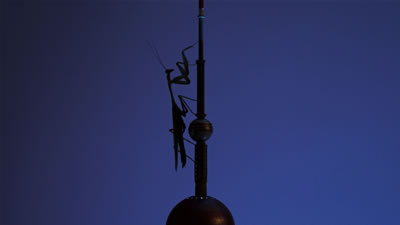
The current exhibit (October 27, 2006 – November 25, 2006) at the Doland Museum of Modern Art in China features the works of Swedish performance artist Tobias Bernstrap, highlighting his current work, “Mantis City”. “Mantis City” is his new exhibit, which becomes available to the viewer upon their immediate entrance into the “museum”, or in the Doland’s case, is really more of a gallery space. The first floor is generally dark, although you can make your way over to a seating area to watch Bernstrap’s “Mantis City”, produced in 2006, projected on a 16:9 screen from a HDV DVD, running on a 12 minutes and 50 seconds loop. “Mantis City” itself focuses the city of Shanghai itself, in which Bernstrap presents the audience with a replica of the Pudong skyline at 1:1000th scale. Two preying mantises climb the Oriental Pearl TV Tower and the Jin Mao Tower, and eventually slowly descend, have a fight, and the winner climbs to the top of the Oriental Pearl once again. The video itself often features only shadows of the mantises, and often blurs out the background. According to the Doland’s statement, “The dramatic lighting recalls the atmosphere of Fritz Lang’s Metropolis (1927) and Carol Reed’s “The Third Man” (1949)”.
The nearly 13 minutes of watching “Mantis City” pass by easily enough, and one is free to head up to the second floor of the Doland. Surprisingly, it is even darker here, and reading plates for works can be quite difficult. Moreover, a large main room is supplied with projections on two of the walls, with a large space in between. On the first wall that comes into view upon arrival on the second floor is Bernstrap’s work, “Freidrich Passage”, made in 2001, running on a 6 minutes and 30 seconds loop. This work entails going through a tunnel, to the mood of gothic music. The work is rather reminiscent of a horror videogame, which is what seems to be the inspiration.
On the opposite side is a projection of “Walking Ego”; a soundless, continually looping girl that walks that was finished in 2003. Passing by, one ventures into a side room featuring another work, “Killing Spree”, a video completed in 2006. In the video, a man, perhaps the artist, is dressed as a character from a modern video game, while performing rock music in front of gothic fans. This video is the longest running of the group at 14 minutes and 36 seconds. One can easily decide to move into the last room, entitled “XSeed 4000”, completed in 2004 as a modification of a computer game. Although it is the most interactive of the exhibits, you are still limited in your explorations to a green space inside of what is presumably the inside of a modern building. Most intriguing is the ability to control the character with a mouse, and listen to random comments that reflect upon a totalitarian society. Yet the inside of the building is apparently gorgeous, with green grass and a fountain surrounded by water.
In all of his works, Bernstrap is presenting a contrast between virtual space and real space, the physical representation of body and architecture in fiction and reality, and the blurred borders between fiction and reality that result as a consequence. Or perhaps a quote by the artist himself, "Today I see a lot of paradoxes in our concepts of reality, such as when looking at architecture in computer games and in real life. The software developers keep pushing limits to achieve more and more realism in the games; at the same time, architecture and design moves towards fiction, i.e. the skyline of Shanghai's Pudong district looks like a scene from an early Sci-Fi movie... There's no clear border or difference anymore - fiction or reality, virtual space or real space, it's all blurred."
The current exhibit “Mantis City” is not to be missed. Bernstrap presents a unique blend of gothic and special effects, producing work that is very much his own. The space is also well suited for the works, with the darkness allowing full visibility of all five. Although not many pieces are on display, it does make it much easier to sit back and fully take in all the pieces – and play around with “XSeed 4000”.
No. 27, Duolun Road, Shanghai, China www.duolunart.com

Monday, October 30, 2006

Doland, One Step Forward


Curvy and serene, Duolun Road exudes a memorable cuteness as it elusively hides in between large buildings and wide roads. Strategically placed at the center, surrounded by a public park, a stadium, a commercial area, and bustling city highways and railways, Duolun Road completes the urban design of this surrounding area with intricate contemporary perfection. Walking on Duolun Road, I return to a similar district I visited only a short while ago: Moganshan Road. Comparable to Moganshan road, Duolun Road also hides itself amongst the bustle of city life and urban architecture.

7 floors tall, Doland Museum of Modern Art stands huddled together with a combination of small buildings lined on both sides of the road. Like the central jewel embellished with smaller adornments, Doland MOMA attracts the attention of tourists and locals with its solitary beauty. In comparison, the single presence of Doland as a representative of contemporary aesthetics surrounded by city urban architecture and infrastructure on Duolun Road contrasts with the small gathering of art galleries in an abandoned industrial corner of Shanghai. While Doland emanates distinction and favor as a significant achievement of the Shanghai government to support and propel Chinese contemporary art to an international level, it segregates itself from other proponents of contemporary art in Shanghai. Unlike other museums in Shanghai that host exhibitions to encourage appreciation and interest in contemporary art, to develop strong relationships between the Chinese and foreign art communities, and to pave way for the aesthetic and intellectual creativity of future generations, Doland conveys an intense political agenda to accompany the encouragement of contemporary art. Although a political agenda does not prevent the growth of contemporary art, Doland does prevent itself from completely accepting, exchanging, and experiencing contemporary art, unlike the MOMA or MOCA.

Upon first glance, Doland MOMA looks like a rectangular brick standing tall among the jagged houses that surround it. From a distance, the Doland MOMA shines a smooth layer of gray with a small section at the top of the building made of bright red steel and transparent glass. As we close in, the structured and quadrangle pattern compose and construct the Doland. The entrance is designed with the combination of black and red and only the black and red letters spelling Doland Shanghai Museum of Modern Art and a red street light compliment the connecting red and black design of the entrance. Simplicity is beauty, and Doland MOMA accentuates this exquisite aesthetic simplicity with its architectural sincerity. I favor the design of Doland over such other museums such as the Shanghai MOMA, the MOCA, and Zendai. The MOMA and MOCA are buildings refurbished and converted into modern art museums from their original architectural designs and purposes and this wanes their aesthetic and cultural objective. And although arguably MOCA and Zendai, with their attractive glass structure, I believe that art is not transparent, and the buildings should not illustrate this. Contemporary art is simple yet complex, a fusion of experience and imagination. It tries to portray truth through beauty and beauty within truth. The glass design of MOCA and Zendai do not convey the sense of this complex simplicity as well as Doland. From the architectural design of Doland’s combination of gray, red, black, and glass, the conveyance of contemporary art is much stronger. Doland’s gray tiles represent the intricate and complex composition of the materials to create the artwork. As we have seen, many contemporary artworks have a finalized product that we perceive to be a simple and candid reflection of life and truth; the earnest colors composing Doland’s structure accentuate these characteristics of contemporary art in its architecture.

In terms of the exterior architectural design, the entrance made from a combination of red and black epitomizes a multitude of meaning. It is this complex simplicity that I felt most impressed with. At first glance, one will only see the contrast between red and black; nothing special. However, after contemplation and examination, the basic design of the entrance symbolizes the cultural reference to Chinese cosmological belief. The strong belief that everything in this world is made of yin and yang, of a balance and integration of light and darkness symbolizes the inclusive and integrative nature of contemporary art. Like yin and yang, modern art is a representation between the balances of existential aspects in and around humanity that search and define truth. Also through the illustration of a modern cosmological reference, the museum seeks to indicate the cultural aspect.

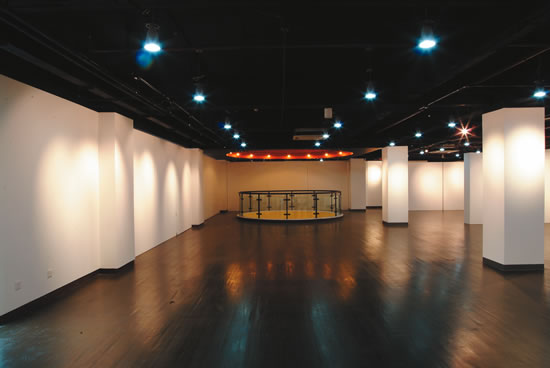
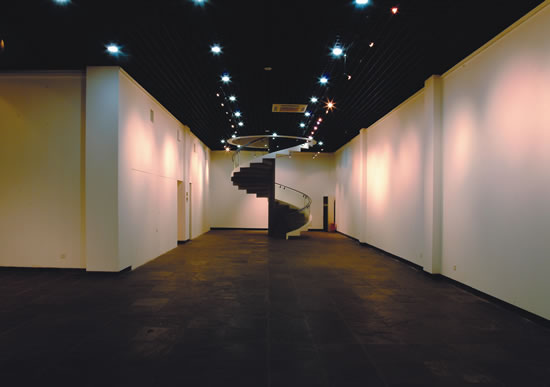
The spacious interior of the Doland MOMA has a construction area of 4800 square meters, of which 1500 square meters (the first 3 floors) are used for art exhibitions. The black ceiling and white walls also support the principle of yin and yang and the brown wooden floor solidifies our relationship with nature as a unified entity. Each floor has sufficient exhibition space for artworks small and large. The two video rooms provide the space necessary for motion picture art. Overall the interior design of Doland has put into consideration the flexibility, modernity, and creativity of contemporary art. The circular stairways that lead to the floor above inject the audience with a sense of blissful search for enlightenment. By climbing the circular stairway, one feels as if it is a trial in search for the experiences in life. Instead of progressing in a diagonally linear movement but circling directly upwards, one feels as if the pursuit of truth is an ordeal that requires patience and determination as there will be moments of redundancy challenging one’s faith and intellect.

In terms of architectural design, Doland proudly exhibits many merits that place it at the forefront of Shanghai modern art and culture. It is the fruit of the effort, experience, and desire of the Chinese people to modernize and integrate themselves into the modern art world and exchange culture and individuality with the rest of the world for mutual progression. The one aspect that could be improved upon is the interaction and interconnection between the interior of Doland and the exterior environment. Doland’s walls completely seal and separate the interior with the exterior world. If instead of using concrete material to create the walls the designers used glass that is transparent from the inside but not observable from the outside, it would give contemporary art and the museum a mystic aura and allure audience in. Once inside, the audience may see and interpret the paintings as well as witness the world outside, which would symbolize an interpretative fusion of modern art and life: an experience of truth.

Thursday, October 26, 2006

History of chemistry 2 by Lu Chunsheng

History of chemistry 2
Excessively restrained mountaineering fancier
Premiere of Lu Chunsheng’s film

Premiere: November 18th, 2006, Saturday (19:00-22:00)
Venue: Paradise Theatre, 308, AnFu Road, by Hua Shan Road
Please dial +8621 62775358 to book your seat.

Exhibition Dates: November 19th- 24th, 2006
Venue: Shanghai BizArt Art Center, Moganshan Rd 50, Building 7th, 4th Floor. 200060

The “company” circuilates with enormous difficulty. “He” is at the edge of bankruptcy
“mountaineering fancier” from three “companies” have been tracing A…..
A , who left the “company” already , is holding a pivotal “contract”about a big trade.
In order to obtain this “contract”, at “the last moment”, the tide could be transferred to some areas of the city which were surveyed time and again by the “mountaineering fancier””.
Thereupon the new “climate” formed ……
This “climate” would compel A to the highland ……
This unfinished “contract” which had the “power of prediction” would be taken to the mare liberum ultimately, and trade on a gambling ship……
Afterward, the “company” got rid of the heavy burden caused by debt crisis gradually.
Finally, the exploiting project about the future terrain started to came to action and became vast and mighty ……

As the story goes,A is the descendant of John Dee. ……

Tuesday, October 17, 2006

Yang Zhenzhong Solo-Exhibition

FOREPLAY--Yang Zhenzhong Solo-Exhibition

Nov. 5th 2006– Nov.29th 2006

Opening Reception: Nov. 4th, 5.00-7.00 pm

ShanghART Gallery & H-Space is proud to present a solo-exhibition with
works by Yang Zhenzhong (b. 1968).

Using innovative techniques Yang Zhenzhong expands the credo that
‘underneath each picture there is always another picture’ into
‘underneath each picture there is always a specific medium’. The
exhibition FOREPLAY focuses on these mediating devices that constitute
the imagery of Yang Zhenzhongs exceptional work, whether it is video,
photography or installation art.

Yang Zhenzhong involves his audience in explorations intended to
generate visual effects and stimulate feelings and thoughts to bring
about unforeseen experiences and multiple points of view. FOREPLAY
provides an ample chance to view a practice that resists any specific
style, medium or material.

The desire to challenge normative notions and fixed formats of social
behavior informs the practices of Yang Zhenzhong’s work. He is
pre-occupied with a tendency to invert the order of things and often
touches upon taboos such as death and out-dated social norms.
His approach is metaphorical rather than narrative: His videos often
start from witty ideas, employing pictorial repetition and rhythmic
coordination of sound, language and image. Yang Zhenzhong became famous
in 2000 with his half-hour video “(I Know) I Will Die” that features
short sequences in which a series of people speak the phrase "I will
die" to the camera. It is a disconcerting, soberly presented film that
confronts the viewer with existential questions. Yang Zhenzhong
recognizes that individual participation is the starting point for the
transformation of perception. Another landmark video includes “Let’s
Puff” which premiered at the fourth Shanghai Biennale (2002) and the
50th Venice Biennale (2003). The video starts from the interplay of two
images: a young woman puffing and exhaling in a busy street. Every time
the woman breathes, the image of the street moves away from the viewer.
The rhythm of the traffic and the angle of perception are altered with
the rhythm of the woman’s breath. Consequently, the image is not fixed,
but remains in a state of change. Yang Zhenzhong’s playful videos are
more than visual reflections; they are intelligent comments on the
design of contemporary society

With a sincere attitude, but in a playful manner, the artist explores
the contemporary preoccupation with questions of identity and
perception, and the ability of images to turn apathy into anticipation,
and ordinariness into desirability. He uses part fiction and part
reality that tangles both the euphoric enthusiasm and deep anxiety of
day-to-day experience. His work has lately been described as “an
extraordinary distillation of an artistic practice that couldn’t be
more preoccupied with the nature of what is real”.

Born in Xiaoshan in 1968, Yang Zhenzhong now lives and works in
Shanghai. He graduated from the oil painting department of the
ChinaFineArtsAcademy in Hangzhou in 1993 and began working with video
and photography in 1995. Yang Zhenzhong’s work has showed at major
international exhibitions, biennales and triennials. Recent exhibitions
include China Contemporary – Art, Architecture and Visual Culture,
Museum Boiman van Beuningen, Rotterdam, The Netherlands (2006), Yang
Zhenzhong Solo-Exhibition, IKON Gallery, Birmingham, UK (2006), and
China Power Station – Part I, Battersea Power Station – The Serpentine
Gallery, London, UK (2006).
2006-10-10 18:21