A classroom blog on contemporary art & new media in China, w focus on Shanghai. Run by students. Instructor: Defne Ayas (since '06), Francesca Tarocco (since '10). Past lecturers included: Yang Zhenzhong, Qiu Anxiong, Gu Wenda, Ding Yi, Hu Jieming, Birdhead, Zhao Chuan, Lynn Pan, Yang Fudong, Davide Quadrio, Jian Jun Zhang, Barbara Pollack, Lisa Movius, Phil Tinari, Li Zhenhua, Aaajiao, Shi Yong, Xu Zhen, Lorenz Helbling, Yan Pei Ming, ShuFu, Liu Ying Mei. Since Fall 2006.
Xu Zhen was born in 1977 in Shanghai, were he is still based. His work employs a variety of media: photography, video, performance, painting and installation. Shortly after graduating from the Shanghai School of Arts & Crafts, he co-founded the artist-run space BizArt Art Center and has organized large scale exhibition such as “Art for Sale.” But in 2009, Xu announced that he would stop his work as a solo artist and instead function under the company name Madeln. Madeln allows Xo to collaborate with over 10 artists and expand the diversity of his work. His most famous work is 8848-1.86, which is an installation piece that includes film and sculpture. His team sawed off the top of Mount Everest (the 1.86m tall peak is included in the exhibit) and documented the process through film and photography. The tools he used are also included in the exhibit.
SONG DONG
Song Dong was born in Beijing in 1966. His work also uses various media, mainly performance, video, photography and sculpture. My favorite work of his is his exhibition at MOMA in 2009, titled “Waste Not.” The exhibit, which was located in the second floor projects gallery atrium of MOMA was, in effect, a tangible record of his mother’s (Zhao Xiangyuan) life. His mom was a hoarder, and after her husband died in 1989, the hoarding only got worse. Everyday object like shopping bags, bowls, chopsticks, etc. would enter their tiny Beijing home and never leave. In 2005, Song asked his mother if he could turn her home into an exhibit and she agreed, but only if Song’s sister, Song Hui, would help. The exhibit was first displayed in Beijing, and then at MOMA. The exhibit itself contains Zhao’s refrigerator and bed and then piles upon piles of meticulously folded clothing clusters of bottles and cans, groupings of stuffed animals. As a finishing touch, Mr. Song created a neon sign reading, “Dad, don’t worry, Mum and we are fine,” and hung it over the installation.
I like that both artists’work tends to question everyday life and is fairly relatable for the everyday person.
Video Documentary Project: Censorship in Chinese Contemporary Art
Joon, Minji, Zach, and I collaborated on a video documentary project that explores the role of government regulation and censorship in contemporary art in China, with a focus on the contemporary art scene in Shanghai. As a collaborator in the project, I organized the interviews, planning the logistics of our meetings and preparing the outlines of our discussions with our interviewees.
Along with my teammates, I also conducted the interviews and edited video footage. The documentary consists of interviews that we conducted with the following nine individuals: Shanghai-based artist Xu Zhen; Shanghai-based artist Jin Shan and American Shanghai-based artist Maya Kramer; Shanghai-based photographers Song Tao and Ji Weiyu of Birdhead; Shanghai's OV Gallery curator Rebecca Catching; Shanghai, Beijing, and Zurich-based curator and artist Li Zhenhua; a representative of the Shanghai Municipal Administration of Culture, Radio, Film, and TV; and NYU in Shanghai professor Ge Yan, who worked as an editor for the Beijing-based weekly publication—World Art in Fine Arts in China—in the early to mid-1980s. We asked our interviewees the following set of questions: From your experience working abroad, can you tell us your impressions of government regulation and censorship of contemporary art in other countries in comparison to China? How is government censorship of contemporary art in Shanghai different from that of Beijing? Do you think government control of contemporary art is loosening as the market for contemporary art is expanding in China? What specific regulations constitute "government control" of contemporary art? Can you tell us the specific process by which the government decides what artworks can be shown in exhibitions, and what kind of exhibitions can be held? What kind of specific standards do you think the government imposes on art works? Were these standards imposed objectively or subjectively? In other words, is there a common set of standards applied to each artwork, or do the subjectivities of Cultural Bureau representatives play a big role? What experiences have you had with government intervention and censorship? Can you give specific examples of artworks that have been targeted by censorship, and exhibitions that you or your colleagues were involved in that have been closed by the government? From what you've seen, what is the worst thing that could happen to an artist? Specific question for artists: How has censorship affected your artwork? When you are creating artwork, do you think about how it will be perceived by the government? Do you feel pressure to undergo self-censorship? How come prominent figures like Ai Wei Wei can get away with exhibiting art and expressing opinions that are often seen as challenges to government authority? Does guanxi play a role in how censorship regulations are applied? Do you think censorship plays a necessary role to some degree in contemporary art? Do you think there should be complete and total freedom of expression in contemporary art? Are there censorship regulations that the government imposes that you think are necessary? Do you think the younger generation of artists is becoming less critical? Do you think that young artists are gradually moving away from creating artworks that openly critique social and political issues, and that are more subtle or elusive in their meanings? Do you think this is the result of government censorship? Do you think this shows the pressures of commercialism and the international market on artists' practice?
Through asking these questions, our documentary seeks to compare and contrast the various responses of our interviewees to issues about censorship that we have discussed throughout the semester. We wish to portray the range of perspectives among a small, yet diverse cross-section of individuals who have experience in the contemporary art scene in Shanghai. We hope to show the ways in which various artists, curators, and art intellectuals' backgrounds, values, and attitudes towards their practice have influenced their views of the relationship between government regulation and contemporary art. In our documentary, we hope to use the issue of censorship as a lens through which to explore the dynamics between artistic expression and the political and economic institutions that govern the contemporary art world.
Seeing One’s Own Eyes offers its audience a rich paradox, dissolving any monolithic views of 'contemporary Middle Eastern art' but instilling a strong sense of the specificity inherent to the art’s identity. It is a border-crossing show, consisting of mostly powerful large-scale installations and a selection of paintings and collages.
The meeting of different moments, referents, and cultures is complicated by the impression that perceptions of the Middle East bear heavily on the identity of art made in the region. This is a richly fascinating survey and anyone with an interest in the Middle East, at any level, would do well to take a look at these views. What were the specific conditions out of which modern and contemporary art emerged? How have ideas about tradition and modernity played out in a specific context? This show looks at how definitions of tradition and modernity have shifted over time and in different national contexts in the Middle East. Curated by the new art agency ‘MadeIn’, the exhibition avoids any prescriptive frame and steers clear of any didactics, instead the exhibition tries to present a representative – if never comprehensive – sample of what Middle Eastern wants to br about today... wheter we like it or not.
Outside conceptions of the Middle East today are often dominated by media images, by reports of death and destruction, and the human misery caused by long-held political and religious antagonism. This widespread conflict overshadowing the region has tended to obscure the remarkably vibrant contemporary art scene that seems to be alive and well.
There are so many powerful, authoritative and insightful works in this show that it will be difficult to mention them all. One of the most arresting and moving pieces is ‘Keep me Calmed (Down)’. This installation piece consists of a floor full of broken bricks, debris, dust – it is a sight of a human shelter that lies flattened beneath you. Nothing is there, besides a yawning emptiness of destruction. Looking closer you can see the debris moving up and down in soft, slow waves, there is no calmness after the bomb. Another eye-catching piece is ‘Extermination’, also a large-scale installation that consists of hundreds of military boots, respectively just the cut of front part of them, shaped to form a big empty circle. This work may be about grievance, about all the people that have suffered from the numerous wars in the region. What makes these artworks so remarkable is they transcend their context. Though all are referring in general terms to the situation in the Middle East, their art is universal in its appeal, and it doesn't depend for its effect on our knowledge of specific political or social issues.
At a distance the painted series titled ‘Make-up’ look like blown-up and distorted Persian miniatures, with their rich colors and delicate arabesques, but their satire is savage. Calligraphies may resemble Pollock’s abstract paintings, and whether the artist’s attitude to this is celebratory or critical is hard to say. The works are pretty or battle-scarred; or, maybe, tacky and clapped out, depending on how you look at it. Its abstract narrative tells a story that cannot be told rationally. The same may be true for the other paintings of the exhibition.
Another hauntingly beautiful installation piece is ‘The Soul has been replaced by Anxiety’ which consists of a merry-go-round. The life-size carrousel itself might allude to childhood dreams, but this piece do certainly not: Here, the carousel is a bleak and black ‘deus ex machina’ – turning around and around without destination. The innocence has been distorted, and the effect is both highly effective and emotional.
Bringing very diverse works together, such as the grand mixed-media collages ‘Widespread’ based on satire and clichéd cartoons of the Middle Eastern conflict found in publications around the world, and contrasting them with each other, the curators of ‘MadeIn’ set up an engaging experiment in which all viewers have to position themselves in relation to the various actions portrayed and their inevitably propagandistic point of view.
Finally, the exhibition takes its title after the installation ‘SEEING ONE'S OWN EYES’ – a grand circular-shaped pool carrying a boat covered with a Persian rug. The spacious installation works as an oasis, a place to rest and dream in the shades of the palm-trees that surrounds the liquid. In line with the title, this piece is a reflection on vision and optics, and self-reflection. It serves to remind us that altering ones perspective will allow and encourage the world to come into and out of focus before our eyes. THE TITLE, AS THE SHOW ITSELF, SIGNIFIES A PARADOX: OBVIOUSLY, YOU CAN ONLY SEE YOUR EYES (i.e. VIEWS) THROUGH OTHER PEOPLE, AND THAT MIGHT BASICALLY BE WHAT THE EXHIBITION WANTED TO BE ALL ABOUT. It demonstrates the exciting potential where two sides are reconciled.
The exhibition is highly affecting, and one reason for its impact is that there is no simple message. It eludes interpretation, but invokes hope.
(MadeIn is a company established in the year 2009 in Shanghai by Xu Zhen. The firm expands its diversity on the creation, support, spread and curation of art.) Category: Artist
Language: English In Other Languages: 看见自己的眼睛——中东当代艺术展 Chinese Related Artist: MadeIn Related Exhibitions: Seeing One's Own Eyes——Middle East Contemporary Art Exhibition Seeing One's Own Eyes——Middle East Contemporary Art Exhibition
Last week Xiaoxia and I spent an absurd amount of time trying to find Stephen the Spectacular at ddmwarehouse, failed, but did manage to see the exhibition at the James Cohan gallery. Featuring works by Xu Zhen, Bill Viola, Nam June Paik, and Anselm Kiefer, Matters of Faith is a small but surprisingly enjoyable exhibition (although it took me a while to figure out that the creepy, giant monkey guarding the bathroom wasn't actually part of this show).
The painted palm leaves didn't manage to engage me at all, and Xu Zhen's model of the Potala Palace built from thousands of miniature playing cards seemed like it was tedious to build but not overly innovative, but I particularly enjoyed the two video art installations. Nam June Paik's Enlightenment Compressed presented a small bronze Buddha watching its own live image displayed on a television screen a few inches in front of it. At first whimsically comical (Buddha seeking enlightenment by contemplating his own image, and on a TV screen, no less), but gradually encountering the layers of meaning, I wondered whether this Buddha was meditating, or merely in a mindless trance. And what about my own childhood, mostly spent inches away from a similar TV? Was Sesame Street really just a vehicle to reaching nirvana? Something tells me no.
Finally, Bill Viola's video featured two women, initially obscured by wierd fuzz. As they approaced the viewer, their forms passed through a grey veil of water before emerging into a world of clarity and color. Upon reaching this world (our world?), a mix of apprehension, outright fear, longing, and hope flashed across their faces. Ultimately, either defeated or disappointed, one woman seemed unable to bear the sight of the new world she had discovered, and fled back through the sheet of water into shades of grey; her companion, after a final warm glance, allowed herself to be pulled back through as well. I found this work to be the most engaging, and I enjoyed hypothesizing what lay on each side of the veil: knowledge and ignorance? order and chaos? Or maybe it was just a room full of monkeys, and the grey-haired lady had a bad childhood experience.
I was taking a stroll along Huaihai Lu last weekend, when I stumbled upon the ShanghART Gallery space at 796 Huaihai Lu. I walked into the gallery very impressed by the exhibition space (I particularly like the bamboo trees lined along the outside of the large glass windows.) ShanghART was having a group show there, including works by Shi Qing, who does some interesting pieces with electricity, and Song Tao, whose work on display is a collection of black and white photographs spread across the gallery floor. In addition, there is an installation of "Exposure" by the artist Shao Yi, which explores the themes of our everyday exposure to and dependence on modern technology that affects the way we produce work.
Finally, I was happy to come across Xu Zhen's recent work, "18 Days", which I had read about while working on my art presentation. There are photographs on display in the gallery which follow Xu and his team's 18-Day trip, taken in 2006, to China's neighboring countries with the intention of invading them with remote controlled toy weapons. The gallery also presented the documentary on their journey. I enjoy Xu's social commentary/humor. New media projects and contemporary installations are fascinating. The way the artist can fully create the space they are in or organize the various elements and players in their works requires ingenious thinking and coordination.
Photo: "18 Days", Xu Zhen, ShanghART Gallery 2009
The Group Show at ShanghART Gallery @ 796 Huahai Lu, Shanghai, was presented on April 12, 2009 - Apr 19, 2009.
The visit to M50 to visit Xu Zhen and Shi Yong's studios was of course, a welcome privilege. However, I wish that we could actually see their works before going to talk to them. It seems that all the research I do on these artists is post-visit, which I think is unfortunate since it is much more difficult to contextualize these artists after I hear their words. I like connecting these artists to his or her work, and without a proper introduction, their words float around in a cloud of abstraction that eventually disappear without the aid of context (such as knowing the artist's biography or seeing the artist's works). I digress, but I still think this is a valid point that needs to be raised in order for us to make the most of our precious time with these artists.
That being said, I still enjoyed the visit. Xu and Shi's words concerning their own artistic upbringings and their takes on the current landscape of contemporary art in China were immensely valuable, especially Xu when he talked about how he and his friends started basically from scratch, exhibiting in almost-impromptu gatherings at their apartments.
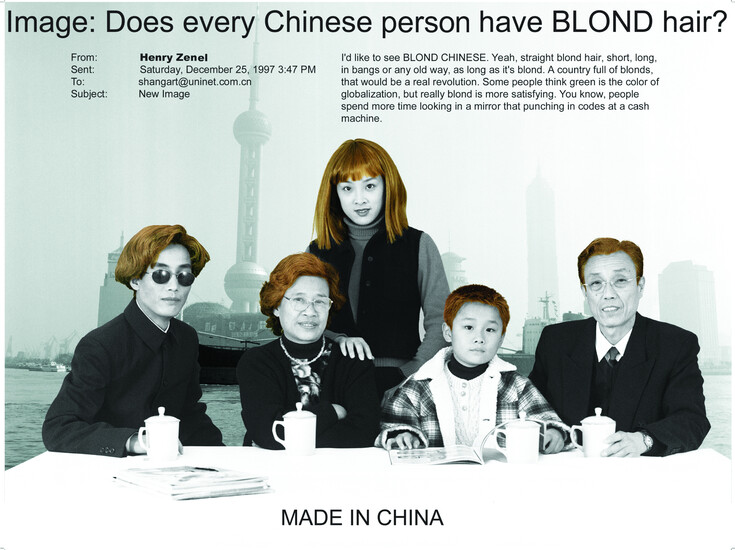
However, after doing post-visit research on these two artists, I really found Shi Yong's work to be striking, especially, the works from 2000 entitled "Yearning", which I speculate came as a result of his photo the previous year entitled "Does Every Chinese Person Have BLOND Hair?". The aforementioned work and the works in the "Yearning" collection are family portraits depicting a typical Chinese family (a set of grandparents, parents, and one child--a boy), however, despite this seeming ordinariness of it all, the family members all have headfuls of strawberry blonde hair. It echoes this perpetually recurring theme of how China looks towards the West: for industry, culture, and in the context of art (and the particular family in this piece), for aesthetics. The historical contexts of Western influences upon China have trickled down to the foundations of Chinese society: the family. Yong's comment upon Chinese families finds itself at an axis that is at the explicit convergence of Western influence upon China and the current trend towards globalization. However, underlying the creepily saccharine semblance of familial bliss comes a damnation upon the Western influences and the forces of globalization. What Yong seems to be arguing is that the picture is actually a facade where hopes and and ambitions are nothing more than an attempt to normalize everyone to a Western standard (in this case, the blonde hair as a standard of beauty).
Here is an outline of my process of trying to reach Xu Zhen/find out more about his work entitled "Impossible Is Nothing". In light of the insufficient source material on the piece, I attempted to create some discussion and awareness about the work only to find that it is incredibly difficult to do so.
Correspondence: An Attempt to Reach Xu Zhen by Normal Means (Email)
Below is my correspondence with Xu Zhen's assitant, Xiaomo, who rather unsuccessfully attempted to set up a meeting between Xu Zhen. I originally emailed a woman named Alexia (who we saw briefly during our visit to Bizart), but she referred me to Xiaomo. The beauty of email, super-fast communication!
From: xiaomo Subject: Date: November 28, 2008 11:17:16 AM GMT+08:00 To: alejandra
Thank you for your mail. Alexia forwarded it to me. This is Xuzhen's assistant Xiaomo.
Xuzhen really appreciates your attention to BizArt and his own work. He's looking forward to have a talk with you.
Could you please give me several days to arrange the meetting? Xuzhen may not be in office lately.
Or you could send me the questions you need to know for the research project, if possible.
best,
xiaomo
Over the next two weeks, I basically sent Xiaomo three pretty desperate emails. The downside to email? The uncertainty of it. I kept checking to make sure I had the right email address, my email account was configured correctly, etc. It was all correct, I was just being ignored (in his defense I'm sure Xiaomo had much more important things to do, but still. Frustrating!) He responded only a week ago, almost immediately after I emailed him for the third time, finally asking if I could just have him forward my questions to Xu Zhen, as it didn't seem likely that Xu Zhen was going to be able to pencil me in.
From: xiaomo Subject: Re: Date: December 11, 2008 2:42:50 PM GMT+08:00 To: alejandra
XuZhen would not be in ShangHai this weekend and may be back in the end of next week. He feels very sorry that could not have a face-to-face meet with you. It would be great if you two could talk by mail.
If you have prepared the questions, please let me know. I'll forward him ASAP.
For any question, do not hesitate to contact me
best,
xiaomo
I can't help but wonder if this squirly correspondence was the direct result of my inqiury to film my interview with Xu Zhen. Though I emphasized that it wasn't entirely necessary to my project (just desirable), I think that's what might have scared him away. I didn't think Xu Zhen would be camera shy.
Here is the list of questions I subsequently sent to Xiaomo, who hopefully forwarded them to Xu Zhen. Xu Zhen, if you are reading this, I eagerly await your reply.
1. Did you have any ethical concerns in the installation of your latest work, "Impossible is Nothing"? 2. What has been the public's perception and reception of the piece?
3. What was your goal in creating such a work?
4. Do you feel that the work has racial or political implications? If so, please elaborate on them.
5. What is it about Kevin Carter's photograph that inspired to you to recreate it in your installation (i.e, why was Carter's photograph a good vehicle to express your message)?
6. In your opinion, what would a viewer gain from seeing "Impossible is Nothing" rather than simply seeing Carter's photograph? Why did your intent call for the creation of an installation rather than a mere two dimensional photograph? What does the "performance" aspect of this work add to your message/the implications of the original photograph?
7. Please elaborate on the title of the work.
8. How did the child's mother react to your work? How was she compensated?
9. How does the nature of this piece challenge typical perceptions of the term "artist"? What I mean to say is that, you are not performing, and this is a recreation of another artist's photograph, so what about the piece leads it to be qualified as authored by Xu Zhen? (*here I am trying to considerately ask if he is really the creator of this work, even though he just brought someone else's work to life in an artistic space.)
10. What were your hopes for spectators' interactions with the child and the exhibition space in general?
11. How do you think this work might be differently received in the West as opposed to its reception in China? Do you have any plans to further exhibit it/recreate it?
Survey- An Attempt at Discourse on "Impossible is Nothing"
I wrote my friends/family a short explanation of what to do (read the article, look at the photos, answer some questions), and provided the following links.
Here is the survey. I attempted to get people from various backgrounds to answer, but only my friends with art backgrounds decided to participate. However, this was interesting in and of itself, because many of them have backgrounds in performance, theater, and film. Others were painters, or art history majors, or writers. Ironically, a few of my most outspoken critics of Impossible is Nothing were actually the actors, who were quick to differentiate Xu Zhen's piece from the employment of a child actor, who (they argued) is not being manipulated for the sake of a political or social statement. I don't necessarily agree with this, but I think the difference may be the business side of child acting (SAG requirements and all that) that would theoretically prevent any mistreatment on the part of the child, and ensure proper compensation for the role. I would be interested to know how much (or even how) the child and his mother were compensated. I also wonder how Xu Zhen convinced the mother that it was a good idea for her baby to sit in a barren room full of overzealous Chinese spectators for five hours a day (or was money enough?).
Impossible is Nothing: Art or Exploitation?
*1)
Do you have any art background? Interest, training, job experience, etc.
2)
If you answered Yes!, please elaborate:
3)
Are you....
*4)
Do you feel that you got a good understanding of this piece through the article and photos I provided? Please support your answer with a few statements (full sentences not neccessary!)
*5)
If you had been in Beijing at the time of this exhibition, knowing what you know now, would you have gone to see it? Why or why not?
*6)
Based on the photos/review, do you feel that the artist's treatment and use of the child was ethical? Why or why not?
*7)
Do you believe this exhibition is racially exploitative? Why or why not?
*8)
Did the techniques used in this exhibition justify its effect?
9)
Were you offended by this exhibition?
*10)
If you are interested in art, do you often use the internet as a source for information? If you are not interested in art, simply respond with NO.
*11)
If you answered YES to the previous question, do you feel that the internet is a reliable source of information on art? If you answered NO, just respond to this question with NO as well.
12)
Had you heard of Xu Zhen before reading about this exhibition?
*13)
How likely are you to research other works by Xu Zhen after reading about "Impossible is Nothing"?
14)
Is there anything else relevant you think I should know?
15)
If you would like to provide your name for my reference, please do so below.
For the question that asks if the person would go on to further research Xu Zhen's work, about 80% of those who answered said "Probably Not". No one said "Very Likely", a couple said "Possibly", and the second largest group said "Definitely Not". 95% of those who answered said they felt that the internet was a reliable tool for researching art, and almost as many felt that they got as good an understanding of "Impossible is Nothing" through the article (criticism) and photos I provided. Almost no one felt it was necessary to have seen the exhibition in real life, and even fewer would have gone even if they had had the chance.
This leads me to question the necessity of the recreation of Kevin Carter's famous photograph, and the importance of performance art in general. It reminds me of the whole mix up between Zhang Huan and the people who photographed his performances. Who is the actual author, Zhang Huan, or the photographers? This is more a question of message, however, as I am unsure why someone might need to actually go to the space to comprehend Xu Zhen's message. I think a lot of the benefit of having this as an installation was specifically for the Chinese audience, as I am unsure of how exposed they were to the original photograph by Carter. Most of the people I polled had seen the photograph and were aware of the controversy surrounding it. To a Chinese person unfamiliar with the photograph, however, it might not even be clear that this is a reference to another piece of art. If Xu Zhen were to exhibit this work in New York, for example, I am sure there would be issues of ownership immediately raised, as the average New York intellectual gallery-goer is almost certainly familiar with the photograph. However, here in China, Xu Zhen was sort of free from that whole issue of the piece. I'm sure that by the average Chinese person seen in the photographs that have surfaced of the exhibition, Xu Zhen was merely recreating a stereotypical African scene in a Chinese artistic context. I actually like the implications of this reading better than anything that would possibly come of the whole recreation of the photograph, the controversy surrounding Carter and his ethical responsibilities as an artist, etc. I think from the Chinese perspective, Xu Zhen is raising questions of Sino-African relations rather than merely referencing someone else's work. He is suggesting the lack of exposure on the part of the Chinese to African culture and society despite the recent influx of Chinese companies into poor African countries for cheap industrial labor. In this context, by point to an African baby in a simulated African setting in a gallery in Beijing, Xu Zhen also suggests this phenomenon of reverse colonialism as China begins to see Africa in a new light from its newly seized perspective of an up and coming superpower. Hopefully, the Chinese people who went to see the exhibition and sat there taking pictures of the poor child in hindsight realized how screwed up the whole situation was and were able to apply this perspective to larger issues of globalization and colonialism.
Other Sources: A Minimal Response from the Blogging Community
The following quote was blown up to full illegibility in my film:
"If Xu Zhen revels in scenes of self-ridicule and awkward, mixed messages, The Starving of Sudan is a new triumph in absurdity. Not only is the work conceptually undeveloped, Xu's failure to address China's current involvement with Sudan begs the question of whether he is even aware of the discussion surrounding China's role in Africa, especially Sudan. To what degree is this work a cognizant reference to the 'mediated fiction' of reportage on Africa in the heavily biased and censored Chinese news media? Xu Zhen will perhaps prove less able to handle the scrutiny of audiences in Beijing than his hired child actor will deal with this strange tableau that will haunt his childhood memories." -Lee Ambrozy ( the full review can be seen here: http://www.artreview.com/forum/topic/show?id=1474022%3ATopic%3A576706)
Amusingly, this review by Lee Ambrozy is reproduced by many sources, none of which actually comment on it so much as simply copy and paste it. There was only one response to his review on all the websites I saw it published on (the review with comment was found on artreview.com). You can see the comment if you follow the link.
The reviewer has his own blog, where he wrote his own review of "Impossible is Nothing", which is similar to Ambrozy's and my opinions as well. However, there are no comments on his blog either. These are the only non "official" reviews/criticisms of the work that I was able to find after hours of scouring the internet, and I contacted "Robin Peckham" through his blog to no avail. Thus, I am beginning to understand why there is little discourse on this work. I mean, there seem to be about three English-speaking, internet using, people (including myself) interested in this piece, and two of them didn't seem particularly interested in initiating discussion on it. This seems to suggest that maybe blogging isn't the best way to share opinions/ideas with the general public (as opposed to friends and family), because there is the issue of credibility (i.e I don't know anything about this person, why the heck should I listen to their opinion/even converse with them on any intellectual topic?) Also, I'm sure that if we were in New York and this work had been done by a famous American or European contemporary artist, there would be a lot of online discourse available on it, namely because its exposure to the public would be a lot greater. I couldn't find any "official" material on "Impossible is Nothing" in English or Chinese (for example newspaper or magazine listings). Most sites that even mentioned it only did so as a "save the date" kind of thing, as the City Weekend listing did, only outlining the exhibition's basics as well as time and date information. I guess I am just too used to being able to read an informed article written by an educated person about a gallery exhibition in the Times before actually going to see it. The presence of such a source won't necessarily decide whether or not this is art that I want to see, but it usually at least provides another perspective and some interesting information about the work that I would otherwise be without. It is also nice to be able to consider other such opinions post-viewing, as I am trying to grapple with the meaning or signifigance of the art that I have seen. However, I think this mindset and practice might be a little too Western for the budding Chinese art world and its participants.
Edit: I have just found a useless blog entry on Impossible Is Nothing, which as far as I can tell is simply a copy and pasted excerpt from an official text on the exhibition, not the writer's own opinion.
This doesn't even seem like a legitimate blog (if there is such a thing). However, I'm sure that anyone who googles "xu zhen" and stumbles upon this blog will find my ramblings' value equally questionable and incomprehensible as well....
Now there is nothing left to do but await Xu Zhen's responses, which will be interesting thanks to the (respectful) prodding nature of my inquiries. Until then...
Xu Zhen’s “Impossible is Nothing” exhibition at Long March Gallery in Beijing poses a fundamental moral dilemma. What are the ethics of turning a subject into an object? The Starving of Sudan consists of an artificial environment constructed to look like a barren African landscape. Inside of the environment, an African child is placed in the gallery space on a daily basis. The exhibition is intended to question degrees of observation in an image-mediated world. Is it somehow unethical to observe an African child in a gallery space while we are observing the same scene on the nightly news on television? In fact, the main difference between the two is that one is real life tragedy happening before the camera and the other is simulacra. Before we are to criticize the moral implications of Zhen’s piece, we must call into question how we already do turn subjects into objects in our daily life. The very act of photographing follows the same process, and in a world where photography has been engrained so deeply into our cultural psyche, it could be said that we turn ourselves into objects as a way of being. Zhen obviously intended to shock his audience, and that he did. But his very intention was to test the limits of boundaries and to call into question our own practices. Zhen asks: What is the difference between lived and observed reality? Perhaps the answer could be that there is no difference anymore.
Xu Zhen, the conceptual darling of the Shanghai art scene, has made a strong reputation for himself with his consist attempts to push artistic and socially acceptable boundaries. Now merely in his early thirties, Xu Zhen has had a full career of aggressive, ironic, and politically charged projects since he began a decade ago. Zhen is known for utilizing performance, photography, video, and installation to boldly confront issues. His intense social critique is often severely ironic to the point of disturbing. His new solo exhibition, Impossible Is Nothing, on display at the Long March space in Beijing begs the question to whether has he finally gone too far.
The show consists of two large installations. The first, titled Decoration presents a model of a space station, the length of the room, suspended from the ceiling in almost complete darkness. The only available light eminates from an opening at the front of the structure illuminating a small painted globe. Both this installation and his previous piece titled Just Did It, employ similar themes of contemporary space travel to analyze notions of lived versus perceived human history and the influence of media in our culture. The second installation, The Starving Of Sudan, further expands on this struggle between historical fact and mediated fiction, an idea which seems to dominate much of Zhen's work recent work. The room is an emmersive environment based on the famous and shocking image of a Sudanese toddler being prayed on by a vulture. The floor is covered with piles of straw baking under heating lamps, while a stuffed vulture perches in the center and a young (live) African boy in a diaper roams around the space. The central questions framing this piece are: how long can an individual live in observed isolation? And what is the difference between observed and lived reality? No doubt gripping themes, they are carelessly explored.
Being confrontational has long been a popular artistic device, Xu Zhen a prime example, but with broader success and popularity artists should maintain a certain amount of responsibility. The child was substantially rewarded for his involvement and one could consider it simply an acting job (this is the opinion of the boy's mother), but just because this has never been done before, does not mean it should. At this point in Zhen's career he has the ability to do almost anything he desires and acquire almost any resource he needs to accomplish it. What makes The Starving Of Sudan particularly curious is China's political involvement with the country of Sudan itself. In this light the piece seems under developed and its message unclear. Whether this dimension of the artwork was overlooked by the artist or he tried to take on too many issues simultaneously it comes off as hasty and tasteless. Xu Zhen is undoubtably one of the most interesting figures in the Chinese contemporary art world, but his artistic proliferation is going to damage his reputation if he does not stop to think and exercise some restraint before acting.
ShanghART Gallery is pleased to present hipic – an innovative online project devoted to a hybrid and elusive form of expression, and a platform for potential endless visual flow.
hipic operates as a globally synchronized image archive that receives, collects, and diffuses pictures via the internet to a variety of visual poles, including public screens and exhibitions, at a pace of one picture per minute. The project was initiated in Shanghai in late 2007 by a group of artists, including Yang Zhenzhong, Xu Zhen and Huang Kui, to create scenarios in which boundaries are deliberately suspended and confused.
Mixing the real with the fictional, the near with the far, and the past with the present, hipic plays simultaneously in galleries and public spaces displaying constant and fluctuating elements. hipic captures imaginations worldwide, in which certain features are highlighted and strengthened, while other details lose their reality and become abstracted.
With its infinite number of possibilities, hipic produces a screen of the mediated reality we live in, and exploits contemporary communication, information and virtual technologies. At the same time, it remains part of the connected and globalized world that it maps, but one that offers material to test the boundaries on liberties offered by art institutions and society.
hipic creates a temporary autonomous zone where relationships and interconnections are reset, before slipping into the system of meanings. The itinerant locations of the screens are reflective of the fluid channels through which information spreads, a dynamic contest of codification and neutralization, where what appears as the everyday conditions of technological mediation and consumption is at stake. Technology is a critical player in this process but its role is essentially that of catalyst and intermediary: hipic enables image exchange and experiences between unlikely groups or individuals.
In this we find the essence of hipic’s nomadic response to the borders between the spaces we occupy and the ideas that occupy us. In a time characterized by information broadcast and exchange, hipic raises the question of what is and isn’t part of the network. With globalization and the world wide web, which is a misnomer in itself, hipic seeks out the reality of this assumed mapping and reach. For the audience the effect never fails to be entertaining and revealing.
2007皮埃.埃尔创作奖提名展 2007 Pierre Huber Creation Prize Nominees Exhibition Opening: September 4th, 2007, Tuesday 18:30 Press Conference: September 4th, 2007, Tuesday 19:00 Exhibition dates: September 5th to 10th, 2007, from 11:00 to 18:00
Organizer: China Art Academy Co-organizer: New Media Art Department, China Art Academy Venue: BizArt Art Center Nominated artists: Dong Dayuan, Jiang Zhuyun, Lu Yang, Shi Chuan, Wang Xin, Ma Xiaoxiao, Sun Huiyuan, Xiao Yuankun
About Pierre Huber New Media Art Creation Prize and Fund
On September 7th, 2006, Mr. Pierre Huber met with the students of the New Media Art Deparment of the China Art Academy and inquired about the education situation. In view of stimulating New Media Art Creation, education and diffusion, as well as encouraging and supporting creative activities of the new media art students, Mr. Pierre Huber founded the "Pierre Huber" New Media Art Creation Prize and Fund.
The grant will finance a small management group in charge of supervising the use of the fund, and formulate a regulation system.
Part of the grant will fund the "Pierre Huber New Media Art Creation Prize" to support over the years the creativity of outstanding students. Three prizes will be awarded to the students. Fund will also be used to support students' creativity: students will directly submit their project which will be examinated and subsidized by the management group. At last, part of the grant will finance studies of prominent new media art students with family difficulties. Reward process will be composed of two phases: first, teachers will nominate skillful students, who will participate to an exhibition. The second phase will be the final selection by a jury made of renowned curators and artists. Jury will be composed of five members selected each year from a list, members will change from a year to another.
Jury members list: Beijing: Fei Dawei, Pili, Karen Smith, Wang Gongxin, Lu Jie Shanghai: Zhang Qing, Zhou Tiehai, Xu Zhen, Yang Zhenzhong, Lorenz Helbling, Chen Jieyang, Lin Shumin, Yang Fudong Guangzhou: Huang Zhuan Abroad: Hou Hanru (U.S.A., France, China), Hans Ulrich-Obrist (U.S.A., France), Barbara London (U.S.A.), Zheng Shengtian (Canada), Yves Aupetitallot (France), Zhang Ga (U.S.A., China).
韩国艺术家朴芝恩和中国艺术家李平虎的展览 Exhibition of Jee Eun Park (Korea) and Li Pinghu (China)
Opening: September 14th, 2007, Friday (18:30) Exhibition Dates: September 15th � September 28th, 2007 (11:00 � 18:00)
Exhibition of the artworks produced by Korean artist, Jee Eun Park, during her residency in BizArt and the works produced by Chinese artist, Li Pinghu, during his residency in Ssamzie Space, Seoul. The exhibition will be held in September in BizArt for one week.
10月October 2007 仔细想想,昨天你究竟干嘛去了? -- 施勇个展 Let's think, where have you been yesterday? --Shi Yong's solo exhibition
Opening: October 12nd, 2007, Friday (18:30) Exhibition Dates: October 13rd �October 22nd, 2007 (11:00 � 18:00)
往事 � 被遗忘的时光 6位印尼艺术家阐释的印尼历史, 1930-1960 The Past - The Forgotten Time Six Indonesian artists interpret Indonesian history, 1930 - 1960
Opening: October 25th, 2007, Thursday (18:30) Exhibition Dates: October 26th � November 11st, 2007 (11:00 � 18:00)
Introduction: This exhibition represents a variety of perspectives focusing on the struggle of "Becoming Indonesia" during the period between 1930 and 1960. Personal stories mixed with formal facts to indicate how the colonial situation became a major part in the attempt to formulate an Indonesian identity. Beginning with the visual forms produced by these artists, we learn to remember and reflect on the past and, together, oppose forgetting.
------------------------ From Propaganda to Profit June 2007
by Rebecca Catching and Anurag Viswanath
This spring at Moganshan Lu, Shanghai's main art district, Beijing Art Now Shanghai christened their gallery opening with a rather unconventional exhibition, "Shanghai Now." Viewers entered the cavernous warehouse and stared blankly at canvases sheathed in money. Gallery founders Huang Liaoyuan and Zhang Haoming had wrapped each painting in shiny wrapping paper printed with faces of various different currencies. In doing so, they sought to remind viewers to look beyond the commercial value of art and contemplate its intrinsic value.
Xu Beihong's 1939 work Put Down Your Whip sold at a recent auction in Hong Kong for a record $9.2 million.
It's a relevant point in the context of the Chinese art market, which some claim has begun to spin out of control. Last year, Sotheby's and Christie's sold $190 million worth of Asian contemporary art—most of it Chinese. Prices reached unprecedented heights, with 43-year-old artist Liu Xiaodong dropping canvases for a whopping $2.7 million, and Xu Beihong's The Slave and Lion smashing the record for a Chinese oil painting at $6.9 million.
Twenty years ago Chinese artists would have had trouble obtaining a passport, but now they are globetrotters. They have studios at home and abroad, showcase their art around the world, and are getting very rich in the process. Why this boom? According to Simon Groom, head of exhibitions at the Tate Liverpool, the Chinese art explosion "reflects the interest in China, driven by the growth of its economy, the emergence of Chinese collectors and an eagerness in the West for new speculative markets."
Tate Liverpool's current exhibition "The Real Thing: Contemporary Art from China" features 26 works by 18 leading Chinese artists, including Ai Weiwei, Gu Dexin, Zhou Tiehai and the Yangjiang group. The exhibit has been billed as the "show of the year" and is evidence of the growing influence of Chinese artists abroad. Indeed, many of China's most exciting artists are now based abroad—for example Xu Bing and Cai Guoqiang—which puts them in close proximity to their collectors, 90% of whom are foreign.
Yet mainland Chinese collectors are starting to get into the Chinese art game, too. Catering to their needs are hundreds of mainland galleries and auction houses which are springing up, as well as foreign institutions that are in the process of opening branches in China, such as the Centre Pompidou and the Guggenheim.
Auction houses, both foreign and local, have begun to deal directly with the top-tier Chinese artists, snatching up works while the paint is still wet, rather than going through collectors and galleries. Some artists have responded to the demand by using teams of assistants to churn out paintings. For example, Shanghai-based artist Zhang Huan employs close to 100 workers in a massive studio that would make Andy Warhol's factory look like a cottage industry.
A Long March
Under Mao, art was meant to "serve the people," i.e., workers, peasants and soldiers—social groups not known for their inclination toward the arts. And the bureaucratic controls designed to oversee Mao's utopian social-engineering projects quickly made art subservient to politics.
Artists were disseminators of propaganda, celebrating revolutionary zeal and socialist euphoria through patriotic paintings. Icons of this era include Dong Xiwen's oil The Founding of the Nation (1953), Jin Shangyi's painting Mao Zedong at the December Conference (1961), and Wu Hufan's Atom Bomb (1965), which marked China's coming of age as a nuclear power.
Woodblock prints and oils done in the Soviet socialist realism style featured square-jawed men leading China's industrialization, and robust women harvesting bumper crops of plump rockmelons, while folk paintings known as nianhua, or New Year's paintings, depicted bouncing baby boys riding atop golden fish adorned with communist slogans.
Under the oppressive Cultural Revolution, a new genre, a variation on socialist realism described as "red, bright and luminous" (hong, guang, liang), celebrated the accomplishments of the Cultural Revolution with the use of theatrical illumination and garish colors. The fall of the Gang of Four in 1976 brought new beginnings, as both artists and art schools were rehabilitated.
Deng Xiaoping's "opening and reform" in 1978 and the preoccupation of the state with economics allowed for expanded realm of individual freedom and space. The officially sponsored "New Spring" art exhibition in February 1979, followed by an exhibition by the Stars, paved the way for the rise of the Contemporaries, which included artists such as Wang Huaqing, Sun Weiman and Zhang Hongtu. The establishment of Fine Arts in China (Zhongguo Meishu Bao) in 1985, a Bejing-based weekly arts newspaper; the formalization of official channels for sale of art by the New York-based Hefner Gallery in 1987-89; and the Chinese Nude Oils exhibition in 1989 were important milestones which led to the culmination of what some consider the Tiananmen of the art world: the highly controversial, socially critical "China/Avant Garde" exhibition at the Chinese National Art Gallery in February 1989.
Following Tiananmen, the art scene limped back to normalcy after a brief hiatus. In the following decade, the first art galleries, such as Red Gate Gallery and Courtyard Gallery in Bejing, and Shanghart and Eastlink in Shanghai, began to pop up, with clients including influential foreign collectors such as Uli Sigg and Pierre Huber.
In the years that followed art was no longer used to further the aims of communism, rather communist imagery was used further the aims of individual artists who made a fortune off of genres such as political pop.
Artists such as Wang Guangyi and Xue Song, produced technicolor images of Mao and graphic paintings of workers. While cynical realists such as Liu Xiaodong, Yue Minjun and Zhang Xiaogang employed both hysterical and forlorn human figures in everyday scenes, giving visual expression to the moral vacuum left behind by communism.
Towards the late 90s, artists began really test the limits of their freedom with exhibitions such as the "Fuck Off" biennale satellite exhibition curated by Ai Weiwei at Eastlink in 2000, and Cang Xin's performance piece To Add One Meter to an Unknown Mountain, where he piled the summit of a mountain with the bodies of his friends—an oblique reference to the terror induced by the Cultural Revolution. Though artists experienced a palpable growth in artistic freedom through out the 90s and onwards, plainclothes spies from the cultural bureaus made their presence felt, asking to speak to artists, removing works, shutting down exhibitions and occasionally holding artists in prison.
In 2006, the Hei Shehui collective—literally "hey, society" and also a pun on the Chinese word for mafia—organized the controversial "38 Solo Exhibitions" in a former army barracks in Shanghai. The exhibition featured Jin Feng's provocative performance piece An Appeal Without Words, which comprised a group of actual peasants covered head to toe in a layer of gold paint, brandishing empty placards—a reference to their compromised status in appealing land disputes. Such incendiary work caused the show's closure and landed two of the artists in jail. New-art observer Geremie Barmé likens the situation to Miklos Haraszti's Velvet Prison. In such an environment, the majority of artists choose not to test the limits, and social critique often takes a back seat to profit.
In some ways, profit poses a more pernicious threat to creativity than government censorship, as galleries pressure artists to create works to feed the market. "Now that [the art world] has become commercialized, these commercial forces inform artists if something has commercial value," opines controversial conceptual artist Xu Zhen. Mr. Xu, who spends much of his time working at nonprofit experimental art center BizArt, pays little attention to the market. Rather he chooses to raise questions about transparency and China's growing military ambitions—filming videos of himself driving remote control tanks into China's neighboring countries and staging mockumentaries of engineers lopping off the top of Mount Everest.
While the success stories, such as Zhang Xiaogang and Yue Minjun, dominate the business pages of the Western press, many critics see them as examples of how Chinese art has failed to innovate. Outside of the works of a small group of exceptional conceptual artists, much of what lines gallery walls is uninspiring and derivative. Pia Camilla Copper, a Chinese contemporary art specialist at the Paris auction house Artcurial, says, "The painters, sculptors and conceptual artists from [China's top academies] are technically skilled, they only lack imagination. A sort of Turner Prize should be created for Chinese art to encourage young artists to break free from academic rules, the scourge of the Chinese art academy, and innovate."
At the same time, experimental art is stifled by the lack of institutional resources. Museums are underfunded, as are nonprofit art centers such as Shanghai's BizArt and Yunnan's Lijiang Studio. Serious art criticism is also compromised by corruption amongst journalists and critics who offer coverage and praise for a fee.
Ms. Catching is the arts and entertainment editor of that's Shanghai, and the Shanghai correspondent for Art Asia Pacific. Ms. Viswanath is a free-lance journalist based in Bangalore.
Ten years ago, Xu Zhen was the archetypal garret-dwelling artist, scraping a living in a Shanghai apartment with barely room to swing a cat. To prove the point, he found a cat and swung it. The artist claims that the animal was already dead when he made the 45-minute performance video, which shows feline entrails being spattered across the walls. But the piece established Zhen as the rising star of the new generation of Chinese artists whose work now features in The Real Thing, an exhibition at Tate Liverpool that is the most comprehensive show of contemporary Chinese art ever staged in this country.
The Liverpool show opens at the same time that a group of Young British Artists make their first appearance in China. Aftershock: Contemporary British Art 1990-2006 brings items such as Tracey Emin's bed and the Chapman Brothers' Stephen Hawking statue to the Capital Museum in Beijing. But while these pieces have a retrospective feel, China arguably has the most vital, imaginative and uncontainable art scene in the world today.
Xu Zhen and his peers represent a new wave of firebrands set to make the Tate Liverpool show go off, quite literally, with a bang. Tomorrow evening, the exhibition launches with an explosive piece by the Yangjiang Group entitled If I Knew the Danger Ahead I'd Have Stayed Well Clear. The work takes the form of a massive firework battle worth £50,000.
If the YBAs are set to be supplanted by YCAs in terms of talent and notoriety, Xu Zhen is arguably the Chinese Damien Hirst. In June 2006 he organised a warehouse show of 30 young artists in Shanghai, of which the centrepiece was a video of a panda being masturbated for artificial insemination. The show was forced to close on its opening night.
It is, however, now quite difficult to provoke the authorities into closing an exhibition, as the Chinese government seeks to co-opt contemporary art to advertise the productivity and tolerance of the new China. In 2006, the Shanghai Biennale became the first major state-sponsored exhibition of contemporary art - even the fringe show, entitled Fuck Off, was left to run unimpeded. The Beijing exhibition of Young British Artists is another example of this eagerness to embrace international influences.
The U-turn in the official attitude can be gauged by the fate of Beijing's avant-garde in the wake of the Tiananmen Square demonstrations in 1989, when Beijing's radical artists relocated to an area beyond the city's third ring road, known as the East Village. With no money or conventional outlets for their work, the artists began to conduct increasingly extreme experiments on themselves. One, Zang Huan, covered himself in fish paste and honey and sat for several hours in a public toilet in 100-degree heat. The piece - a comment on the fate of the poet Ai Qing, who was forced to clean toilets during the Cultural Revolution - provoked the police to raid the East Village and evict its inhabitants. In 2001, the area was bulldozed to make way for a public park.
A new artistic community sprang up in the north-east of the city at Dashanzi, centred on a former machine tool plant known as Factory 798. This time, the government sanctioned the area as a cultural quarter, opening up a flood of international investment. Today, Dashanzi is a hub of international galleries, plush apartments and restaurants, with few practising artists left.
The official acceptance of the avant garde is a paradox for Chinese artists. Beijing-based critic and curator Pi Li identifies the emergence of "a kind of official, harmless contemporary art" which leaves artists in danger of losing their identity. "Their position had been the underground. Now they are widely shown and can sell their work very successfully. This has not brought about a good situation for Chinese art; on the contrary, it made the art lose its energy."
Works by Chinese artists have recently changed hands for as much as $1.5m - the amount paid recently by Charles Saatchi for a painting by Zhang Xiaogang - but The Real Thing's curator, Simon Groom, hopes the exhibition will re-establish Chinese art's radical edge. He has taken the bold, possibly even foolhardy, step of inviting Xu Zhen to collaborate in the selection process. "Some of his initial suggestions were a little unworkable," Groom says. "He proposed that we kidnap a drunk, lock him in the gallery and witness his reactions when he wakes up." Zhen also suggested handing out knives to exhibition visitors. One piece that did make the display is the tip of Mount Everest, lopped off by the artist during an expedition to the mountain and mounted in a glass case.
The Liverpool show also features a mammoth engineering project by Ai Weiwei, now China's best-known artist. Ai Weiwei recently collaborated with architects Herzog and de Meuron on the innovative "bird's nest" design of Beijing's Olympic Stadium. For Liverpool, he has created a soaring, illuminated spiral floating outside the Tate in the Albert Dock. "It's the kind of piece that could only be realised in China, where material and labour costs are low," says Groom. "But you cannot underestimate the speed of change in China. Young Chinese artists are less interested in politics than their own dreams and desires. That has never happened in China before, where art had always been a response to the state."
Groom still doesn't know if Zhen plans to attend. "In some ways, I'm rather hoping he doesn't. He's more likely to show up in disguise, or try to sabotage the show in some way. He might even try to close it down." That could be seen as the ultimate irony - once, the Chinese authorities used to shut down exhibitions. These days, the artists do it themselves.
The Real Thing: Contemporary Art From China is at Tate Liverpool from Friday to June 10. Details: 0151-702 7400
Organizer: China Academy of Art, New Media Department Co-organizer: Shanghai BizArt Art Center Opening: December 15th, 2006, from 17:00 to 20:00
Curators: Geng Jianyi, Fan Li, Shen Ligong, Yang Zhenzhong, Xu Zhen Participating artists:
Chen Xiaoyun, Chu Yun, Cui Shaohan, Feng Chen, Fei Pingguo, Geng Jianyi, He An, Huang Kui, Jiang Zhuyun, Jin Feng, Jin Feng (lao), Kan Xuan, Li Wen, Liu Wei, Peng Yun, Shao Yi, Shen Ligong, Shi Qing, Shi Yong, Sun Huiyuan, Sun Xun, Wang Xiaofeng, Wang Xin, Wu Juehui, Xu Zhen, Yang Lu, Yang Qingqing, Yang Zhenzhong, Zhang Ding, Zhang Ruyu, Zhang Lehua, Zhang Liaoyuan, Zhang Moyi, Zhang Peili, Zhang Xutao, Zhang Qing, Zheng Guogu, Zhong Su, Zhu Yu, Zhu Yun
Venue opening hours: December 16th to 20th, 2006 Everyday from 10:00 a.m. to 17:00 Venue: Hu Qing Tang Museum of Traditional Chinese Medicine No. 95, Da Jin Xiang, Qing He Fang, West Lake District, Hangzhou, Zhejiang Province (Factory at the back of the group of ancient houses, at the feet of the mountain Wushan) Website: http://www.nma.com.cn/nqnp/
The idea of organizing the contemporary art exhibition, "It’s all right", was suddenly decided as we found the perfect exhibition venue: an old factory of the Hu Qing Yu Tang Museum of Traditional Chinese Medicine about to be demolished in the town center. The new media art department of the China Art Academy and BizArt Art Center took this decision in July and maintained the same dynamic attitude since then: from the concept of the show to its accomplishment, although the whole process lasted six months only. This wouldn’t have been possible without the efforts of each of the participants. The main problem the exhibition has to face now is the unforeseeable elements. The new media art department of the China Art Academy and BizArt Art Center always focused on each artist’s progression in the production of their works. Each show include some risks: it is sometime uncertain for the artists themselves to know what the last shape of their works will be as they enter the exhibition room. The artworks projects were severely selected on the basis of various criteria of quality: the selection was sometime cruel to the point that it nearly violated art rules. This constitutes a particular aspect of this exhibition that can be seen before its opening. Here again, each artist showed their understanding and their responsibility sense when collaborating. This conscientious attitude exceeded all our expectations. Until now, the exhibition’s process and preparation was fully synchronized, which reveals the efforts of each of its participant.
Published: September 12 2006 03:00 | Last updated: September 12 2006 03:00
Travel to Shanghai for its biennale, and you may find more shows than you had bargained for. As well as Hyper Design, the city's sixth biennale, housed in the Shanghai Art Museum, there are a host of other group exhibitions - some calling themselves "biennales" too - to investigate: Crossovers: Beyond Art and Design at the Contrasts Gallery; Entry Gate: Chinese Aesthetics of Heterogeneity at the Museum of Contemporary Art; the Second Shanghai Duolun Exhibition of Young Artists at the Duolon Museum of Modern Art; and another show organised by young artists that calls itself "the alternative biennale".
The number of satellite biennale platforms is as hard to ignore as the dearth of debate about their content. Instead of discussions about what these artists and curators have produced, many of the conversations taking place around these shows are focused on questions of monetary value.
ADVERTISEMENT
The market for Chinese art continues to soar. But commercial value alone is no proof of a work's intellectual worth; indeed, if its intellectual worth remains suspect, its long-term market value will be shaky. Remarkably, I have noticed only a few jabs at globalisation or consumer culture; there seems instead to be a wholly unironic celebration of capitalism's possibilities.
Another noticeable feature is the absence of politically charged art. Unlike the 1990s, there are few references to Mao Zedong or Tiananmen Square. What a New York Times article of March 2006 called "a quiet but forceful cultural revolution" now looks like an all-out rejection of any polical concerns among those exhibiting this season in Shanghai. For it is not merely, as the NYT noted, that "such artists operate without government interference." Rather, it is that - as the video artist Xu Zhen has put it - "now the Chinese government is more conceptual and forward-thinking than the artists".
Interestingly, some have returned to analyses of ancient Chinese traditions to make sense of new trends. For these observers, it is the history of centuries rather than of decades that provides an illustrative foil for these exhibitions. The catalogue essay for the Crossovers show by Li Xu, the former director of the Shanghai Museum, explains this comparative approach, and it is an explanation that applies equally well to MoCA's Entry Gate and to several of the works in Hyper Design. In earlier centuries, when referring to the concept of "art", the Chinese thought of ji shu, meaning craftsmanship, and xue shu, meaning knowledge. For items as diverse as teapots, gardens, calligraphy and poetry, there was no segregation of art and design. The wen ren or artist scholar was valuable because his creativity and skill implied spiritual and intellectual worth. Yet today a Chinese artist's social worth may too often be based on his market value.
Perhaps neither a lack of political content nor an emphasis on market value should be decisive factors in evaluating a contemporary art show's worth. But if Hyper Design is anything to go by, it is clear that the conceptual has been almost entirely taken over by the commercial in China.
But what of the exhibition's subtitle, The Practice of Everyday Life? Certainly, the Dutch artist and designer Atelier von Lieshout's free-standing desk/bed unit and the Chinese artist Liu Jianhua's "Dream Installation" - a shipping container overflowing with cheap plastic utensils - both involve considerations of work and the economy. So too does the impressive installation by Lee Kyung-Ho from South Korea, a landscape surrounded by video projections of more than 20 remote-control toy trucks at work in the space. These playtime work vehicles were imported to and sold on the street in Seoul, and, as'the artist explains, he "has brought them back home to work".
Another striking work-about-work is Zhou Wu's "Tribute to Handicrafts", an installation of white glazed ceramic tools that look like mummified antiques leaning against the wall. However, any implied concern with productivity is lessened by the juxtapositioning of Maurizio Mochetti's sleek hybrid model aircraft/human/penguin sculptures. The uncanny combinations in this Italian artist's squat, immobile gnomes are certainly preferable to another series of hybrid constructions by Daniel Lee, who uses Photoshop to combine human portraits with animal features, resulting in disturbing digital paintings. The most impressive digitised works based on photographs of people are by Julian Opie, who reduces the human figure to its most essential form and yet - despite the barest detail - renders the most dynamic movements. Opie's LED boxes are scattered throughout the exhibition.
Work by several artists such as Ceal Floyer, Kristian Ryokan and Nara Yashitomo are similarly dispersed. Floyer has two distinct wall works on different levels of the museum - one covering the wall's entire surface in diagonal strips of yellow and black adhesive tape, the other a discreet ready-made entitled "Spirit Level". Ryokan's flatly rendered oil paintings of everyday objects - a book spine, two-wheeled vehicles, modernist chairs - stylistically border on both photorealism and cartoonism. Often placed in rooms dominated by other artists, these pieces seems to question the supposedly therapeutic function of desire. They certainly challenge Yashitomo's doll-like children and animal made-for-museum-store products, pieces that nurture a compulsion to consume art objects not ideas.
Despite my attempts to consider these biennale exhibitions in terms of international contemporary art trends, the reality of sales almost always prevailed. Some of this is related to the spectacular performance of China's economy in recent years. As I was informed by a Hong Kong-born Stanford University MBA student, "a rise in the GDP of a specific culture does indeed mean an increase in the sale of that culture's art". While this assessment may become (or may already be) a reality for China and its art, my sense is that a culture of for-the-market art is not a good fit with art history's standards of measurement.
'Hyper Design' is at the Shanghai Art Museum until November 5. Tel +86 21 6327 2829