Alright so after taking a look at what people had posted here before going at this myself - I came across a lot of thoughts that threw some basic questions at me that I'll go on to respond to here.
To begin, I'm going to talk about some foundational questions that would apply to art and museums anywhere. The first real important question isn't even what should a museum do but whether a museum is a good place for art to be exhibited. This is something that Helena talks about, which is one of those foundational things that I just assumed and hadn't really thought about questioning. I happen to agree that art is in its most "pure" form when it is out in the "wild" so to say. If art can touch you in a very powerful way, when you're in your daily life - I think that shows just how great the art is. Also museums are restricting in many ways, besides sometimes cost, it is always in one location and people have to go out of their way to view this art and when they do so - I think people have a different mind set then they would if they simply had come across that art. At least I know that for myself, engaging with art in a museum drastically changes how I interact with it and how I think about it. This can both be a good thing and a bad thing.
Does that mean we should not have museums because they are not the best portrayal of art possible? Certainly not, museums can go on to serve a valuable purpose. I think that museums should try to exhibit art with a low barrier to entry, so most anyone in the public can view it (for that, location and cost come into play) - although I think that museums can also have a very important role in bringing about thoughtful discussion about the arts and many other subjects as well and they should try to do this, as the Zendai museum did when we attended its exhibition and workshop. I will disagree with Yvon though, she said that "I think that we need more art museums in Shanghai, bigger and multifunctional.", Its probably not what you meant - but this sounds like throwing quantity over quality. If it's not what you meant, that's okay :P - I'll just use it as a stepping stone anyway. I certainly think that multifunction is a great thing, as is having a lot of space to show art - but I think that a smaller museum can also be much more productive than something like the Shanghai Art Museum simply by toning its catalogue properly and working with its space correctly. For example, I think the 140sqm exhibition area is great - the location is great for a lot of people, it's not exactly large - but I think that it can exhibit art quite well.
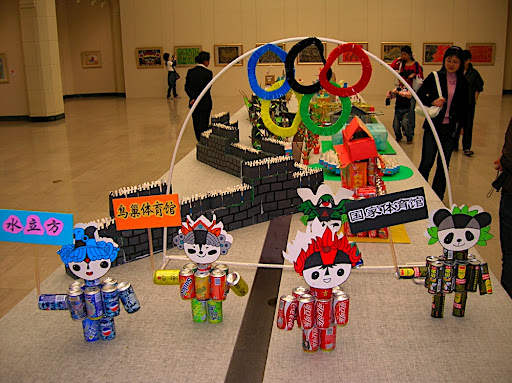
Going back to the point of what museums should be doing but here I'll relate to the Shanghai museum. I think that you can see that the Shanghai's Art Museum is to say "Art Museum" in the title of the building, and a public face for China to be like - "hey! We have art! See, we have a museum that's all nice and such!" Other than that though, it doesn't really follow through with what I would call the mission or mantra of being a museum. If it looks like a museum, is called a museum and show cases "art" it must be a museum - right? Well not so much. The first floor was neat and I'm glad to see them showing off a childrens exhibition and it makes me wonder whether the school had to pay for the space or whether it was given to them. That part was neat and I don't mind that at all. But the upper level where you can see advertisements by Volkswagen among other things, including photoshopped pictures of the sky above Pudong. The whole area didn't have a real feel too it, there was no overall coherance and you could certainly tell that it was simply a hodgepodge of whomever had paid for space on the wall. Don't get me wrong, some of the pictures were cool and pretty well done, but overall it didn't accomplish the goal of what I think a museum should do. However, it did seem to attract the locals - which is a very major plus for any museum. Perhaps, if they were to open up a dialogue and have people talk about why they thought this type of stuff is art, and what it brings to society - and were still able to get the local people to come, I would then call it a museum.
MOCA however is a very interesting place, they had a show about Ferragamo shoes going on which was sponsored by the Ferragamo company. I think that it's alright if a museum has to mix between sponsored shows and regular exhibitions. I do agree (I can't remember who said it) that the entrance room was the best room in the show and the rest was just so so - if they can work to improve the sponsored shows and also have their own great shows then I think it could be a great place. I really like what they are trying to do with the restaurant area and think that would also be extremely cool and a great place to dialogue and discussion to come around in a normal context without making it seem like your going to a museum. "Normalizing" art is a very important thing I think - the more we make it less of an elitist thing to do and more something that people can do while attending other things is key. Breaking down such barriers is great and I think goes with what art should be there for.
Now I've gone on a bit too much but there's so much go to with here - I'll quickly finish by sayying that I think that the Zendai was great and it was intersting to have dialogue and discourse about the possiblities for art. Reading what Sophie says though about none of her friends really knowing about the place makes me realize how difficult it is to balance between getting the locals (Shanghai Art Museum), bringing the educational and intelligent discourse aspect (Zendai) and the contemporary (MOCA) parts of art. All of the museums do serve a positive function to promoting art and for that they are all good - however without visiting all of them you miss out on vital parts of the art experience, perhaps we should be evaluating these museums as part of a whole of Art in Shanghai and not independently.
Showing posts with label zendai museum. Show all posts
Showing posts with label zendai museum. Show all posts
Thursday, May 01, 2008


Wednesday, April 30, 2008
Museum Photos
So since I didn't have internet to post these earlier this week, here are a few of the photos I took from MOCA, SAM and Zendai (I tried not to repeat ones people had already posted) - you can see the others here.
(taken at MOCA - Ferragamo's exhibit)


(taken at the Shanghai Art Museum - children's exhibition)
(taken at the Shanghai Art Museum - second floor)

(taken at the Zendai Museum)
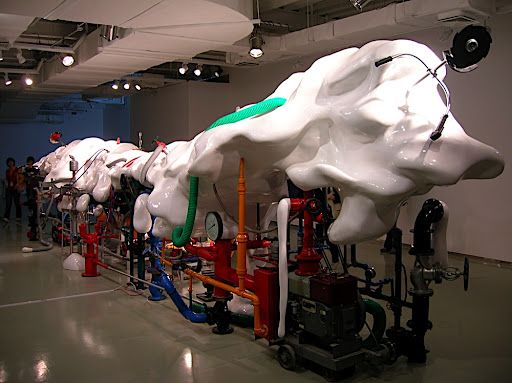
(taken at MOCA - Ferragamo's exhibit)
(taken at the Shanghai Art Museum - children's exhibition)
(taken at the Shanghai Art Museum - second floor)
(taken at the Zendai Museum)
Some of My Thoughts on Museums
In terms of the main functions of museums, I think that a museum should be a place in the service of society and of its development; it should open to the public, which conserves, researches, communicates and exhibits, for purpose of study, education and enjoyment. Museums exhibit to provide the objects and information necessary for visitors to learn and also enable them to have an enjoyable experience.
In the early period of its development, museums focused on researches, collection and exhibits, but museums are now experiencing the transition from traditional function to social function, and the idea of museums should serve the society is strengthened. Because of the museum’s unique cultural value, abundant educational and cultural information and special education method, museums take the mission to spread scientific knowledge, patriotism education, and aesthetic education.
Museums can be considered as complementary classrooms for students, meanwhile, they also offer opportunities for people from all walks of life to expand their scope of knowledge.
Education and entertainment can be combined together to enable visitors to attain the satisfaction of cultural life. The educating means can be diversified, varying from all kinds of exhibitions to performances, lectures and academic forums.
Last week we visited MOCA, Shanghai Art Museum and Zendai Museum of Modern Art. Generally speaking, the state-owned museums are bigger than privately-owned ones. Both of them hold forums and lectures, but I think that state-owned museums enjoy some advantages. For example, the latest information of the coming show can be publicized through mass media such as TV and radio, but we seldomly hear about exhibitions in privately-owned ones. Before I took this class, I knew little about private-owned museums in Shanghai. I asked some of my Shanghainese classmates about Zendai Museum, but none of them was familiar with it, so I think there are still a lot to do to expand the public participation.
As the first non-profit, independently-operated contemporary art institution in Shanghai, MOCA is devoted to the promotion of Chinese and international contemporary art. It aims to bring to China high quality international contemporary art and design and to collect and research on Chinese contemporary art and design. Evolving Legend, the Ferragamo show inspires visitors’ creativity by showcasing the innovative materials, creative use of color and fine craftsmanship that make each Ferragamo product a work of art, those elements can also be borrowed into the creation of contemporary art. This reminds me of one of the functions of museums, that is to inspire creativity and contribute to the support of creative industries.
Art is not only an important component of our society and life and an important means of intercultural communication, but also a way of learning and understanding the world around us. Museums are not only the places to display antiques, they should also be able to reflect modernity in China. As one of the most dynamic metropolis in the world, Shanghai has undergone significant changes in recent years. Cultural prosperity has offered museums in Shanghai the opportunity of development and transformation.
In Shanghai Art Museum, I saw the photograph exhibition which shows the current development of Shanghai. Also, Shanghai Biennale takes the city itself and its urban conditions as a starting point for its artistic exploration. The forum in Zendai Art Museum focusing on the current and future directions possible for China’s culture deals with a wide range of issues all pertinent to a broad understanding of Chinese cultural development. Through discussing some main issues about future development of contemporary art, and the role of art in culture, we are able to place China’s cultural progress in the context of its reemergence into the world. Wang Jianwei’s Hostage reminds me that in such a society with rapid scientific development, people are enjoying the comforts brought by material life, however, we are gradually falling into victims of material life even if we haven’t realized that. Although it is strange-looking, the installation art inspires visitors to rethink on current living state. So, art is a reflection of the outside world, a reflection of the globalized reordering of the city.
In February2008, the national department of cultural antiques announced that some of the museums should open to public free of charge. This will create more opportunities for people to go to museums to experience the spiritual education, especially young people. Without any entry fees, museums can be less of corporate spaces, however, it is not impossible to open all the museums to public free. Museums should charge fees according to the quality and standards of the exhibition on display so as to protect the exhibits.
Today, there are millions of bloggers, in order to make better use of the internet, museums representing arts and culture in China can also use blog as a tool. Pictures and videos of some exhibitions that were no longer on display can be put on the blog so that people can review those exhibitions at any time. People can also make any comments on the blog. In this way, blogs can become internet-based virtual museums.
In terms of future development of museums, I think more forums and lectures should be held for visitors of all levels, more opportunities can be offered for art audience to have face-to face conversations with artists.
Museums in Shanghai should open a window for audience, both from home and abroad, to experience the tremendous changes Shanghai is undergoing, and inspire people to think what we everyone can do to further the development of this city.
In the early period of its development, museums focused on researches, collection and exhibits, but museums are now experiencing the transition from traditional function to social function, and the idea of museums should serve the society is strengthened. Because of the museum’s unique cultural value, abundant educational and cultural information and special education method, museums take the mission to spread scientific knowledge, patriotism education, and aesthetic education.
Museums can be considered as complementary classrooms for students, meanwhile, they also offer opportunities for people from all walks of life to expand their scope of knowledge.
Education and entertainment can be combined together to enable visitors to attain the satisfaction of cultural life. The educating means can be diversified, varying from all kinds of exhibitions to performances, lectures and academic forums.
Last week we visited MOCA, Shanghai Art Museum and Zendai Museum of Modern Art. Generally speaking, the state-owned museums are bigger than privately-owned ones. Both of them hold forums and lectures, but I think that state-owned museums enjoy some advantages. For example, the latest information of the coming show can be publicized through mass media such as TV and radio, but we seldomly hear about exhibitions in privately-owned ones. Before I took this class, I knew little about private-owned museums in Shanghai. I asked some of my Shanghainese classmates about Zendai Museum, but none of them was familiar with it, so I think there are still a lot to do to expand the public participation.
As the first non-profit, independently-operated contemporary art institution in Shanghai, MOCA is devoted to the promotion of Chinese and international contemporary art. It aims to bring to China high quality international contemporary art and design and to collect and research on Chinese contemporary art and design. Evolving Legend, the Ferragamo show inspires visitors’ creativity by showcasing the innovative materials, creative use of color and fine craftsmanship that make each Ferragamo product a work of art, those elements can also be borrowed into the creation of contemporary art. This reminds me of one of the functions of museums, that is to inspire creativity and contribute to the support of creative industries.
Art is not only an important component of our society and life and an important means of intercultural communication, but also a way of learning and understanding the world around us. Museums are not only the places to display antiques, they should also be able to reflect modernity in China. As one of the most dynamic metropolis in the world, Shanghai has undergone significant changes in recent years. Cultural prosperity has offered museums in Shanghai the opportunity of development and transformation.
In Shanghai Art Museum, I saw the photograph exhibition which shows the current development of Shanghai. Also, Shanghai Biennale takes the city itself and its urban conditions as a starting point for its artistic exploration. The forum in Zendai Art Museum focusing on the current and future directions possible for China’s culture deals with a wide range of issues all pertinent to a broad understanding of Chinese cultural development. Through discussing some main issues about future development of contemporary art, and the role of art in culture, we are able to place China’s cultural progress in the context of its reemergence into the world. Wang Jianwei’s Hostage reminds me that in such a society with rapid scientific development, people are enjoying the comforts brought by material life, however, we are gradually falling into victims of material life even if we haven’t realized that. Although it is strange-looking, the installation art inspires visitors to rethink on current living state. So, art is a reflection of the outside world, a reflection of the globalized reordering of the city.
In February2008, the national department of cultural antiques announced that some of the museums should open to public free of charge. This will create more opportunities for people to go to museums to experience the spiritual education, especially young people. Without any entry fees, museums can be less of corporate spaces, however, it is not impossible to open all the museums to public free. Museums should charge fees according to the quality and standards of the exhibition on display so as to protect the exhibits.
Today, there are millions of bloggers, in order to make better use of the internet, museums representing arts and culture in China can also use blog as a tool. Pictures and videos of some exhibitions that were no longer on display can be put on the blog so that people can review those exhibitions at any time. People can also make any comments on the blog. In this way, blogs can become internet-based virtual museums.
In terms of future development of museums, I think more forums and lectures should be held for visitors of all levels, more opportunities can be offered for art audience to have face-to face conversations with artists.
Museums in Shanghai should open a window for audience, both from home and abroad, to experience the tremendous changes Shanghai is undergoing, and inspire people to think what we everyone can do to further the development of this city.
Sunday, April 20, 2008


Friday, April 18, 2008
A Cultural Forum around Hostage
A Cultural Forum around Hostage:Wang Jianwei Solo Exhibition
Hostage is the grey area among science, history, society and hypothesis and a kind of imaginary relationship between potential knowledge and certain reality. Individual can be regarded as the hostage of history and knowledge, hijacked by the present and the future. Wang Jianwei continues his themes of placing people or object out of contexts.
Forum:What is possible?
A Forum examining the current and future directions possible for China's culture.
Presented by: Shanghai Zendai Museum of Modern Art
Venue of the Forum: Zendai MoMA Shanghai
Art Classroom, Second Floor, No. 28, Lane 199 Fangdian Road, Shanghai, China
Date of the Forum: 20 April,2008,10:00—18:00
Convener: Binghui Huangfu, Deputy Director of Zendai MoMA
This Forum will address a set of cultural and social issues by refocusing art theory and cultural theory upon a set of much broader philosophical questions concerning the role of art in culture. Its methodological innovation lies in its detailed focus on the processes of visual art as defined and developed within a network of (social and disciplinary) relationships and in its use of empirically grounded action-based research. The Forum enables us to examine the way in which art constructs relationships in a number of different registers (cultural, community and disciplinary).
Speakers: Dai Zhikang, Chairman and CEO, Zendai Group
Shen Qibin, Director of Shanghai Zendai MoMA
Marianne Brouwer, Curator from Holland
Andreas SchmidA Gift from Beijing to İstanbul
, Artist/Curator
Jérome Sans, Director of UCCA
Huang zhuan, Director of OCT
Shi Jian, Isreading Culture
Wang Hui, Researcher of Chinese Academy of Social Sciences
Geremie R. Barme, Australian Academy of Humanity
Wang Min'an, Philosopher/Critic
Jonathan, Scholar
Gary Carsley, curater
Hostage is the grey area among science, history, society and hypothesis and a kind of imaginary relationship between potential knowledge and certain reality. Individual can be regarded as the hostage of history and knowledge, hijacked by the present and the future. Wang Jianwei continues his themes of placing people or object out of contexts.
Forum:What is possible?
A Forum examining the current and future directions possible for China's culture.
Presented by: Shanghai Zendai Museum of Modern Art
Venue of the Forum: Zendai MoMA Shanghai
Art Classroom, Second Floor, No. 28, Lane 199 Fangdian Road, Shanghai, China
Date of the Forum: 20 April,2008,10:00—18:00
Convener: Binghui Huangfu, Deputy Director of Zendai MoMA
This Forum will address a set of cultural and social issues by refocusing art theory and cultural theory upon a set of much broader philosophical questions concerning the role of art in culture. Its methodological innovation lies in its detailed focus on the processes of visual art as defined and developed within a network of (social and disciplinary) relationships and in its use of empirically grounded action-based research. The Forum enables us to examine the way in which art constructs relationships in a number of different registers (cultural, community and disciplinary).
Speakers: Dai Zhikang, Chairman and CEO, Zendai Group
Shen Qibin, Director of Shanghai Zendai MoMA
Marianne Brouwer, Curator from Holland
Andreas SchmidA Gift from Beijing to İstanbul
, Artist/Curator
Jérome Sans, Director of UCCA
Huang zhuan, Director of OCT
Shi Jian, Isreading Culture
Wang Hui, Researcher of Chinese Academy of Social Sciences
Geremie R. Barme, Australian Academy of Humanity
Wang Min'an, Philosopher/Critic
Jonathan, Scholar
Gary Carsley, curater
Wednesday, January 30, 2008
Art is popping up all over town, says the article. Himm...
http://www.china.org.cn/english/culture/241338.htm
Many people find that art is distant and irrelevant to their daily lives. So every single day this year, a people-friendly art and cultural event will pop up somewhere in the city.
The Chinese contemporary art market booms, but art is still far away from most people's daily lives. This is where "Intrude: Art and Life 366" comes in, or intrudes: 366 days of this leap year and often right in front of you.
You will see surprising events. An ordinary house is turned into a museum one day a month; doves connected with strings are tossed into the air; a pretty dress will be hung on every tree on a certain street.
One the one hand, some artists believe that art is loftier than life, rather than springing from life. Their works are often considered irrelevant to daily life and not worth understanding.
And it is still uncommon to see art events in public venues other than galleries or museums. Most galleries care more about professional art buyers or agents, and museums open their doors to the public while keeping them at homage-paying distance.
On the other hand, the public is not very interested in contemporary art either, unless it's related to entertainment industry or celebrities.
Many artists are grappling with this problem. Some have merged all kinds of daily essentials like clothes, cosmetics, snacks, or dishes into artistic creations. Open studios in art centers like Moganshan Road in Shanghai or 798 in Beijing have also attracted crowds.
Enter "Intrude." Organized by the Shanghai Zendai Museum of Modern Art, MoMA, it began January 1 and will last through December 31-with an event every day in every creative field.
Throughout the year, 366 cultural events will be presented in public and private venues likes parks, gardens, squares, shopping areas, ordinary homes and other sites. Around 100 Chinese and 266 international artists will take part in exhibitions, site-specific installations, performances, concerts, film screenings, debates, and other events.
"The project aims to intervene in people's daily life, draw their attention to art happenings and stimulate the public debate on art," says Shen Qibin, director of MoMA.
"To intrude in culture is to infiltrate and influence the daily scenes or situations within a certain time and place. We hope to narrow the gap between culture and everyday life, making art more accessible to a broader public."
In order to narrow the gap, the art group Utopia merges public and private space and created the ninth and ongoing event of the project on January 9-"Family Art Museum." It will take place every month in 12 private homes.
The group found ordinary citizens who were interested in art and willing to open their homes for one day. Then Utopia turned it into an art museum to display art works from Utopia.
The group uses all existing facilities and spaces like television, computers, balconies, kitchens and bathrooms to accommodate the art.
While Utopia takes art to the public, others like American artist and art writer Mathieu Borysevicz try to turn the public into art.
Borysevicz's project began on January 17. He takes photos of the workers in a construction site in Shanghai every day and will use the photos to decorate the wall of the construction site, usually covered with advertisements.
Moreover, Borysevicz will also lend digital cameras to some workers so they can record their work and life. The workers' photos will be compiled into a journal.
And to Chinese artist Wu Junyong, the Internet is a faster and more convenient way to reach the public.
For his project "Dictionary of Slams," Wu collects frequently used slams online and selects the most interesting to interpret visually.
At the end of the year, Wu plans to compile a dictionary to upload online.
In February, artistic intruders include Australian artist Annabelle Collett who will hang a dress she made on every tree of a selected street. Chinese artist Ye Nan will release 500 pigeons on a selected plaza. All the birds will be connected to each other by threads to create a large image through their movements. All these art events will be methodically archived and will be presented later as international touring exhibitions. Catalogues will be published regularly on the projects and their issues.
Intrude: Art and Life 366:
Date: through December 31
Tel: 8621-5033-9801
(Shanghai Daily January 30, 2008)
Many people find that art is distant and irrelevant to their daily lives. So every single day this year, a people-friendly art and cultural event will pop up somewhere in the city.
The Chinese contemporary art market booms, but art is still far away from most people's daily lives. This is where "Intrude: Art and Life 366" comes in, or intrudes: 366 days of this leap year and often right in front of you.
You will see surprising events. An ordinary house is turned into a museum one day a month; doves connected with strings are tossed into the air; a pretty dress will be hung on every tree on a certain street.
One the one hand, some artists believe that art is loftier than life, rather than springing from life. Their works are often considered irrelevant to daily life and not worth understanding.
And it is still uncommon to see art events in public venues other than galleries or museums. Most galleries care more about professional art buyers or agents, and museums open their doors to the public while keeping them at homage-paying distance.
On the other hand, the public is not very interested in contemporary art either, unless it's related to entertainment industry or celebrities.
Many artists are grappling with this problem. Some have merged all kinds of daily essentials like clothes, cosmetics, snacks, or dishes into artistic creations. Open studios in art centers like Moganshan Road in Shanghai or 798 in Beijing have also attracted crowds.
Enter "Intrude." Organized by the Shanghai Zendai Museum of Modern Art, MoMA, it began January 1 and will last through December 31-with an event every day in every creative field.
Throughout the year, 366 cultural events will be presented in public and private venues likes parks, gardens, squares, shopping areas, ordinary homes and other sites. Around 100 Chinese and 266 international artists will take part in exhibitions, site-specific installations, performances, concerts, film screenings, debates, and other events.
"The project aims to intervene in people's daily life, draw their attention to art happenings and stimulate the public debate on art," says Shen Qibin, director of MoMA.
"To intrude in culture is to infiltrate and influence the daily scenes or situations within a certain time and place. We hope to narrow the gap between culture and everyday life, making art more accessible to a broader public."
In order to narrow the gap, the art group Utopia merges public and private space and created the ninth and ongoing event of the project on January 9-"Family Art Museum." It will take place every month in 12 private homes.
The group found ordinary citizens who were interested in art and willing to open their homes for one day. Then Utopia turned it into an art museum to display art works from Utopia.
The group uses all existing facilities and spaces like television, computers, balconies, kitchens and bathrooms to accommodate the art.
While Utopia takes art to the public, others like American artist and art writer Mathieu Borysevicz try to turn the public into art.
Borysevicz's project began on January 17. He takes photos of the workers in a construction site in Shanghai every day and will use the photos to decorate the wall of the construction site, usually covered with advertisements.
Moreover, Borysevicz will also lend digital cameras to some workers so they can record their work and life. The workers' photos will be compiled into a journal.
And to Chinese artist Wu Junyong, the Internet is a faster and more convenient way to reach the public.
For his project "Dictionary of Slams," Wu collects frequently used slams online and selects the most interesting to interpret visually.
At the end of the year, Wu plans to compile a dictionary to upload online.
In February, artistic intruders include Australian artist Annabelle Collett who will hang a dress she made on every tree of a selected street. Chinese artist Ye Nan will release 500 pigeons on a selected plaza. All the birds will be connected to each other by threads to create a large image through their movements. All these art events will be methodically archived and will be presented later as international touring exhibitions. Catalogues will be published regularly on the projects and their issues.
Intrude: Art and Life 366:
Date: through December 31
Tel: 8621-5033-9801
(Shanghai Daily January 30, 2008)
Wednesday, December 12, 2007
Shanghai this month
Artists: Ma Lina, Li Wei, Zhang Shanshan
Curator: Ding Yi
Academic Director: Zhao Li
Exhibition Period: Nov 30- December 30, 2007
Venue: South ShanXi Road,Shanghai
Thanks!
Cetus Gallery
Address: No.165 South Shanxi Road, Shanghai, China
Tel: 86-021-54653655
Fax: 86-021-54650675
www.cetusgallery.com
Curator: Ding Yi
Academic Director: Zhao Li
Exhibition Period: Nov 30- December 30, 2007
Venue: South ShanXi Road,Shanghai
Thanks!
Cetus Gallery
Address: No.165 South Shanxi Road, Shanghai, China
Tel: 86-021-54653655
Fax: 86-021-54650675
www.cetusgallery.com
---------------------------
Zhang Xian
As the director of the Downstream Garage (Xiahe Micang), which hosts
the annual Ideas Festival and the Downstream Garage Fringe Festival,
Zhang Xian is a key actor in the development of Shanghai's independent
theater scene. Zhang has received several fellowships abroad and has
sat on the judge's panel of the Zurich Festival and Cairo International
Experimental Arts Festival. He's worked as a director and a playwright
in the fields of dance, drama and film and has written and directed 19
works which have been shown in Shanghai, Beijing and abroad. His
physical theater work, Tongue's Memory of Home, won the grand prize at
the Zurich Festival.
-------------
Exhibition: Soft Power: Asian Attutude
Organized by: Shanghai Zendai Museum of Modern Art
Chief Curator: Shen Qibin
Co-Curators: Binghui Huangfu Biljana Ciric
Dates: 17 November - 28 December 2007
Opening Reception: 17 November 2007, 4pm
Venue: Shanghai Zendai Museum of Modern Art (No.28, Lane 199 Fangdian
Road, Shanghai, China)
Artist: Lida Abdul, Chen Chiehjen, Heri Dono, Shilpa Gupta, Ho Tzu
Nyen, Jin Feng, Jitish Kallat, Reena Kallat, Gulnara Kasmalieva &
Muratbek Djumaliev, Will Kwan, Lee Changwon, Owen Leong, leung Mee
Ping, Liu Guangyun, Yukinori Maeda & Yuki Kimura, Qiu Zhijie, Khaled
Sabsabi, Shen Shaomin, Vasan Sitthiket, Song Dong, Manit Sriwanichpoom,
Su Xinping, Kai Syng Tan, Nan See Tan, Chandraguptha Thenuwara, Tseng
Yuchin, Wu Gaozhong, Mahmoud Yekta
【Special Event】Shadow Play from Thai artist Vasan Sitthiket
Event time: During the opening, November 17, 2007
Event Venue: Shanghai Zendai Museum of Modern Art
The work itself takes a form of shadow puppets that are
representations of major political proponents in the world, which shows
an active political context. South East Asian countries are struggling
to find balance in its cultural identity. Like any theatrical
performance there is the surface interpretation and underlying message.
The audience is presented with an entertaining show, however, what they
walk away with is an interpretation of truth, which is difficult to
forget. Vasan Sitthiket combines aspects of traditional shadow puppet
culture with the contemporary cultural commentary of today. In reality
Vasan Sitthiket is using a long tradition of theater production to
comment on the human condition.
Wednesday, March 07, 2007
"Stop 30 Seconds" Contemporary Art Exhibition
"Stop 30 Seconds" Contemporary Art Exhibition
Organised by: Shanghai Zendai Museum of Modern Art, Artbank
Organised by: Shanghai Zendai Museum of Modern Art, Artbank
Exhibition Venue: Shanghai Zendai Museum of Modern Art
2/F Building 28, 199 Fang Dian Rd, Pudong New Area, Shanghai
Opening Reception: 10 th March 2007, 3.30pm
Exhibition Dates: 10th -24th March 2007, 10am-6pm (closed Mondays)
Curator: Duan Dongtao Zhang Dachuan
Participating Artists: Duan Dongtao Du Junmin Du Yiyao Feng Jing
Lu Yonglei Jiang Kun Kang Shiwei Qiao Shouhui Song Zhiqiang
Zhang Dachuan Zhang Qi Zhang Xiaotong
Tel/ ~{5g;0#:~}86-21 50339801
Fax/ ~{4+Uf#:~}86-021-50339803
www.zendaiart.com
Wednesday, January 24, 2007
50 Jahrs/Years documenta, archive in motion 1955-2005
50 Jahre / Years documenta 1955 – 2005
archive in motion
Exhibition dates: January 21 - February 5, 2007
Venue: Shanghai Zendai Museum of Modern Art (Bd.28, 199 Fangdian
Rd,Pudong, Shanghai 2F)
archive in motion
Exhibition dates: January 21 - February 5, 2007
Venue: Shanghai Zendai Museum of Modern Art (Bd.28, 199 Fangdian
Rd,Pudong, Shanghai 2F)
The world's most important contemporary art exhibition: documenta in
Kassel. It shows current trends in contemporary art every five years,
offering space for new exhibition concepts at the same time. And it has
been doing this for fifty years. Scarcely anyone imagined that it would
be such a success when the first documenta opened in 1955. Arnold Bode,
who conceived and initiated the documenta world art exhibition, worked
with art historian Werner Haftmann to present the development of art
from the early 20th century onwards, banned under the National
Socialists, in the ruins of the Museum Fridericianum, which had been
destroyed in the Second World War. At that time, Classical Modernism
was deliberately emphasized as a pan-European phenomenon. documenta
still connects a wide variety of art worlds - with a different
artistic director each time – and has made history itself by doing
this. Our major anniversary exhibition unfolds this history for us: the
documenta phenomenon can be experienced and lived through in a variety
of ways.
The story of documenta from its first appearance as an exhibition
accompanying the National Horticultural Show (1955) to documenta 11
(2002) is full of contradictions and breaks reflecting different
artistic and curatorial passions, philosophies and theories just as
much as political and social movements. 50 years of documenta are 50
years of the history of art and of contemporary history that cannot be
grasped in linear sequence.
To do justice to the unique nature of each documenta, the wide range of
documentary material is presented in eleven separate small galleries.
This presentation method makes the archive material directly accessible
and immediately intelligible. The compilation is accompanied by work by
contemporary artists who respond to the archives by addressing one
documenta each. Their work proposes a broader view of things and
shows – alongside the documentary material – how archives can be
handled creatively.
Thursday, December 21, 2006

Thursday, November 30, 2006
Christmas is Approaching at Zendai Museum
This Saturday Zendai Museum is hosting an exhibition.
“Christmas is Approaching” will examine the Chinese concept of
Christmas – an interesting mutation of the Western holiday. The show
opens 3:30 pm at Zendai Museum.
This group show features 5 artists and 4 designers. There will be three other shows, “The Dieter
Jung Solo Exhibition: The Passion of Light”, “New City Vision Creation” a Mixed Media Group Show and “Out of the Internet” a
multimedia show which features the works of Ian Mott. There will be wine (imported not dynasty) and finger food catered by the hotel.
Exhibition: Christmas is Approaching!
Artists: Chen Hangfeng, Gao Xiaowu, Lee Hwan Kwon(South Korea), Zhou
Fan, Zhu Jingyi
Designers: Perk, Helen, Eve & Anna, Gao Xin
Venue: Radisson Hotel Pudong Century Park 1199 Ying Chun Lu,
accessible through the Zendai MoMA
Zendai Moma, Zendai Thumb Plaza, No. 28, Lane 199, Fangdian Lu, by
Dingxiang Lu, Pudong, Century Park Metro (5033 9801) From the Century
Park Metro you can take a 12 Kuai cab or a 5 Kuai pedicab. It’s
really not that far and worth it since there are four exhibitions
going on at once.
Exhibition Dates: 2nd December 2006 - 20th January 2007
Opening: 2nd December 2006, 15:30
展览名:耶诞来袭
艺术家: 陈航峰, 周范, 高孝午, 朱敬一,李桓权(韩国)
设计师: Perk, Helen, Eve & Anna, 高欣
地点: 上海证大丽笙酒店 (迎春路1199号, 也可从艺术
馆进入)
证大当代艺术馆,证大拇指广场,芳甸路近丁香路199
弄,28号,世纪公园地铁站。(5033 9801)
展期: 2006年12月2日至2007年1月20日
开幕: 2006年12月2日 下午3:30
“Christmas is Approaching” will examine the Chinese concept of
Christmas – an interesting mutation of the Western holiday. The show
opens 3:30 pm at Zendai Museum.
This group show features 5 artists and 4 designers. There will be three other shows, “The Dieter
Jung Solo Exhibition: The Passion of Light”, “New City Vision Creation” a Mixed Media Group Show and “Out of the Internet” a
multimedia show which features the works of Ian Mott. There will be wine (imported not dynasty) and finger food catered by the hotel.
Exhibition: Christmas is Approaching!
Artists: Chen Hangfeng, Gao Xiaowu, Lee Hwan Kwon(South Korea), Zhou
Fan, Zhu Jingyi
Designers: Perk, Helen, Eve & Anna, Gao Xin
Venue: Radisson Hotel Pudong Century Park 1199 Ying Chun Lu,
accessible through the Zendai MoMA
Zendai Moma, Zendai Thumb Plaza, No. 28, Lane 199, Fangdian Lu, by
Dingxiang Lu, Pudong, Century Park Metro (5033 9801) From the Century
Park Metro you can take a 12 Kuai cab or a 5 Kuai pedicab. It’s
really not that far and worth it since there are four exhibitions
going on at once.
Exhibition Dates: 2nd December 2006 - 20th January 2007
Opening: 2nd December 2006, 15:30
展览名:耶诞来袭
艺术家: 陈航峰, 周范, 高孝午, 朱敬一,李桓权(韩国)
设计师: Perk, Helen, Eve & Anna, 高欣
地点: 上海证大丽笙酒店 (迎春路1199号, 也可从艺术
馆进入)
证大当代艺术馆,证大拇指广场,芳甸路近丁香路199
弄,28号,世纪公园地铁站。(5033 9801)
展期: 2006年12月2日至2007年1月20日
开幕: 2006年12月2日 下午3:30
Thursday, November 23, 2006
Museums vs. Chinese Art Market
The current state of contemporary museums in Shanghai is a complex web of funding and weaving of resources to attempt to provide a feasible museum to the public. With the emerging interest in the collection of Asian art, galleries and collectors have often times made quick assertions about the perceived value of contemporary Chinese art. In Shanghai alone, dozens of museums and galleries have emerged with the goal of not only advancing artistic ideas, but pushing, and literally selling these ideas to the rest of the world. In this new emerging world of Asian art questions begin to arise as to whether or not contemporary museums and galleries in Shanghai are taking the ethical steps necessary to provide the proper reciprocal benefits to the artistic community, as well as valuing art for its creativity, and not simply its capitalistic market worth.
Currently in China today, the government lacks a cohesive plan that would allow for non-profit organizations to feasibly exist. As a result, this situation makes the various museums and galleries come up with creative means to sustain and fund their artistic ventures. Unlike in the United States, where a system of donations allows a tax benefit and unlike in Europe, where the governments provide cultural budgets to stimulate the arts, a void exists in China to the extent that neither of these two forces are present. With the lack of government support and philanthropic tradition, Chinese galleries and museums have resorted to various means of raising capital, such as finding corporate sponsors, selling the art being displayed, providing professional services like graphic and concept design, and in some cases receiving donations from private individuals.
As a result, many galleries have been forced to find a business solution to allow for the continued existence of their organization. In the case of BizArt, which opened in 1996, an innovative solution had to be found. According to the director of BizArt, David Quadrio, “BizArt is a self-supported and not-for-profit art center that combines artistic and commercial pursuits with the ultimate goal of advancing contemporary art in Shanghai and beyond. The name ‘BizArt’ refers to our straddling the duel roles of business and art, and the ‘bizarre’ nature of our existence.” Although BizArt advocates its non-for-profit status in the pursuit of artistic creativity and development, the harsh reality is that BizArt needs to receive revenue to survive. This gray area, or as BizArt would say, “bizarre” nature of its existence, points to the conflicts that exist within its not-for-profit status and its need to create revenue through business endeavors such as graphic and concept design. Despite this juxtaposition of values, BizArt recognizes the growing imbalance of the cost of Chinese art in relation to funding allocated to artists and creative organizations. BizArt acknowledges this growing hyper-inflation of Chinese art, and strives to reinvest in the artistic community by the creation of Arthub. Arthub supports a process of creative contemporary art free of pressures resulting from the hyper-inflated contemporary Chinese art market.
Another contemporary art space in Shanghai, the Shanghai Museum of Contemporary Art, better known as the Shanghai MoCA, has experienced many of the effects of commercialization due to the lack of a philanthropic tradition. Opened in 2005 from the support of Samuel Kung, who contributed US$1.5 million, the museum quickly needed to find a way to bring in extra revenue that would allow for its continued existence. Endorsed by the Shanghai Municipal Government, the MoCA has become a notable tourist attraction in the heart of Shanghai. Despite its not-for-profit status, the MoCA contains a restaurant, as well as holds private functions. Thus the MoCA’s status of non-for-profit is tainted by its need to bring in income. A perfect example arises from personal experience when we visited the MoCA, the staff members were preparing to move a famous clay pot exhibit by Ai WeiWei to make space for a Ferrari that was to be shown at a private party later that evening. In addition, an AirFrance model for their new first class seating was blocking Miao Xiaochun’s “Last Judgment” exhibit, which already had poor visibility and viewing space. These two examples force us to question what is the priority of the MoCA - is it to make money, or display contemporary art? The MoCA claims to be the first not-for-profit contemporary art museum, but what line is to be drawn between where art ends and profit begins?
Likewise, the Zendai Museum of Contemporary Art brings to mind similar ethical questions. The Zendai is funded by the Zheng Da Property Group, which is the largest single property developer in Pudong. Although the Zendai is willing to take chances and exhibit edgy, more controversial pieces of art, the fact is that Zendai is entirely funded by a single organization, thereby creating a potential conflict of interests. In addition, the future plans are to create a center for contemporary art, called The Himalaya Center, which includes a five-star hotel, commercial space, and office space for creative businesses. The Zendai therefore represents the current commercialization of contemporary art, and the current hyper-inflation that threatens artistic creativity. Despite being free from having to look for outside contributors to fund its space, the relationship between Zendai and the parent corporation is in need of scrutiny. The fact remains that Zheng Da is a developer in Shanghai, and the Zendai may not be free to take truly creative measures in displaying art. It may instead be forced to display art that would appeal to the hyper-inflated art market and bring in tourism money to create a profit for the parent sponsor.
In our examination of these three major players in the Shanghai art world, there is a lack of definite boundaries between art for its intrinsic value, and art for its commercial value. There lacks a sanctity in the use of an art space such as the MoCA or Zendai, as compared to museums in America and Europe, which believe that art should be displayed for intellectual and cultural value. Understandably, the realm that these art spaces exist within is inextricably bound to the need to attain financial viability due to lack of proper societal contributions. However, these museums and galleries should strive to limit the influence of the commercial art market to maintain their integrity as public art spaces. As the Shanghai art scene develops and expands, one can only hope that the true spirit of art will be preserved from an ever growing capitalist influence.
Currently in China today, the government lacks a cohesive plan that would allow for non-profit organizations to feasibly exist. As a result, this situation makes the various museums and galleries come up with creative means to sustain and fund their artistic ventures. Unlike in the United States, where a system of donations allows a tax benefit and unlike in Europe, where the governments provide cultural budgets to stimulate the arts, a void exists in China to the extent that neither of these two forces are present. With the lack of government support and philanthropic tradition, Chinese galleries and museums have resorted to various means of raising capital, such as finding corporate sponsors, selling the art being displayed, providing professional services like graphic and concept design, and in some cases receiving donations from private individuals.
As a result, many galleries have been forced to find a business solution to allow for the continued existence of their organization. In the case of BizArt, which opened in 1996, an innovative solution had to be found. According to the director of BizArt, David Quadrio, “BizArt is a self-supported and not-for-profit art center that combines artistic and commercial pursuits with the ultimate goal of advancing contemporary art in Shanghai and beyond. The name ‘BizArt’ refers to our straddling the duel roles of business and art, and the ‘bizarre’ nature of our existence.” Although BizArt advocates its non-for-profit status in the pursuit of artistic creativity and development, the harsh reality is that BizArt needs to receive revenue to survive. This gray area, or as BizArt would say, “bizarre” nature of its existence, points to the conflicts that exist within its not-for-profit status and its need to create revenue through business endeavors such as graphic and concept design. Despite this juxtaposition of values, BizArt recognizes the growing imbalance of the cost of Chinese art in relation to funding allocated to artists and creative organizations. BizArt acknowledges this growing hyper-inflation of Chinese art, and strives to reinvest in the artistic community by the creation of Arthub. Arthub supports a process of creative contemporary art free of pressures resulting from the hyper-inflated contemporary Chinese art market.
Another contemporary art space in Shanghai, the Shanghai Museum of Contemporary Art, better known as the Shanghai MoCA, has experienced many of the effects of commercialization due to the lack of a philanthropic tradition. Opened in 2005 from the support of Samuel Kung, who contributed US$1.5 million, the museum quickly needed to find a way to bring in extra revenue that would allow for its continued existence. Endorsed by the Shanghai Municipal Government, the MoCA has become a notable tourist attraction in the heart of Shanghai. Despite its not-for-profit status, the MoCA contains a restaurant, as well as holds private functions. Thus the MoCA’s status of non-for-profit is tainted by its need to bring in income. A perfect example arises from personal experience when we visited the MoCA, the staff members were preparing to move a famous clay pot exhibit by Ai WeiWei to make space for a Ferrari that was to be shown at a private party later that evening. In addition, an AirFrance model for their new first class seating was blocking Miao Xiaochun’s “Last Judgment” exhibit, which already had poor visibility and viewing space. These two examples force us to question what is the priority of the MoCA - is it to make money, or display contemporary art? The MoCA claims to be the first not-for-profit contemporary art museum, but what line is to be drawn between where art ends and profit begins?
Likewise, the Zendai Museum of Contemporary Art brings to mind similar ethical questions. The Zendai is funded by the Zheng Da Property Group, which is the largest single property developer in Pudong. Although the Zendai is willing to take chances and exhibit edgy, more controversial pieces of art, the fact is that Zendai is entirely funded by a single organization, thereby creating a potential conflict of interests. In addition, the future plans are to create a center for contemporary art, called The Himalaya Center, which includes a five-star hotel, commercial space, and office space for creative businesses. The Zendai therefore represents the current commercialization of contemporary art, and the current hyper-inflation that threatens artistic creativity. Despite being free from having to look for outside contributors to fund its space, the relationship between Zendai and the parent corporation is in need of scrutiny. The fact remains that Zheng Da is a developer in Shanghai, and the Zendai may not be free to take truly creative measures in displaying art. It may instead be forced to display art that would appeal to the hyper-inflated art market and bring in tourism money to create a profit for the parent sponsor.
In our examination of these three major players in the Shanghai art world, there is a lack of definite boundaries between art for its intrinsic value, and art for its commercial value. There lacks a sanctity in the use of an art space such as the MoCA or Zendai, as compared to museums in America and Europe, which believe that art should be displayed for intellectual and cultural value. Understandably, the realm that these art spaces exist within is inextricably bound to the need to attain financial viability due to lack of proper societal contributions. However, these museums and galleries should strive to limit the influence of the commercial art market to maintain their integrity as public art spaces. As the Shanghai art scene develops and expands, one can only hope that the true spirit of art will be preserved from an ever growing capitalist influence.
Contemporary Chinese Art - Piecing it Together
Last Thursday we were privileged to have three active members of the contemporary Chinese art scene who live in Shanghai arrive and present our small class with a lecture on the emerging and evolving performance art scene in Shanghai and China today.
The first of these specialists was Yang Zhanzhong, who was the curator an exhibition “Art for Sale”, which was compiled over half a year in Beijing, Shanghai, and Guangzhou. The exhibit resembled a supermarket, offering up art in wholesale quantities. One could possibly imagine Wal-Mart adding an art arm, as it were. After discussing the “Art for Sale” exhibit for a short while, and presenting a film highlighting his role as an “employee”, he showed a short film entitled “I Will Die”, in which people are recorded saying, “I Will Die”. This work, like the rest of Yang Zhanzhong’s work is rather lighthearted, and simply asks us to examine death from a less morbid sensibility.
The next speaker was Philip Tinari, a writer living in Shanghai, although he also has extensive experience living in Beijing. Philip’s lecture highlighted “The Long March Project” (www.longmarchspace.com), in which various artists retraced the stops during Mao’s own Long March. These artists often created site-specific pieces along the way. In an exampled that remembered the violence that occurred in one stop, knives were used to highlight the events at that locale. The key element for the artist involved has been to keep a unique Chinese social tradition as an intrinsic part of their works, going back to the Chinese countryside to find “roots”. Lastly Philip brought up the Yan’An Project, which has set out to help future artists in China, as an adequate art education system is something that has been seriously lacking in China today. This education system will become increasingly important as China moves towards a goal of creating one thousand museums by 2015.
The last speaker, Liu Ying Mei, is another curator who has lived both in Shanghai and Beijing, and is well known for working with artists who push the limits of what is to be tolerated in modern China. Liu began by presenting us with a history of modern art in China, starting in 1750 with an Italian priest, moving towards the 1979 Stars Exhibition, the 1989 Modern Art Exhibition, and finally into the 1990s with the beginning of solo exhibitions as a way to present contemporary Chinese art. After giving us a general history of art in China, she moved on to discuss the creation of Shanghai’s first art school, an oil painting school in Xu Jia Hui. The Catholic Church can be attributed to the creation of the school, which was founded in 1860 as an orphanage, but was converted to an art school in 1864 by Juan Ferrerra. Shanghai’s first art school lasted around ninety years, from 1864 – 1949, ending with the accession of Mao.
Interspersed between illuminating us with the fascinating history of contemporary art in China, Liu presented us with pictures from the various art exhibits she has been associated with. Her most fascinating story comes from 2002, when during one of her works at a library, eight artists had to removed their works and offer less “offensive” creations, due to disapproval from the organizer.
Although these three speakers touched on different topics, all wove together to give an underlying presentation of what is happening today in contemporary Chinese art. Liu Ying Mei highlighted the history of the contemporary art movement, as well as serious issues facing the Chinese gallery scene, where an organizer has too much power over their sponsored artists. This strangulation of artistic creativity is a worrisome possibility in some of Shanghai’s new museums, such as the Zendai. This new building spree is also worrisome because of an acute lack of art education in China, upon which Philip touched upon, as well as the attempt by contemporary Chinese artists to find their own, indigenous inspiration with his discussion of the Long March Project. Finally Yang Zhanzhong highlights issues of China’s inflated contemporary art market with his work “Art for Sale”, which while being shut down shortly, also highlights the still restrictive nature of China in relation to allowing artist freedoms. These three artists brought together all of the critical issues facing Chinese art through their own personal experiences of working in China in a thoroughly thought provoking manner.
The first of these specialists was Yang Zhanzhong, who was the curator an exhibition “Art for Sale”, which was compiled over half a year in Beijing, Shanghai, and Guangzhou. The exhibit resembled a supermarket, offering up art in wholesale quantities. One could possibly imagine Wal-Mart adding an art arm, as it were. After discussing the “Art for Sale” exhibit for a short while, and presenting a film highlighting his role as an “employee”, he showed a short film entitled “I Will Die”, in which people are recorded saying, “I Will Die”. This work, like the rest of Yang Zhanzhong’s work is rather lighthearted, and simply asks us to examine death from a less morbid sensibility.
The next speaker was Philip Tinari, a writer living in Shanghai, although he also has extensive experience living in Beijing. Philip’s lecture highlighted “The Long March Project” (www.longmarchspace.com), in which various artists retraced the stops during Mao’s own Long March. These artists often created site-specific pieces along the way. In an exampled that remembered the violence that occurred in one stop, knives were used to highlight the events at that locale. The key element for the artist involved has been to keep a unique Chinese social tradition as an intrinsic part of their works, going back to the Chinese countryside to find “roots”. Lastly Philip brought up the Yan’An Project, which has set out to help future artists in China, as an adequate art education system is something that has been seriously lacking in China today. This education system will become increasingly important as China moves towards a goal of creating one thousand museums by 2015.
The last speaker, Liu Ying Mei, is another curator who has lived both in Shanghai and Beijing, and is well known for working with artists who push the limits of what is to be tolerated in modern China. Liu began by presenting us with a history of modern art in China, starting in 1750 with an Italian priest, moving towards the 1979 Stars Exhibition, the 1989 Modern Art Exhibition, and finally into the 1990s with the beginning of solo exhibitions as a way to present contemporary Chinese art. After giving us a general history of art in China, she moved on to discuss the creation of Shanghai’s first art school, an oil painting school in Xu Jia Hui. The Catholic Church can be attributed to the creation of the school, which was founded in 1860 as an orphanage, but was converted to an art school in 1864 by Juan Ferrerra. Shanghai’s first art school lasted around ninety years, from 1864 – 1949, ending with the accession of Mao.
Interspersed between illuminating us with the fascinating history of contemporary art in China, Liu presented us with pictures from the various art exhibits she has been associated with. Her most fascinating story comes from 2002, when during one of her works at a library, eight artists had to removed their works and offer less “offensive” creations, due to disapproval from the organizer.
Although these three speakers touched on different topics, all wove together to give an underlying presentation of what is happening today in contemporary Chinese art. Liu Ying Mei highlighted the history of the contemporary art movement, as well as serious issues facing the Chinese gallery scene, where an organizer has too much power over their sponsored artists. This strangulation of artistic creativity is a worrisome possibility in some of Shanghai’s new museums, such as the Zendai. This new building spree is also worrisome because of an acute lack of art education in China, upon which Philip touched upon, as well as the attempt by contemporary Chinese artists to find their own, indigenous inspiration with his discussion of the Long March Project. Finally Yang Zhanzhong highlights issues of China’s inflated contemporary art market with his work “Art for Sale”, which while being shut down shortly, also highlights the still restrictive nature of China in relation to allowing artist freedoms. These three artists brought together all of the critical issues facing Chinese art through their own personal experiences of working in China in a thoroughly thought provoking manner.
Wednesday, November 22, 2006
Museum Review
As we utter the word “Shanghai,” images of 88 story glass towers penetrating the hazy gray sky and stretching shadows across many bustling streets filled with rushing cars and shuffling pedestrians flash in our minds. Or perhaps it is the dazzling gold lights on the colonial Bund constructions fusing with the sparkling rainbow brilliance of the Pearl Tower in the Huangpu River to radiate an entrancing symphony of colors.
If we shift our attention away from the surreal beauty of Shanghai’s modern architecture towards the developing modern art community, we can proudly affirm that we bear witness to the growth of contemporary Chinese art scene in Shanghai. Since the turning of the millennium, an intense passion and desire for modern Chinese art spread across Shanghai. Spanning the city, reaching from corner to corner, museums, galleries, and exhibitions increasingly become an essential evidence of Shanghai’s progression into modernity. Even though the increase in art institutions justifies Shanghai’s success and promise of further growth—to more than 300 art museums—current museums still face various problems that challenge their aesthetics, authenticity, and subsistence.
Money. Like any institution or individual in a modern society, museums also require financing to maintain their establishment. Museums in Shanghai have various methods to acquire financial support to continue museum operation. Through our inquiry with some of the directors and curators of museums in Shanghai they informed us that they gather funding through donations and patronage. For nonprofit museums such as the Shanghai MOMA and MOCA—both conveniently and fittingly located in People’s Park—in order for them to finance exhibitions they seek funding through donations. There are often individuals and groups that willingly finance exhibitions in order to exhibit contemporary Chinese art to a wider domestic and foreign audience. With patronage and support, nonprofit museums in Shanghai such as MOMA and MOCA can then allocate resources to invite artists and host exhibitions. However, when budgets are tight, these museums often face pressures and the unease of not being able to host an exhibition. Ironically, the Shanghai government proposes adamantly for Shanghai to establish a high number of museums to portray the city as a modern Chinese equivalent of developed Western cities such as New York and Paris but does not support Shanghai museums with sufficient funding. With inadequate government funding and weak government sponsorship, nonprofit museums often struggle to successfully open an exhibit through sheer determination. On the bright side, nonprofit museums have gradually developed a larger audience of both foreign and Chinese backgrounds even with lethargic government support. Private museums such as Zendai in Pudong face similar concerns. However, because of Zendai and other private museums’ privately owned nature, they have more flexibility and deeper financial resources than nonprofit museums. For privately owned museums such as Zendai, they may distribute earnings from exhibited work into construction and preparation for future exhibitions. A basic system to recycle appropriated funds is the foundation for privately owned museum operation.
Museum locations in Shanghai formulate an intricate part of the city’s restructuring to correspond with international standards of a modern developed city. As with any modern city, tourists are always attracted to alluring landmarks and sites. Shanghai museums—such as MOMA, MOCA and Zendai—are all located in accessible and tourist-friendly locations. For example, the MOMA and MOCA are both located in People’s Park. People’s Park is the central hub of Shanghai that links the busy subway lines 1 and 2 together. Along either line, an array of tourist sites awaits visitors; as the centrally located People’s Park, the flux of tourists—local and foreign—provide museums with a steady financial income. Museum sites not only act as tourist attractions, they also integrate Shanghai into a structurally modern city. As the MOMA and MOCA are constructed in People’s Park to exude serenity and culture in the modern city, Zendai in Pudong reflects economic success and improved living standards. Part of the Zendai Shopping Plaza in Pudong, Zendai museum of modern art is conveniently and thoughtfully located near boutique upscale restaurants and the large Carrefour mall. Whereas MOMA and MOCA illustrate intellectual development and aesthetic appreciation, Zendai portrays aesthetic accentuation within economic prosperity. Both types confirm Shanghai as a representative modern Chinese city with characteristic Chinese culture complimenting globalization.
When we visit museums as observers we wish to discover or understand emotions and intellect hidden from our daily routines. That is why museums and the art work they exhibit should be aesthetic or creative. However, as China has only recently begun to develop art in a continuous and contemporary context, many of the artworks exhibited are experimental. Similarly, museums in Shanghai are also in a trial stage to establish their existence in the modernizing city. From a present perspective, the effort of museums to host exhibits in short intervals and the city government’s oath to construct hundreds of museums both seem like exaggerated efforts to portray Shanghai as a rapidly modernizing city. However, I believe that this extravagant endeavor is a phase for Shanghai to find its own identity in the artistic world and in the global community. Museums in Shanghai are coursing through a necessary series of events and activities to find and evolve their presence as an integral part of the artistic community and also as a part of the city. By first establishing museums in easily accessible and widely visited areas, their presence would slowly but surely fuse with the city and the populace. And through these museums, art in China—whether it is contemporary or classical art—would root itself in the population and mature.
Even though museums and the art scene in Shanghai are evolving like the city, there are still obstacles and flaws that need to be overcome before museums will be able to fully embrace art. Government censorship and control still has a tight hold on contemporary Chinese art. Explicit or politically sensitive material or art would often and swiftly be censored by the government, preventing complete and open growth for the museum and art. A select audience also prevents museums from developing fully. As the current museum audience in Shanghai is erudite local intellectuals, young white collars, or Western influenced individuals, museums and their respective art have not reached the masses. This prevents museums from branching out and finding their identity. Hopefully with the gradual relaxing of government censorship on art and an increase and expansion of audience, museums in Shanghai would be able to flourish and join Shanghai with the modern world.
If we shift our attention away from the surreal beauty of Shanghai’s modern architecture towards the developing modern art community, we can proudly affirm that we bear witness to the growth of contemporary Chinese art scene in Shanghai. Since the turning of the millennium, an intense passion and desire for modern Chinese art spread across Shanghai. Spanning the city, reaching from corner to corner, museums, galleries, and exhibitions increasingly become an essential evidence of Shanghai’s progression into modernity. Even though the increase in art institutions justifies Shanghai’s success and promise of further growth—to more than 300 art museums—current museums still face various problems that challenge their aesthetics, authenticity, and subsistence.
Money. Like any institution or individual in a modern society, museums also require financing to maintain their establishment. Museums in Shanghai have various methods to acquire financial support to continue museum operation. Through our inquiry with some of the directors and curators of museums in Shanghai they informed us that they gather funding through donations and patronage. For nonprofit museums such as the Shanghai MOMA and MOCA—both conveniently and fittingly located in People’s Park—in order for them to finance exhibitions they seek funding through donations. There are often individuals and groups that willingly finance exhibitions in order to exhibit contemporary Chinese art to a wider domestic and foreign audience. With patronage and support, nonprofit museums in Shanghai such as MOMA and MOCA can then allocate resources to invite artists and host exhibitions. However, when budgets are tight, these museums often face pressures and the unease of not being able to host an exhibition. Ironically, the Shanghai government proposes adamantly for Shanghai to establish a high number of museums to portray the city as a modern Chinese equivalent of developed Western cities such as New York and Paris but does not support Shanghai museums with sufficient funding. With inadequate government funding and weak government sponsorship, nonprofit museums often struggle to successfully open an exhibit through sheer determination. On the bright side, nonprofit museums have gradually developed a larger audience of both foreign and Chinese backgrounds even with lethargic government support. Private museums such as Zendai in Pudong face similar concerns. However, because of Zendai and other private museums’ privately owned nature, they have more flexibility and deeper financial resources than nonprofit museums. For privately owned museums such as Zendai, they may distribute earnings from exhibited work into construction and preparation for future exhibitions. A basic system to recycle appropriated funds is the foundation for privately owned museum operation.
Museum locations in Shanghai formulate an intricate part of the city’s restructuring to correspond with international standards of a modern developed city. As with any modern city, tourists are always attracted to alluring landmarks and sites. Shanghai museums—such as MOMA, MOCA and Zendai—are all located in accessible and tourist-friendly locations. For example, the MOMA and MOCA are both located in People’s Park. People’s Park is the central hub of Shanghai that links the busy subway lines 1 and 2 together. Along either line, an array of tourist sites awaits visitors; as the centrally located People’s Park, the flux of tourists—local and foreign—provide museums with a steady financial income. Museum sites not only act as tourist attractions, they also integrate Shanghai into a structurally modern city. As the MOMA and MOCA are constructed in People’s Park to exude serenity and culture in the modern city, Zendai in Pudong reflects economic success and improved living standards. Part of the Zendai Shopping Plaza in Pudong, Zendai museum of modern art is conveniently and thoughtfully located near boutique upscale restaurants and the large Carrefour mall. Whereas MOMA and MOCA illustrate intellectual development and aesthetic appreciation, Zendai portrays aesthetic accentuation within economic prosperity. Both types confirm Shanghai as a representative modern Chinese city with characteristic Chinese culture complimenting globalization.
When we visit museums as observers we wish to discover or understand emotions and intellect hidden from our daily routines. That is why museums and the art work they exhibit should be aesthetic or creative. However, as China has only recently begun to develop art in a continuous and contemporary context, many of the artworks exhibited are experimental. Similarly, museums in Shanghai are also in a trial stage to establish their existence in the modernizing city. From a present perspective, the effort of museums to host exhibits in short intervals and the city government’s oath to construct hundreds of museums both seem like exaggerated efforts to portray Shanghai as a rapidly modernizing city. However, I believe that this extravagant endeavor is a phase for Shanghai to find its own identity in the artistic world and in the global community. Museums in Shanghai are coursing through a necessary series of events and activities to find and evolve their presence as an integral part of the artistic community and also as a part of the city. By first establishing museums in easily accessible and widely visited areas, their presence would slowly but surely fuse with the city and the populace. And through these museums, art in China—whether it is contemporary or classical art—would root itself in the population and mature.
Even though museums and the art scene in Shanghai are evolving like the city, there are still obstacles and flaws that need to be overcome before museums will be able to fully embrace art. Government censorship and control still has a tight hold on contemporary Chinese art. Explicit or politically sensitive material or art would often and swiftly be censored by the government, preventing complete and open growth for the museum and art. A select audience also prevents museums from developing fully. As the current museum audience in Shanghai is erudite local intellectuals, young white collars, or Western influenced individuals, museums and their respective art have not reached the masses. This prevents museums from branching out and finding their identity. Hopefully with the gradual relaxing of government censorship on art and an increase and expansion of audience, museums in Shanghai would be able to flourish and join Shanghai with the modern world.
Monday, October 30, 2006
Doland, One Step Forward

Curvy and serene, Duolun Road exudes a memorable cuteness as it elusively hides in between large buildings and wide roads. Strategically placed at the center, surrounded by a public park, a stadium, a commercial area, and bustling city highways and railways, Duolun Road completes the urban design of this surrounding area with intricate contemporary perfection. Walking on Duolun Road, I return to a similar district I visited only a short while ago: Moganshan Road. Comparable to Moganshan road, Duolun Road also hides itself amongst the bustle of city life and urban architecture.
7 floors tall, Doland Museum of Modern Art stands huddled together with a combination of small buildings lined on both sides of the road. Like the central jewel embellished with smaller adornments, Doland MOMA attracts the attention of tourists and locals with its solitary beauty. In comparison, the single presence of Doland as a representative of contemporary aesthetics surrounded by city urban architecture and infrastructure on Duolun Road contrasts with the small gathering of art galleries in an abandoned industrial corner of Shanghai. While Doland emanates distinction and favor as a significant achievement of the Shanghai government to support and propel Chinese contemporary art to an international level, it segregates itself from other proponents of contemporary art in Shanghai. Unlike other museums in Shanghai that host exhibitions to encourage appreciation and interest in contemporary art, to develop strong relationships between the Chinese and foreign art communities, and to pave way for the aesthetic and intellectual creativity of future generations, Doland conveys an intense political agenda to accompany the encouragement of contemporary art. Although a political agenda does not prevent the growth of contemporary art, Doland does prevent itself from completely accepting, exchanging, and experiencing contemporary art, unlike the MOMA or MOCA.
 Upon first glance, Doland MOMA looks like a rectangular brick standing tall among the jagged houses that surround it. From a distance, the Doland MOMA shines a smooth layer of gray with a small section at the top of the building made of bright red steel and transparent glass. As we close in, the structured and quadrangle pattern compose and construct the Doland. The entrance is designed with the combination of black and red and only the black and red letters spelling Doland Shanghai Museum of Modern Art and a red street light compliment the connecting red and black design of the entrance. Simplicity is beauty, and Doland MOMA accentuates this exquisite aesthetic simplicity with its architectural sincerity. I favor the design of Doland over such other museums such as the Shanghai MOMA, the MOCA, and Zendai. The MOMA and MOCA are buildings refurbished and converted into modern art museums from their original architectural designs and purposes and this wanes their aesthetic and cultural objective. And although arguably MOCA and Zendai, with their attractive glass structure, I believe that art is not transparent, and the buildings should not illustrate this. Contemporary art is simple yet complex, a fusion of experience and imagination. It tries to portray truth through beauty and beauty within truth. The glass design of MOCA and Zendai do not convey the sense of this complex simplicity as well as Doland. From the architectural design of Doland’s combination of gray, red, black, and glass, the conveyance of contemporary art is much stronger. Doland’s gray tiles represent the intricate and complex composition of the materials to create the artwork. As we have seen, many contemporary artworks have a finalized product that we perceive to be a simple and candid reflection of life and truth; the earnest colors composing Doland’s structure accentuate these characteristics of contemporary art in its architecture.
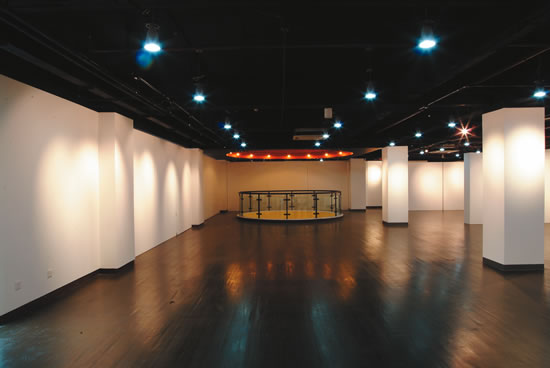 In terms of the exterior architectural design, the entrance made from a combination of red and black epitomizes a multitude of meaning. It is this complex simplicity that I felt most impressed with. At first glance, one will only see the contrast between red and black; nothing special. However, after contemplation and examination, the basic design of the entrance symbolizes the cultural reference to Chinese cosmological belief. The strong belief that everything in this world is made of yin and yang, of a balance and integration of light and darkness symbolizes the inclusive and integrative nature of contemporary art. Like yin and yang, modern art is a representation between the balances of existential aspects in and around humanity that search and define truth. Also through the illustration of a modern cosmological reference, the museum seeks to indicate the cultural aspect.
The spacious interior of the Doland MOMA has a construction area of 4800 square meters, of which 1500 square meters (the first 3 floors) are used for art exhibitions. The black ceiling and white walls also support the principle of yin and yang and the brown wooden floor solidifies our relationship with nature as a unified entity. Each floor has sufficient exhibition space for artworks small and large. The two video rooms provide the space necessary for motion picture art. Overall the interior design of Doland has put into consideration the flexibility, modernity, and creativity of contemporary art. The circular stairways that lead to the floor above inject the audience with a sense of blissful search for enlightenment. By climbing the circular stairway, one feels as if it is a trial in search for the experiences in life. Instead of progressing in a diagonally linear movement but circling directly upwards, one feels as if the pursuit of truth is an ordeal that requires patience and determination as there will be moments of redundancy challenging one’s faith and intellect.
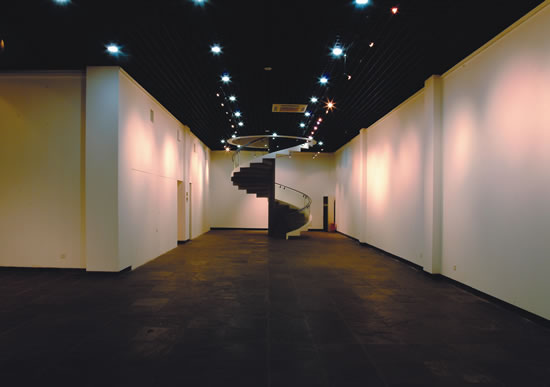 In terms of architectural design, Doland proudly exhibits many merits that place it at the forefront of Shanghai modern art and culture. It is the fruit of the effort, experience, and desire of the Chinese people to modernize and integrate themselves into the modern art world and exchange culture and individuality with the rest of the world for mutual progression. The one aspect that could be improved upon is the interaction and interconnection between the interior of Doland and the exterior environment. Doland’s walls completely seal and separate the interior with the exterior world. If instead of using concrete material to create the walls the designers used glass that is transparent from the inside but not observable from the outside, it would give contemporary art and the museum a mystic aura and allure audience in. Once inside, the audience may see and interpret the paintings as well as witness the world outside, which would symbolize an interpretative fusion of modern art and life: an experience of truth.
Thursday, October 19, 2006
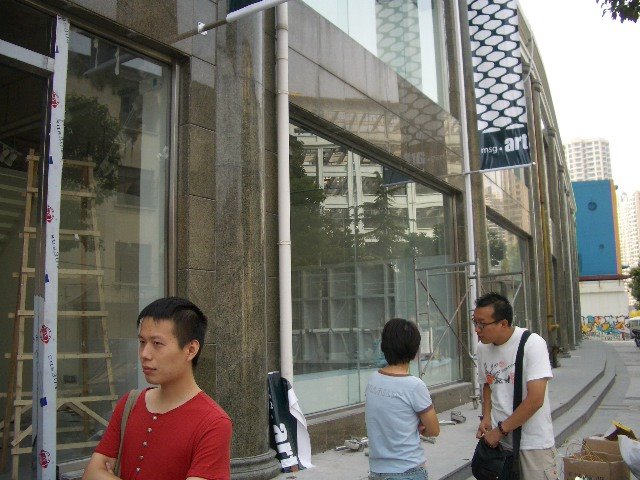
Moganshan Lu (Road in English) is situated next to Suzhou Creek in north-central PuXi, Shanghai. A collection of art galleries featuring contemporary painters, Moganshan Road calls to mind a unique artistic vibe, something akin to Chelsea in New York. Of course, one is unable to not feel that it remains a bit peculiar, an artistic enclave among a sea of skyscrapers that tower in the distance. Of course, one has to come to expect these odd juxtapositions in Shanghai, and in terms of art, the galleries of Moganshan Road do not disappoint.
MSG Art, a gallery operating out of Los Angeles, has recently opened its doors at 87 Moganshan Road, featuring the works of Chi Peng, He Jie, and Zhong Shan. Perhaps the most exciting feature about the gallery is its hopes to open a cultural exchange among its artists, allowing for American and international artists to spend a month on site at the gallery exchanging ideas with local Chinese artists. http://www.msgart.com/
Another important gallery is that of BizArt, which is located on the fourth floor of 50 Moganshan Road, Building No. 7. Opening in 1998, BizArt is one of the only truly non-profit galleries in Shanghai. As China does not currently have a system in place for non-profit galleries, BizArt has to engage in a rather complicated system to move money around. The director is committed, however, to ensuring that BizArt remain untainted from cashing in on artists, or being supported by large real estate developers, as is Zendai. Although recently having run into some problems (which remain sensitive), the gallery continues to forge ahead with new artist exhibitions. The current exhibition, running from October 13th until October 20th, is ElectriCITY, featuring the work of Shi Qing. For more information, visit http://www.bizart.com/.
 Yet another important gallery is that of Eastlink, located at 50 Moganshan Road, Building No. 6, fifth floor. Having opened in 1999, the gallery boasts 900 square meters of space, and is currently exhibiting “Extension Turn 2”, with works by a collection of international contemporary artists. One of the most striking currently on display is that of Johannes Speder, entitled “Mountain”. This work lies near the entrance to Eastlink, and occupies most of the front of the gallery. This captivating work lies across from another piece by He Yunchang entitled, “Beyond Mountains and the Sky”, a series of photographs detailing the artists attempt to use his own strength to push against the strength of an explosion. Eastlink is also featuring articles by seventeen different scientists in its catalogue, along with the twenty-seven participating artists. Eastlink also sells various antiques and past artwork in side rooms, to raise capital for its artistic endeavors. http://www.eastlinkgallery.cn/
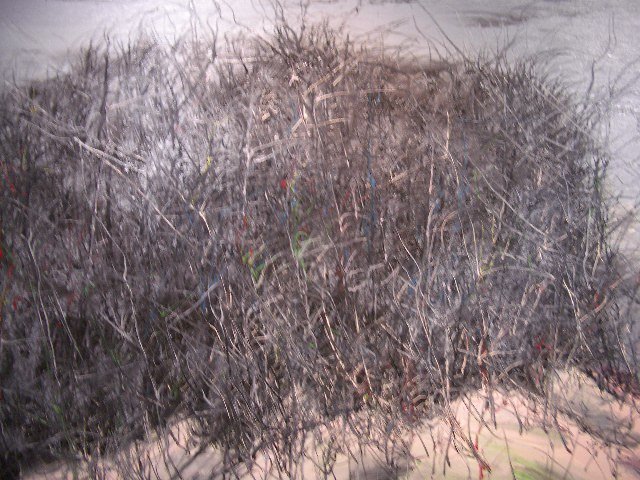 Finally, one should not finish their visit to Moganshan without stopping at ShanghART, located on 50 Moganshan Road, Buildings 16 & 18. Currently, the works of Zeng Fanzhi were on display, displaying his completely unique approach to art, with various works on display. The new exhibit, by Pu Jie, has been set to open on October 18th, and runs until October 31st. One can find more at http://www.shanghart.com/.Although some might feel that Moganshan has a feel of a slightly contrived space, especially in high-rise Shanghai, there is no disputing that the galleries there have no qualms about taking risks and pushing boundaries in China. A visit to Moganshan will not disappoint, and with around 100 galleries that are constantly changing exhibits, the scene here is never static. Moganshan sets the pace for the rest of the Shanghai art scene, and for those who want to see things before the move to the Shanghai MoCA or Zendai, Moganshan is the place to be.
Tuesday, September 26, 2006
Palladium at NYU vs Zendai Museum in Pudong


Client: Ian Schrager
Program: Disco Stage & Rigging
Architect: Arata Isozaki & Associates
Architectural Lighting: Fisher Marantz Stone & Partners
Completion: 1985
In 1985, famed real estate partners Steve Rubell and Ian Schrager, owners of the legendary Studio 54, purchased the theater, setting their sights on establishing a second chic New York club. They hired to redesign the cinema. Isozaki gutted much of the inside to create the state-of-the-art club, which featured a 3,200 square foot dance floor. Its ceiling featured artwork by New York artists like Keith Haring, Jean-Michel Basquiat, Kenny Scharf, and Andy Warhol.
When the Palladium finally opened its doors in 1985, it was an instant smash, attracting 20,000 people per week, including many NYU students. Much like Studio 54, movie stars and musicians frequented the club, receiving VIP treatment while there.
from isozaki & the architects of the new zendai museum...
From RCA website
"One client, for the Shanghai Zendai Himalayas Art Centre in Shanghai, obtained a good site from the government provided he included cultural facilities in the development. ‘I was interested to see if it is possible to support the museum with commercial functions like hotels, shopping and offices… normally they would be separate buildings, but I did not want to separate them, as a kind of hybrid where from the outside the functions are made visible through different shapes.’
The principle of using commercial development to fund cultural institutions, he says, has some similarities with the Mori Tower in Roppongi Hills, Tokyo. But there, he explains, ‘all the functions come together in one big volume which looks the same from the outside. It is one very small museum in a very big development, maybe two per cent of the whole project… in mine [the amount of space devoted to culture] will be 20 per cent. If this goes on it will be another type of model for an art museum today, but everyone knows it is very difficult.’ "
Thursday, September 21, 2006
We were at the Zendai Museum today!

We visited ‘The Twelve: Chinese Contemporary Art Awards Exhibition 2006’ today. Thanks to Jody, Yoki Xiao and Jennifer! 12 recipients of the CCA Awards are featured in this exhibition, the largest of the Biennale’s concurrent showcases. Works from Cao Fei (Whose Utopia?- performance/interview project done with Osrem lightbulb factory workers in Foshan) is striking! Works by Heng Guogu, Chen Shaoxiong, Gong Jian, Hong Hao, Kan Xuan, Li Dafang, Liu Wei, Qing Ga, Qiu Anxiong, Zhou Xiaohu, and Huang Yongping among others.
Subscribe to:
Posts (Atom)