Showing posts with label auctions. Show all posts

Sunday, August 26, 2007

M50 vs. 800 Wujiaochang

Shanghai's hot new hub for artists
2007-03-07 Shanghai Daily
http://e.cnci.gov.cn/doce/news/news_detail.aspx?news_id=976

The booming art market needs more space. The newest art center
is Wujiaochang 800 Art Space in the emerging northeastern Wujiaochang
area. Planners aim to attract high-end international galleries, writes
Yao Minji.

Artists and creative people are ceaselessly searching for fresh
new art space. When one trendy center becomes established, they tire of
it and move on.

Meanwhile, the booming art market also seeks more well-planned
space to attract artists, studios, collectors and high-end
international galleries.

To provide more space, art centers have opened in Moganshan
Road, Yangshupu area, Damuqiao area, Taikang Road and elsewhere.

The newest one is the the Wujiaochang 800 Art Space - the only
one planned from the very beginning.

The Wujiaochang 800 Art Space, which was opened in late
January, is in the center of northeastern Shanghai's Wujiaochang
business area in Yangpu District - away from the downtown in an
emerging area. Developers hope it will become a new Xujiahui, with an
artistic atmosphere.

"Among the art centers, Moganshan Road is the only sizable and
established one, but it was not well planned and managed from the
beginning," says Hong Pingtao, president and CEO of Wujiaochang 800 Art
Space Management Co.

Many artists moved their studios to Moganshan Road and
gradually the area has become a gathering spot for artists and hub for
artistic events,'' says Hong.

Unlike Moganshan Road, Wujiaochang 800 has been planned from
the start as a gallery center.

The Yangpu District government hired architect Zhong Song from
Chenyifei Studio to convert the former warehouse.

Hence, compared with Moganshan Road, where galleries and
artists' studios are scattered in former factories, the Wujiaochang 800
Art Space is an enclosed five-story building featuring galleries and
offices.

It occupies 21,460 square meters.

The ceilings are 4.5 meters high, so that large art sculpture,
installations and paintings can be displayed.

The center is rectangular from the outside, with well-planned
areas for galleries on each floor and one three-story multi-function
room in the center.

Zhong did not remove the stone transport system alongside the
interior stairwell. It will be converted to a dramatic aquarium with
gold fish, from the roof to the ground floor.

Wujiaochang 800 is planned and managed by art collectors, not
artists.

Hong, president and CEO of the management company, has worked
in the art market for nearly 30 years.

He started Caves Art Center in Taiwan and was general director
of the Taiwan Art Galleries Association.

He moved to Shanghai in the 1990s and was general manager of
Poly Auction House.

"An international metropolis like Shanghai needs an art center,
centrally located with easy transport. Moreover, this art center needs
organized management from the very beginning to attract high-end
international galleries," says Hong.

Currently, only Dunhuang Gallery on the ground floor, owned and
run by Hong himself, has completed renovation and started having
regular exhibitions.

In the following week, a second group of galleries will move
into the art center.

"Our goal is to make Wujiaochang 800 the art center in
Shanghai," concludes Hong.

A Gift Offer for Artists in China: Museums

http://www.nytimes.com/2007/08/25/arts/design/25muse.html

A Gift Offer for Artists in China: Museums
Xiao Quan

Eight contemporary Chinese artists have been offered their own personal
museums in Dujiangyan, in Sichuan Province. The city plans to begin
construction on an 18-acre plot of land soon.

By DAVID BARBOZA
Published: August 25, 2007

SHANGHAI, Aug. 24 — For years their work could not be exhibited in
China, but now the country's leading contemporary artists are being
courted by major art collectors abroad and their paintings set records
at international auction sales. A local government in Sichuan Province
— the area in western China known for its natural beauty, spicy food
and talented painters — is taking notice.
Skip to next paragraph
Chang W. Lee/The New York Times

Zhang Xiaogang is one of eight artists who have been offered their own
museums as contemporary art flourishes in China.
The New York Times

Sichaun Province is known for its spicy food and, now, its art.

It has offered to give eight contemporary artists, all under 60, their
own personal museums to operate. The group includes some of China's
best-known avant-garde artists: Zhang Xiaogang, Wang Guangyi, Fang
Lijun, Yue Minjun, Zhou Chunya, He Duoling, Zhang Peili and Wu
Shanzhuan. All have accepted, and Dujiangyan, a city near the
provincial capital, Chengdu, will soon begin construction on an 18-acre
plot of land. The museums are scheduled to open in October 2008.

In a country with no major museum of contemporary art — not even in
Beijing, where most of the eight artists work — this is a novel
development. But in China, everything is changing at warp speed:
artists who sold works for $100 in the 1990s have become
multimillionaires operating huge studios and driving BMWs. They are
helping to transform the style of the country's biggest cities.

"Modern art used to be neglected," said Lu Peng, an associate professor
at the China Academy of Art in Hangzhou, who selected the artists.
"Then modern art became popular in the market."

The new project, which will also include a public museum, is expected
to bolster tourism and to benefit a group of real estate companies that
are redeveloping the provincial area. In addition to providing the
land, Dujiangyan's government is investing around $13 million in the
museums.

The eight artists, ranging in age from 42 to 59, include a few from
Sichuan, but the others come from all over China. They rose to
prominence in the late 1980s and early 1990s by producing paintings,
installations and multimedia pieces that were often radical. Some of
the work was viewed by the Chinese government as distasteful or
antiauthoritarian.

But in recent years Beijing has significantly loosened restrictions on
what can be exhibited in China as the global art market has fed a boom
in new studios, galleries, museums and art districts in many of its
cities. Today only the most controversial works — those with explicit
sexual images or harsh depictions of high-ranking Communist Party
officials — are banned.

How the artists plan to operate their own museums remains unclear.

"I was very happy when I heard that they were going to give me my own
museum," said Mr. Wu, 47, whose radical red character paintings and
nude performance art are well known here and abroad. "Right now, I have
no idea what I'm going to do with it. In the future all the artists
will sit down and discuss how these museums will be operated."

If the artists choose to display their own works, the museums will have
an enviable collection. Prices for art from many of them have
skyrocketed on the auction market. Individual pieces by Zhang Xiaogang
and Mr. Yue, for example, have sold for more than $2 million.

Friday, August 24, 2007

The Fusion on the Menu Is Art and Food

Asia > China > Beijing
The Fusion on the Menu Is Art and Food
By JULIA CHAPLIN
Published: August 19, 2007

IT was a familiar art-world ritual. Mint BMWs and Audis snaked down a
dark alley off the Second Ring Road in Beijing and pulled up to a gray
industrial bunker. Samuel Keller, the director of Art Basel Miami
Beach, had just jetted in from Switzerland. The local hotshot painters
Liu Ding and Liu Wei were huddled with the Svengali-esque curator Pi
Li, and in one corner would-be collectors were chatting with one of
China's most renowned contemporary artists, Ai Weiwei.

Insiders could be forgiven for mistaking this as yet another gallery
opening in art-crazed Beijing, with free-flowing Yen Jing beers, an
international crowd and a minimalist interior of stark white walls and
bare concrete floors. But then the kitchen doors swung open, and a
banquet of Zhejiang province dishes like steam-dried yellow croaker and
a wild-mushroom casserole in a fragrant broth poured forth.

The place was Qu Nar, a restaurant owned and designed by Mr. Ai as a
kind of dining club for his creative circle. "The restaurant actually
loses money because we don't promote it," said Mr. Ai, who opened Qu
Nar (16 Dongsanhuan Bei Road, Chaoyang; 86-10-6508-1597) in 2005 with
several bohemian friends. "But it's worth it because now we have a
place to hang out."

Mr. Ai is among a growing number of Beijing artists who are stepping
outside their studios and into the kitchen to open some of the most
talked-about restaurants in the city. These
artists-turned-restaurateurs are introducing cuisine from their
ancestral provinces — albeit with a nouvelle twist — to a city where
local Mandarin cooking has had a lock on upscale dining.

The current market for Chinese art has turned a handful of struggling
artists into overnight multimillionaires, with their works commanding
as much as $2.3 million at auction houses like Christie's. Along with
their newfound fame, some of these Beijing artists are now rolling in
the materialist trappings of a rap star, with their Range Rovers,
Ferragamo suits and, now, their own cult-of-personality restaurants.

That's not to say these places don't serve a more communal function. As
new art districts pop up along the industrial outskirts and dirt-road
villages off the Fifth Ring Road — often with no discernible center —
the restaurants have also emerged as a kind of ad hoc salon.

At the Dashanzi arts complex, housed in a defunct military factory near
the airport, artists and dealers can be found during lunch at Tian Xia
Yan (4 Jiuxianqiao Lu, 798 Factory District, Dashanzi;
86-10-6432-3577), a casual Sichuan cafe opened five years ago by the
photographer Cang Xin, known for his provocative self-portraits. Tucked
in a back alley behind a maze of galleries, boutiques and coffee shops,
the homey cafe has a red, Cultural Revolution-style décor and serves
Sichuan standards like spicy tea-mushroom pork pot and red-hot sesame
noodles.

By far the most entrepreneurial of the new artist-cum-restaurateurs is
Fang Lijun, a cynical-realist painter known for his canvases of eerie
bald men floating in space. Mr. Fang opened six upscale restaurants
around the city, each displaying important artworks that Mr. Fang and
his curator friends pick.

"It's a business, but it's also a place for the art world to meet and
gather," said Mr. Fang, who can often be seen holding court at Yuelu
Montain's Qian Hai Branch (10 Lotus Lane, 51-10 Dianmen Xidajie,
Xicheng District; 86-10-6617-2696).

Mr. Fang's flagship — South Silk Road in Soho New Town (3/F, Building
D, 88 Jianguolu Road; 86-10-8580-4286) — is the Beijing art world
equivalent to the Ivy in Los Angeles, where power curators and
collectors from Hong Kong, Seoul and the West wine and dine with the
art elite. Set on an upper floor of an office tower, the room is a
soaring loftlike space with black lacquered furniture and chic
waitresses in brightly colored folk outfits.

On one wall, behind a banquet table for 18 people, is a
floor-to-ceiling painting by the leading artist Wang Guangyi that
depicts, in pop yellow and red, retro-Communist workers with the word
"art" stamped in the corner like a corporate logo.

Viewing the painting on a winter afternoon was Meg Maggio, the director
of the Pekin Fine Arts gallery and a consultant for the Gagosian
galleries. "China is a country where relationships are best built over
a good meal," Ms. Maggio said, as she entertained a museum group over
glasses of rice wine and dishes like caterpillar fungus chicken soup in
steam pot, made with four varieties of Yunnan mushrooms.

Three years ago, an artist collective from Guizhou — a poor province in
south central China — arrived in Beijing to sell their paintings. To
pay the bills and to keep from getting homesick, they opened a 24-hour
restaurant named after themselves, Three Guizhou Men (1-2/F, Building
7, Jianwai SOHO, 39 Dongsanhuan; 86-10-5869-0598). The sleek gray
dining room served nouvelle Guizhou specialties like sour fish soup,
lavender tea with milk, and mango and ice purée.

Their art careers never took off, but their restaurant now has five
branches. And they are always packed

Monday, June 25, 2007

hinese artists capitalise on avant-garde boom

By John Ruwitch at Reuters

DAFEN, China (Reuters) - It only takes two days for Chen Quan to crank out a reproduction of a Yue Minjun.

"I have done hundreds of his paintings," says the shirtless 25-year-old, his hair tied in a ponytail, referring to the Chinese artist renowned for his paintings of absurd, grinning faces.

Standing by a half-finished copy that features bald men smiling sardonically while perched in a boat on a lake, Chen adds: "Copies like this aren't really hard at all. It just takes time."

While reproductions like Chen's go for only about 250 yuan ($33) apiece in Dafen, where copies of paintings by anyone from Da Vinci to Norman Rockwell are churned out in the dozens, prices of genuine works by China's top artists are soaring.

At Sotheby's contemporary art auction in London last week seven works by some of China's top painters, including Yue and Zhang Xiaogang, raked in 4.86 million pounds ($9.68 million) -- more than double their pre-sale estimate.

Yue's 1997 oil on canvas entitled "The Pope" sold for 2.15 million pounds ($4.28 million).

Another piece by Yue, depicting an open head with a pool of blue water in which late Chinese revolutionary leader Mao Zedong is having a dip, fetched 692,000 pounds -- almost five times the high end of the pre-auction estimate.

These prices come after previous auction records were set in May at a Christie's auction in Hong Kong.

COPIES POPULAR

"Chinese art these past few years has been extremely hot," says Wei Guangqing, another well-known painter and contemporary of Yue's who serves as dean of the Hubei Institute of Fine Arts.

The appearance of knock-offs of Chinese paintings in Dafen, an urban "village" in the southern boomtown of Shenzhen known for its reproductions of Western oil paintings, is a testament to their blossoming popularity.

The streets here are lined with shops, and on second and third floors, thousands of young artists churn out phoney Van Goghs, Monets, Dalis and generic hotel room art, often in assembly lines that would have made Henry Ford proud.

Chen says reproductions of the works of Chinese contemporary big-hitters make up more than 30 percent of his small shop's sales, although the walls are covered with realist nudes and Renaissance reproductions.

Other art dealers in Dafen estimate contemporary Chinese works make up 10-20 percent of their sales, and say they have been a steady staple since demand for the paintings emerged on the Dafen scene a couple of years ago.

In theory, there are copyright issues in copying, but in reality nobody here has any problems.

"When leaders or cultural officials come they say: 'These items are copyrighted, so just don't put them on top'," says one gallery owner.

FOREIGN BUYERS

The contemporary Chinese knock-offs -- the retro-revolutionary Wang Guangyis, the precocious baby-populated Tang Zhigangs, the colourful Fang Lijuns and the sneering Yue Minjuns -- are popular with foreigners and Hong Kongers.

"These are a little alternative," says Huang Zhenyi, who tends a gallery on one of Dafen's main streets.

Clicking on computer images of Yue Minjun art that customers can order, he adds: "Many foreigners who come here know a lot about this guy, but Chinese people don't know him. They just see all those teeth and the smile and think it's funny."

At Thursday's auction, the Chinese works were bought by Asians, but not mainland Chinese, says Evelyn Lin, head of the contemporary Chinese art department at Sotheby's Asia.

But, she says, there is growing appetite for contemporary Chinese art among mainlanders.

"Chinese consumers have just started to pay attention recently ... the mainland Chinese have learned to appreciate Chinese contemporary art," Lin says.

China's fast-growing economy is buoying the art market from the rarefied stratosphere all the way down to would-be starving art students.

"All my graduate students can sell paintings these days," says Wei. "But I think they are being influenced by the market too soon ... Youth today lack a lot of experience. Their evaluations of things are realistic, practical."

In Dafen, Chen is just focused on cranking out replicas as quickly as he can. He says he doesn't have time to work on his own art but he'd like to because he is under no illusions about what he does.

"This is just a craft," he says. "It's not really art."

($1 = 7.621 yuan)

Thursday, June 14, 2007

Chinese Art Prices Soar

From June 1st, 2007;

Text from Reuters, Images googled by Borna


PRICES for works by contemporary and avant-garde Chinese artists hit record highs at Christie’s spring auctions in Hong Kong on Sunday, in a sign of sustained strong demand. Yue Minjun, known for his paintings of absurd, grinning faces, saw his Portrait of the Artist and his Friends fetch $2,62m, his highest price at auction. In a packed Hong Kong auction hall, bursts of spirited bidding — including live online bids — sent works by other top artists to new highs.


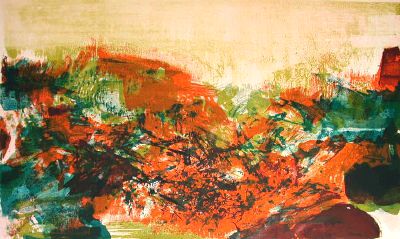
Zao Wou-ki’s vivid coloured abstract, 14,12,59, named after the date it was painted, fetched $3,8m — almost five times its pre-auction estimate.


A pair of bronze figures by Taiwan-born sculptor Ju Ming, called Big Sparring, made $1,9m — also a new high for the artist’s work at auction.


“There’s been no letdown, the (Chinese art) market’s still going very strongly,” said Jonathan Stone, a Christie’s international business director for Asian art.


Chinese art prices have boomed in recent years, fuelled by a robust global economy,


Firstly, a word to Business Day; ending a news article with a comma is highly unprofessional.


Secondly, these prices are astronomical. As Erol was quick to suspect in class, the amount of money being thrown around on Chinese Contemporary Art may signal that the market is in a bubble -- and that this stuff actually isn't worth this much money.


My guess is that that's not the case. There is an ever growing number of people - like that crazed woman who came in to speak with us - who are championing Chinese Contemporary Art in hopes of making it the next big thing in the global art market. But wether it actually becomes the next big thing or not is of no matter, the fact is that the Art in China is getting steadily worked into the global art discourse -- (at the same time, art discourse itself is getting more Global - it goes both ways) -- and through sheer virtue of that, this stuff should atleast hold its value, if not appreciate.

Thursday, June 07, 2007

From Propaganda to Profit

------------------------
From Propaganda to Profit
June 2007

by Rebecca Catching and Anurag Viswanath

This spring at Moganshan Lu, Shanghai's main art district, Beijing Art
Now Shanghai christened their gallery opening with a rather
unconventional exhibition, "Shanghai Now." Viewers entered the
cavernous warehouse and stared blankly at canvases sheathed in money.
Gallery founders Huang Liaoyuan and Zhang Haoming had wrapped each
painting in shiny wrapping paper printed with faces of various
different currencies. In doing so, they sought to remind viewers to
look beyond the commercial value of art and contemplate its intrinsic
value.

Xu Beihong's 1939 work Put Down Your Whip sold at a recent auction in
Hong Kong for a record $9.2 million.

It's a relevant point in the context of the Chinese art market, which
some claim has begun to spin out of control. Last year, Sotheby's and
Christie's sold $190 million worth of Asian contemporary art—most of
it Chinese. Prices reached unprecedented heights, with 43-year-old
artist Liu Xiaodong dropping canvases for a whopping $2.7 million, and
Xu Beihong's The Slave and Lion smashing the record for a Chinese oil
painting at $6.9 million.

Twenty years ago Chinese artists would have had trouble obtaining a
passport, but now they are globetrotters. They have studios at home
and abroad, showcase their art around the world, and are getting very
rich in the process. Why this boom? According to Simon Groom, head of
exhibitions at the Tate Liverpool, the Chinese art explosion "reflects
the interest in China, driven by the growth of its economy, the
emergence of Chinese collectors and an eagerness in the West for new
speculative markets."

Tate Liverpool's current exhibition "The Real Thing: Contemporary Art
from China" features 26 works by 18 leading Chinese artists, including
Ai Weiwei, Gu Dexin, Zhou Tiehai and the Yangjiang group. The exhibit
has been billed as the "show of the year" and is evidence of the
growing influence of Chinese artists abroad. Indeed, many of China's
most exciting artists are now based abroad—for example Xu Bing and Cai
Guoqiang—which puts them in close proximity to their collectors, 90%
of whom are foreign.

Yet mainland Chinese collectors are starting to get into the Chinese
art game, too. Catering to their needs are hundreds of mainland
galleries and auction houses which are springing up, as well as
foreign institutions that are in the process of opening branches in
China, such as the Centre Pompidou and the Guggenheim.

Auction houses, both foreign and local, have begun to deal directly
with the top-tier Chinese artists, snatching up works while the paint
is still wet, rather than going through collectors and galleries. Some
artists have responded to the demand by using teams of assistants to
churn out paintings. For example, Shanghai-based artist Zhang Huan
employs close to 100 workers in a massive studio that would make Andy
Warhol's factory look like a cottage industry.

A Long March

Under Mao, art was meant to "serve the people," i.e., workers,
peasants and soldiers—social groups not known for their inclination
toward the arts. And the bureaucratic controls designed to oversee
Mao's utopian social-engineering projects quickly made art subservient
to politics.

Artists were disseminators of propaganda, celebrating revolutionary
zeal and socialist euphoria through patriotic paintings. Icons of this
era include Dong Xiwen's oil The Founding of the Nation (1953), Jin
Shangyi's painting Mao Zedong at the December Conference (1961), and
Wu Hufan's Atom Bomb (1965), which marked China's coming of age as a
nuclear power.

Woodblock prints and oils done in the Soviet socialist realism style
featured square-jawed men leading China's industrialization, and
robust women harvesting bumper crops of plump rockmelons, while folk
paintings known as nianhua, or New Year's paintings, depicted bouncing
baby boys riding atop golden fish adorned with communist slogans.

Under the oppressive Cultural Revolution, a new genre, a variation on
socialist realism described as "red, bright and luminous" (hong,
guang, liang), celebrated the accomplishments of the Cultural
Revolution with the use of theatrical illumination and garish colors.
The fall of the Gang of Four in 1976 brought new beginnings, as both
artists and art schools were rehabilitated.

Deng Xiaoping's "opening and reform" in 1978 and the preoccupation of
the state with economics allowed for expanded realm of individual
freedom and space. The officially sponsored "New Spring" art
exhibition in February 1979, followed by an exhibition by the Stars,
paved the way for the rise of the Contemporaries, which included
artists such as Wang Huaqing, Sun Weiman and Zhang Hongtu. The
establishment of Fine Arts in China (Zhongguo Meishu Bao) in 1985, a
Bejing-based weekly arts newspaper; the formalization of official
channels for sale of art by the New York-based Hefner Gallery in
1987-89; and the Chinese Nude Oils exhibition in 1989 were important
milestones which led to the culmination of what some consider the
Tiananmen of the art world: the highly controversial, socially
critical "China/Avant Garde" exhibition at the Chinese National Art
Gallery in February 1989.

Following Tiananmen, the art scene limped back to normalcy after a
brief hiatus. In the following decade, the first art galleries, such
as Red Gate Gallery and Courtyard Gallery in Bejing, and Shanghart and
Eastlink in Shanghai, began to pop up, with clients including
influential foreign collectors such as Uli Sigg and Pierre Huber.

In the years that followed art was no longer used to further the aims
of communism, rather communist imagery was used further the aims of
individual artists who made a fortune off of genres such as political
pop.

Artists such as Wang Guangyi and Xue Song, produced technicolor images
of Mao and graphic paintings of workers. While cynical realists such
as Liu Xiaodong, Yue Minjun and Zhang Xiaogang employed both
hysterical and forlorn human figures in everyday scenes, giving visual
expression to the moral vacuum left behind by communism.

Towards the late 90s, artists began really test the limits of their
freedom with exhibitions such as the "Fuck Off" biennale satellite
exhibition curated by Ai Weiwei at Eastlink in 2000, and Cang Xin's
performance piece To Add One Meter to an Unknown Mountain, where he
piled the summit of a mountain with the bodies of his friends—an
oblique reference to the terror induced by the Cultural Revolution.
Though artists experienced a palpable growth in artistic freedom
through out the 90s and onwards, plainclothes spies from the cultural
bureaus made their presence felt, asking to speak to artists, removing
works, shutting down exhibitions and occasionally holding artists in
prison.

In 2006, the Hei Shehui collective—literally "hey, society" and also a
pun on the Chinese word for mafia—organized the controversial "38 Solo
Exhibitions" in a former army barracks in Shanghai. The exhibition
featured Jin Feng's provocative performance piece An Appeal Without
Words, which comprised a group of actual peasants covered head to toe
in a layer of gold paint, brandishing empty placards—a reference to
their compromised status in appealing land disputes. Such incendiary
work caused the show's closure and landed two of the artists in jail.
New-art observer Geremie Barmé likens the situation to Miklos
Haraszti's Velvet Prison. In such an environment, the majority of
artists choose not to test the limits, and social critique often takes
a back seat to profit.

In some ways, profit poses a more pernicious threat to creativity than
government censorship, as galleries pressure artists to create works
to feed the market. "Now that [the art world] has become
commercialized, these commercial forces inform artists if something
has commercial value," opines controversial conceptual artist Xu Zhen.
Mr. Xu, who spends much of his time working at nonprofit experimental
art center BizArt, pays little attention to the market. Rather he
chooses to raise questions about transparency and China's growing
military ambitions—filming videos of himself driving remote control
tanks into China's neighboring countries and staging mockumentaries of
engineers lopping off the top of Mount Everest.

While the success stories, such as Zhang Xiaogang and Yue Minjun,
dominate the business pages of the Western press, many critics see
them as examples of how Chinese art has failed to innovate. Outside of
the works of a small group of exceptional conceptual artists, much of
what lines gallery walls is uninspiring and derivative. Pia Camilla
Copper, a Chinese contemporary art specialist at the Paris auction
house Artcurial, says, "The painters, sculptors and conceptual artists
from [China's top academies] are technically skilled, they only lack
imagination. A sort of Turner Prize should be created for Chinese art
to encourage young artists to break free from academic rules, the
scourge of the Chinese art academy, and innovate."

At the same time, experimental art is stifled by the lack of
institutional resources. Museums are underfunded, as are nonprofit art
centers such as Shanghai's BizArt and Yunnan's Lijiang Studio. Serious
art criticism is also compromised by corruption amongst journalists
and critics who offer coverage and praise for a fee.

Ms. Catching is the arts and entertainment editor of that's Shanghai,
and the Shanghai correspondent for Art Asia Pacific. Ms. Viswanath is
a free-lance journalist based in Bangalore.

Saturday, June 02, 2007

Wu Guanzhong Painting Tops Poly's `Crazy' Beijing Art Auction

Wu Guanzhong Painting Tops Poly's `Crazy' Beijing Art Auction

By Eugene Tang

June 1 (Bloomberg) -- Wu Guanzhong's ``Ancient City of Jiaohe'' sold
for a record 37 million yuan ($4.8 million) last night at Poly Auction
Co. in Beijing, on the day the Chinese stock market recovered from its
worst slump in three months.

The one-square-meter (10.8 square feet) depiction of a ruined city,
painted during Wu's 1981 teaching sojourn in western China's Xinjiang
province, was estimated by Poly to sell for 15 million yuan. The buyer
was identified only by his surname Cai.

Cai was among hundreds of collectors crowding Poly's inaugural night
sale, scheduled to avoid clashing with the spate of summer art
auctions that typically take place on weekends in the Chinese capital.
Of 65 paintings on offer, 48 reached or exceeded their high estimates.
The sale totaled 247 million yuan.

``People have gone crazy,'' said Sun Liangliang, after his 4 million
yuan bid for Shi Chong's ``Contemporary Scenery'' was surpassed by a
rival's 15 million yuan offer. ``They're paying 10 million yuan as if
it's 100,000 yuan. If you want prove that there's too much money in
Beijing, just watch this market.''

Cai, a private collector who declined to give his full name, bought
two of the eight Wu Guanzhong oil paintings on auction, paying 42
million yuan, not including a 10 percent buyer's premium.

``Jiaohe'' was last sold in 1991 by Sotheby's Holdings auction for
HK$2.55 million ($326,900), a record at that time for Chinese oil
paintings outside the country.

``Jiaohe is the epitome of Wu's work,'' said Chang Tiangu, Poly's art
director. ``This is the piece that a true collector and admirer of
Wu's work would aspire to.''

Yue Minjun

Poly's record prices extend a trend that has seen paintings from
China's contemporary artists regularly sell for many times the
expected price. On May 27, Christie's International sold a record $79
million of 20th century Chinese art and Asian Contemporary works. Yue
Minjun's ``Portrait of the Artist and His Friends'' fetched HK$20.5
million, five times the presale top estimate.

At Poly's auction, Yue's ``Untitled'' sold for 1.7 million yuan,
beating the 1.2 million yuan top estimate.

Wang Yidong's ``Innocent Years,'' depicting a newlywed couple's
journey home, sold for an artist record of 8.5 million yuan, beating
the 6.7 million yuan fetched in December for his oil painting of a
girl playing cards.

Wang, 52, paints in a signature style that dresses a maiden entirely
in bright red against a backdrop that's usually a darkened interior or
the stark snow-covered landscape of his native Shandong province. He
began his art training at 17 and has held exhibitions in Tokyo, Paris,
Rome and the U.S.

Zeng Triple

Three oil paintings by Zeng Fanzhi, a favorite among overseas
collectors of Chinese contemporary art, surpassed top estimates. His
``Mask No. 14'' sold for 8 million yuan, his portrait ``Andy Warhol''
fetched 2.4 million yuan, while ``Landscape'' sold at 4 million yuan.

Mao Yan's ``Memory or the Dancing Black Rose'' sold for 9.1 million
yuan, triple the top estimate.

The auction wasn't all smooth sailing. Xia Xing's ``Perfume in
February'' was auctioned twice. The painting depicting a naked maiden
was first sold for 820,000 yuan. Fifteen minutes later the auctioneer
put the painting back on the block. This time the hammer came down at
750,000 yuan -- to a different winner. Poly officials declined to
explain the discrepancy.

To contact the reporter on this story: Eugene Tang in Beijing on
eugenetang@bloomberg.net

Tuesday, April 17, 2007

Once hated, now feted - Chinese artists come out from behind the wall

Once hated, now feted - Chinese artists come out from behind the wall

Charles Saatchi joins the swell of collectors beating a path to the east

Jonathan Watts in Beijing
Wednesday April 11, 2007
The Guardian


Zhang Dali's Chinese Offspring
Art world turned upside down ... Charles Saatchi has bought 15 of Zhang Dali's Chinese Offspring. Photograph: courtesy Saatchi Gallery


The naked Chinese migrant workers were dangling on hooks and ropes from a ceiling in north-east Beijing until a few months ago, when they were bundled up in bubble wrap, crammed into a container and shipped off to London.

They are not desperate Chinese peasants seeking illegal entry into the UK. Far from it. Their arrival in Britain is part of a cultural invasion, paid for by the UK's most famous art collector, and signalling a surge of interest in Chinese sculpture, painting and photography.

The life-sized resin figures are the work of Zhang Dali, one of China's leading artists. To highlight the role played by countryside labourers in his country's rapid urbanisation, Zhang took casts of 100 of them, substituted numbers for their names, signed the figures and offered them for sale like pieces of meat hung in a window.

Except, of course, they are a lot more expensive. Thanks to the booming market in Chinese art, the price for a single figure has doubled in the past two years to £10,000. That value is likely to increase further if they are shown at the opening of Charles Saatchi's new gallery in the King's Road this year.

Saatchi snapped up 15 of Zhang's Chinese Offspring in a shopping spree that has also seen him spend more than a million dollars each on two huge paintings by Zhang Xiaogang, the hottest property in the Chinese contemporary art scene, as well as works from at least 18 of his compatriots.

The UK buyer, whose patronage helped to establish the careers of Damien Hirst and Tracey Emin in the 1990s, is now paying increasing attention to the east. This year he launched a Mandarin version of his website, which gets more than 4m hits a day.

"I have been looking at lots of contemporary Chinese art in the past few years and find that a small percentage of it is world class and as good as the best contemporary art anywhere else," he told the Guardian. "There is a huge gulf, though, between the small amount that is world class and the majority, which is derivative and kitsch."

Saatchi is a late but influential arrival. Thanks to a near eightfold increase in the market in only two years, Sotheby's in Hong Kong recorded Chinese contemporary art sales of $21.9m (£11m) in 2006. It is a similar story at auction houses from London to New York, many of which started only recently to offer modern Chinese work but now find it their biggest driver of growth.

It has bordered on a frenzy. During the first auction of Chinese contemporary art in New York last April, so many bidders were calling in that Sotheby's ran out of telephones.

Among the most sought-after works was Lions, the roaring, guffawing multiple self-portrait by Yue Minjun, which eventually sold for more than half a million dollars. Yue's paintings and sculptures of garishly coloured laughing men are seen as symbols of China's consumer culture. This is one of the central themes for contemporary artists, along with reflections on materialism, the loss of traditional values, environmental destruction and the political legacy of Mao Zedong and Tiananmen Square.

Most of the headlines have been made by Zhang Xiaogang, whose giant family portraits and split-focus images from the Cultural Revolution era have generated the biggest interest among buyers. Last April, his Bloodline Series: Comrade No 120 sold for $979,200, almost three times Sotheby's high estimate. It was a record for Chinese contemporary art, but one that lasted only until October, when Saatchi paid £769,600 for another work by Zhang Xiaogang at a London auction.

With auction sales of $23.6m last year, Zhang Xiaogang was narrowly second to Jean-Michel Basquiat in the ArtPrice ranking of the 100 top-selling artists. But he was far from alone on the chart. There were 24 Chinese names last year, up from almost none five years ago.

This represents a huge change in attitudes and lifestyles. Ten years ago, avant-garde artists were on the fringe of Chinese society. Their works were often banned, exhibitions were shut down and, for most, the sales of their work were barely enough to make ends meet. Today, however, a growing number of artists own villas, foreign cars and apartments. "Cynical realist" Fang Lijun is said to own six restaurants in Beijing and a hotel in Yunnan province.

Among the newcomers to the top-seller list is Su Xinping, an artist from Inner Mongolia. Su said the price of his work had tripled in the past three years. "My life has changed a little. I still eat simple food and lead a simple life, but I have a more convenient house and a more convenient car. I have several homes, and I bought a studio in the city last year."

Su is one of many artists who struggled after their participation in the Tiananmen Square protests. But now he sees greater opportunities to do the work he wants to do, and to get paid for what it is worth. He received a call from New York recently to say several of his works had just sold for almost $400,000. "I won't get any of that money," he grinned. "I sold those pieces years ago." But he will benefit from now on. "The price for Chinese art was too low before. Even now some fine pieces have not reached their true value."

Zhang Dali agrees. "I expect the price will keep rising for at least five years because more and more people want to buy Chinese art, but there are not that many Chinese artists. The demand is increasing, but the supply is limited so the price will keep rising."

The reasons for the boom are manifold. The establishment of the Dashanzi art district in Beijing three years ago attracted many foreign buyers, who account for about 80% of sales. A government crackdown on property speculation and unease about stock market prices have also pushed many investors to consider art. But many overseas purchasers are motivated by a desire to grab a piece of history.

"I think the rise of the art market is highly related to the rising interest in China," said Jonathan Wong of Sotheby's in Hong Kong. "We observe money comes from all over the world and new buyers keep emerging in every auction."

Amid concerns about a speculative bubble, insiders say the boom is a mixed blessing. "For big-name artists, the price of works has gone up dramatically - by 10 to 20 times in some cases," said Brian Wallace, whose Red Gate Gallery was the first to show contemporary works in Beijing. "If you were in it for the money 10 years ago, you would be very well off today. But it is not easy. With all the new entrants into the market, more galleries are taking up more artists. So the overall quality is not as high as before. There are many good artists out there, but a lot of them are now painting for the market - even some of the big names."


Saturday, March 24, 2007

Sotheby’s woos buyers from mainland China

Art.view

Asian spring

Mar 24th 2007
From Economist.com

Sotheby’s woos buyers from mainland China

ALL manner of wonderful wares have been on sale in New York during Asia Week, which ended yesterday. Cups and bowls and vases and vessels, made of everything from rhinoceros horn to porcelain, celadon and jade. But it was the auction of contemporary art, more than any other, that demonstrated how Asian buying is changing.

The contemporary auction market has expanded fast in the past two years. In 2004 Sotheby’s and Christie’s between them sold $22m-worth of contemporary Asian art, which included photography and paintings. Two years on that figure had jumped ten times, to $190m. The growth was especially steep for Sotheby’s. In 2004 its contemporary Asian art sales totalled just $3m. By 2006 they had leapt to $70m.

It was only a year ago that Sotheby’s held its first sale of contemporary Asian art in New York. Both auction houses had hosted sales in Hong Kong before that, but these offered mostly local art to local buyers.

Selling Asian art in America posed quite a different challenge.

On the one hand there were Western buyers, with a different aesthetic and history. A small number had already begun buying Chinese art in Shanghai and Beijing. But their aim was often speculative. Who knew how many more collectors might be interested, if any? And then there were the Asian, particularly mainland Chinese buyers. Sotheby’s was keen to attract more wealthy mainlanders to New York. But how?

In the event, Sotheby’s March 2006 sale brought in $13.8m, and 20 of the artists represented saw their work sell for record prices. Some pieces went for more than ten times the pre-sale estimates, though it is unclear whether this was the result of new-won popularity or a sign of Sotheby’s inexperience at setting estimates.

This year’s sale nearly doubled the 2006 figure, bringing in $25.3m, and the market is visibly more mature. Buyers were pickier, happy to bid high for select works while refusing others. A small number of artists again saw their work sell for record prices. Yue Minjun’s “Goldfish” (pictured below) shows 16 identikit Chinese men standing in line at the balustrade of a white bridge, laughing as they look down into the water at a solitary goldfish. Six bidders fought for this 1993 work, which was sold eventually to an anonymous buyer on the telephone for $1.38m against a pre-sale estimate of $700,000. None of Mr Yue’s four other pictures in the sale fetched more than $240,000. Buyers were equally particular about other lots; many sold within the estimate, while some did not sell at all.

Mr Yue’s laughing men, Zhang Xiaogang’s creepy pink babies with their outsized genitals and Zeng Fanzhi’s cartoon twins with their mask-like faces have all been bought by Westerners and Asian collectors alike. But one school—the photorealists—has an almost exclusively Chinese following. By offering 41 paintings of this kind, Sotheby’s was taking a gamble that it could attract new buyers from the mainland to New York.

To Westerners, who value the many innovations of modernist painting, such realism may seem sentimental, slavish and retrograde. But to Chinese collectors, these technically skilled artists, many of whom came of age in the 1970s, tried to see past the propaganda and capture the essential beauty of Chinese life.

Not surprisingly, women and the countryside feature strongly, but even here the images vary enormously. Works by Shanghai-born Chen Danqing depict tribal women with yaks, long woollen dresses and elaborate hairdos; prices for the artist ranged from $90,000-168,000. Wang Yidong’s “Yi River”—which fetched $801,600, more than twice the low estimate—depicts a young woman with pigtails standing on a flat stone as if edging across a river. Above her, in almost Freudian counterpoint, lies another woman (or perhaps it is the same one), asleep and possibly dreaming.

Leng Jun’s “Five Pointed Star” proved the realists’ stellar offering, realising $1.22m against a pre-sale estimate of $350,000-450,000. Painted against a black background, the star appears to be made of bits of rough scrap metal that have been folded and soldered together. The surface is depicted in minute detail, but it is the star’s symbolism that gives real feeling to the painting. It might be old and wrinkled, but despite its battered condition the star resiliently holds its form.

Sotheby’s chose well. Mainland Chinese collectors bought 22 of the photorealist paintings in the sale. Half of those lots, 11 in all, went to six mainland Chinese buyers who had never bought art in New York before.

The “Contemporary Art Asia: China, Korea, Japan” sale was at Sotheby’s, New York, on March 21st

Thursday, March 22, 2007

Collector sells £15m Turner collection to buy Chinese contemporary art

Baron Ullens is acquiring new works for his Beijing gallery
By Georgina Adam |
Posted 22 March 2007
LONDON. The Belgian collector Baron Guy Ullens
has consigned 14 Turner watercolours to auction, because he wants to
focus on contemporary Chinese art. The works, which will be sold at
Sotheby's London on 5 July, are expected to fetch £10m-£15m
($19.7m-$29.55m).

Baron Ullens has founded the first private museum for both Chinese and
international contemporary art in Beijing, which is to open in
October. Titled the Ullens Centre for the Arts, it is located in
Beijing's Dashanzi art district and its first chairman is Jan Debbaut,
former head of collections at Tate.

Guy Ullens, whose fortune derives from the food industry,
lived in China in the early years of his career, and collects
classical Chinese landscapes as well as his newest interest,
contemporary Chinese art. He acquired the Turner watercolours over the
past 20 years, some at auction, and some through dealers. Most were
kept in store at the Geneva Free Port and according to Sotheby's
specialist Henry Wemyss, there will be no problems exporting the works
out of the UK should they go to foreign buyers. Indeed, Sotheby's is
taking the group around the world, including Hong Kong and Los
Angeles, before the sale. "Turner is such an international name and
his technique of brush on paper resonates with Chinese buyers, as well
as the more traditional American collectors of his work," says Mr
Wemyss.

The Ullens collection covers everything from early, naturalistic
renditions of British coastal scenes to late, impressionistic views in
Switzerland, Germany, France, and Italy. Among the most expensive
works is a large Swiss view, The Lake Lucerne from the Landing Place
at Fluellen, probably 1807-10, estimated at £2m-£3m ($3.95m-$5.91m).
This last appeared at auction in the Wills sale at Sotheby's just two
years ago when it made £1.86m ($3.35m). Another work, Oberwesel, 1840,
carries the same estimate.

Last year saw new Turner records established for an oil and
for a work on paper: a Venetian oil, Giudecca, La Donna della Salute
and San Giorgio sold for $35.86m at Christie's New York while the
watercolour The Blue Rigi sold for £5.83m ($11m) at Christie's London.
Christie's has traditionally dominated the Turner market so the sale
of this collection, which is the biggest to come to auction since the
Munro sales in 1878 and 1879, is a coup for Sotheby's, which offered a
guarantee on the group.

Friday, March 16, 2007

"IMAGE-NATION: Works by New Generation of Chinese Artists"

"IMAGE-NATION: Works by New Generation of Chinese Artists"

Featuring works by: Chao Ziyi & Chao Ziwei, Chen Yun, Chen Yunquan, Guo Peng, He Jia, He Jiandan, Jiao Xingtao, Liang Binbin, Liu Danhua, Liu Lifen, Ren Zhe, Wang Mian, Wang Zi, Xia Hang, Xue Tao, Yang Bo, Yin Yanhua, Zhang Hua, Zhao Guanghui


Exhibition: 18 March till 10 May 2007
Vernisage/ Opening party: 17 March with the attendance of several artists

IMAGE-NATION is an exhibition which reflects the interests of a younger group of artists who no longer take as their subject the political content which widely characterises the western view of the work of their predecessors of the 1980s and early 90s. Political art produced today has at times recently become a parody of itself and no longer holds the significance or impact that work from the 80s and early 90s did. Collectors are becoming more discerning and are less easily swayed by images of pandas, Mao or the colour red; and seasoned auction goers are becoming more selective when it comes to political art post-1997. The artists in the present exhibition were too young to feel directly the impact of Tiananmen Square, and are rather affected by the new commercial and cultural openness, the rapid urbanisation and transformation of the cities, the incessant bombardment of consumer culture and the influence of mass media. The present exhibition takes as its starting point three different categories of cars, cartoons, and daily life. Through each of these subjects artists give an independent insight into life in China today.

The aim of the exhibition is to show that although the main collecting base for young Chinese artists for the short term remains in the west, that artists are no longer merely pandering (no pun intended) to a Western preconception of China or cynically producing political pop for the export market (although this clearly persists). There are artists who are exploring their own cultural identity, engaging with popular culture, reflecting the contemporary experience of daily life in China, and concerning themselves with issues and influences that directly affect them - an engagement which brings about an art with an independence of outlook and one which will in time bring them a domestic as well as international audience.

Contrasts gallery Principal: 181 JiangXi Middle Rd, Shanghai 20002

Gallery Hours: Monday to Sunday 10am -10pm

Wednesday, March 14, 2007

Let 10,000 Young Artists Bloom, Saatchi

http://www.nytimes.com/2007/03/11/magazine/11wwlnQ4.t.html?_r=1&ref=magazine&oref=slogin

Among the young artists whose work can be seen on Charles Saatchi's new
Chinese Web site are two who posted self-portraits: Huiyuan Sun, who
posted a series of photographs called "A Little Matter and My Face,"
above.

Stephanie Hueon Tung describes herself as a "fan of adrenaline and
adventure" on the Saatchi site, on which she has posted her "Light
Writing No. 1" and five other images.

PERUSING the student art on his Web site recently, as he does somewhat
obsessively throughout the day, the British collector Charles Saatchi
happened upon an entry from a painter named Liu Yang. This artist had
posted images of seven of his works, including a painting of a factory
set against a haunting gray background and a work on paper depicting a
woman's elongated torso.

But unlike European, American or Australian users of the site, who use
their Web pages there to tell the world everything about themselves —
their favorite artists, what movies and books inspired them, their
convictions about art or politics — Mr. Liu, a student at the Sichuan
Fine Arts Institute, simply wrote: "I can't speak a lot English. Sorry.
But love. ..." His message trailed off in a few lines of Chinese that
read in part: "I admit that my knowledge of art is limited at present.
However, I am sure I can learn quite a bit from your Web site."

Soon Mr. Saatchi began to notice that Mr. Liu was not alone. Every day
more art students from China were posting their work at Stuart (short
for Student Art), a popular nook of Mr. Saatchi's recently reinvented
Web site, saatchi-gallery.co.uk).

Known a decade ago for spotting talent and turning his discoveries into
superstars, as he did with so-called Young British Artists like Damien
Hirst and Rachel Whiteread, Mr. Saatchi is fixated these days on
Chinese artists, the hottest sector of the global market. And when he
saw these shyly tentative Web postings, something clicked.

"There are so many artists in China who want their work to be seen," he
said in a recent interview at his London home, pausing every now and
then to scan the large computer screen on his desk. "These students,
like all the others, want to know what's going on around the world."

So in January he decided to create a Chinese version of his Web site to
cater to that audience. Working in a warren of makeshift offices in the
basement of his Eaton Square home, 16 experts now oversee both the
popular Saatchi Gallery site, which is getting more than six million
hits a day, and a site in Mandarin, accessible from the home page, that
went online two weeks ago.

"Our goal is to break down language and cultural barriers," said Neeraj
Rattu, who is leading the site's technology team. Having compiled a
considerable amount of data, the team estimates that 20 to 30 art
schools operate in China; that about 10,000 students will graduate from
such schools this year; and that some 14,000 artists in China are
represented by galleries.

"That leaves roughly 10,000 unrepresented artists," said Kieran McCann,
who is in charge of the site's content and creative development.

About 300 art galleries operate in Beijing and about 300 in Shanghai: a
relatively small number, Mr. Saatchi said, considering the surge in
interest in Chinese work. China also has 100 to 200 auction houses,
many of which sell contemporary works.

Like Stuart, the Chinese site is designed to be as navigable as
possible, so that posting work will be as easy as opening an e-mail
account. So far 23 Chinese students have posted work on the site.

Each has a distinct personality. Kang Can, a serious-looking young man
photographed in sunglasses, writes, in perfect English, that he was
born in 1982 in Chongqing and graduated from the Sichuan Fine Art
Institute, and that he has already shown his work at Art Basel Miami.
Among the 15 images he has posted are a series of paintings in which a
sleeping infant is variously depicted in a chewing-gum wrapper, on top
of a gun, on the rim of a KFC plastic cup and in other poses.

"Babies as a symbol of human purity came to this world simple and
unadulterated," Mr. Kang writes.

Some of the pages are more cosmopolitan than others. Stephanie Hueon
Tung, a student at Peking University, writes that she recently
graduated from Harvard. "Now living and working in the wonderful city
of Beijing," her posting says. "Fan of adrenaline and adventure. Olé!"

Ms. Tung shows six images from her "light writing" series, in which she
scrawled in light on photographs ranging from a still life of a park
bench to an image of a closed-up shop that she embellished with a
heart-shaped graffito. Another student, Huiyuan Sun, has posted a work
called "A Little Matter and My Face," a series of 10 photographic
self-portraits in which he depicts himself in many guises.

In a few weeks the Saatchi team hopes the new site will be as
interactive as the English-language one, with a chat room in Mandarin
and a forum encouraging artists to debate current issues. The team's
eventual goal is to make its chat rooms seamlessly international, so
that students from all over the world can talk to one another in many
languages.

As it did for Stuart, the Saatchi team is reaching out to art schools
in China to let them know that their students can post pages at the
site. "It's all been word of mouth," Mr. Rattu said.

One looming concern is potential censorship by the Chinese government.
In recent months China has aggressively brokered controversial accords
with Google and Yahoo to filter the search-engine services they offer
in China and blocked access to some material offered by the Chinese
version of the online encyclopedia Wikipedia.

Mr. Saatchi's team knows it may encounter problems if work posted on
the site is overtly political or directly critical of the Chinese
leadership. Its pioneering effort is likely to be closely monitored by
Western dealers and auction houses in the months ahead.

Pressed on that possibility Annabel Fallon, a spokeswoman for the
Saatchi Gallery, played down the potential for conflict. "After
discussions with the Chinese Embassy here we don't believe censorship
will be too much of a problem," she said in a written statement.
"According to the dealers and artists in China we are in contact with,
government interference in the arts seems to be at a very low level in
the last 10 years."

She added, "We don't foresee our site becoming a platform for
anti-government propaganda, but we do of course aim to be respectful to
the wishes of our host nation if our site starts being abused."

In remaking his Web site nine months ago to appeal to artists and
students and to be more interactive, Mr. Saatchi says, he resolved to
buy nothing posted there for the site's first year. Nonetheless he has
already bought works elsewhere by popular Chinese artists like Wang
Guangyi, Yue Minjun and Zhang Xiaogang. And when his new gallery, a
50,000-square-foot space on Kings Road in the Chelsea section of
London, opens in the fall, its first show will be devoted to
contemporary Chinese artists.

In the meantime he and his Internet team spend their days pondering
ways of attracting more artists to the site. In addition to Stuart, for
art students, and Your Gallery, a separate area where artists of all
ages can post their work and sell it directly without relying on a
dealer or other middleman, the site offers links to museums around the
world and a magazine with art world news and feature articles.

It is also sponsoring a six-month competition called Showdown, the art
Web equivalent of "Pop Idol" in Britain or "American Idol" in the
United States. Artists registered at the site can enter works on which
the Internet public will vote; the winner will get £1,000 (about
$1,930) and a chance to show his or her work at the Saatchi Gallery
when it opens. The runner-up will get £750, or about $1,450.

After posting its first call for submissions last week, the site
reported nine million hits over a 24-hour period. The team will soon
post the contest instructions in Mandarin so that Chinese artists can
compete.

But Mr. Saatchi says he won't stop with China. Over the next six months
his team hopes to draw in artists from India, Russia, Spain and South
America.

"My aim," Mr. Saatchi said, " is to do everything I can to maximize the
site's exposure."

Thursday, January 04, 2007

In China’s New Revolution, Art Greets Capitalism

In China’s New Revolution, Art Greets Capitalism
By DAVID BARBOZA
Published: January 4, 2007

Images:http://www.nytimes.com/slideshow/2007/01/03/arts/20070104_ARTI_SLIDESHOW_2.html

SHANGHAI, Jan. 3 — After the peppered beef carpaccio and before the pan-fried sea bass there were raucous toasts and the clinking of wine glasses in the V.I.P. room of New Heights, a jazzy restaurant in this city’s most luxurious location, overlooking the Bund.

Wang Guangyi, one of China’s pioneering contemporary artists, was there. So were Zhang Xiaogang, Fang Lijun, Yue Minjun, Zeng Fanzhi and 20 other well-known Chinese artists and their guests, many of whom had been flown in from Beijing to celebrate the opening of a solo exhibition of new works by Zeng Hao, another rising star in China’s bubbly art scene.

“We’ve had opening dinners before,” said the Shanghai artist Zhou Tiehai, sipping Chilean red wine, “but nothing quite like this until very recently.”

The dinner, held on a recent Saturday night in a restaurant located on the top floor of a historic building that also houses an Armani store and the Shanghai Gallery of Art, was symbolic of the soaring fortunes of Chinese contemporary art.

In 2006 Sotheby’s and Christie’s, the world’s biggest auction houses, sold $190 million worth of Asian contemporary art,

most of it Chinese, in a series of record-breaking auctions in New York, London and Hong Kong. In 2004 the two houses combined sold $22 million in Asian contemporary art.

The climax came at a Beijing auction in November when a painting by Liu Xiaodong, 43, sold to a Chinese entrepreneur for $2.7 million, the highest price ever paid for a piece by a Chinese artist who began working after 1979, when loosened economic restrictions spurred a resurgence in contemporary art.

That price put Mr. Liu in the company of the few living artists, including Damien Hirst and Jeff Koons, whose work has sold for $2 million or more at auction.

“This has come out of nowhere,” said Henry Howard-Sneyd, global head of Asian arts at Sotheby’s, which, like Christie’s, has just started a division focusing on contemporary Chinese art.

With auction prices soaring, hundreds of new studios, galleries and private art museums are opening in big cities like Beijing and Shanghai. Chinese auction houses that once specialized in traditional ink paintings are now putting contemporary experimental artworks on the block.

Western galleries, especially in Europe, are rushing to sign up unknown painters; artists a year out of college are selling photographic works for as much as $10,000 each; well-known painters have yearlong waiting lists; and the Solomon R. Guggenheim Museum and the Pompidou Center in Paris are considering opening branches in China.

“What is happening in China is what happened in Europe at the beginning of the 20th century,” said Michael Goedhuis, a collector and art dealer specializing in Asian contemporary art who has galleries in London and New York. “New ground is being broken. There’s a revolution under way.”

But the auction frenzy has also sparked debate here about whether sales are artificially inflating prices and encouraging speculators, rather than real collectors, to enter the art market.

Auction houses “sell art like people sell cabbage,” said Weng Ling, the director of the Shanghai Gallery of Art. “They are not educating the public or helping artists develop. Many of them know nothing about art.”

But the boom in Chinese contemporary art — reinforced by record sales in New York last year — has also brought greater recognition to a group of experimental artists who grew up during China’s brutal Cultural Revolution (1966-1976).

After the 1989 government crackdown in Tiananmen Square, avant-garde art was often banned from being shown here because it was deemed hostile or anti-authoritarian. Through the 1990s many artists struggled to earn a living, considering themselves lucky to sell a painting for $500.

That has all changed. These days China’s leading avant-garde artists have morphed into multi-millionaires who show up at exhibitions wearing Gucci and Ferragamo.

Wang Guangyi, best-known for his Great Criticism series of Cultural Revolution-style paintings emblazoned with the names of popular Western brands, like Coke, Swatch and Gucci, drives a Jaguar and owns a 10,000-square-foot luxury villa on the outskirts of Beijing.

Yue Minjun, who makes legions of colorful smiling figures, has a walled-off suburban Beijing compound with an 8,000-square-foot home and studio. Fang Lijun, a “Cynical Realist” painter whose work captures artists’ post-Tiananmen disillusionment, owns six restaurants in Beijing and operates a small hotel in western Yunnan province.

If China’s art scene can be likened to a booming stock market, Zhang Xiaogang, 48, is its Google. More than any other Chinese artist Mr. Zhang, with his huge paintings depicting family photographs taken during the Cultural Revolution, has captured the imagination of international collectors. Prices for his work have skyrocketed at auction over the last two years.

When his work “Bloodline Series: Comrade No. 120” sold for $979,000 at Sotheby’s auction in March, many art insiders predicted the market had topped out and prices would plummet within months.

But in October, the British collector Charles Saatchi bought another of Mr. Zhang’s pieces at Christie’s in London for $1.5 million. Then in November at Christie’s Hong Kong auction, Mr. Zhang’s 1993 “Tiananmen Square” sold to a private collector for $2.3 million. According to Artnet.com, which tracks auction prices, 16 of Mr. Zhang’s works have sold for $500,000 or more during the past two years.

Are such prices justified? Uli Sigg, the former Swiss ambassador to China and perhaps the largest collector of Chinese contemporary art with more than 1,500 pieces, calls the market frothy but not finished.

“I don’t see anything at the moment that will stop the rise in prices,” he said. “More and more people are flocking to the market.”

Mr. Goedhuis insists that this is the beginning of an even bigger boom in Chinese contemporary art.

“I don’t think there’s a bubble,” he said. “There’s a lot of speculation but no bubble. That’s the paradox. In China there are only a handful of buyers — 10, 20, 30 — out of a billion people. You only need another 10 to come in and that will jack up prices.”

He added: “Another astonishing fact is there is not a single museum in the West that has committed itself to buying Chinese art. It’s just starting to happen. Guggenheim, the Tate Modern, MoMA, they’re all looking.”

Representatives from those museums, as well as others, have made scouting missions to China. A growing number of international collectors are looking at Chinese art too.

“After the 2005 Sotheby’s show I just jumped in,” said Didier Hirsch, a French-born California business executive who has long collected American and European contemporary art. “People said the next big run-up in prices would be at Sotheby’s in March so I said, ‘Now or never.’ ” Mr. Hirsch purchased nearly his entire collection — about 40 works — by phone after doing research on the Internet. He said he went first for what he called the titans — the original group of post-’79 painters — including Wang Guangyi and Liu Xiaodong.

Some critics here say the focus on prices has led to a decline in creativity as artists knock off variations of their best-known work rather than exploring new territory. Some are even employing teams of workers in assembly-line fashion.

Christopher Phillips, a curator at the International Center of Photography in New York, has become a regular visitor to China, scouting young artists for the center and other places. On a recent trip “I went to visit the studio of a well-known Beijing painter,” Mr. Phillips said. “The artist wasn’t there, but I saw a group of canvases being painted by a team of young women who seemed to be just in from the countryside. I found it a little disconcerting.”

There are also complaints that some artists are ignoring international standards by selling works directly into the auction market, rather than selling first to collectors. And many experts here say that some gallery officials and artists are sending representatives to the auctions to bid on their own works to prop up prices, or “protect” the prices of some rising stars.

But Lorenz Helbling, director of the ShanghART Gallery here, said Chinese artists continue to produce an impressive array of works, and that talk about the market being overrun by commercialism is exaggerated.

“Things are much better than they were 10 years ago,” he said. “Back then many artists were commissioned to simply paint dozens of paintings for a gallery owner, who went out and sold those works. Now these artists are thinking more deeply about their work because they’re finally getting the recognition they deserve.”

Wednesday, December 20, 2006

Up Close and Curious

A warm and welcoming voice beckoned me in after I knocked lightly on the turquoise wooden door. As I opened the door, I caught eye of my interviewee and the desk he was sitting behind. After seating myself in the seat offered to me, I was able to see clearly the stacks of paper, books and photographs stacked on my interviewee’s desk. Amazement was my first impression. How could someone manage to have the room to write in such a chaotic sea of papers and books? Casting aside my bewildered admiration, I began my interview.

The person I interviewed is Professor Sun Naishu of ECNU. Professor Sun is the professor and vice president of the School of Art at ECNU. The primary courses that Professor Sun teaches are Research of Western Art History, Research of Chinese Art History and Selected Readings of Art History Masterpieces. His areas of research include Chinese art history, Western art history and art theory. Professor Sun has also published many books in recent years, of which include Chinese Traditional Art, Western Art and European Art Tour.

To start the interview off after exchanging pleasantries with Professor Sun, I asked my first question, “What do you think of Chinese contemporary art?” With a proud smile he answered me, “Chinese contemporary art is definitely lively. As with other aspects of China, there is a lot of Western influence in Chinese contemporary art. For a developing country like China, it is absorbing and learning what successful predecessors did and still does. China is trying to develop in the same successful direction; Chinese contemporary art is the same. China is no longer an isolated country. It is communicating with the world; through the economy, technology, and art.”

Professor Sun’s description left me fervently desiring to better understand the current conditions and characteristics of Chinese contemporary artists. As the professor has mentioned in his first reply, the rapid economic development in China is like a rock tossed into a placid river and causing the giant and frequent ripples to expand outward. Other aspects of Chinese society and culture are influenced by the economic growth and gradually become an influence of their own. Contemporary Chinese art is a perfect example.

Professor Sun explained that two primary factors influence Chinese contemporary art and Chinese contemporary artists. The two factors are money and passion. After China opened up for economic reform, many artists recognize the potential patronage from Western collectors or buyers and have produced art work with the desire to appeal to wealthy Westerners. “The auctions last year were especially good, this year the trend seems to be downhill.” Professor Sun replied as I inquired about the financial situation relevant to Chinese contemporary art. Not all Chinese contemporary artists are motivated by financial return for their art, they do it for passion. Professor Sun remarks that “These artists are very admirable. They observe foreign art and transform it into their own. Many artists that are not driven primarily by money are pioneers to explore modernity and philosophical questions through art. They are portraying the modern and sometimes the post-modern in their works.”

As Professor Sun mentioned, two characteristics of Chinese contemporary art are money and passion. Hopefully Chinese contemporary art can continue to develop and expand, ascending to new heights. But to do this, I believe that a balance between finance and creativity is reached so that artists can understand both perceptions—the financial perspective and the artistic perspective—and produce art that reflect the success of uniting money with passion. And after today’s interview, I believe that even I desperately desire for a successful future for Chinese contemporary art and that Professor Sun’s words could reach a wider audience and gain support.

Wednesday, December 06, 2006

Chinese Art in the news

Art in the news from Artzinechina.com

A painting by Liu Xiaodong sold in November for $2.7 million, shattering the record set by Zhang Xiaogang to become the most expensive Chinese contemporary art work ever sold at auction. The painting, "Three Gorges:Newly displaced Population," was sold to a Singapore collector in 2005. But the piece was put up for auction and the Chinese Poly auction house sold it today. The buyer was Zhang Lan, the founder of the South Beauty chain of expensive Chinese restaurants.

A conference called“The Reality and Dream of Chinese Contemporary Art” was held on November 17 at the Central Academy of Fine Arts in Beijing. Artists Liu Xiaodong, Xia Xing, Cui Xiuwen and the critics Yi Jinna, Zhao Li, Yu Ding and Feng Boyi discussed the topic “Can artists create artworks freely when they live in the market”drew lots of attention from the audience.

The Shanghai Art Fair arranged 2000 square meters space for 50 Young Chinese Contemporary Artists under 35 years old. Ma Liang, Han Zijian, Zhanghua, Xiang Qinghua, Zhou Jianhua, Liang Haopeng and Shen Na attended this special exhibition.

Zhai Mo, a 35-year-old abstract artist, will set out alone by sailboat from Shanghai for his around-the-globe voyage on January 1, 2007. His press conference was held at Chang An Club in Beijing last month. Zhai is hoping to become the first Chinese to travel around –the globe by sailboat.

Gu Ya, A 32-year-old woman from Yi Liang village in Yunnan Province, has created more than one thousand abstract pen–and-ink paintings in past three years, but she was only educated as high school level and never received art training. When asked to explain the meaning behind her images, Ms. Gu spoke in a language no one was able to decipher. The artist strange art and language has drawn enormous coverage from the media and on the internet. Now, CCTV – the national television network – plans an interview in the hopes of figuring out what this woman is saying and drawing.

Now in his 80s, famous Chinese abstract artist Zhao Wuji, who lives in Paris, was named last month an honorary professor of Fudan University. Five of his traditional art works have recently sold at auction for over $1 million, the highest being a 1958 composition that sold for $3.1 million – the highest price ever fetched by a living artist in China. Among contemporary artists, Liu Xiaodonghas sold for the highest price.

“Visible-Invisible”Chinese abstract painting exhibition was opened in One Moon Art Gallery which was located on Beijing Ditan Park on Dec. 2. Based on this exhibition, the seminar named “Chinese abstract painting” was held on Dec. 3. The artists of the exhibition were Chen Ruobing, Li Yang, Lin Yan, Tan Ping, Tang Kaizhi, Wang Guangle, Xu Hongming, Zhang Fan, Zhou Yangming.And the attendees of the seminar were: Gao Minglu, He Guiyan, Huang Du, Lei Hong, Li Xu, Liu Libing, Shao Yiyang, Sheng Wei, Wang Dunting, Wang Luyan, Wang Nanming, Wang Xiaojian, Zhu Jinshi, Zhu Qingsheng, Zhao Xun.

Christie's completed a record breaking auction of 20th Century Chinese art today with sales of $67.9 million worth of Asian contemporary and 20th century Chinese art works. Zhang Xiaogang's 1993 work, "Tiananmen Square," sold for $2.3 million, the second highest price ever paid for a work by a Chinese avant garde artist. Zhang Xiaogang had another work sell for $2.3 million and two other paintings sell for close to $1 million, making him easily the most sought after Chinese contemporary artist. Also, Yue Minjun's 1993 piece, "Kites," sold for $962,000 -- a record for a work by the artist. And a Zeng Fanzhi piece, "Mask 1999 No. 3," sold for 816,400 -- a record for the artist.

Two works by Chinese contemporary artists were banned from the Shanghai Art Fair held this week at the ShanghaiMART. The works were by Huang Rui and Cang Xin. The Cang Xin work portrayed him licking a Mao figurine. The works were being shown by the Hong Kong gallery 10 Chancery Lane. The gallery's other images -- including photographs of Zhang Huan and Ma Liuming undressing and standing naked with a large group of artists and other people -- were not taken down.

The latest issue of Time magazine features an article about the boom in Chinese contemporary art. The article, by Simon Elegant, is called "The Great China Sale," and it explains how hot the art market is right now. The article also mentions that Christie's auction in New York last week, one of Zhang Xiaogang's paintings sold for $1.36 million. The article also says that the British collector Charles Saatchi paid $1.5 million at a London auction for another piece by Zhang Xiaogang.

A man calling himself the “Yanan Clay Sculpture King,”Wang Wenhai, has accused the well-known Beijing sculptor Sui Jianguo, who is the professor of Central Academy of Fine Arts, of violating the copyright by creating a sculpture called Sleeping Chairman Mao. Wang, who worked in the Revolutionary Museum in Yan'an, the central province of Shaanxi, has devoted much of his life to creating sculptures of Mal. In 2002, Wang said he created a sculpture of Mao sleeping. Mr. Wang,who says Mao is his hero, also say Sui Jianguo's Mao in his work "Nightmare," also depicts Mao as the devil. Wang told one Chinese newspaper he was so angry about the image he fainted. This case was heard at a court in Beijing Chaoyang District People Court on November 21 2006. No word yet on the verdict.

In 2006 Taipei Biennale, the young artist from Guangzhou, Cao Fei, created what is being called her National Father project. As a curator, Cao Fei planned the whole sculpture solo exhibition for her father, the sculptor Cao Chongen. At the exhibition, she exhibited six small bronze sculptures of the famous Chinese leader Sun Yat Sen in his different time such as youngster Sun Yat Sen, the Great President, Great Marshal, etc. Cao Chongen, Cao Fei’s father, created many of the Sun Yat Sen sculptures that are now displayed in China.

Sunday, October 22, 2006

China's new millionaires see capital gain in art

China's new millionaires see capital gain in art

By Will Bennett - Financial Times

Published: September 29 2006 16:37 | Last updated: September 29 2006 16:37

China may still pay lip service to communism but it is fast emerging as a capitalist superpower and its rapidly growing millionaire class, already numbering more than 300,000, is starting to flex its muscles in the international art market.

Auction houses and dealers are watching the progress of China's new rich as well as their counterparts in India, another booming Asian economy, with self-interested fascination.


India's new millionaires are sending prices for their country's contemporary art soaring but it is the mainland Chinese who represent the most glittering prize for the likes of Sotheby's, Christie's, Bonhams, all among the world's leading dealers in Asian art.

Most of China's 1.3bn people are poor by western standards but economic reforms have created a breed of wealthy entrepreneurs some of whom are keen to buy art, either as an investment or to display their recently acquired riches.

In May and June, Christie's ran up more than $154m at its Hong Kong sales, the highest for a series of auctions held in Asia.

A few weeks earlier, Sotheby's sales in the former British colony, now a semi-autonomous part of China, brought in $108.5m with record prices for paintings, textiles and jewellery.

In March, Sotheby's New York Asian sales totalled $51.6m with a 14th-century Yuan dynasty jar becoming, at $4.7m, the most expensive Chinese work of art ever sold by the auction house in the US.

The market for contemporary Chinese art has never been stronger with Christie's Hong Kong sale totalling a record $39.1m.

Bidding from mainland China has been credited with driving these remarkable prices but the reality, as with most things in this vast, complex nation, is more complicated. The market for Asian art and, in particular, for Chinese works has always been international and many of today's biggest buyers are American and European collectors and dealers.

At Christie's Hong Kong sales, the piece that attracted headlines worldwide was a 14th-century Ming porcelain vase that sold for a record $10.2m. The buyer was Steve Wynn, the American gambling magnate, more usually known as a buyer of impressionist and Old Master paintings, who donated it to a museum in the Chinese port of Macau, where he is due to open a casino.

The most expensive lot at London's Asian art sales in July was a Yuan dynasty jar bought for $3.9m by London-based Giuseppe Eskenazi, the world's most important dealer in Chinese art.

That price was a fraction of the $27.7m that Eskenazi had paid for an even rarer Yuan dynasty jar at Christie's in London a year previously, a purchase for a European collector rather than a millionaire in Shanghai or Beijing.

A syndicate from mainland China had bid up to $18m for the jar but the final four contenders, who pushed the price into the stratosphere, were from elsewhere.

"The mainland Chinese have not had such an impact at the very, very top end of the market," says Eskenazi. "They are buying in the upper part of the middle market but not at the top where you need a sophistication that people acquire when they have been buying for a long time."

Although Asian art buyers are often Chinese, they are not necessarily from the People's Republic. Many of the high rollers are from Singapore, Taiwan and Hong Kong, which now have more than 170,000 millionaires between them.

One of the big spenders in London's summer sales was veteran Hong Kong dealer and collector Robert Chang and, when he won a hotly contested battle for a vase at Bonhams, his chief rival was a Taiwanese dealer.

Hong Kong's importance is undoubtedly growing but New York and London remain the biggest centres for the market. Their strength will be evident at the ninth annual Asian Art in London exhibition. Auction houses, dealers and museums will combine to stage the event from November 2-10 to promote the British capital's important role in the sector.

One of the key, and as yet unanswered, questions is whether western auction houses will hold sales in mainland China. Since the communist authorities legalised the private art market in 1992, almost 2,000 local auctioneers have set up businesses boasting, in 2004, a combined turnover of more than $1bn. Works of art made up about a quarter of this total and it is clearly a market with huge potential.

The problem is that although the People's Republic theoretically opened its doors to foreign competition almost two years ago, in order to fulfil its obligations as a member of the World Trade Organisation, government regulations, in effect, exclude outsiders.

Christie's discovered this last year when it formed an alliance with the Beijing-auction house Forever and held a successful $12.1m sale of modern and contemporary Chinese paintings. Within weeks, Forever's auction licence was withdrawn because the law bans joint ventures to sell cultural items with foreign companies. Christie's is still waiting for its local partner to resolve the situation with the authorities.

For the moment Sotheby's and Christie's find it easier to sell in the less bureaucratic atmosphere of Hong Kong. But, in spite of such setbacks, there is no doubt that China's new millionaires will play an increasingly important role in the market for Asian art.

"They will get there in the end," says Eskenazi. "There is so much cash available."

www.asianartinlondon.com