Showing posts with label real estate. Show all posts

Sunday, August 26, 2007

A Gift Offer for Artists in China: Museums

http://www.nytimes.com/2007/08/25/arts/design/25muse.html

A Gift Offer for Artists in China: Museums
Xiao Quan

Eight contemporary Chinese artists have been offered their own personal
museums in Dujiangyan, in Sichuan Province. The city plans to begin
construction on an 18-acre plot of land soon.

By DAVID BARBOZA
Published: August 25, 2007

SHANGHAI, Aug. 24 — For years their work could not be exhibited in
China, but now the country's leading contemporary artists are being
courted by major art collectors abroad and their paintings set records
at international auction sales. A local government in Sichuan Province
— the area in western China known for its natural beauty, spicy food
and talented painters — is taking notice.
Skip to next paragraph
Chang W. Lee/The New York Times

Zhang Xiaogang is one of eight artists who have been offered their own
museums as contemporary art flourishes in China.
The New York Times

Sichaun Province is known for its spicy food and, now, its art.

It has offered to give eight contemporary artists, all under 60, their
own personal museums to operate. The group includes some of China's
best-known avant-garde artists: Zhang Xiaogang, Wang Guangyi, Fang
Lijun, Yue Minjun, Zhou Chunya, He Duoling, Zhang Peili and Wu
Shanzhuan. All have accepted, and Dujiangyan, a city near the
provincial capital, Chengdu, will soon begin construction on an 18-acre
plot of land. The museums are scheduled to open in October 2008.

In a country with no major museum of contemporary art — not even in
Beijing, where most of the eight artists work — this is a novel
development. But in China, everything is changing at warp speed:
artists who sold works for $100 in the 1990s have become
multimillionaires operating huge studios and driving BMWs. They are
helping to transform the style of the country's biggest cities.

"Modern art used to be neglected," said Lu Peng, an associate professor
at the China Academy of Art in Hangzhou, who selected the artists.
"Then modern art became popular in the market."

The new project, which will also include a public museum, is expected
to bolster tourism and to benefit a group of real estate companies that
are redeveloping the provincial area. In addition to providing the
land, Dujiangyan's government is investing around $13 million in the
museums.

The eight artists, ranging in age from 42 to 59, include a few from
Sichuan, but the others come from all over China. They rose to
prominence in the late 1980s and early 1990s by producing paintings,
installations and multimedia pieces that were often radical. Some of
the work was viewed by the Chinese government as distasteful or
antiauthoritarian.

But in recent years Beijing has significantly loosened restrictions on
what can be exhibited in China as the global art market has fed a boom
in new studios, galleries, museums and art districts in many of its
cities. Today only the most controversial works — those with explicit
sexual images or harsh depictions of high-ranking Communist Party
officials — are banned.

How the artists plan to operate their own museums remains unclear.

"I was very happy when I heard that they were going to give me my own
museum," said Mr. Wu, 47, whose radical red character paintings and
nude performance art are well known here and abroad. "Right now, I have
no idea what I'm going to do with it. In the future all the artists
will sit down and discuss how these museums will be operated."

If the artists choose to display their own works, the museums will have
an enviable collection. Prices for art from many of them have
skyrocketed on the auction market. Individual pieces by Zhang Xiaogang
and Mr. Yue, for example, have sold for more than $2 million.

Wednesday, July 18, 2007

The problem with a collector-driven market

The problem with a collector-driven market
链接
By Jane Kallir |
Posted 12 July 2007

For the past century or so, the art world has been supported by four principal pillars: artists, collectors, dealers and the art-historical establishment (critics, academics, and curators). From a wider historical perspective, the latter two entities are relative newcomers. The development of art history as an academic discipline, and of public museums, dates back only to the 19th century. Only in the 20th century did dealers evolve from passive shopkeepers to pro-active impresarios, promoting the often difficult efforts of the pioneering modernists with missionary zeal. Public resistance to modernism, coupled with the pressures of international capitalism, gave new importance to dealers and museums, both of which played key roles by superintending the distribution of new art and ratifying its seriousness. At varying points in the course of the past 100 years, the weight of the art world has shifted from one of the four pillars to another. Artists made the modernist revolution; dealers recognised and supported it before academia did; in the post-war period, critics became so dominant that Tom Wolfe lampooned their influence in his 1975 book The Painted Word. And now, it seems, collectors have taken charge.

Over the long term, art-historical value is determined by consensus among all four art-world pillars. When any one of the four entities assume disproportionate power, there is a danger that this entity’s personal preferences will cloud everyone’s short-term judgement. Put bluntly, the danger of a collector-driven art world is that money will trump knowledge. Great collectors should ideally become nearly as knowledgeable as the curators and dealers who help them build their collections. But not all of today’s collectors have the passion or the time necessary to develop this depth of knowledge. Collecting, once the pursuit of a relatively small number of driven individuals, has become far more common among far more people.

This expansion of the art market, made possible by the broader dissemination of concentrated pockets of wealth and by the globalisation of art and related information, has drawn in players who do not have the focused commitment of the traditional collector. The exponential growth of the market, and the genuine gains realised by those who got in early, inevitably fuel the tendency, justifiable or not, to view art as an asset class comparable to stocks or real estate.

Art has also become the greatest common denominator in the new global social order. Today’s rich are an international elite whose members can measure their cachet by the level of VIP services given them at Art Basel and Art Basel/Miami Beach. Anointed by the glamour that today attends the public display of great wealth, the art world has acquired the patina of trendiness that was formerly exclusive to the entertainment and fashion industries. The contemporary focus on trendiness and investment potential, each of which operates on a relatively short timeline, obscures the fact that lasting value in art accrues in the course of generations.

The corollary to a collector-driven art world is that the canon of ostensibly great artists is being largely determined by market forces. The huge prices that have been achieved lately at the top of the market are the result not only of new concentrations of wealth, but of the fact that many people are pursuing the same handful of artists and works of art. Therefore the drop-off from the peak can be steep, becalming the middle market and consigning lesser works and lesser artists to also-ran status.

This is a market with a voracious appetite for alleged masterpieces, and little patience for historical or developmental nuances. It encourages superficiality: rather than collecting a single artist or group of artists in depth, collectors now often prefer to amass scattered masterworks: here a Matisse, there a Picasso, and then perhaps a Schiele. In an overheated environment, the art-historical establishment often finds itself chasing rather than guiding the market. The press must keep up with the latest trends, and coverage of social events and record prices often takes precedence over quiet critical reflection. Museums need the support of trustees, but the most powerful collectors no longer need the imprimatur of an existing museum; they can simply open their own.

If it sometimes seems that the art-historical establishment is missing in action, this is in part because, while the market has been aggressively constructing a new canon, academia has been busy deconstructing the old one. For several decades now, scholars have generally agreed that the white, male, Eurocentric canon that traditionally dominated Western art evolved from historical biases that are no longer morally or intellectually justifiable. Although this change in orientation has literally opened up a whole new world of aesthetic possibilities, it has discouraged academics from making qualitative judgements. Scholarship in areas that are useful to the marketplace, such as provenance and authenticity, has flourished, but overall connoisseurship has declined. Similarly, market pressures push dealers to become generalists, showcasing a hodge-podge of high-ticket items instead of specialising as they formerly did. Auctioneers, operating within a timeframe that seldom extends much beyond the next sale date, focus most of their energies on the highest priced lots. Novice collectors, justifiably wary and insecure, engage consultants who often know far less than the dealers and auctioneers. At every level of the art world, deeper knowledge and principled guidance seem to be in short supply.

The writer is co-director of Galerie St Etienne in New York

Monday, March 05, 2007

Tokyo builder brings mixed-use formula to Shanghai megaproject


TOKYO: When the Shanghai World Financial Center finally rises to its planned height of 492 meters next year, the builders will be toasting more than its size.

They also will be celebrating yet another example of blending lifestyle activities like dining and entertaining into the 1,614-foot home of major banks and securities firms.

At least, one of its planners, Mori Building, sees it that way.

Shanghai's financial center is an echo of the company's flagship projects, Roppongi Hills and Atago Green Hills, both in Tokyo. "I believe it is going to be a very advanced financial city," said Minoru Mori, president of Mori Building.

The 101-story building, estimated to cost more than $850 million, will have retail space on its lower levels, offices in the middle and a five-star hotel at the top. An observation platform is being built on the 100th floor, 472 meters above the ground, to provide a panoramic view of the city and the Huangpu River.

As for the residential component, a complex of luxury apartment buildings is planned for an adjacent lot.

The Shanghai city authority, which selects the names of large facilities, does not plan to add "Hills" to the building's name.

But for Mori, the Hills concept is at work here — the company's first full- scale attempt at marketing its urban mixed-use development concept overseas. And the address for the project's Web site is www.shanghaihills.com.

Mori Construction was founded by Mori's father, Taikichiro, in 1959. Over the years it has expanded to encompass, as the company Web site www.mori.co.jp puts it, "every aspect of the urban landscape" — including redevelopment; real estate leasing and management; and cultural, art and town management.

The company's revenue for the year that ended March 31, 2006, was ¥152.7 billion, or $1.28 billion.

Until now, the company's headline project has been Roppongi Hills. The complex, which opened in 2003, has created a lasting buzz in Tokyo. During its first year it attracted more than 45 million people — or 120,000 a day — to its mixture of offices, shops, restaurants, movie theaters, a museum and open space. And, the company says, the numbers have held steady ever since.

"I receive many requests to build the 'Hills' in their local area," Mori said, referring to requests from Japanese cities like Gifu as well as other communities throughout Asia.

The company does plan to be involved in such projects. "We could serve as advisers, put up capital or help with the marketing," Mori said. "There are many ways we could be of help." But for now, he said, he is focused on the Shanghai project and on advising a mixed-use development in South Korea.

While Mori is known throughout Asia as an advocate — and builder — of mixed-use developments, the concept also has been spreading elsewhere, like Canary Wharf in London and HafenCity in Hamburg.

Roppongi Hills and other Hills projects are not unique, said Azby Brown, director of the Future Design Institute at the Kanazawa Institute of Technology in Tokyo. "It is a similar approach to that taken when someone is trying to build a new city from scratch," he said.

Mori said today's urban lifestyle demanded the integration of a whole range of human activities. "We are living in the knowledge-based society, where thinking and creating becomes the focus of our activity," he said. "Then, working and living become inseparable."

It is an environment much like that of man's early agricultural age, he said, when people lived close to their fields, "and the workmen who created the work tools and the furniture all lived nearby."

Then came the Industrial Revolution. "When factories are built in town, it creates smoke and pollution," Mori said. "The work environment was a tough one, so people couldn't be living where they worked.

"Soon, imposing strict zoning became a prerequisite for a good city," he said, artificially forcing homes, workplaces and leisure locations into different areas.

In the 21st century, though, Mori said, a daily commute between an office in the city and a home in the suburbs absorbs too much time for information-oriented white-collar professionals — and is not environmentally positive, either.

A multipurpose complex, like the Shanghai finance center or the Hills complexes, also is a winner in terms of space utilization, Mori said.

Restaurants in traditional office areas might see few customers on weekends. But if their surroundings include more than just offices — if there is shopping or other attractions like museums and hotels to create traffic on nonworking days — then they can count on weekend business, Mori said.

Also, the existence of hotels and apartments in the same complex should assure entertainment facilities of customers well into late evening, he said.

"Since it's the most convenient location, wealthy people would choose to live there, which, in turn, drives retail business," Mori said. The synergy extends to personnel as well, he added: "Because of high utilization, you can hire excellent chefs, for example, and retain them."

Despite Mori's successes at Roppongi and Atori, the concept has its share of critics, including Brown of the Kanazawa Institute of Technology.

On its face, Roppongi Hills appears to be an interesting idea, Brown said, but it and similar Mori projects replaced living neighborhoods. They blocked pathways that people once used to get from one part of town to another, Brown said, and did away with playgrounds that belonged to the local community.

"In the case of Roppongi, it was a fairly dynamic and vital and living and well-mixed neighborhood before Mori took a wrecking ball to it," he said.

Thursday, October 19, 2006


Moganshan Lu (Road in English) is situated next to Suzhou Creek in north-central PuXi, Shanghai. A collection of art galleries featuring contemporary painters, Moganshan Road calls to mind a unique artistic vibe, something akin to Chelsea in New York. Of course, one is unable to not feel that it remains a bit peculiar, an artistic enclave among a sea of skyscrapers that tower in the distance. Of course, one has to come to expect these odd juxtapositions in Shanghai, and in terms of art, the galleries of Moganshan Road do not disappoint.
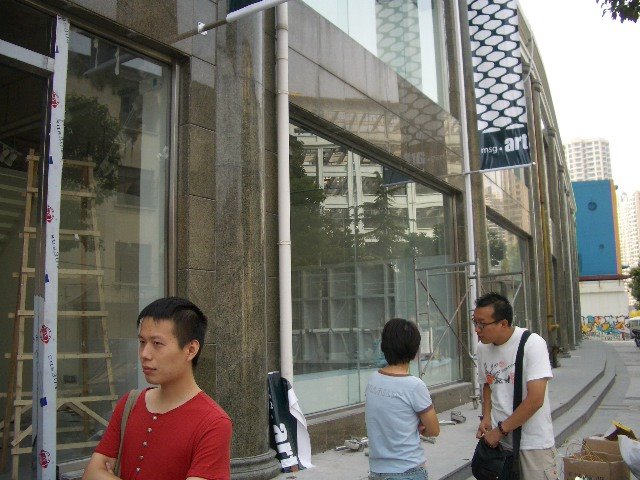
MSG Art, a gallery operating out of Los Angeles, has recently opened its doors at 87 Moganshan Road, featuring the works of Chi Peng, He Jie, and Zhong Shan. Perhaps the most exciting feature about the gallery is its hopes to open a cultural exchange among its artists, allowing for American and international artists to spend a month on site at the gallery exchanging ideas with local Chinese artists. http://www.msgart.com/
Another important gallery is that of BizArt, which is located on the fourth floor of 50 Moganshan Road, Building No. 7. Opening in 1998, BizArt is one of the only truly non-profit galleries in Shanghai. As China does not currently have a system in place for non-profit galleries, BizArt has to engage in a rather complicated system to move money around. The director is committed, however, to ensuring that BizArt remain untainted from cashing in on artists, or being supported by large real estate developers, as is Zendai. Although recently having run into some problems (which remain sensitive), the gallery continues to forge ahead with new artist exhibitions. The current exhibition, running from October 13th until October 20th, is ElectriCITY, featuring the work of Shi Qing. For more information, visit http://www.bizart.com/.
Yet another important gallery is that of Eastlink, located at 50 Moganshan Road, Building No. 6, fifth floor. Having opened in 1999, the gallery boasts 900 square meters of space, and is currently exhibiting “Extension Turn 2”, with works by a collection of international contemporary artists. One of the most striking currently on display is that of Johannes Speder, entitled “Mountain”. This work lies near the entrance to Eastlink, and occupies most of the front of the gallery. This captivating work lies across from another piece by He Yunchang entitled, “Beyond Mountains and the Sky”, a series of photographs detailing the artists attempt to use his own strength to push against the strength of an explosion. Eastlink is also featuring articles by seventeen different scientists in its catalogue, along with the twenty-seven participating artists. Eastlink also sells various antiques and past artwork in side rooms, to raise capital for its artistic endeavors. http://www.eastlinkgallery.cn/
Finally, one should not finish their visit to Moganshan without stopping at ShanghART, located on 50 Moganshan Road, Buildings 16 & 18. Currently, the works of Zeng Fanzhi were on display, displaying his completely unique approach to art, with various works on display. The new exhibit, by Pu Jie, has been set to open on October 18th, and runs until October 31st. One can find more at http://www.shanghart.com/.Although some might feel that Moganshan has a feel of a slightly contrived space, especially in high-rise Shanghai, there is no disputing that the galleries there have no qualms about taking risks and pushing boundaries in China. A visit to Moganshan will not disappoint, and with around 100 galleries that are constantly changing exhibits, the scene here is never static. Moganshan sets the pace for the rest of the Shanghai art scene, and for those who want to see things before the move to the Shanghai MoCA or Zendai, Moganshan is the place to be.

Tuesday, September 26, 2006

Palladium at NYU vs Zendai Museum in Pudong


Client: Ian Schrager
Program: Disco Stage & Rigging
Architect: Arata Isozaki & Associates
Architectural Lighting: Fisher Marantz Stone & Partners
Completion: 1985

In 1985, famed real estate partners Steve Rubell and Ian Schrager, owners of the legendary Studio 54, purchased the theater, setting their sights on establishing a second chic New York club. They hired to redesign the cinema. Isozaki gutted much of the inside to create the state-of-the-art club, which featured a 3,200 square foot dance floor. Its ceiling featured artwork by New York artists like Keith Haring, Jean-Michel Basquiat, Kenny Scharf, and Andy Warhol.

When the Palladium finally opened its doors in 1985, it was an instant smash, attracting 20,000 people per week, including many NYU students. Much like Studio 54, movie stars and musicians frequented the club, receiving VIP treatment while there.