For an exhibit about comfort, the comfort exhibit was oddly uncomfortable.
But perhaps that's what makes the experience so interesting.
Lets start with the location. By no means was it located in a run down shanty part of town, but an art exhibition (at least from my limited experience) it was not. Rather it was a little apartment on the second floor of an old apartment complex at the end of a semi-secluded alleyway. I'm sure the used pots and pans in the hallway extenuated the entrance. Walking up the dimly lit stairwell, I distinctly remember being confused, especially in the presence of pots. I don't know about my fellow classmates, perhaps more observant then I, but it was several seconds before I could decide where the exhibit started and where they stopped, i.e. was the kitchen actually an exhibit, because apparently the bathroom was one.
So upon entering the local we were asked to take of our shoes, a common enough Chinese custom. As such I decided to look for slippers, and indeed they had them. And on the theme of uncomfortable? They were most definitely uncomfortable (due to my oddly shaped/size feet).
Then the heat hits you. Wow, it's sort of hot in the room, and why is that? The very first art exhibit catches my attention. It's a gigantic ugly looking air con unit. The guide/artist directing our awkward group explains:
This air-con unit is put in reverse, usually the contraption is on the outside. The idea is that by putting in the reverse we are trying make the outside cooler, even if it is only by a minuscule amount.
Interesting, but on the flip side it raises the temperature of the exhibit by a significant amount, as beads of sweat on my forehead can most probably attest to.
Next we are introduced and ushered into the second room. It's another odd one, the room's floor is decorated with light blue tiles, tiles that sink into the floor when you step on them. An interesting contraption that creates a visually, physically unique experience as you make your way around the small room. But what's the practical result? A room that is very hard to navigate in. I tread around very carefully, keeping my balance and trying not to bump into anybody in the overly crowded room. Pain was my next thought, my toe gets crushed by one of the tiles as ironically the guide accidentally steps to near my own foot. He of course obligingly moves his foot after I rudely ask him to. Dealing with a throbbing foot and the mild heat I turned my attention to the steps leading up a window resting at waist height. The guide tells me its an interactive piece of art. OK, so I try to get on the platform, only to find that the "cushion" floor and the wooden viewing platform are not really built to accommodate each other. In others words, I almost fall off.
My experience gets more normal from that point. Others things of note include the open windows, which again in one sense allow the attendee to view the outside landscape (someoneelse's apartment, the alleyway, and empty plot of land). But on the other they let insects in, as well as the aforementioned heat. And don't forget the awkwardly placed mattress that somehow you are supposed to step on...
As we leave I get the feeling that most us (as in the NYU study abroad students) don't really have any idea what is exactly going on. One of my teachers makes a funny comment about how uncomfortably odd this whole exhibit is. I think our guide overhears, but I concur, if not in a positive manner.
To top off the trip I figure I might check out the bathroom. I step in and draw a blank, where is the exhibit? Then I notice that all the daily items used in the bathroom are instead hanging or glued onto the walls. I don't get it, but even if I had wanted to use the bathroom (which at that point I had a slight urge to do) I don't think I would have.
That pretty much was the general feeling. Where does the exhibit end and where does it start? It's an apartment so the toilet bowl should work right? I don't know...
Thus concludes our little escapade to the comfort exhibit as I take of my unconformable slippers and put on my pair of flip-flops.
But let me digress, I have yet to give my opinion of the exhibit itself. I liked it. It wasn't the pieces of art, it wasn't the cute ideas, it wasn't the reverse-air con, rather it was on a whole the way that such art was displayed. This kind of modern art was intelligently displayed in this manner, it's unique flavor is lost if shoved in an upscale exhibit. I don't know if it was purposefully designed as such, or if I had a uniquely "Kevin" experience, but I felt that the comfort exhibit was displayed in a hilariously uncomfortable way.
With a throbbing toe (which got better later that day) a sweaty shirt and a confused demeanor I can safely say that I thoroughly enjoyed my uncomfortable experience.
Showing posts with label comfortable. Show all posts
Showing posts with label comfortable. Show all posts
Wednesday, September 17, 2008


The Business of Art


When different artists combine their works into a group show, there is always the risk of an inconsistency and an awkward result. With “Comfortable”, I didn’t feel that at all, and I think it’s because of the setting within an actual apartment. In a home, things don’t need to necessarily match in order to feel right, and that response carries over into this show, - it was comfortable. There was something natural about the way the gruop of artists got together to exhibit their works. I particularly liked the room with the foam and tiled floor. It simply was very cool and unique. The whole exhibit was actually rather unique; the way each installation contributed to the greater picture but was able to stand on its own, with its own meaning and purpose while really connecting with the idea of the artist existing within a community outside of a formal institution.
This sense of pure community I was feeling dissipated quickly upon arrival at the “ShContemporary 08” art fair. I feel the need to preface this entry with a disclaimer about how I really am not into the commercial side of the art world. What I saw, was a market of new wealth that has lead artists and galleries to create and support really commercial works of art in order to cater to this new group of customers who may now know anything of art except that it is fashionable and shows off their status. A booth at the fair, occupied by a magazine held a sign that put this manipulation and pretention best, “No one knows china’s rich better. Influencing the spending of china’s richest.” I saw a trend of works that tried to be very provocative, deep, and revolutionary, but just came off as contrived and un-unique. An example of this is a statue of a monk (I think it may be Gandhi but I’m not sure) with an ipod, a juxtaposition that I find to be extremely obvious and boring –shock value that fails to shock. Of course I understand that it is a business after all and catering to your market is just smart, but I can’t help but feel it is being done at the expense of the art, that art wasn’t being created for a reason other then to be a commodity.
It wasn’t all bad though of course. There were works by artists whom I knew of, and other I hadn’t head of before. In this way, I really appreciated the fair for exposing me to new and different talents, and to show me old favorites. I really enjoyed checking out the whole show –even the parts I didn’t agree with. Especially, I really was taken with Miao Xiaochun’s re-imagining of Heironymus Bosch’s ‘garden of earthly delights’, “Microcosm.” Using digital imagery and adding modern accoutrements such as phones, lamps, and other electronics, he has created an extremely fascinating piece of social commentary. Unlike the statue mentioned above, here I do think the inclusions of items of contemporary pop culture are appropriate given the nature of the work and for the message conveyed. It’s very cool that the work is a complete take on such an old classic but can definitely stand on its own. I have since done a little research on Miao Xiaochun and have discovered that he has digitally interpreted several classic works, each containing his own take of course. All in all, I can put my feelings about the business aside because even with all the mediocre, there always seems to be something special to find at these big group shows.
This sense of pure community I was feeling dissipated quickly upon arrival at the “ShContemporary 08” art fair. I feel the need to preface this entry with a disclaimer about how I really am not into the commercial side of the art world. What I saw, was a market of new wealth that has lead artists and galleries to create and support really commercial works of art in order to cater to this new group of customers who may now know anything of art except that it is fashionable and shows off their status. A booth at the fair, occupied by a magazine held a sign that put this manipulation and pretention best, “No one knows china’s rich better. Influencing the spending of china’s richest.” I saw a trend of works that tried to be very provocative, deep, and revolutionary, but just came off as contrived and un-unique. An example of this is a statue of a monk (I think it may be Gandhi but I’m not sure) with an ipod, a juxtaposition that I find to be extremely obvious and boring –shock value that fails to shock. Of course I understand that it is a business after all and catering to your market is just smart, but I can’t help but feel it is being done at the expense of the art, that art wasn’t being created for a reason other then to be a commodity.
It wasn’t all bad though of course. There were works by artists whom I knew of, and other I hadn’t head of before. In this way, I really appreciated the fair for exposing me to new and different talents, and to show me old favorites. I really enjoyed checking out the whole show –even the parts I didn’t agree with. Especially, I really was taken with Miao Xiaochun’s re-imagining of Heironymus Bosch’s ‘garden of earthly delights’, “Microcosm.” Using digital imagery and adding modern accoutrements such as phones, lamps, and other electronics, he has created an extremely fascinating piece of social commentary. Unlike the statue mentioned above, here I do think the inclusions of items of contemporary pop culture are appropriate given the nature of the work and for the message conveyed. It’s very cool that the work is a complete take on such an old classic but can definitely stand on its own. I have since done a little research on Miao Xiaochun and have discovered that he has digitally interpreted several classic works, each containing his own take of course. All in all, I can put my feelings about the business aside because even with all the mediocre, there always seems to be something special to find at these big group shows.
A Whole Other World


The Comfortable Exhibition was perhaps the best and the oddest experience yet. We started off going into a small alleyway, up a set of steep stairs in to what seemed like a typical local Chinese home. We passed by the kitchen, in which food had recently been cooked. As I took my shoes off and walked into the place, I stood around waiting for the man to show us his artwork in that typical neat manner on the walls. Instead, we were released to just look around his place. Being completely befuddled at what was going on, I stumbled into a room in which the entire floor was layered with sponge, in which a layer of blue tiles was loosely glued on top. This was when I finally realized that his home itself was an art exhibition. I was awe-stricken by such a creative idea. And most of all, I felt like I was more open-minded to interpretation because I was thrown into it without expectations.
My favorite part of the Comfortable Exhibition was the drawers. One of them had steam flowing out of a mysteriously red inside that could barely be seen. The other drawer had once again contained a mysterious red structure inside as well that was revealed as well. The latter had humid drops collecting inside the mysterious, red identity inside. I loved these parts because it reminded me of how in life, answers won’t just be laid out for you. There are some things that you will never know, and some things that just don’t have a solution, an answer. But that is the beauty of it, just like these pieces of art emitted a mysterious aura of beauty.
The second place, SH Contemporary Art Fair, was just as delightful and insightful. My favorite pieces were the ones that represented the looming future problems of today’s world, given that I have a strong interest in eco-friendly practices. As we entered, we came across this clear contained filled with water that you can pump. In it were tiny imitations of plastic Coke bottles, trash, and to-go-boxes clustering around the decaying boat under the sea and on the surface. This was such a realistic representation of today’s polluted world and its forthcoming environmental detrimental effects. Its purpose seemed to be to emit a sense of urgency and responsibility in the world’s citizens. Lin Hairong painted the other artwork that captured a similar societal/environmental concern. It was an oil on canvas work called, April: Sand Storm Coming, Quick, Plant Trees! The gray background seemed to represent the suffocating smoggy air and the girl’s dire expression seemed to show the gravity of the environmental situation.
Out on the Tiles

Certainly from my perspective, which has been limited almost exclusively to western traditions, it’s difficult for me at this stage to comment historically or contextually on the contemporary Shanghai art scene. I have spent countless hours in lecture halls and slide rooms learning the objective facts of thousands of works of western art, and it is an admitted departure for me to interact with a vibrant art community, departed from ivory tower intellectualism.
This past week, at the apartment exhibition Comfortable, I was able to experience a highly cultivated and manipulated treatment of space in the midst of gritty realism of urban Shanghai. Fundamentally, the installation left me with several impressions. Firstly, there was a definite effort paid to arranging the space in such a way that the viewer became particularly observant of his or her physical interaction with the space. When one entered the apartment, one first had to pass through a narrow hallway, condensing the group, before removing one’s shoes to both preserve the space and to create a more intimate interaction between the viewer and the exhibit. When one entered the space and moved to the room on the right, the tiles gave way under one’s weight, and to look out of the window in the room, one had to stand on a set of stairs, precariously placed on the loose tiles. Both manipulations of space create an increased awareness of the viewer’s movement and positioning. A similar tactic is used in the bedroom, as one must stand on the bed to view the pictures and words pasted on the wall.
The exhibit also left me with the impression of attention to the exterior neighborhood surrounding the apartment. Each window was left open, and the viewer was encouraged in the bedroom to peer through a telescope, voyeuristically placed so it focused on a neighbor’s window in the distance. In the room with tile floors, the stairs next to the window allowed the viewer to look farther out the window than if his or her feet were on the ground, thus allowing for a greater perspective on the neighborhood. Overall, it was a strong exhibit, particularly in its way to call attention to interactions between inhabitant and living space.
The Shanghai Art Fair was an entirely different experience. The focus of the fair was not only to present the art as aesthetically and culturally relevant, but also to market each piece as an item for sale for potential collectors, galleries, or museums. The art there could be classified by its pluralism: in one stall there may be a piece seemingly influenced by American abstract expressionism, in the stall next to that there may be a piece that draws from early European modern influences, in the stall next to that there may be a piece that is indebted to more contemporary forms of photo-realism. It was certainly valuable as a demonstration of the real world buying and selling of art, as well as providing a pluralistic view of contemporary art from Shanghai and around the world.
finding comfort in Shanghai
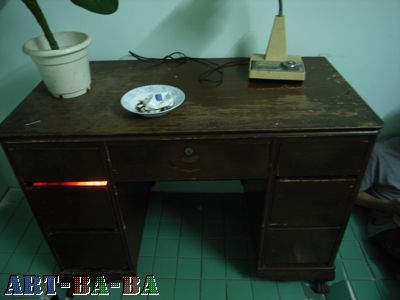

I was lead into a semi-clean alley with a group of my peers from our arts and media class for our visit to an arts exhibition. Not being given any prior background on where we were about to go, I had no idea what to expect. I noticed a wall surrounding a home with shards of glass on top of it, and soon realized that we were walking into an apartment. I walked up the narrow steps which led into a narrow hallway. To my left was a man chopping meats, to my right, a kitchen where we were asked to take off our shoes. If this were any situation besides a class field trip I would have immediately turned around and left but onwards I went. I walked inside a little room and the first thing I saw was a rack with white T-shirts with black pieces of advice on them. People started filtering into the room on the right. I glanced in and saw people stepping on the green tiles, tiles that came off the floor! "Oh, crap" I thought to myself, until I realized that every inch of the floor in that room was like that--tiles stuck on time of some sort of foam cushion material. I walked in, feeling the plush cushion fold underneath my weight, causing the tiles to rise and tickle my foot ever so slightly. I moved around the room with a little bounce in my step while the artists came in and passed out sheets of papers indicating what each part of the exhibition was. It was only then when it hit me that I was in the actual exhibition. The tiles moving up and down with every step I took I believe showed how no matter how volatile the world is, it will move with you. Every step and every move you make will affect your surroundings. Every push you make onwards, the more some force will push back, but not enough to stop you. The mysterious smoke emanating from the depths of a random table in the corner of the room showed that not all things are clear cut and even though it was strange to see the smoke coming from a drawer, that not all questions needed to be answered.
I walked into the next room, filled with strategically placed note cards and objects. Each note contained a piece of the artist's opinion, most of them filled with animosity towards his father. I felt as if I was looking directly into a part of the artist's life. This was the first time I had ever been in an art exhibition of this kind, and it allowed me to appreciate that everything I had seen. Every single placement of a photograph, a toothbrush in the bathroom, the air conditioner, the angle of the telescope looking out, were all placed there for a reason, for a purpose. The artists was trying to convey their feelings through their vision of what they deemed "Comfortable" in a bustling and growing metropolis. The simple representations of their world and what was in it tells us about their life.
Outside


Comfortable-Interesting exhibit. As I was climbing up the stairs the apartment, I never expected that the rooms themselves would be the art. Coming from a business background, art is a complete mystery, which is why I chose this class. It is interesting to see what I can get from this. So far, I like it. It's different, versatile, and open; adjectives not really used to describe accounting. What I liked most of all the art installations was the A 0.0001 Drop in Temperature. The idea, I found, was extremely clever: placing the air conditioner inside out, cooling outside instead of inside. Everything in the apartment seemed to want to break out of the confines fo the apartment. I felt that though everything was in those 4 rooms, nothing was meant for the inside: the telescope, the break in the wall, the foamed tiles, the smoke escaping from the draw, the art about homosexuality and the "outside" air conditioner. The message concerning the air conditioning was very interesting because it was such an unique yet, in a way, obvious idea. The air trying to cool the hot Shanghai weather, making a 0.0001 difference. Though it is small, it still can make a difference. It just made me realize that even the smallest difference is a change.
The SH Contemporary Art Fair was also a sight. The paintings and sculptures were eye-opening, colorful, and some were highly detailed. I left remembering the old and learning the new. The art piece of the gigantic pig and its mini piglets obviously represented greed and the evils of materialism. So many jewels, gold blocks, and selfish piglet followers. It was a disturbing yet true sight to see. I unfortunately did not gather any of the names of the artisits from the fair. One artist I would liked to have known was the artist who painted the picture above with all the people in the streets. I feel that represents China perfectly. There is a definite evidence of overpopulation in such concentrated areas. Just the detail and immense feeling you get from just looking at the picture created a feeling of tightness and pressure. I especially like the colors and the way it was painted. It is vibrant and detailed. The people all look the same but don't: dressed in different colors, some carrying things, others not. The people in the painting just look lost, desperate and even a little scared, all going in one direction. All cramping together to go towards one direction. It's as if they are just following the masses, going where everyone else is going without even thinking it through.
From The Ritz To The Rubble

Last weekend concluded the glamorous 2nd annual Sh Contemporary Art Fair, hosted here in Shanghai. Still a very young event, Sh Contemporary seems destined for success. Conceived by Lorenzo Rudolph, mastermind behind Art Basel and Art Basel Miami, Rudolph appears to have a knack for turning art fairs into high profile, world-class events. An art lover at heart, but a businessman by training, Rudolph has instantaneously marketed Sh Contemporary as a brand—and a popular one at that. Not to say that the onslaught of collectors, parties, and VIP events detract attention from the art. It is undoubtedly a wise career move for many artists and affords great exposure, providing the piece gets found in the labyrinth of an exhibition hall.
Lorenzo Rudolph seized the perfect opportunity to establish the first international art fair in Asia. The Chinese government saw the fair as an opportunity to broaden their cultural influence, collectors around the world seem to be drooling over contemporary Chinese art, and of course local galleries and artists were both clambering for international recognition. The fair was sure to be a hit.
The fundamental concept behind an elite art fair however, is to exhibit only the highest quality of work. But you have to wonder with all the attention put on commercial success, who is responsible for deeming certain art ‘of the highest quality’? Local curator, Biljana Ciric's recently published book Rejected Collection, provides a database of Chinese contemporary artists refused proposals. The book highlights the relationship between artist and art market. It questions the expectations of art institutions and the authenticity of contemporary Chinese works as pure expressions of artistic voice.
By no means does this represent the entirety of art in China. At the same time Sh Contemporary was in full swing, another show was on display just around the corner. Located in a Chinese housing complex, a group of a dozen friends have rented an apartment and set up site-specific installations based on their individual ideas of comfort. This group show called Comfortable, takes a much more personal approach to art and demonstrates the importance of home in a city full of skyscrapers and shopping malls.
So where exists the middle ground--an art institution that encourages creative experimentation and genuine expression, while providing the appropriate recognition and success for all parties. It sounds a little too good to be true, but maybe Lorenzo Rudolph is already hard at work on it.
Image World


We live in an increasingly virtualized world, where the image of reality comes to define reality itself. The invention of photography can be said to have transformed an entire worldview, constructing a particular way of perceiving ourselves and the world around us. It is a state of constant paranoia. Just like Foucault’s theory of the panoptican, there is a sense that we are constantly being watched, and in return, that we are constantly watching. This element of surveillance is found in one particular work in the "Comfortable" exhibition. Set in a makeshift gallery space that resembles a functional apartment, the piece consists of a telescope that points out the window, directing towards an apartment balcony of a high-rise building above. It is ambiguous as to where the viewer should be looking. The placement of the telescope suggests an intentional location to monitor; yet there is little to no activity to observe. The piece recalls Michelangelo Antonioni's 1966 film “Blow Up”, where the protagonist, a photographer, seemingly photographs a murder in a park. Yet, the more he blows up the image, the grainier the images gets, and the loss of detail makes it impossible to prove what is actually taking place in the photograph. Such is the ambience of the "Comfortable" exhibition's telescope, where the viewer is left in a state of confusion as to what the telescope aims to reveal. Just as our image-mediated world provides an overload of information, the message is lost in the act of looking. In contrast to the traditional notion of observation, which serves as a means to an end, the act of looking becomes a means in itself.
Osang Gwon’s Black Slider, showcased at the SH Contemporary Art Fair, illustrates a similar theoretical framework but focuses on the effect of the individual psyche. Osang Gwon’s sculptures are made entirely of photographs that cumulatively constitute the body. It suggests that our modern way of knowing is a process of fragmentation. Just as we catch glimpses of ourselves through storefront windows as we pass busily through the city, we understand ourselves as parts. Similarly, it could be said that our identity is constructed through a collection of fragmented images of who we think we are supposed to be. In any case, it is the image that defines who we are, and one might ponder just where authenticity stands facing such a predicament.
Subscribe to:
Posts (Atom)