The exquisite corpse, both an intriguing concept and combination of words, provides the idea that informs the exhibition of the same name currently at m97 Gallery. For those unfamiliar with the game of Exquisite Corpse or the ideology behind it, below I quote the curator’s statement:
“The Exquisite Corpse game began in France in 1925 around a table of poets and artists. In this improvisational game a player would write a phrase on a sheet of paper, fold the paper to cover part of it, and pass it on to the next player for their contribution. “The exquisite/corpse/will drink/the young/wine” was the poetic result of the first round played and hence the game’s name was born. While many initially condemned it as a frivolous game, others were quick to praise its significance for illuminating what Nicolas Calas deemed as the "unconscious reality in the personality of the group" or the group’s collective subconscious. Max Ernst identified these subconscious outcomes as the result of the process called "mental contagion." The game was quickly adapted to the visual realm of drawing and collage by assigning a section of the human body for each player to imagine.”
More familiar to most young people today is probably the visual version of the game, which I remember being played during math or science class, as it was easy to covertly pass a strip of folded paper to a nearby classmate. I’m not sure how much the game tapped into the subconscious of ten-year-old minds; we, however, found it thoroughly amusing to see the head of an alien on the body of a horse with the feet of a ballet dancer.
The intellectual, more ideological side to the game (I suppose it should henceforth be referred to as an “exercise”, not a game) is something I had never really considered before. The name alone, exquisite corpse, lends a mysterious tone of 19th century thought (at least in my mind). The combination of exquisite, evoking something extremely beautiful and delicate, and corpse, perhaps suggesting something not so much delicate as vulgar, together create something elegantly macabre, like something out of an Edgar Allen Poe story. This combination is not thoroughly paradoxical though, and it reminds us that even the most unlikely pairs can work in harmony under the right circumstances.
Just as paradoxical is the word that might come to mind when hearing the term exquisite corpse, I have realized that many people also think of contemporary China as paradoxical. Cities in China are paradoxical. Take Beijing as an example. Beijing, the imperial city, is the pride and joy China, home of the Forbidden City, the Summer Palace, and numerous famous temples. However, the Chinese are quick to forget about that history in the name of upward mobility. One of aspect of Beijing culture that doesn’t involve emperors but common people, is the style of neighborhood construct known as the hutong. Anyone who has been to Beijing, or seen older photographs of Beijing can visualize these low, curving blocks of houses divided by narrow, swooping alleyways. They are the epitome of the word community, as most people not only live in them but work nearby, and there are many people living in close proximity (which I imagine doesn’t lend itself too much privacy). However, in the wake of the recent Beijing Olympics, the government was all too quick to destroy much of this housing, early versions of which date back to the 13th century or so. About 15% of Beijing’s hutongs have been maintained for tourist purposes only. The paradox here is as follows: China takes a certain pride in its history, however, it fails to realize the value of such a structure that not so long ago dominated the city. The Beijing government wants the city to appear modern and prosperous, and decided to do so by destroying anything that wasn’t super modern, lest a Westerner’s conception of China actually be accurate. However, what people want to see when coming to China is, in fact, China. I can see incredibly modern buildings in New York, saving myself the 22-hour flight and visa application process. When I am in China, however, I would like to feel as though I am actually on a different continent. That said, there are definitely benefits to a modernized China, most of which are too complex and great to go into here. However, what China fails to achieve is balance, that harmonious blend between Eastern and Western (often things in China are dramatically polar, Eastern or Western, modern or ancient). More and more often, in dialogue about contemporary Chinese society some kind of binary will arise. As China grapples with its rich history and its desperate hunger to catapult itself into a future of modernity and prosperity, it remains caught up in (and set back by) much of its past.
To relate this back to the exhibition at m97 and the principle of exquisite corpse, I will reference Hong Lei’s photograph entitled “I Dreamt I was Hanging Upside Down While Listening to Emperor Song Hui Zong Playing Guqin with Chairman Mao” (2004). The photograph is a montage of bizarre images that cause a few double takes. The photograph depicts the following in a barren field: a man dressed in imperial clothing seated under a tree, apparently Emperor Song Hui Zong, playing the traditional Chinese instrument guqin. To his right sits a somewhat disproportionate Mao Zedong, whose profile is not entirely clear at first glance, but whose haircut is unmistakable. The ground is not only barren but appears to be the kind of overworked, nutrient-free soil so dry that the ground cracks and crumbles under foot. It is enhanced with obviously digital, copy-and-pasted emerald green shrubbery. To the left of the Emperor, looking more digitally imposed on the scene than either of his historical counterparts, is the artist, feet bound in rope, hanging upside down from an unseen source. A chair identical to the Chairman’s sits below the hanging man, suggesting that he was previously seated for the Emperor’s performance. Above the horizon line floats a small explosion, surrounded by the heavenly glow usually associated with the father of China, Mao Zedong. This photograph is almost an exquisite corpse game on the subject of Chinese history, juxtaposing several elements of Chinese politics and society from different eras. The way I see it, three eras are represented: the golden age of China’s dynastic years, the formation of the PRC and the Cultural Revolution, and the present. The artist chooses himself to represent the present, which I admire, as he is admitting that he can only speak for himself. Though the sentiments he expresses might be shared, but ultimately they are of his own opinion. And his opinion is clear- whether he his suggesting suicide by hanging (though he dangles from his feet, probably more torturous than suicidal) or he is simply evoking the feeling of blood rushing to one’s head from hanging upside down, the feeling isn’t good. His arms dangle at an unnatural 90-degree angle, and if he is turned right side up he appears to be putting his arms up in surrender. Is he surrendering himself to history, to China’s inescapable past (both the good and the bad) or is he surrendering himself to the future? Or do both just make him want to hang himself? There is a wide realm of interpretation in this photograph, much of it depending on how you view contemporary China. Physically, the emperor is entertaining Chairman Mao, not as a host but as a bard. I think this use of classical Chinese imagery suggests the employment of sacred Chinese history and culture as commodity, something that is prided in on the surface yet really exploited in the name of money. I get the feeling that, like Mao Zedong, contemporary China would rather forget the history that it somehow can’t escape. It seems as though China has jumped from ancient times to hypermodernity, which accounts for many of its current issues of identity. Mao sitting there, politely listening to classical Chinese music is akin to snap-happy tourists gawking at underdeveloped parts of old Shanghai or buying qipaos to take home to Florida. They are tokens of a bygone era, yet they are inextricable symbols of China, past and present. Symbols that China paradoxically seems equally eager to embrace and escape.
Showing posts with label mao. Show all posts
Showing posts with label mao. Show all posts
Sunday, November 16, 2008


Sunday, October 12, 2008
Qin Yifeng and Wang Ziwei
QIN YIFENG (b. 1961, Shanghai)
1961 Born in Shanghai
1983 Graduated from Shanghai Arts and Crafts College
1989 Graduated from the Fine Arts College of Shanghai University
Present Instructor, Fine Arts College of Shanghai University
Abstract Expressionist
Qin Yifeng was particularly interested in Abstract Expressionism and in how elements of this could be combined with the Chinese tradition. He is said to be influenced by Jackson Pollock's drip paintings of the late 1940s and early 1950s, and Mark Rothko and Barnett Newman's Color Field paintings. In these works the field of the painting was more important than internal structures in the composition. Qin is seen as integrating this idea with traditional Chinese artistic methods. His allover patterns originate in the columns of characters in traditional Chinese calligraphy. Qin has said, “The basic form and foundation of all Chinese characters is a line.” As a child he remembers writing as simple lines, and now he uses this concept in his paintings.


WANG ZIWEI (b. 1963, Shanghai)
Graduate of Shanghai Academy of Fine Arts (Shanghai, China)
Wang Ziwei uses an intercultural method of expression by blending different aspects of Chinese and American Pop Art and integrating the image of Mao into a contradictory context. Western cartoon or popular culture icons, most commonly Disney characters, are put in the context of Cultural Revolution propagandist imagery, or Mao's likeness is put into a Disney scene. I felt that his work was trying too hard, and that this concept has been used before to a greater effect. I understand the implications of juxtaposing Mao's image with something as disrespectful as bourgeois Disney characters, yet I feel that the concept of putting Mao in a capitalist context is rather transparent. However, I thin the few pieces he has done using Roy Lichtenstein's style and imagery (below) are a little more challenging, but probably don't provide the instant gratification of the Disney-related pieces.


1961 Born in Shanghai
1983 Graduated from Shanghai Arts and Crafts College
1989 Graduated from the Fine Arts College of Shanghai University
Present Instructor, Fine Arts College of Shanghai University
Abstract Expressionist
Qin Yifeng was particularly interested in Abstract Expressionism and in how elements of this could be combined with the Chinese tradition. He is said to be influenced by Jackson Pollock's drip paintings of the late 1940s and early 1950s, and Mark Rothko and Barnett Newman's Color Field paintings. In these works the field of the painting was more important than internal structures in the composition. Qin is seen as integrating this idea with traditional Chinese artistic methods. His allover patterns originate in the columns of characters in traditional Chinese calligraphy. Qin has said, “The basic form and foundation of all Chinese characters is a line.” As a child he remembers writing as simple lines, and now he uses this concept in his paintings.


WANG ZIWEI (b. 1963, Shanghai)
Graduate of Shanghai Academy of Fine Arts (Shanghai, China)
Wang Ziwei uses an intercultural method of expression by blending different aspects of Chinese and American Pop Art and integrating the image of Mao into a contradictory context. Western cartoon or popular culture icons, most commonly Disney characters, are put in the context of Cultural Revolution propagandist imagery, or Mao's likeness is put into a Disney scene.


Sunday, August 26, 2007
EXHIBITION: NET, curated by Wu Hung
For Immediate Release
September 1, 2007
September 1, 2007
EXHIBITION: NET, curated by Wu Hung
DATES: Sept 20 – Nov 3, 2007
Seven years after the opening of Chambers Fine Art in New York in 2000,
Christophe W. Mao is pleased to announce the opening of Chambers Fine
Art in Beijing on September 20th. Opening at a time when the interest
in contemporary Chinese was becoming an international phenomenon,
Chambers Fine Art became one of the primary showcases for the work of a
wide range of Chinese artists in the United States. As the art world
has become increasingly globalized in the last seven years, the
significance of Beijing as a cultural and artistic center has grown
enormously, leading to the decision to open a gallery there.
The striking new gallery, designed by Ai Weiwei is located in the Cao
Changdi district, a choice location which is rapidly becoming one of
the major centers for contemporary art in Beijing. The first exhibition
to be held in the new space, Net: Reimiganing Space, Time and Culture
is organized by Wu Hung, who has served as chief curator for many of
the biennials held in China and South Korea including the Shanghai
Biennale (2000) and the Gwangju Biennial (2006) and influential
exhibitions held in the United States and Great Britain (Between Past
and Future: New Photography and Video in China, 2004).
Wu Hung's first association with Chambers Fine Art began in 2000 with
First Encounter: Lu Shengzhong. For the current exhibition which brings
together specially commissioned works by seventeen artists associated
with Chambers Fine Art, Wu Hung has investigated the concept of a "net"
which "transcends any given time of space, history and region,
specificity and abstraction. At the same time it also inhabits any
given time and space, history and region, specificity and abstraction."
The meanings of the word range from the simple fishing net to Laozi's
use of the word as a political metaphor, and continue into the present
day with the omnipresence of the internet. As Wu Hung points out: "To
modern and contemporary artists, the "net" has become a favorite
subject of their work, mainly because this image allows them to explore
the connectivity and fluidity between the phenomenal world and the
conceptual world… Because of the complexity of this concept, the show
is expected to address many issues, from history and culture to its
status as a fundamental image."
Included in the exhibition are works by Ai Weiwei, He Yunchang, Hong
Hao, Hong Lei, Lu Shengzhong, Qiu Zhujie, Rong Rong, Shi Jinsong, Song
Dong, Wang Jianwei, Wang Tiande, Wu Jian'an, Yin Xiuzhen, Yu Hong, Zhan
Wang, Zhang Peili, Zheng Guogu. Representing several generations, the
selected are notably diverse stylistically and in the nature of their
relationship to the overpowering presence of the culture of classical
China. Their attitude to the massive transformation of Chinese society
in the last two decades, unparalleled in history, also ranges from
outright rejection to enthusiastic acceptance.
In the various phases of his development, Ai Weiwei has attempted to
emulate the achievements of classical art, on occasion to rescue it and
to demolish it altogether. Wang Tiande, Qiu Zhijie and Zheng Guogu have
turned to calligraphy to examine how it might become something other
than an antiquarian pursuit. Lu Shengzhong and Wu Jian'an have delved
deeply into the traditional world of Chinese paper-cut and have turned
away from the face of contemporary China. For Zhang Peili in his
photographic works, and for the searching Realist paintings of Yu Hong,
on the other hand, it is life as it is lived today that is of primary
importance. Song Dong and Yin Xiuzhen have used video, performance and
installation in their investigation of personal and social issues. Rong
Rong, Hong Hao and Hong Lei have used the contemporary medium of
photography as a means of creating haunting pictorial illusions while
Wang Jianwei and Zhang Peili have made major contributions in the field
of video. The disturbing performances of He Yunchang, one of which will
take place during the opening, in which he frequently puts himself in
situations of extreme discomfort or even danger, contrast with the
steely perfection of the sculpture of Shi Jinsong in which the element
of risk is an essential part of its appeal.
Christophe W. Mao has remarked: "It has been a rewarding experience
for me over the past seven years to work with this group of artists,
all great individualists unmoved by trends and what is currently in
vogue. Finally - and thanks to Wu Hung - I will be able to see what it
is that attracted me to them in the first place. Installed in the new
gallery their works will speak to each other and I will be able to see
not only what unites artists with similar interests but also artists at
the other end of the artistic spectrum from each other. Is there any
connection between the performances of He Yunchang and the sculptures
of Shi Jinsong and Zhan Wang. Or between the paper- cuts of Lu
Shengzhong and the paintings of Yu Hong. The "net" that Wu Hung
described will occupy real space from September 20."
A catalog on the exhibition will be available
For further information, please contact the gallery at (212) 414-1169
or cfa@chambersfineart.com
Monday, June 25, 2007
hinese artists capitalise on avant-garde boom
DAFEN, China (Reuters) - It only takes two days for Chen Quan to crank out a reproduction of a Yue Minjun.
"I have done hundreds of his paintings," says the shirtless 25-year-old, his hair tied in a ponytail, referring to the Chinese artist renowned for his paintings of absurd, grinning faces.
Standing by a half-finished copy that features bald men smiling sardonically while perched in a boat on a lake, Chen adds: "Copies like this aren't really hard at all. It just takes time."
While reproductions like Chen's go for only about 250 yuan ($33) apiece in Dafen, where copies of paintings by anyone from Da Vinci to Norman Rockwell are churned out in the dozens, prices of genuine works by China's top artists are soaring.
At Sotheby's contemporary art auction in London last week seven works by some of China's top painters, including Yue and Zhang Xiaogang, raked in 4.86 million pounds ($9.68 million) -- more than double their pre-sale estimate.
Yue's 1997 oil on canvas entitled "The Pope" sold for 2.15 million pounds ($4.28 million).
Another piece by Yue, depicting an open head with a pool of blue water in which late Chinese revolutionary leader Mao Zedong is having a dip, fetched 692,000 pounds -- almost five times the high end of the pre-auction estimate.
These prices come after previous auction records were set in May at a Christie's auction in Hong Kong.
COPIES POPULAR
"Chinese art these past few years has been extremely hot," says Wei Guangqing, another well-known painter and contemporary of Yue's who serves as dean of the Hubei Institute of Fine Arts.
The appearance of knock-offs of Chinese paintings in Dafen, an urban "village" in the southern boomtown of Shenzhen known for its reproductions of Western oil paintings, is a testament to their blossoming popularity.
The streets here are lined with shops, and on second and third floors, thousands of young artists churn out phoney Van Goghs, Monets, Dalis and generic hotel room art, often in assembly lines that would have made Henry Ford proud.
Chen says reproductions of the works of Chinese contemporary big-hitters make up more than 30 percent of his small shop's sales, although the walls are covered with realist nudes and Renaissance reproductions.
Other art dealers in Dafen estimate contemporary Chinese works make up 10-20 percent of their sales, and say they have been a steady staple since demand for the paintings emerged on the Dafen scene a couple of years ago.
In theory, there are copyright issues in copying, but in reality nobody here has any problems.
"When leaders or cultural officials come they say: 'These items are copyrighted, so just don't put them on top'," says one gallery owner.
FOREIGN BUYERS
The contemporary Chinese knock-offs -- the retro-revolutionary Wang Guangyis, the precocious baby-populated Tang Zhigangs, the colourful Fang Lijuns and the sneering Yue Minjuns -- are popular with foreigners and Hong Kongers.
"These are a little alternative," says Huang Zhenyi, who tends a gallery on one of Dafen's main streets.
Clicking on computer images of Yue Minjun art that customers can order, he adds: "Many foreigners who come here know a lot about this guy, but Chinese people don't know him. They just see all those teeth and the smile and think it's funny."
At Thursday's auction, the Chinese works were bought by Asians, but not mainland Chinese, says Evelyn Lin, head of the contemporary Chinese art department at Sotheby's Asia.
But, she says, there is growing appetite for contemporary Chinese art among mainlanders.
"Chinese consumers have just started to pay attention recently ... the mainland Chinese have learned to appreciate Chinese contemporary art," Lin says.
China's fast-growing economy is buoying the art market from the rarefied stratosphere all the way down to would-be starving art students.
"All my graduate students can sell paintings these days," says Wei. "But I think they are being influenced by the market too soon ... Youth today lack a lot of experience. Their evaluations of things are realistic, practical."
In Dafen, Chen is just focused on cranking out replicas as quickly as he can. He says he doesn't have time to work on his own art but he'd like to because he is under no illusions about what he does.
"This is just a craft," he says. "It's not really art."
($1 = 7.621 yuan)
Thursday, June 14, 2007
Surviving Under Mao: A Slacker’s Guide
This book looks good. I might read it in a year or so.. when I'm not tired of China anymore.
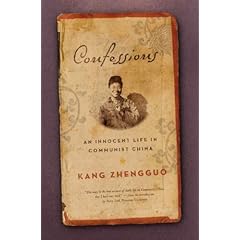
From the New York Times;
Like a character in a picaresque novel, Mr. Kang stumbles from one misadventure to the next, his big mouth and relaxed habits ensuring disaster at every turn. City, country, prison—he covers it all. The confessions pile up, his dossier swells, and even China begins to look too small to accommodate him. All he wants, really, is a quiet place to curl up and read a book, and a few notebooks to write in. The party won’t allow it.
Mr. Kang serves as an extraordinary guide through an extraordinary period of Chinese history. He lives through the Great Leap Forward, the Cultural Revolution, the thaw following Mao’s death, the growing democracy movement of the 1980s and the crackdown after the protests in Tiananmen Square.
The great events are expressed in personal terms, and they are colored by Mr. Kang’s unusual sensibility. He suffers, but he sees himself more often than not as a comic figure, and the repressive machinery of the Chinese state as a tangle of absurdities.
the rest of the review can be found here:
Confessions - Kang Zhengguo - Books - Review - New York Times
From the New York Times;
Like a character in a picaresque novel, Mr. Kang stumbles from one misadventure to the next, his big mouth and relaxed habits ensuring disaster at every turn. City, country, prison—he covers it all. The confessions pile up, his dossier swells, and even China begins to look too small to accommodate him. All he wants, really, is a quiet place to curl up and read a book, and a few notebooks to write in. The party won’t allow it.
Mr. Kang serves as an extraordinary guide through an extraordinary period of Chinese history. He lives through the Great Leap Forward, the Cultural Revolution, the thaw following Mao’s death, the growing democracy movement of the 1980s and the crackdown after the protests in Tiananmen Square.
The great events are expressed in personal terms, and they are colored by Mr. Kang’s unusual sensibility. He suffers, but he sees himself more often than not as a comic figure, and the repressive machinery of the Chinese state as a tangle of absurdities.
the rest of the review can be found here:
Confessions - Kang Zhengguo - Books - Review - New York Times
Thursday, June 07, 2007
From Propaganda to Profit
------------------------
From Propaganda to Profit
June 2007
From Propaganda to Profit
June 2007
by Rebecca Catching and Anurag Viswanath
This spring at Moganshan Lu, Shanghai's main art district, Beijing Art
Now Shanghai christened their gallery opening with a rather
unconventional exhibition, "Shanghai Now." Viewers entered the
cavernous warehouse and stared blankly at canvases sheathed in money.
Gallery founders Huang Liaoyuan and Zhang Haoming had wrapped each
painting in shiny wrapping paper printed with faces of various
different currencies. In doing so, they sought to remind viewers to
look beyond the commercial value of art and contemplate its intrinsic
value.
Xu Beihong's 1939 work Put Down Your Whip sold at a recent auction in
Hong Kong for a record $9.2 million.
It's a relevant point in the context of the Chinese art market, which
some claim has begun to spin out of control. Last year, Sotheby's and
Christie's sold $190 million worth of Asian contemporary art—most of
it Chinese. Prices reached unprecedented heights, with 43-year-old
artist Liu Xiaodong dropping canvases for a whopping $2.7 million, and
Xu Beihong's The Slave and Lion smashing the record for a Chinese oil
painting at $6.9 million.
Twenty years ago Chinese artists would have had trouble obtaining a
passport, but now they are globetrotters. They have studios at home
and abroad, showcase their art around the world, and are getting very
rich in the process. Why this boom? According to Simon Groom, head of
exhibitions at the Tate Liverpool, the Chinese art explosion "reflects
the interest in China, driven by the growth of its economy, the
emergence of Chinese collectors and an eagerness in the West for new
speculative markets."
Tate Liverpool's current exhibition "The Real Thing: Contemporary Art
from China" features 26 works by 18 leading Chinese artists, including
Ai Weiwei, Gu Dexin, Zhou Tiehai and the Yangjiang group. The exhibit
has been billed as the "show of the year" and is evidence of the
growing influence of Chinese artists abroad. Indeed, many of China's
most exciting artists are now based abroad—for example Xu Bing and Cai
Guoqiang—which puts them in close proximity to their collectors, 90%
of whom are foreign.
Yet mainland Chinese collectors are starting to get into the Chinese
art game, too. Catering to their needs are hundreds of mainland
galleries and auction houses which are springing up, as well as
foreign institutions that are in the process of opening branches in
China, such as the Centre Pompidou and the Guggenheim.
Auction houses, both foreign and local, have begun to deal directly
with the top-tier Chinese artists, snatching up works while the paint
is still wet, rather than going through collectors and galleries. Some
artists have responded to the demand by using teams of assistants to
churn out paintings. For example, Shanghai-based artist Zhang Huan
employs close to 100 workers in a massive studio that would make Andy
Warhol's factory look like a cottage industry.
A Long March
Under Mao, art was meant to "serve the people," i.e., workers,
peasants and soldiers—social groups not known for their inclination
toward the arts. And the bureaucratic controls designed to oversee
Mao's utopian social-engineering projects quickly made art subservient
to politics.
Artists were disseminators of propaganda, celebrating revolutionary
zeal and socialist euphoria through patriotic paintings. Icons of this
era include Dong Xiwen's oil The Founding of the Nation (1953), Jin
Shangyi's painting Mao Zedong at the December Conference (1961), and
Wu Hufan's Atom Bomb (1965), which marked China's coming of age as a
nuclear power.
Woodblock prints and oils done in the Soviet socialist realism style
featured square-jawed men leading China's industrialization, and
robust women harvesting bumper crops of plump rockmelons, while folk
paintings known as nianhua, or New Year's paintings, depicted bouncing
baby boys riding atop golden fish adorned with communist slogans.
Under the oppressive Cultural Revolution, a new genre, a variation on
socialist realism described as "red, bright and luminous" (hong,
guang, liang), celebrated the accomplishments of the Cultural
Revolution with the use of theatrical illumination and garish colors.
The fall of the Gang of Four in 1976 brought new beginnings, as both
artists and art schools were rehabilitated.
Deng Xiaoping's "opening and reform" in 1978 and the preoccupation of
the state with economics allowed for expanded realm of individual
freedom and space. The officially sponsored "New Spring" art
exhibition in February 1979, followed by an exhibition by the Stars,
paved the way for the rise of the Contemporaries, which included
artists such as Wang Huaqing, Sun Weiman and Zhang Hongtu. The
establishment of Fine Arts in China (Zhongguo Meishu Bao) in 1985, a
Bejing-based weekly arts newspaper; the formalization of official
channels for sale of art by the New York-based Hefner Gallery in
1987-89; and the Chinese Nude Oils exhibition in 1989 were important
milestones which led to the culmination of what some consider the
Tiananmen of the art world: the highly controversial, socially
critical "China/Avant Garde" exhibition at the Chinese National Art
Gallery in February 1989.
Following Tiananmen, the art scene limped back to normalcy after a
brief hiatus. In the following decade, the first art galleries, such
as Red Gate Gallery and Courtyard Gallery in Bejing, and Shanghart and
Eastlink in Shanghai, began to pop up, with clients including
influential foreign collectors such as Uli Sigg and Pierre Huber.
In the years that followed art was no longer used to further the aims
of communism, rather communist imagery was used further the aims of
individual artists who made a fortune off of genres such as political
pop.
Artists such as Wang Guangyi and Xue Song, produced technicolor images
of Mao and graphic paintings of workers. While cynical realists such
as Liu Xiaodong, Yue Minjun and Zhang Xiaogang employed both
hysterical and forlorn human figures in everyday scenes, giving visual
expression to the moral vacuum left behind by communism.
Towards the late 90s, artists began really test the limits of their
freedom with exhibitions such as the "Fuck Off" biennale satellite
exhibition curated by Ai Weiwei at Eastlink in 2000, and Cang Xin's
performance piece To Add One Meter to an Unknown Mountain, where he
piled the summit of a mountain with the bodies of his friends—an
oblique reference to the terror induced by the Cultural Revolution.
Though artists experienced a palpable growth in artistic freedom
through out the 90s and onwards, plainclothes spies from the cultural
bureaus made their presence felt, asking to speak to artists, removing
works, shutting down exhibitions and occasionally holding artists in
prison.
In 2006, the Hei Shehui collective—literally "hey, society" and also a
pun on the Chinese word for mafia—organized the controversial "38 Solo
Exhibitions" in a former army barracks in Shanghai. The exhibition
featured Jin Feng's provocative performance piece An Appeal Without
Words, which comprised a group of actual peasants covered head to toe
in a layer of gold paint, brandishing empty placards—a reference to
their compromised status in appealing land disputes. Such incendiary
work caused the show's closure and landed two of the artists in jail.
New-art observer Geremie Barmé likens the situation to Miklos
Haraszti's Velvet Prison. In such an environment, the majority of
artists choose not to test the limits, and social critique often takes
a back seat to profit.
In some ways, profit poses a more pernicious threat to creativity than
government censorship, as galleries pressure artists to create works
to feed the market. "Now that [the art world] has become
commercialized, these commercial forces inform artists if something
has commercial value," opines controversial conceptual artist Xu Zhen.
Mr. Xu, who spends much of his time working at nonprofit experimental
art center BizArt, pays little attention to the market. Rather he
chooses to raise questions about transparency and China's growing
military ambitions—filming videos of himself driving remote control
tanks into China's neighboring countries and staging mockumentaries of
engineers lopping off the top of Mount Everest.
While the success stories, such as Zhang Xiaogang and Yue Minjun,
dominate the business pages of the Western press, many critics see
them as examples of how Chinese art has failed to innovate. Outside of
the works of a small group of exceptional conceptual artists, much of
what lines gallery walls is uninspiring and derivative. Pia Camilla
Copper, a Chinese contemporary art specialist at the Paris auction
house Artcurial, says, "The painters, sculptors and conceptual artists
from [China's top academies] are technically skilled, they only lack
imagination. A sort of Turner Prize should be created for Chinese art
to encourage young artists to break free from academic rules, the
scourge of the Chinese art academy, and innovate."
At the same time, experimental art is stifled by the lack of
institutional resources. Museums are underfunded, as are nonprofit art
centers such as Shanghai's BizArt and Yunnan's Lijiang Studio. Serious
art criticism is also compromised by corruption amongst journalists
and critics who offer coverage and praise for a fee.
Ms. Catching is the arts and entertainment editor of that's Shanghai,
and the Shanghai correspondent for Art Asia Pacific. Ms. Viswanath is
a free-lance journalist based in Bangalore.
Saturday, June 02, 2007
Wu Guanzhong Painting Tops Poly's `Crazy' Beijing Art Auction
Wu Guanzhong Painting Tops Poly's `Crazy' Beijing Art Auction
By Eugene Tang
June 1 (Bloomberg) -- Wu Guanzhong's ``Ancient City of Jiaohe'' sold
for a record 37 million yuan ($4.8 million) last night at Poly Auction
Co. in Beijing, on the day the Chinese stock market recovered from its
worst slump in three months.
The one-square-meter (10.8 square feet) depiction of a ruined city,
painted during Wu's 1981 teaching sojourn in western China's Xinjiang
province, was estimated by Poly to sell for 15 million yuan. The buyer
was identified only by his surname Cai.
Cai was among hundreds of collectors crowding Poly's inaugural night
sale, scheduled to avoid clashing with the spate of summer art
auctions that typically take place on weekends in the Chinese capital.
Of 65 paintings on offer, 48 reached or exceeded their high estimates.
The sale totaled 247 million yuan.
``People have gone crazy,'' said Sun Liangliang, after his 4 million
yuan bid for Shi Chong's ``Contemporary Scenery'' was surpassed by a
rival's 15 million yuan offer. ``They're paying 10 million yuan as if
it's 100,000 yuan. If you want prove that there's too much money in
Beijing, just watch this market.''
Cai, a private collector who declined to give his full name, bought
two of the eight Wu Guanzhong oil paintings on auction, paying 42
million yuan, not including a 10 percent buyer's premium.
``Jiaohe'' was last sold in 1991 by Sotheby's Holdings auction for
HK$2.55 million ($326,900), a record at that time for Chinese oil
paintings outside the country.
``Jiaohe is the epitome of Wu's work,'' said Chang Tiangu, Poly's art
director. ``This is the piece that a true collector and admirer of
Wu's work would aspire to.''
Yue Minjun
Poly's record prices extend a trend that has seen paintings from
China's contemporary artists regularly sell for many times the
expected price. On May 27, Christie's International sold a record $79
million of 20th century Chinese art and Asian Contemporary works. Yue
Minjun's ``Portrait of the Artist and His Friends'' fetched HK$20.5
million, five times the presale top estimate.
At Poly's auction, Yue's ``Untitled'' sold for 1.7 million yuan,
beating the 1.2 million yuan top estimate.
Wang Yidong's ``Innocent Years,'' depicting a newlywed couple's
journey home, sold for an artist record of 8.5 million yuan, beating
the 6.7 million yuan fetched in December for his oil painting of a
girl playing cards.
Wang, 52, paints in a signature style that dresses a maiden entirely
in bright red against a backdrop that's usually a darkened interior or
the stark snow-covered landscape of his native Shandong province. He
began his art training at 17 and has held exhibitions in Tokyo, Paris,
Rome and the U.S.
Zeng Triple
Three oil paintings by Zeng Fanzhi, a favorite among overseas
collectors of Chinese contemporary art, surpassed top estimates. His
``Mask No. 14'' sold for 8 million yuan, his portrait ``Andy Warhol''
fetched 2.4 million yuan, while ``Landscape'' sold at 4 million yuan.
Mao Yan's ``Memory or the Dancing Black Rose'' sold for 9.1 million
yuan, triple the top estimate.
The auction wasn't all smooth sailing. Xia Xing's ``Perfume in
February'' was auctioned twice. The painting depicting a naked maiden
was first sold for 820,000 yuan. Fifteen minutes later the auctioneer
put the painting back on the block. This time the hammer came down at
750,000 yuan -- to a different winner. Poly officials declined to
explain the discrepancy.
To contact the reporter on this story: Eugene Tang in Beijing on
eugenetang@bloomberg.net
Tuesday, April 17, 2007
Once hated, now feted - Chinese artists come out from behind the wall
Once hated, now feted - Chinese artists come out from behind the wall
Charles Saatchi joins the swell of collectors beating a path to the eastJonathan Watts in Beijing
Wednesday April 11, 2007
The Guardian

Art world turned upside down ... Charles Saatchi has bought 15 of Zhang Dali's Chinese Offspring. Photograph: courtesy Saatchi Gallery
The naked Chinese migrant workers were dangling on hooks and ropes from a ceiling in north-east Beijing until a few months ago, when they were bundled up in bubble wrap, crammed into a container and shipped off to London.
They are not desperate Chinese peasants seeking illegal entry into the UK. Far from it. Their arrival in Britain is part of a cultural invasion, paid for by the UK's most famous art collector, and signalling a surge of interest in Chinese sculpture, painting and photography.
The life-sized resin figures are the work of Zhang Dali, one of China's leading artists. To highlight the role played by countryside labourers in his country's rapid urbanisation, Zhang took casts of 100 of them, substituted numbers for their names, signed the figures and offered them for sale like pieces of meat hung in a window.
Except, of course, they are a lot more expensive. Thanks to the booming market in Chinese art, the price for a single figure has doubled in the past two years to £10,000. That value is likely to increase further if they are shown at the opening of Charles Saatchi's new gallery in the King's Road this year.
Saatchi snapped up 15 of Zhang's Chinese Offspring in a shopping spree that has also seen him spend more than a million dollars each on two huge paintings by Zhang Xiaogang, the hottest property in the Chinese contemporary art scene, as well as works from at least 18 of his compatriots.
The UK buyer, whose patronage helped to establish the careers of Damien Hirst and Tracey Emin in the 1990s, is now paying increasing attention to the east. This year he launched a Mandarin version of his website, which gets more than 4m hits a day.
"I have been looking at lots of contemporary Chinese art in the past few years and find that a small percentage of it is world class and as good as the best contemporary art anywhere else," he told the Guardian. "There is a huge gulf, though, between the small amount that is world class and the majority, which is derivative and kitsch."
Saatchi is a late but influential arrival. Thanks to a near eightfold increase in the market in only two years, Sotheby's in Hong Kong recorded Chinese contemporary art sales of $21.9m (£11m) in 2006. It is a similar story at auction houses from London to New York, many of which started only recently to offer modern Chinese work but now find it their biggest driver of growth.
It has bordered on a frenzy. During the first auction of Chinese contemporary art in New York last April, so many bidders were calling in that Sotheby's ran out of telephones.
Among the most sought-after works was Lions, the roaring, guffawing multiple self-portrait by Yue Minjun, which eventually sold for more than half a million dollars. Yue's paintings and sculptures of garishly coloured laughing men are seen as symbols of China's consumer culture. This is one of the central themes for contemporary artists, along with reflections on materialism, the loss of traditional values, environmental destruction and the political legacy of Mao Zedong and Tiananmen Square.
Most of the headlines have been made by Zhang Xiaogang, whose giant family portraits and split-focus images from the Cultural Revolution era have generated the biggest interest among buyers. Last April, his Bloodline Series: Comrade No 120 sold for $979,200, almost three times Sotheby's high estimate. It was a record for Chinese contemporary art, but one that lasted only until October, when Saatchi paid £769,600 for another work by Zhang Xiaogang at a London auction.
With auction sales of $23.6m last year, Zhang Xiaogang was narrowly second to Jean-Michel Basquiat in the ArtPrice ranking of the 100 top-selling artists. But he was far from alone on the chart. There were 24 Chinese names last year, up from almost none five years ago.
This represents a huge change in attitudes and lifestyles. Ten years ago, avant-garde artists were on the fringe of Chinese society. Their works were often banned, exhibitions were shut down and, for most, the sales of their work were barely enough to make ends meet. Today, however, a growing number of artists own villas, foreign cars and apartments. "Cynical realist" Fang Lijun is said to own six restaurants in Beijing and a hotel in Yunnan province.
Among the newcomers to the top-seller list is Su Xinping, an artist from Inner Mongolia. Su said the price of his work had tripled in the past three years. "My life has changed a little. I still eat simple food and lead a simple life, but I have a more convenient house and a more convenient car. I have several homes, and I bought a studio in the city last year."
Su is one of many artists who struggled after their participation in the Tiananmen Square protests. But now he sees greater opportunities to do the work he wants to do, and to get paid for what it is worth. He received a call from New York recently to say several of his works had just sold for almost $400,000. "I won't get any of that money," he grinned. "I sold those pieces years ago." But he will benefit from now on. "The price for Chinese art was too low before. Even now some fine pieces have not reached their true value."
Zhang Dali agrees. "I expect the price will keep rising for at least five years because more and more people want to buy Chinese art, but there are not that many Chinese artists. The demand is increasing, but the supply is limited so the price will keep rising."
The reasons for the boom are manifold. The establishment of the Dashanzi art district in Beijing three years ago attracted many foreign buyers, who account for about 80% of sales. A government crackdown on property speculation and unease about stock market prices have also pushed many investors to consider art. But many overseas purchasers are motivated by a desire to grab a piece of history.
"I think the rise of the art market is highly related to the rising interest in China," said Jonathan Wong of Sotheby's in Hong Kong. "We observe money comes from all over the world and new buyers keep emerging in every auction."
Amid concerns about a speculative bubble, insiders say the boom is a mixed blessing. "For big-name artists, the price of works has gone up dramatically - by 10 to 20 times in some cases," said Brian Wallace, whose Red Gate Gallery was the first to show contemporary works in Beijing. "If you were in it for the money 10 years ago, you would be very well off today. But it is not easy. With all the new entrants into the market, more galleries are taking up more artists. So the overall quality is not as high as before. There are many good artists out there, but a lot of them are now painting for the market - even some of the big names."
Thursday, April 05, 2007
Designed for Hitler, modified by Stalin, manufactured by Mao.
Yet another example of China's main strategy for modernization, stealing technology from the rest of the world.
On display in the lobby of the Ramada Inn in Pudong is this Chinese copy of a Russian knockoff of a BMW R-71.
Flickr user, Marina Gorbis, snapped some photos...


The full text of this plaque can be read here.
Via BoingBoing.
On display in the lobby of the Ramada Inn in Pudong is this Chinese copy of a Russian knockoff of a BMW R-71.
Flickr user, Marina Gorbis, snapped some photos...
The full text of this plaque can be read here.
Via BoingBoing.
Thursday, March 29, 2007
Long March Project
ReBloggd, via Art Krush:
 Inspired by the historic Mao Zedong-led Long March — the Red Army's grueling 6,000-mile retreat across China from pursuing Nationalist forces — the Long March Project was founded in 1999. In 2002, it enacted The Long March: A Walking Visual Display, a series of performances and interventions at sites along the Red Army's original route. In 2003, the 25000 Cultural Transmission Center (the Long March Space) was established in Beijing as a dynamic exhibition space. The Long March Project also continues to participate in international exhibitions and is included in the Fifth Asia-Pacific Triennial of Contemporary Art. Artkrush reviews editor Andrew Maerkle spoke with founder and chief curator Lu Jie about the project's history and current activities.
The interview, along with some other images can be found in the original post, here.
Image: Artwork by Qin Ga, Photograph from series The Miniature Long March, 2002–05 Courtesy the artist and Long March Project, Beijing, All Rights Reserved
 Inspired by the historic Mao Zedong-led Long March — the Red Army's grueling 6,000-mile retreat across China from pursuing Nationalist forces — the Long March Project was founded in 1999. In 2002, it enacted The Long March: A Walking Visual Display, a series of performances and interventions at sites along the Red Army's original route. In 2003, the 25000 Cultural Transmission Center (the Long March Space) was established in Beijing as a dynamic exhibition space. The Long March Project also continues to participate in international exhibitions and is included in the Fifth Asia-Pacific Triennial of Contemporary Art. Artkrush reviews editor Andrew Maerkle spoke with founder and chief curator Lu Jie about the project's history and current activities.
The interview, along with some other images can be found in the original post, here.
Image: Artwork by Qin Ga, Photograph from series The Miniature Long March, 2002–05 Courtesy the artist and Long March Project, Beijing, All Rights Reserved
Tuesday, March 27, 2007
Never Say
The Sun Never Sets on the Maoist Empire
The Sun Never Sets on the Maoist Empire

Few Remaining Works of Maoist Propaganda Reinvent Themselves in Western Commodity Fetish Niche Market
1949-1952
The Founding of Peoples’ Republic of China, The Land Reform, the Korean War, and Movements Against the Three Evils and the Five Evils
The Founding of Peoples’ Republic of China, The Land Reform, the Korean War, and Movements Against the Three Evils and the Five Evils
The plaque introducing the first period '49-'52 noted that nearly all posters were produced not by state owned enterprises, but instead by private enterprises which had formerly produced European style commercial advertisements in the '20’s and '30’s – proof that the sweetest irony is never fictional.
The plaque cited three broad categories of influences for the works of this period;  traditional silks and Lunar New Year wood cut prints, Western art, and Eastern European art and literature. Particularly strong examples from the first camp are “Good for Both Water & Boss to Develop Production” – note, that’s not a typo, the placard really said that – and “Resist U.S. and Supporting Korea for Defending Family and Motherland,” which depicts Chinese and North Korean soldiers stabbing a stars and stripes clad big bad wolf caricature crawling its way across the Korean peninsula with Chinese and North Korean dual flagpole bayonets. The influence of western political cartoons on the latter is undeniable as it is in “Raise the Peace Torch to Brighten the Whole World,” “Founding Ceremony of New China,” and “Liberate Taiwan to Realize Reunification”, all of which also appear to draw on Eastern European (Soviet Style) art. With regard to the latter, I found it interesting to see the sham idea of liberation used to support imperialist ambitions in some context other than the
Perhaps the strongest piece of this period was the visually stunning “Strive to Produce More to Support the Most Beloved People to Attack U.S. Imperialism” whose use of sweeping movement in depicting a worker in the bottom left corner shoveling up and to the right and a soldier in the upper right corner rifle butting a grotesque caricature of a westerner down and to the left perfectly encapsulates the sense of sweeping change and juxtaposition of optimism and playful destruction of the political scene of the period.
Despite the political climate, some works of this period depict a docile proletariat’s life as domestic bliss. Works with this type of content drew stylistically mostly from traditional silks and Lunar New Year woodcut prints to display, as the poster puts it, “[display the] abundant imagination of a happy future,” of the time.
1954-1956
Peace, Industry, Domestic Bliss
During the subsequent period '54-'56, a peaceful and stable political milieu shifted the focus of majority of the propaganda to domestic industry and social life with a few notable exceptions. Perhaps one of the most exquisite pieces in the entire exhibit, entitled “Gala Night” comes from this period. In the foreground of the piece two porcelain faced school girls are engaged in a hypnotic, simultaneously symmetric and asymmetric pas de deux under a night sky trisected by spotlights’ beams at the intersection of which a firecracker explodes, creating an amazing sense of radial symmetry and motion. The piece reminded me of an equally exquisite Hermès scarf I bought for a lady friend entitled “Parapluies d’enticelles.”
Among the more visually interesting pieces related to industry during this period were “Strive to Produce More and Better Steel” in which two brawny steelworkers ride atop a steel dragon and “More Pigs for More Fertilizer to Obtain High Yield Grain” in which an enormous sow lies in front of a wall of grain with a litter of piglets suckling at her teat. The latter for some reason brought to mind that Sylvia Plath poem “Sow, ”included at the end of this entry should anyone wish to read it.
1957-1967
The Vietnam War and Dissolution of Soviet Alliances
 The information plaque for the period 1957-1967 states that masses of farmers and workers produced cartoon style posters caricaturing the “naïve thought of the overenthusiastic people under Mao’s influence at that time,” though it’s difficult to tell whether or not it references the works displayed. If it does, the works do an excellent job of maintaining the Camp sensibility of the type of propagandist works they mimic – and all original agit-prop art falls into the realm of Camp sensibility. However I’d conjecture that the plaque is most likely not referencing them, as they appear too seamlessly campy to be intentional. As Susan Sontag notes “one must distinguish between naïve and deliberate Camp. Pure Camp is always naive. Camp which knows itself to be Camp ("camping") is usually less satisfying[…] pure examples of Camp are unintentional; they are dead serious.”
The plaque also asserts that the Chinese style of propaganda posters came into its own during this period, something I disagree with. The style of this period seems to be little more than a heavy handed illustrating style, one which I can’t quite put a name to, but extends far beyond the realm of Chinese agit-prop art. Though it is hard for me to say, not being an art historian, whether it influenced Chinese agit-prop art or whether Chinese agit-prop influenced it. Given the political history though, and the degree of openness between the West and
1967-1971

First Four Years of the Cultural Revolution
 During the period of '67-'71, the start of the Cultural Revolution, a distinctly Chinese style of agit-prop art first emerges. The subject of almost all the pieces is Mao as the “red sun whose light brightens the whole country.” In these pieces Mao’s head usually blocks the sun, something which forms a halo around his face. Note the parallels between these images and Christian religious iconography as well as depictions of Louis XIV.

 In many pieces his images is depicted only on posters within a mass of proletariat. It’s almost as if the communist propaganda becomes aware of itself as propaganda. Mao becomes an image within an image (think Godard’s films within films), or rather a plurality of images within a plurality
of images.
1972 - 1979
As the cultural revolution continued in the following period, propaganda poster production wound down, lost its center, and spun out into stylistic miscellany. Mao succeeded in deifying himself visually through the propaganda, but could only do so transiently. Mortality being at odds with deification, Mao ultimately failed and failed miserably. As for the masses who, in the words of the famous sociological tenet known as Thomas theorem, “defined the situation [of Mao’s deification] as real” and thus for whom the situation became ”real in [its] consequences”, something Anatole France said comes to mind; if ten million people believe a foolish thing, it is still a foolish thing -- or in this case if one billion people believe a foolish thing, it is still a foolish thing. Mao’s image as a communist Helios ultimately faded; Deng Xiao Ping destroyed the vast majority of the posters when he took power, some 3000 exist in the collection of the

Contemplating questions of megalomania and arts awareness of itself as I exited, I came across a question of another sort; what visit to a communist propaganda museum wouldn’t be complete without a trip to the consumer capitalist crap fest that is the gift shop? The American side got the best of me and I ended up buying 16 postcards for 160 reminbi, most of which will be sent to my most conservative investment banker friends.
Throughout my perusing of the gift shop I couldn’t help but note, if the consumer capitalist nation-states in the West didn’t have a commodity fetish for vintage posters – remember that hideous craze like six years ago – this record of communist propaganda probably wouldn’t still exist. To the extent that the remaining images of Mao's deification does live on, it does so in an utterly ironic context.
***
Sow
Sylvia Plath
God knows how our neighbor managed to breed
His great sow:
Whatever his shrewd secret, he kept it hid
In the same way
He kept the sow--impounded from public stare,
Prize ribbon and pig show.
But one dusk our questions commended us to a tour
Through his lantern-lit
Maze of barns to the lintel of the sunk sty door
To gape at it:
This was no rose-and-larkspurred china suckling
With a penny slot
For thrift children, nor dolt pig ripe for heckling,
About to be
Glorified for prime flesh and golden crackling
In a parsley halo;
Nor even one of the common barnyard sows,
Mire-smirched, blowzy,
Maunching thistle and knotweed on her snout-
cruise--
Bloat tun of milk
On the move, hedged by a litter of feat-foot ninnies
Shrilling her hulk
To halt for a swig at the pink teats. No. This vast
Brobdingnag bulk
Of a sow lounged belly-bedded on that black
compost,
Fat-rutted eyes
Dream-filmed. What a vision of ancient hoghood
must
Thus wholly engross
The great grandam!--our marvel blazoned a knight,
Helmed, in cuirass,
Unhorsed and shredded in the grove of combat
By a grisly-bristled
Boar, fabulous enough to straddle that sow's heat.
But our farmer whistled,
Then, with a jocular fist thwacked the barrel nape,
And the green-copse-castled
Pig hove, letting legend like dried mud drop,
Slowly, grunt
On grunt, up in the flickering light to shape
A monument
Prodigious in gluttonies as that hog whose want
Made lean Lent
Of kitchen slops and, stomaching no constraint,
Proceeded to swill
The seven troughed seas and every earthquaking
continent.
Friday, March 16, 2007
"IMAGE-NATION: Works by New Generation of Chinese Artists"
"IMAGE-NATION: Works by New Generation of Chinese Artists"
Featuring works by: Chao Ziyi & Chao Ziwei, Chen Yun, Chen Yunquan, Guo Peng, He Jia, He Jiandan, Jiao Xingtao, Liang Binbin, Liu Danhua, Liu Lifen, Ren Zhe, Wang Mian, Wang Zi, Xia Hang, Xue Tao, Yang Bo, Yin Yanhua, Zhang Hua, Zhao Guanghui
Exhibition: 18 March till 10 May 2007
Vernisage/ Opening party: 17 March with the attendance of several artists
IMAGE-NATION is an exhibition which reflects the interests of a younger group of artists who no longer take as their subject the political content which widely characterises the western view of the work of their predecessors of the 1980s and early 90s. Political art produced today has at times recently become a parody of itself and no longer holds the significance or impact that work from the 80s and early 90s did. Collectors are becoming more discerning and are less easily swayed by images of pandas, Mao or the colour red; and seasoned auction goers are becoming more selective when it comes to political art post-1997. The artists in the present exhibition were too young to feel directly the impact of Tiananmen Square, and are rather affected by the new commercial and cultural openness, the rapid urbanisation and transformation of the cities, the incessant bombardment of consumer culture and the influence of mass media. The present exhibition takes as its starting point three different categories of cars, cartoons, and daily life. Through each of these subjects artists give an independent insight into life in China today.
The aim of the exhibition is to show that although the main collecting base for young Chinese artists for the short term remains in the west, that artists are no longer merely pandering (no pun intended) to a Western preconception of China or cynically producing political pop for the export market (although this clearly persists). There are artists who are exploring their own cultural identity, engaging with popular culture, reflecting the contemporary experience of daily life in China, and concerning themselves with issues and influences that directly affect them - an engagement which brings about an art with an independence of outlook and one which will in time bring them a domestic as well as international audience.
Contrasts gallery Principal: 181 JiangXi Middle Rd, Shanghai 20002
Gallery Hours: Monday to Sunday 10am -10pm
Wednesday, March 14, 2007
Problematic Propaganda and Fretting for the Future...
I made my way last Friday (9/March/2007) down the twists and turns of Huashan Lu towards the Shanghai Propaganda Poster Art Center.
And I have wisdom to pass down to any unsuspecting pilgrims interested in walking down Huashan Lu: the road curves at one point even though there's no sign to warn you. So keep an eye out for the cross streets and, well, you won't wind up getting Shanghai'd (haha).
The museum entrance is is ominously placed in an inconspicuous looking apartment complex - the perfect setting for either a horror movie or soap opera. After some gesturing the guard showed me THE WAY...which was on a business card/map. The actual museum is in a basement complex - again the perfect setting for a horror movie. But aside from some very interesting propaganda posters, you need have no fear.
Though I could have sworn I saw one of the Mao poster figures blink at me.
Anyway, I chose two particular pieces to review/critique because I felt they could be connected by virtue of both being visions into China's future. It is obvious that the intended vision to be disseminated among the people changes over time and as I'll explain.

Ok so I would give the Chinese name for this first poster but I'm slightly embarrassed to admit that I don't know all the characters. Sorry folks. I can tell you the English name though: "Hail for Over-fulfilling Steel Production of 10.7 Million Tons". This was published in 1958 by an anonymous artist. The version you're looking at now was cropped by yours truly but if you feel so inclined you can find the original image here.
My first impression of it was striking: the dark colors of the factories in the lower background are contrasted by the illumination from what appear to be crowds of people and fireworks. Though if you look carefully, you will notice smokestacks all with fires ablaze, a telltale sign of continuous work and continuous progress. The question I would raise to the viewer is to imagine exactly what kind of progress is taking place. The China depicted in the picture is undoubtedly industrialized, but at the price of mechanization and a sort of sterility - apart from the working masses 'celebrating' their work there is no sign of life. And surely no sign of individuality which reinforces the mechanization that has undergone the workforce, ironically one of the problems of industrialization that communism in a pure form is supposed to address. If this is the intended future of China then it surely comes at a high price of the sacrifice of the individual. It is minor and probably in consequential in light of cultural differences, but notice that there are no stars to wish on and no faces in the crowd. I would say this detail alone is the icing on the cake as far as sacrifice of the individual for the sake of the state is concerned.

I actually know all the characters for this next image so you're in luck. Or maybe not if you don't care for Chinese. It is called "中华人民共和国千岁"(zhong1 hua2 ren2 min2 gong1 he2 guo2 qian1 sui4) or in English "Long Live the Chinese Republic". Again I have cropped the version you're seeing but you can find the original here.
This poster was made in 1979 and again presents a future vision of China, but one that is arguably both more confident and more positive overall. If you look carefully you will notice that we have yet another industrialized future (and this is an amusing 70s rendition in which I can't help but feel that all the technology depicted looks somewhat outdated nowadays - the helicopter is hilarious). Yet this future is much more service oriented with all the forms of transportation and seemingly more accessible to the people. You can see suggested Chinese superiority in terms of trains, cars, boats, airplanes, satellites, and even spacecraft. This last spacecraft is especially interesting as it suggests the inevitability of the expansion and success of the Chinese nation beyond its borders, carrying the country and its ideals into a new beyond. In the center lower foreground there is a tractor as if to remind the viewer where the People's Republic has come from and how the long history of China is inevitably interconnected with its presumably rich future. The sky is literally not even the limit as these seemingly highly industrialized ideals are starting to reach much beyond the sky. The city is again sterile in comparison to the previous picture, but not in such a bleak fashion. And it is surprisingly clean looking as compared to the previous picture. I would argue that the city is void of people because it has developed exponentially beyond the real life scenario where people must walk on the street - people are using highly developed transportation.
Overall I very much enjoyed my visit to the propaganda museum and would highly recommend it to anyone. This is a rare chance for both Chinese and Foreigners to see important contemporary history artifacts concerning the development of Chinese culture. The two pictures I mentioned especially strike a chord for me as I watch Shanghai be developed. Are we finally getting a glimpse into unfulfilled past Chinese dreams? If you take a look at the skyline on the Bund, it doesn't seem so far away from the second picture. The question I would again raise is not whether this is development is going to happen because it undoubtedly already is and will continue to do so - but rather, what kind of future will Shanghai and the rest of China ultimately have? Personally, I feel like Shanghai is destined for the second picture right now...and we'll have to wait and see as far as the rest of China is concerned!
I welcome any other analysis from anyone. Feel free to agree or disagree and write a comment ;]
And I have wisdom to pass down to any unsuspecting pilgrims interested in walking down Huashan Lu: the road curves at one point even though there's no sign to warn you. So keep an eye out for the cross streets and, well, you won't wind up getting Shanghai'd (haha).
The museum entrance is is ominously placed in an inconspicuous looking apartment complex - the perfect setting for either a horror movie or soap opera. After some gesturing the guard showed me THE WAY...which was on a business card/map. The actual museum is in a basement complex - again the perfect setting for a horror movie. But aside from some very interesting propaganda posters, you need have no fear.
Though I could have sworn I saw one of the Mao poster figures blink at me.
Anyway, I chose two particular pieces to review/critique because I felt they could be connected by virtue of both being visions into China's future. It is obvious that the intended vision to be disseminated among the people changes over time and as I'll explain.
Ok so I would give the Chinese name for this first poster but I'm slightly embarrassed to admit that I don't know all the characters. Sorry folks. I can tell you the English name though: "Hail for Over-fulfilling Steel Production of 10.7 Million Tons". This was published in 1958 by an anonymous artist. The version you're looking at now was cropped by yours truly but if you feel so inclined you can find the original image here.

My first impression of it was striking: the dark colors of the factories in the lower background are contrasted by the illumination from what appear to be crowds of people and fireworks. Though if you look carefully, you will notice smokestacks all with fires ablaze, a telltale sign of continuous work and continuous progress. The question I would raise to the viewer is to imagine exactly what kind of progress is taking place. The China depicted in the picture is undoubtedly industrialized, but at the price of mechanization and a sort of sterility - apart from the working masses 'celebrating' their work there is no sign of life. And surely no sign of individuality which reinforces the mechanization that has undergone the workforce, ironically one of the problems of industrialization that communism in a pure form is supposed to address. If this is the intended future of China then it surely comes at a high price of the sacrifice of the individual. It is minor and probably in consequential in light of cultural differences, but notice that there are no stars to wish on and no faces in the crowd. I would say this detail alone is the icing on the cake as far as sacrifice of the individual for the sake of the state is concerned.
I actually know all the characters for this next image so you're in luck. Or maybe not if you don't care for Chinese. It is called "中华人民共和国千岁"(zhong1 hua2 ren2 min2 gong1 he2 guo2 qian1 sui4) or in English "Long Live the Chinese Republic". Again I have cropped the version you're seeing but you can find the original here.

This poster was made in 1979 and again presents a future vision of China, but one that is arguably both more confident and more positive overall. If you look carefully you will notice that we have yet another industrialized future (and this is an amusing 70s rendition in which I can't help but feel that all the technology depicted looks somewhat outdated nowadays - the helicopter is hilarious). Yet this future is much more service oriented with all the forms of transportation and seemingly more accessible to the people. You can see suggested Chinese superiority in terms of trains, cars, boats, airplanes, satellites, and even spacecraft. This last spacecraft is especially interesting as it suggests the inevitability of the expansion and success of the Chinese nation beyond its borders, carrying the country and its ideals into a new beyond. In the center lower foreground there is a tractor as if to remind the viewer where the People's Republic has come from and how the long history of China is inevitably interconnected with its presumably rich future. The sky is literally not even the limit as these seemingly highly industrialized ideals are starting to reach much beyond the sky. The city is again sterile in comparison to the previous picture, but not in such a bleak fashion. And it is surprisingly clean looking as compared to the previous picture. I would argue that the city is void of people because it has developed exponentially beyond the real life scenario where people must walk on the street - people are using highly developed transportation.
Overall I very much enjoyed my visit to the propaganda museum and would highly recommend it to anyone. This is a rare chance for both Chinese and Foreigners to see important contemporary history artifacts concerning the development of Chinese culture. The two pictures I mentioned especially strike a chord for me as I watch Shanghai be developed. Are we finally getting a glimpse into unfulfilled past Chinese dreams? If you take a look at the skyline on the Bund, it doesn't seem so far away from the second picture. The question I would again raise is not whether this is development is going to happen because it undoubtedly already is and will continue to do so - but rather, what kind of future will Shanghai and the rest of China ultimately have? Personally, I feel like Shanghai is destined for the second picture right now...and we'll have to wait and see as far as the rest of China is concerned!
I welcome any other analysis from anyone. Feel free to agree or disagree and write a comment ;]
Friday, March 02, 2007
Francesco Bonami on Chinese Art
http://www.nytimes.com/2007/02/25/magazine/25Style.China.t.htmlr=2&oref=slogin&oref=slogin
For every Koolhaas the West produces, [China] can produce 10 very good young Chinese architects able to deliver the same project, at the same level of quality, for about a third of the price. This doesn't mean, of course, that China is immune from nouveau riche posturing.
Published: February 25, 2007
Recently I received an e-mail message from a curator friend inquiring about a painter and sculptor named Liu Wei. I had included his work in a show I organized in Turin called "AllLookSame?" that featured pieces by young Korean, Chinese and Japanese artists. "Do you believe that Liu Wei is just a good artist or a very good artist that will be famous in the future like Zhang Xiaogang?" my friend asked. (Zhang Xiaogang is a Chinese art star whose paintings fetch six figures.)
I am a curator, but I am not a clairvoyant. The word on Chinese art right now is "Buy!" but I'm not convinced that we really understand what's going on there. Ten years ago, a few Chinese artists, like Chen Zen or Huang Yong Ping, appeared on the West's radar screen, satisfying a certain outdated "Orientalist" craving among some collectors. People like Uli Sigg, the former Swiss ambassador to China, who counts some 1,500 pieces of Chinese and Asian art in his collection, and another Swiss citizen, Lorenz Helbling, who opened his gallery, ShanghART, in China more than a decade ago, are reaping the profits of their foresight. But now Western collectors and dealers are descending on China like a swarm of annoying and aimless flies. Actually, today's burgeoning Chinese art world depends very marginally, if at all, on the gallery establishment in New York and London. Huge crowds may jam the Miami Basel and Frieze
art fairs, but those numbers are nothing compared with the potential size of the art market within China itself.
All of these things make it hard for me to answer my friend's question about Liu Wei. But the real difficulty has less to do with the dangers of market speculation than with the fact that I haven't quite figured out how a Chinese artist thinks, creates and produces a work of art.
A studio visit to an artist in Beijing is often like 10 studio visits in Brooklyn. In China, you don't find a painter, and a sculptor, and a video artist, but rather one artist who is working on painting, sculpture, photography, video and (why not?) performance all at the same time. When I visited Liu Wei in Beijing to select works for my show in Turin, he offered me not only beautiful cityscape paintings but also architectural models of famous buildings, like St. Peter's
Cathedral and the Empire State Building, made from the same rubber used to make fake dog bones. (I chose a painting.) In Europe, an artist that looks for inspiration in both a pet shop and the early work of Gerhard Richter would most likely be dismissed as lacking a consistent point of view. But in China the same criteria do not apply.
European artists often develop different bodies of work. Many Chinese artists seem to develop different bodies for each work. A great chaos under the sky was supposedly an excellent sign for Chairman Mao Zedong, and the same may be true for today's Chinese artists. Complexity and change is part of Chinese philosophy. To favor one medium over the others would be to impose a silly constraint. If all is possible in contemporary art, why limit yourself?
Beijing's Central Academy of Fine Arts currently receives applications from some 17,000 aspiring artists annually. Maybe a third of these will be accepted. But even if only 10 percent of those succeed in some way, there will be plenty of Chinese art to collect. What and by which ones has yet to be determined. But there is less and less doubt that the future, in some form or shape, will belong to the Chinese — not only as producers of art but also as consumers of it. Their capacity to devour and digest global ideas in order to create their own new aesthetic is
simply astonishing. It's happening already with architecture. After overcoming their initial inferiority complex, the Chinese are realizing that they don't need to buy into the Western star system. For every Koolhaas the West produces, they can produce 10 very good young Chinese
architects able to deliver the same project, at the same level of quality, for about a third of the price. This doesn't mean, of course, that China is immune from nouveau riche posturing. Louis Vuitton and Prada bags are as avidly consumed there as they are everywhere else on the planet. But a new, more sophisticated generation of creative people and style makers seems to be taking control.
Today, even government censorship has become a sort of performance art. During my visit to Shanghai last year, the government closed down a weeklong exhibition of ambitious installations in a newly renovated factory — some of the art was said to contain pornographic content — and a mild protest followed. But it all seemed to be part of a continuing game of cat and mouse, if not even a weird new form of art marketing.
They say that if you show a video of a tiger running in the jungle, a person from the West will focus on the tiger while a person from China will take in the whole image. There's no question that while Americans and Europeans are looking at individual artists or individual works of
art, the Chinese are seeing a cultural transformation of enormous proportions. Some Chinese artists will no doubt get eaten by the tiger. But perhaps it's the dealers and the collectors in the West who are missing the big picture.
Sunday, February 11, 2007
Mao Now (Ross Terrill - The Wilson Quarterly)
Mao Now (Ross Terrill - The Wilson Quarterly)
January 22, 2007
http://www.wilsoncenter.org/index.cfm?
January 22, 2007
http://www.wilsoncenter.org/index.cfm?
fuseaction=wq.essay&essay_id=202988
In the early 1990s, a story circulated among Chinese taxi drivers
about an eight- car traffic accident in Guangzhou that resulted in
injuries to seven of the drivers involved; the eighth, unscathed, had a
Mao portrait attached to his windshield as a talisman. The story fueled
Mao fever (Mao re) in China, with shopkeepers offering busts of Mao
that glowed in the dark and alarm clocks with Red Guards waving Mao's
little red book at each tick of the clock. Mao temples appeared in some
villages, with a serene portrait of the Chairman on the altar.
Transmuted uses of Mao continue today. Nightclub singers in Beijing
croon songs that cite Mao's words. Youths dine in "Cultural Revolution-
style" cafés off rough- hewn tables with Mao quotations on the wall,
eating basic peasant fare as they answer their cell phones and chat
about love or the stock market.
This nonpolitical treatment of Mao Zedong (1893–1976) is an escape that
fits a Chinese tradition. When floods hit the Yangzi valley and farmers
clutch Mao memorabilia to ward off the rushing waters, it is
reminiscent of Chinese Buddhists over the centuries clutching images or
statues of Guan Yin, the goddess of mercy, to keep them safe and make
them prosperous. Following the eclectic nature of Chinese popular
beliefs, Mao is added to the panoply of faith.
But where is Mao the totalitarian? Each of the major nations that
experienced an authoritarian regime in the 20th century emerged in its
own way from the trauma. Japan, Germany, Italy, even Russia departed
politically from systems that brought massive war and repression.
China, still ruled by a communist party, has been ambiguous about Mao.
Although Mao's portrait and tomb dominate Tiananmen Square in the heart
of Beijing, Mao himself— unlike Stalin in Russia or Hitler in Germany—
has floated benignly into a nether zone as if somehow he was not a
political figure at all, let alone the architect of China's communist
state.
The cab drivers, farmers, pop singers, and shopkeepers are really only
following the lead of the Chinese Communist Party, which does not quite
know how to handle Mao's legacy. New history textbooks approved for
initial use in Shanghai have largely brushed Mao out of China's
20th-century story. China has abandoned Mao's policies but not faced
the structural and philosophical issues involved in Maoism— and
probably won't until the Party's monopoly on political power comes to
an end. Yet unless China gets the Mao story correct, it may not have a
happy political future.
The moral compass of the Mao era has gone, unregretted. But money
making, national glory, and a veil over the past in the name of "good
feelings" are not enough to replace it. Can a society that lived by the
ideas of Confucianism for two millennia, and later by Mao's political
athleticism, be content with amnesia about the Mao era and the absence
of a believed public philosophy?
In a recent biography, Mao: The Unknown Story (2006), Jung Chang and
Jon Halliday pile up evidence that Mao was a monster to eclipse Stalin
and probably Hitler and Lenin as well. "Absolute selfishness and
irresponsibility lay at the heart of Mao's outlook" from his teens to
his dotage, say the authors. In a second influential volume, The
Private Life of Chairman Mao (1995), Mao's physician Li Zhisui portrays
the Chairman as exceedingly selfish, jealous, and promiscuous. Soon
after his book came out, Dr. Li came to speak at Harvard, and I showed
him around the campus. "Three words did not exist for Mao," the gentle
doctor remarked as we strolled. "Regret, love, mercy." These two books—
both written from outside China— explain the Mao era in China as
essentially the consequence of having an evil man at the helm.
Certainly Mao's rule was destructive. Tens of millions of Chinese died
in the forced collectivization of the Great Leap Forward of 1958–59,
victims of Mao's willful utopianism and cruelty. Millions more died,
and tens of millions had their lives ruined, during the Cultural
Revolution of the 1960s. Practicing brinkmanship toward India, Taiwan,
and the Soviet Union, Mao declared that a loss of hundreds of millions
of Chinese in a nuclear war would be a setback China could readily
digest.
Yet "bad man" does not adequately sum up Mao and his legacy. To believe
so would be to embrace the moral absolutism of communism itself, with
its quick verdicts ("enemy of the people," "hero of the proletariat"),
and to repeat the manipulations of official Chinese imperial history,
in which even a flood or earthquake "proved" the evil character of the
emperor. Were the "good men" around bad man Mao blind to his failings
for so many decades? Were the hundreds of millions of Chinese who bowed
before Mao's portrait and wept at the sight of him out of their minds?
Mao made history; at the same time, history made Mao. In addition to
looking at Mao's failings as a human being, we must look at the
structures and pressures that turned whim into tyranny. At the ideas
Mao wielded. At the evaporation— in Mao's case, as in that of several
other dictators— of youthful idealism and exactitude. Above all, at the
seduction of a "freedom" bestowed from above by a party- state that
believed it knew what was best for the citizenry.
In a Jesus was dismembered for speaking out… . He who speaks out does
not necessarily transgress, and even if he does transgress, this is but
a small matter to a wise man." Immediately we face a puzzle: Young Mao
was an ardent individualist. In his years at the teachers' training
college he attended in Changsha, the capital of Hunan Province, Mao's
credo became the self- realization of the individual. "Wherever there
is repression of the individual," he wrote in the margin of a
translation of Friedrich Paulsen's System of Ethics (1889), "wherever
there are acts contrary to the nature of the individual, there can be
no greater crime." His first published newspaper work, written in 1919,
was a plea for the liberation of women, a passionate nine- part
commentary on the suicide of a young woman in Changsha moments before
her arranged marriage.
Mao at 24 saw the Russian Revolution of 1917 as an outbreak of freedom
for the individual that lit the way for China. A young female friend
objected, "It's all very well to say establish communism, but lots of
heads are going to fall." Mao, who had recently read Marx and Engel's
Communist Manifesto, retorted, "Heads will fall, heads will be chopped
off, of course. But just think how good communism is! The state won't
bother us anymore, you women will be free, marriage problems won't
plague you anymore." Although these words hint at Mao's later
callousness about human life, it is striking that he viewed Lenin's
revolution in terms of the "marriage problems" of individual women.
The anarchism of Peter Kropotkin, the author of Mutual Aid (1902), had
a strong hold on Mao until he was nearly 30. A great virtue of the
Russian anarchist, Mao felt, was that "he begins by understanding the
common people." Anarchism in Mao's perception was linked with
Prometheanism; Friedrich Nietzsche was also among his early
enthusiasms. The Promethean individual would prepare for his heroic
role by taking cold baths, running up mountains, and studying books in
the noisiest possible places. This prefigures the fascism to come in
Mao's Cultural Revolution, just as fascism in Europe owed a debt to
Nietzsche. At the time, however, Mao's individualism was nurtured by
the influence of a Chinese professor at Changsha who had imbibed the
idealist liberalism of T. H. Green, the late-19th-century British
philosopher.
Mao was a rebel before becoming a communist. The psychological root of
his rebelliousness was hostility to his father, and, by extension, to
other authority figures. The political root was dismay at China's
weakness and disarray in the face of foreign encroachment, shared by
most informed Chinese of the period. Mao's chief use for the steeled
individual was as a fighter for justice and China's salvation. "The
principal aim of physical education," he wrote in 1917 in New Youth
magazine, "is military heroism." The authoritarian strain in Mao's
individualism was already present.
Eventually, Mao's respect for individual freedom collapsed. There were
four causes. One was the powerful current of nationalism in
early-20th-century China; the cry to rescue the nation eclipsed the cry
for the self- realization of the individual. A second was the large
role of war in China from the 1920s to the '40s. Pervasive violence
made political debate a luxury and favored repression. A third was
Mao's embrace of Marxist ideas of class, central economic planning, and
communist party organization. Fourth was the hangover in Mao's mind and
Chinese society generally of a paternalistic imperial mentality.
In the end, Mao Zedong, facilitated by Stalin, put the population of
the world's largest nation under a regimen that combined Leninism, the
paternalism of early Chinese sage- rulers, and, by the 1960s, a
hysteria and military romanticism that amounted to fascism Chinese-
style.
The imperative of national salvation was the first factor working
against Mao's attraction to freedom. Mao was mildly attracted to a
movement comparable in spirit to Europe's Enlightenment that sprang
into existence in China in 1919. Named May Fourth (after the date of an
initial student demonstration), it aimed at modernizing China by
embracing quasi- Western ideas of individualism, democracy, and
science. Liberated individuals would rescue China. But May Fourth soon
split in two, a left wing jumping to Marxist collectivism and a right
wing sticking with individualism. Leftists, including the 27- year- old
Mao, founded the Chinese Communist Party (CCP) in 1921.
Bolshevism helped Mao be progressive and anti- Western at the same
time. Opposition to the West was necessary to many young Chinese
leftists, despite the appeal of Western ideas, because of British and
other foreign bullying of China since the Opium War of 1839–42. From
Lenin, Mao learned that social justice and national salvation could
come as one package. Leninism— and to a lesser degree Marxism— joined
anarchism, nationalism, and individualism in the rag bag of Mao's
political ideas. It was Lenin who showed Mao his road to power. Anti-
imperialism was going to be for Mao, as it was for Lenin, the framework
for revolution. But this anti- imperialist— soon anti-Japanese— nation
alism that Mao injected into the Chinese Revolution negated individual
freedom.
In the 1930s, Mao argued to the semi criminal secret society Gelaohui
(Elder Brother Club) that its principles and the CCP's were "quite
close— especially as regards our enemies and the road to salvation." Of
course, the threat of enemies was the central point. In his appeal to
non- Han "minority" peoples during the Long March of 1935–36, when Mao
emerged as the CCP's top leader as the Communists retreated before
Chiang Kai- shek's Nationalist forces, Mao challenged Mon golians to
"preserve the glory of the era of Genghis Khan" by cooperating with the
Communists. Pressing the Muslims to support him, he told them that this
would ensure the "national revival of the Turks." Of course, Chinese
nationalism had turned Mao into a trickster. After the wars with Japan
and Chiang Kai- shek were over, there would be no common cause with the
Gelaohui, no freedom for the Mongolians or the Muslims of Xinjiang.
The violence that continually rippled through China was another force
militating against individual freedom. After the death in 1925 of Sun
Yat- sen, a leader in the overthrow of the Manchu dynasty in 1911 and a
founder of the Nationalist movement, the gun was prominent in Chinese
public life. Sun's wavering leadership gave way to warlordism, a
violent rupture of the tenuous coalition of Nationalists and Communists
in 1927, and growing incursions by Japan beginning in 1931. Guns were
to freedom as a cat is to mice. From the time Mao used force to
confiscate the holdings of Hunan landowners in 1925, when he was just
one of many CCP leaders, his political life cannot be understood aside
from violence, both the wars he waged and those waged against him. As
he sought to organize farmers in a remote mountain region, he remarked,
"The struggle in the border area is exclusively military. The Party and
the masses have to be placed on a war footing." Mao spoke of
"criticizing the Nationalists by means of a machine gun."
A third enemy of freedom was the class, organizational, and economic
theory Mao drew from Marx and Lenin. Here Mao's story is similar to
that of Stalin, Castro, and others. Class theory has intrinsic
distortions; people often do not act as members of an economic class.
Class labeling became especially inimical to freedom when Mao was
forced to rely on farmers rather than workers as the key class in
Copyright The Wilson Quarterly
China's revolution. Anyone who pointed out this departure from Marx's
theory of proletarian revolution was stamped out as a renegade.
Eventually, class became little more than a convenient way to demarcate
friends and enemies of the moment. Hence, longtime colleague and
expected successor Liu Shaoqi was "discovered" by Mao in the 1960s to
be a "bourgeois" who had "sneaked into the Party." Never mind that Mao
and Liu had worked together as leftist organizers on and off since
1922.
Subscribe to:
Posts (Atom)