Sunday, March 09, 2008


Saturday, June 02, 2007
Wu Guanzhong Painting Tops Poly's `Crazy' Beijing Art Auction
By Eugene Tang
June 1 (Bloomberg) -- Wu Guanzhong's ``Ancient City of Jiaohe'' sold
for a record 37 million yuan ($4.8 million) last night at Poly Auction
Co. in Beijing, on the day the Chinese stock market recovered from its
worst slump in three months.
The one-square-meter (10.8 square feet) depiction of a ruined city,
painted during Wu's 1981 teaching sojourn in western China's Xinjiang
province, was estimated by Poly to sell for 15 million yuan. The buyer
was identified only by his surname Cai.
Cai was among hundreds of collectors crowding Poly's inaugural night
sale, scheduled to avoid clashing with the spate of summer art
auctions that typically take place on weekends in the Chinese capital.
Of 65 paintings on offer, 48 reached or exceeded their high estimates.
The sale totaled 247 million yuan.
``People have gone crazy,'' said Sun Liangliang, after his 4 million
yuan bid for Shi Chong's ``Contemporary Scenery'' was surpassed by a
rival's 15 million yuan offer. ``They're paying 10 million yuan as if
it's 100,000 yuan. If you want prove that there's too much money in
Beijing, just watch this market.''
Cai, a private collector who declined to give his full name, bought
two of the eight Wu Guanzhong oil paintings on auction, paying 42
million yuan, not including a 10 percent buyer's premium.
``Jiaohe'' was last sold in 1991 by Sotheby's Holdings auction for
HK$2.55 million ($326,900), a record at that time for Chinese oil
paintings outside the country.
``Jiaohe is the epitome of Wu's work,'' said Chang Tiangu, Poly's art
director. ``This is the piece that a true collector and admirer of
Wu's work would aspire to.''
Yue Minjun
Poly's record prices extend a trend that has seen paintings from
China's contemporary artists regularly sell for many times the
expected price. On May 27, Christie's International sold a record $79
million of 20th century Chinese art and Asian Contemporary works. Yue
Minjun's ``Portrait of the Artist and His Friends'' fetched HK$20.5
million, five times the presale top estimate.
At Poly's auction, Yue's ``Untitled'' sold for 1.7 million yuan,
beating the 1.2 million yuan top estimate.
Wang Yidong's ``Innocent Years,'' depicting a newlywed couple's
journey home, sold for an artist record of 8.5 million yuan, beating
the 6.7 million yuan fetched in December for his oil painting of a
girl playing cards.
Wang, 52, paints in a signature style that dresses a maiden entirely
in bright red against a backdrop that's usually a darkened interior or
the stark snow-covered landscape of his native Shandong province. He
began his art training at 17 and has held exhibitions in Tokyo, Paris,
Rome and the U.S.
Zeng Triple
Three oil paintings by Zeng Fanzhi, a favorite among overseas
collectors of Chinese contemporary art, surpassed top estimates. His
``Mask No. 14'' sold for 8 million yuan, his portrait ``Andy Warhol''
fetched 2.4 million yuan, while ``Landscape'' sold at 4 million yuan.
Mao Yan's ``Memory or the Dancing Black Rose'' sold for 9.1 million
yuan, triple the top estimate.
The auction wasn't all smooth sailing. Xia Xing's ``Perfume in
February'' was auctioned twice. The painting depicting a naked maiden
was first sold for 820,000 yuan. Fifteen minutes later the auctioneer
put the painting back on the block. This time the hammer came down at
750,000 yuan -- to a different winner. Poly officials declined to
explain the discrepancy.
To contact the reporter on this story: Eugene Tang in Beijing on
eugenetang@bloomberg.net
Thursday, January 04, 2007
In China’s New Revolution, Art Greets Capitalism
By DAVID BARBOZA
Published: January 4, 2007
Images:http://www.nytimes.com/slideshow/2007/01/03/arts/20070104_ARTI_SLIDESHOW_2.html
SHANGHAI, Jan. 3 — After the peppered beef carpaccio and before the pan-fried sea bass there were raucous toasts and the clinking of wine glasses in the V.I.P. room of New Heights, a jazzy restaurant in this city’s most luxurious location, overlooking the Bund.
Wang Guangyi, one of China’s pioneering contemporary artists, was there. So were Zhang Xiaogang, Fang Lijun, Yue Minjun, Zeng Fanzhi and 20 other well-known Chinese artists and their guests, many of whom had been flown in from Beijing to celebrate the opening of a solo exhibition of new works by Zeng Hao, another rising star in China’s bubbly art scene.
“We’ve had opening dinners before,” said the Shanghai artist Zhou Tiehai, sipping Chilean red wine, “but nothing quite like this until very recently.”
The dinner, held on a recent Saturday night in a restaurant located on the top floor of a historic building that also houses an Armani store and the Shanghai Gallery of Art, was symbolic of the soaring fortunes of Chinese contemporary art.
In 2006 Sotheby’s and Christie’s, the world’s biggest auction houses, sold $190 million worth of Asian contemporary art,
most of it Chinese, in a series of record-breaking auctions in New York, London and Hong Kong. In 2004 the two houses combined sold $22 million in Asian contemporary art.
The climax came at a Beijing auction in November when a painting by Liu Xiaodong, 43, sold to a Chinese entrepreneur for $2.7 million, the highest price ever paid for a piece by a Chinese artist who began working after 1979, when loosened economic restrictions spurred a resurgence in contemporary art.
That price put Mr. Liu in the company of the few living artists, including Damien Hirst and Jeff Koons, whose work has sold for $2 million or more at auction.
“This has come out of nowhere,” said Henry Howard-Sneyd, global head of Asian arts at Sotheby’s, which, like Christie’s, has just started a division focusing on contemporary Chinese art.
With auction prices soaring, hundreds of new studios, galleries and private art museums are opening in big cities like Beijing and Shanghai. Chinese auction houses that once specialized in traditional ink paintings are now putting contemporary experimental artworks on the block.
Western galleries, especially in Europe, are rushing to sign up unknown painters; artists a year out of college are selling photographic works for as much as $10,000 each; well-known painters have yearlong waiting lists; and the Solomon R. Guggenheim Museum and the Pompidou Center in Paris are considering opening branches in China.
“What is happening in China is what happened in Europe at the beginning of the 20th century,” said Michael Goedhuis, a collector and art dealer specializing in Asian contemporary art who has galleries in London and New York. “New ground is being broken. There’s a revolution under way.”
But the auction frenzy has also sparked debate here about whether sales are artificially inflating prices and encouraging speculators, rather than real collectors, to enter the art market.
Auction houses “sell art like people sell cabbage,” said Weng Ling, the director of the Shanghai Gallery of Art. “They are not educating the public or helping artists develop. Many of them know nothing about art.”
But the boom in Chinese contemporary art — reinforced by record sales in New York last year — has also brought greater recognition to a group of experimental artists who grew up during China’s brutal Cultural Revolution (1966-1976).
After the 1989 government crackdown in Tiananmen Square, avant-garde art was often banned from being shown here because it was deemed hostile or anti-authoritarian. Through the 1990s many artists struggled to earn a living, considering themselves lucky to sell a painting for $500.
That has all changed. These days China’s leading avant-garde artists have morphed into multi-millionaires who show up at exhibitions wearing Gucci and Ferragamo.
Wang Guangyi, best-known for his Great Criticism series of Cultural Revolution-style paintings emblazoned with the names of popular Western brands, like Coke, Swatch and Gucci, drives a Jaguar and owns a 10,000-square-foot luxury villa on the outskirts of Beijing.
Yue Minjun, who makes legions of colorful smiling figures, has a walled-off suburban Beijing compound with an 8,000-square-foot home and studio. Fang Lijun, a “Cynical Realist” painter whose work captures artists’ post-Tiananmen disillusionment, owns six restaurants in Beijing and operates a small hotel in western Yunnan province.
If China’s art scene can be likened to a booming stock market, Zhang Xiaogang, 48, is its Google. More than any other Chinese artist Mr. Zhang, with his huge paintings depicting family photographs taken during the Cultural Revolution, has captured the imagination of international collectors. Prices for his work have skyrocketed at auction over the last two years.
When his work “Bloodline Series: Comrade No. 120” sold for $979,000 at Sotheby’s auction in March, many art insiders predicted the market had topped out and prices would plummet within months.
But in October, the British collector Charles Saatchi bought another of Mr. Zhang’s pieces at Christie’s in London for $1.5 million. Then in November at Christie’s Hong Kong auction, Mr. Zhang’s 1993 “Tiananmen Square” sold to a private collector for $2.3 million. According to Artnet.com, which tracks auction prices, 16 of Mr. Zhang’s works have sold for $500,000 or more during the past two years.
Are such prices justified? Uli Sigg, the former Swiss ambassador to China and perhaps the largest collector of Chinese contemporary art with more than 1,500 pieces, calls the market frothy but not finished.
“I don’t see anything at the moment that will stop the rise in prices,” he said. “More and more people are flocking to the market.”
Mr. Goedhuis insists that this is the beginning of an even bigger boom in Chinese contemporary art.
“I don’t think there’s a bubble,” he said. “There’s a lot of speculation but no bubble. That’s the paradox. In China there are only a handful of buyers — 10, 20, 30 — out of a billion people. You only need another 10 to come in and that will jack up prices.”
He added: “Another astonishing fact is there is not a single museum in the West that has committed itself to buying Chinese art. It’s just starting to happen. Guggenheim, the Tate Modern, MoMA, they’re all looking.”
Representatives from those museums, as well as others, have made scouting missions to China. A growing number of international collectors are looking at Chinese art too.
“After the 2005 Sotheby’s show I just jumped in,” said Didier Hirsch, a French-born California business executive who has long collected American and European contemporary art. “People said the next big run-up in prices would be at Sotheby’s in March so I said, ‘Now or never.’ ” Mr. Hirsch purchased nearly his entire collection — about 40 works — by phone after doing research on the Internet. He said he went first for what he called the titans — the original group of post-’79 painters — including Wang Guangyi and Liu Xiaodong.
Some critics here say the focus on prices has led to a decline in creativity as artists knock off variations of their best-known work rather than exploring new territory. Some are even employing teams of workers in assembly-line fashion.
Christopher Phillips, a curator at the International Center of Photography in New York, has become a regular visitor to China, scouting young artists for the center and other places. On a recent trip “I went to visit the studio of a well-known Beijing painter,” Mr. Phillips said. “The artist wasn’t there, but I saw a group of canvases being painted by a team of young women who seemed to be just in from the countryside. I found it a little disconcerting.”
There are also complaints that some artists are ignoring international standards by selling works directly into the auction market, rather than selling first to collectors. And many experts here say that some gallery officials and artists are sending representatives to the auctions to bid on their own works to prop up prices, or “protect” the prices of some rising stars.
But Lorenz Helbling, director of the ShanghART Gallery here, said Chinese artists continue to produce an impressive array of works, and that talk about the market being overrun by commercialism is exaggerated.
“Things are much better than they were 10 years ago,” he said. “Back then many artists were commissioned to simply paint dozens of paintings for a gallery owner, who went out and sold those works. Now these artists are thinking more deeply about their work because they’re finally getting the recognition they deserve.”
Wednesday, December 06, 2006
Chinese Art in the news
A painting by Liu Xiaodong sold in November for $2.7 million, shattering the record set by Zhang Xiaogang to become the most expensive Chinese contemporary art work ever sold at auction. The painting, "Three Gorges:Newly displaced Population," was sold to a Singapore collector in 2005. But the piece was put up for auction and the Chinese Poly auction house sold it today. The buyer was Zhang Lan, the founder of the South Beauty chain of expensive Chinese restaurants.
A conference called“The Reality and Dream of Chinese Contemporary Art” was held on November 17 at the Central Academy of Fine Arts in Beijing. Artists Liu Xiaodong, Xia Xing, Cui Xiuwen and the critics Yi Jinna, Zhao Li, Yu Ding and Feng Boyi discussed the topic “Can artists create artworks freely when they live in the market”drew lots of attention from the audience.
The Shanghai Art Fair arranged 2000 square meters space for 50 Young Chinese Contemporary Artists under 35 years old. Ma Liang, Han Zijian, Zhanghua, Xiang Qinghua, Zhou Jianhua, Liang Haopeng and Shen Na attended this special exhibition.
Zhai Mo, a 35-year-old abstract artist, will set out alone by sailboat from Shanghai for his around-the-globe voyage on January 1, 2007. His press conference was held at Chang An Club in Beijing last month. Zhai is hoping to become the first Chinese to travel around –the globe by sailboat.
Gu Ya, A 32-year-old woman from Yi Liang village in Yunnan Province, has created more than one thousand abstract pen–and-ink paintings in past three years, but she was only educated as high school level and never received art training. When asked to explain the meaning behind her images, Ms. Gu spoke in a language no one was able to decipher. The artist strange art and language has drawn enormous coverage from the media and on the internet. Now, CCTV – the national television network – plans an interview in the hopes of figuring out what this woman is saying and drawing.
Now in his 80s, famous Chinese abstract artist Zhao Wuji, who lives in Paris, was named last month an honorary professor of Fudan University. Five of his traditional art works have recently sold at auction for over $1 million, the highest being a 1958 composition that sold for $3.1 million – the highest price ever fetched by a living artist in China. Among contemporary artists, Liu Xiaodonghas sold for the highest price.
“Visible-Invisible”Chinese abstract painting exhibition was opened in One Moon Art Gallery which was located on Beijing Ditan Park on Dec. 2. Based on this exhibition, the seminar named “Chinese abstract painting” was held on Dec. 3. The artists of the exhibition were Chen Ruobing, Li Yang, Lin Yan, Tan Ping, Tang Kaizhi, Wang Guangle, Xu Hongming, Zhang Fan, Zhou Yangming.And the attendees of the seminar were: Gao Minglu, He Guiyan, Huang Du, Lei Hong, Li Xu, Liu Libing, Shao Yiyang, Sheng Wei, Wang Dunting, Wang Luyan, Wang Nanming, Wang Xiaojian, Zhu Jinshi, Zhu Qingsheng, Zhao Xun.
Christie's completed a record breaking auction of 20th Century Chinese art today with sales of $67.9 million worth of Asian contemporary and 20th century Chinese art works. Zhang Xiaogang's 1993 work, "Tiananmen Square," sold for $2.3 million, the second highest price ever paid for a work by a Chinese avant garde artist. Zhang Xiaogang had another work sell for $2.3 million and two other paintings sell for close to $1 million, making him easily the most sought after Chinese contemporary artist. Also, Yue Minjun's 1993 piece, "Kites," sold for $962,000 -- a record for a work by the artist. And a Zeng Fanzhi piece, "Mask 1999 No. 3," sold for 816,400 -- a record for the artist.
Two works by Chinese contemporary artists were banned from the Shanghai Art Fair held this week at the ShanghaiMART. The works were by Huang Rui and Cang Xin. The Cang Xin work portrayed him licking a Mao figurine. The works were being shown by the Hong Kong gallery 10 Chancery Lane. The gallery's other images -- including photographs of Zhang Huan and Ma Liuming undressing and standing naked with a large group of artists and other people -- were not taken down.
The latest issue of Time magazine features an article about the boom in Chinese contemporary art. The article, by Simon Elegant, is called "The Great China Sale," and it explains how hot the art market is right now. The article also mentions that Christie's auction in New York last week, one of Zhang Xiaogang's paintings sold for $1.36 million. The article also says that the British collector Charles Saatchi paid $1.5 million at a London auction for another piece by Zhang Xiaogang.
A man calling himself the “Yanan Clay Sculpture King,”Wang Wenhai, has accused the well-known Beijing sculptor Sui Jianguo, who is the professor of Central Academy of Fine Arts, of violating the copyright by creating a sculpture called Sleeping Chairman Mao. Wang, who worked in the Revolutionary Museum in Yan'an, the central province of Shaanxi, has devoted much of his life to creating sculptures of Mal. In 2002, Wang said he created a sculpture of Mao sleeping. Mr. Wang,who says Mao is his hero, also say Sui Jianguo's Mao in his work "Nightmare," also depicts Mao as the devil. Wang told one Chinese newspaper he was so angry about the image he fainted. This case was heard at a court in Beijing Chaoyang District People Court on November 21 2006. No word yet on the verdict.
In 2006 Taipei Biennale, the young artist from Guangzhou, Cao Fei, created what is being called her National Father project. As a curator, Cao Fei planned the whole sculpture solo exhibition for her father, the sculptor Cao Chongen. At the exhibition, she exhibited six small bronze sculptures of the famous Chinese leader Sun Yat Sen in his different time such as youngster Sun Yat Sen, the Great President, Great Marshal, etc. Cao Chongen, Cao Fei’s father, created many of the Sun Yat Sen sculptures that are now displayed in China.
Thursday, October 19, 2006
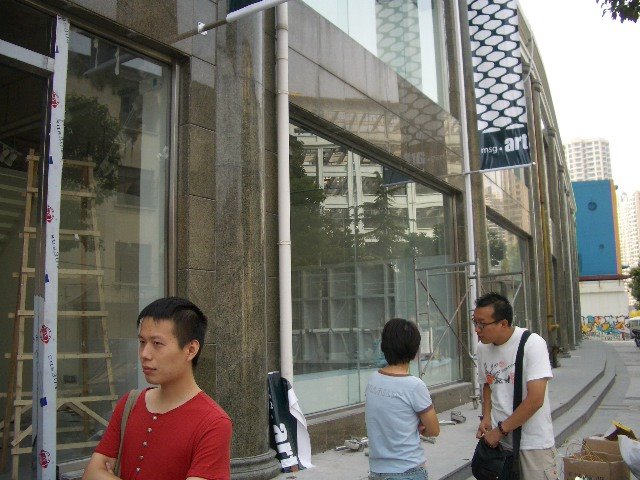
Moganshan Lu (Road in English) is situated next to Suzhou Creek in north-central PuXi, Shanghai. A collection of art galleries featuring contemporary painters, Moganshan Road calls to mind a unique artistic vibe, something akin to Chelsea in New York. Of course, one is unable to not feel that it remains a bit peculiar, an artistic enclave among a sea of skyscrapers that tower in the distance. Of course, one has to come to expect these odd juxtapositions in Shanghai, and in terms of art, the galleries of Moganshan Road do not disappoint.
MSG Art, a gallery operating out of Los Angeles, has recently opened its doors at 87 Moganshan Road, featuring the works of Chi Peng, He Jie, and Zhong Shan. Perhaps the most exciting feature about the gallery is its hopes to open a cultural exchange among its artists, allowing for American and international artists to spend a month on site at the gallery exchanging ideas with local Chinese artists. http://www.msgart.com/
Another important gallery is that of BizArt, which is located on the fourth floor of 50 Moganshan Road, Building No. 7. Opening in 1998, BizArt is one of the only truly non-profit galleries in Shanghai. As China does not currently have a system in place for non-profit galleries, BizArt has to engage in a rather complicated system to move money around. The director is committed, however, to ensuring that BizArt remain untainted from cashing in on artists, or being supported by large real estate developers, as is Zendai. Although recently having run into some problems (which remain sensitive), the gallery continues to forge ahead with new artist exhibitions. The current exhibition, running from October 13th until October 20th, is ElectriCITY, featuring the work of Shi Qing. For more information, visit http://www.bizart.com/.
 Yet another important gallery is that of Eastlink, located at 50 Moganshan Road, Building No. 6, fifth floor. Having opened in 1999, the gallery boasts 900 square meters of space, and is currently exhibiting “Extension Turn 2”, with works by a collection of international contemporary artists. One of the most striking currently on display is that of Johannes Speder, entitled “Mountain”. This work lies near the entrance to Eastlink, and occupies most of the front of the gallery. This captivating work lies across from another piece by He Yunchang entitled, “Beyond Mountains and the Sky”, a series of photographs detailing the artists attempt to use his own strength to push against the strength of an explosion. Eastlink is also featuring articles by seventeen different scientists in its catalogue, along with the twenty-seven participating artists. Eastlink also sells various antiques and past artwork in side rooms, to raise capital for its artistic endeavors. http://www.eastlinkgallery.cn/
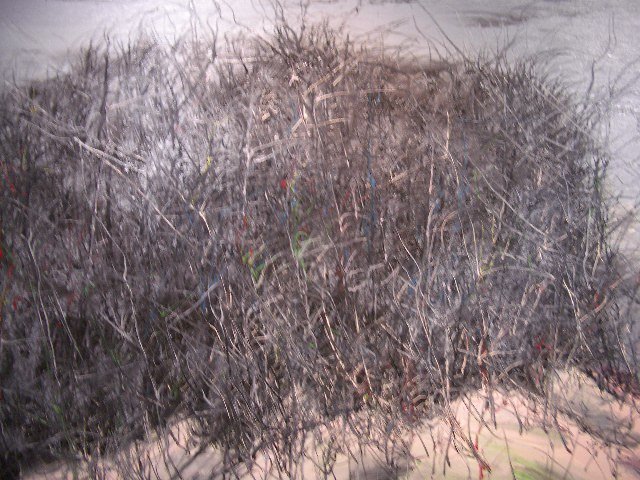 Finally, one should not finish their visit to Moganshan without stopping at ShanghART, located on 50 Moganshan Road, Buildings 16 & 18. Currently, the works of Zeng Fanzhi were on display, displaying his completely unique approach to art, with various works on display. The new exhibit, by Pu Jie, has been set to open on October 18th, and runs until October 31st. One can find more at http://www.shanghart.com/.Although some might feel that Moganshan has a feel of a slightly contrived space, especially in high-rise Shanghai, there is no disputing that the galleries there have no qualms about taking risks and pushing boundaries in China. A visit to Moganshan will not disappoint, and with around 100 galleries that are constantly changing exhibits, the scene here is never static. Moganshan sets the pace for the rest of the Shanghai art scene, and for those who want to see things before the move to the Shanghai MoCA or Zendai, Moganshan is the place to be.
Tuesday, October 17, 2006
Diamond in the Rough?
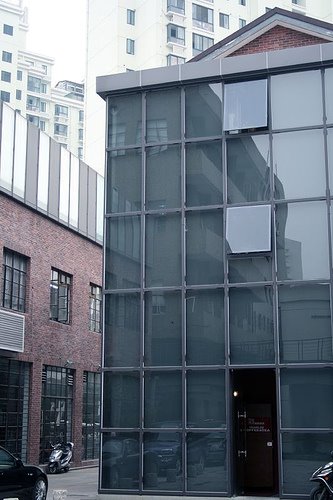
When I think of Shanghai, I think of colossal buildings that pierce into the sky as if Man desires to connect the sky and the earth once again. I think of waves of bustling people, trailing bicycles, rampaging cars, and fuming buses all clashing in the same environment to orchestrate a symphony of chaos. I think of immeasurable gaps between the wealthy and the impoverished. I did not think of art. When I see China, each time I only see the structural change of the city or the change and division in the living standard of the people. I never see art. However, this experience to M50 changed my impression of Shanghai. Hidden in the cusp of Moganshan Road, old factories that seem to have lost the care and favor of the city, old and broken, stand adjacent to traditional 2-floor Chinese buildings made from rotting wood and fragile brick. Decay and abandonment are all that reminds a passing pedestrian of this elusively small district.
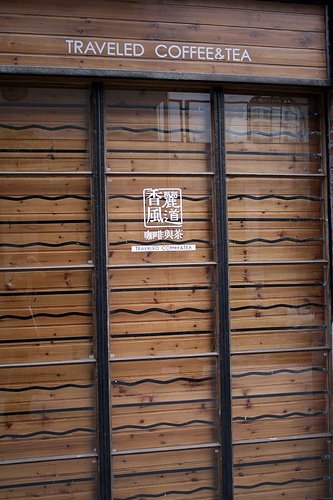
However, the peculiar gathering of fashionable youths and foreigners to this seemingly desolate district arouses suspicion and interest, and the open coffe shop also seems misplaced. Stepping out of the cumbersome old warehouse lifts, the world opened up by the rusty old elevator door presents us with an entirely different atmosphere. Aesthetic works created by Chinese or foreign artists alike adorn the walls, branch across the floor, or cluster in rooms and corners of the warehouse. As a visitor I didn’t know if I felt more surprised by the hidden secrets of the warehouses or by each individual art piece present in the warehouses. To find contemporary art pieces that reflect emotional and intellectual struggle, understanding, and portrayal hidden in this quiet neighborhood is nothing short of finding lost treasure.
 Of the artworks that we witnessed, none astonished me more than the works produced by Zeng Fanzhi. With strong brushstrokes and dark colors, Zeng Fanzhi collides colors and canvas. Each stroke he slashes onto the canvas tears another wound of ghastly beauty that pulls the audience into the aesthetic turmoil. Beyond the individual chaos of every stroke, a ghoulish image emerges from the dark colors and rugged outlines.
 The picture of a female walking beside branching bushes and stretching grass forms from the depths and solidify into finality. Unlike other pictures that combine and contrast human and surrounding, the colors in this work create a hopeless darkness. Instead of a natural background of transcendence, in Zeng’s art piece, only abysmal darkness extends to the edges of the canvas. If the canvas does not trap the darkness, it would possibly shroud the audience with treacherous dismay. The grassy brush intensifies the despair of the piece and specifically of the female. Complimenting the darkness beyond, the bushes present only an agonizing sense of decay. As if each grass has a soul, they scream and rip at the canvas in desperation. Seemingly trying to escape inevitable suffering, Zeng masterfully slices the darkness with lone strokes of putrefied grass. As if trepidation caused by darkness is not enough to satisfy his apocalyptic presentation, the grass accentuates and extends this horrific sensation. The illustration of the lone female contrasts immensely with the rest of the picture. Dressed in a silky white dress with youthful pink flesh, the female is the only focus in the artwork that pacifies the tension of the environment. However, as the female is the only subject in the entire painting, her calm is only complimented by her solitude. Hiding her face from the audience, Zeng conveys to us the suffering and gloom that this female has endured and the faith and optimism that she represents by the lightening darkness left in her wake and the rigid darkness ahead.
Tragedy is beauty. Without knowing pain, suffering, sorrow, or grief, it would be hard to understand the struggles of others. Perhaps Zeng is trying to show the destructive history of China on the land and the people, to foretell of their persevering spirit. Or perhaps he wishes to exceed national and cultural borders and resonate his personal experience among humanity. Only Zeng Fanzhi himself knows. As a witness of his aesthetic despondency, I may only yearn for happiness and grip faith tightly.
Monday, October 16, 2006
more on Zeng Fanzhi Solo-Exhibition

Zeng Fanzhi Solo-Exhibition
ShanghART/Gallery/PressRelease
ShanghART Gallery & H-Space is proud to present a solo-exhibition with new works by Zeng Fanzhi (b. 1964).
Zeng Fanzhi delivers an art that feels new, not in its premises, but in its intense, yet refined vitality, and constant renewal. His new paintings are at the same time expressively figurative and abstract, held in cool shades of dark colors, and they represent both a tension of human solitude and exceptional beauty. Zeng Fanzhi is continuously engaged in exploring adequate and innovative ways in expressing his visual representations.
His latest paintings signify a shift in his focus from a formal concern with the representation of existential trauma, to an interest in how we imagine ourselves interacting with nature. Within these large-scale images there is a notion of fragility and vulnerability; like an attempt to create a terrain of uncertainty that inhabits both characters and landscape depicted.
The grand scale of the paintings lends them a certain suggestive and sublime appearance, and when viewed, the paintings constantly seem to evolve and create new particular impressions. The grand scale images stand both as reflections of a social reality that are made up of multiple signifying systems, of which the landscape is one.
Zeng Fanzhi’s paintings appear simultaneously chaotic as well as controlled, intentional as well as unintentional, and his distinctive strokes signify the importance to process. Forcible intertwined curved lines may rest on a beautifully and calm background, and abstract and figurative elements appear side by side. The images therefore often carry references not to one but to many different realities. It is an energetic and reflective gesture that just serves to underscore Zeng Fanzhi’s status as one of China’s most innovative and skillful painters who’s acclaimed recognition and impact on the international art scene is rapidly expanding.
Zeng Fanzhi was born in 1964 in Wuhan where he also studied oil painting at the Art Academy. Today he lives and works in Beijing. Exhibitions include Contemporary China, PKM Gallery, Seoul, Korea (2006), Scapes 1989-2004, He Xiangning Art Museum, Shenzhen, China (2004), I/We – The Painting of Zeng Fanzhi, Shanghai Art Museum, Shanghai, China (2003), Left Hand, Right Hand, 798 Art Space, Beijing, China (2003), and The first Triennial of Chinese Arts, Guangzhou Art Museum, Guangzhou, China (2002).