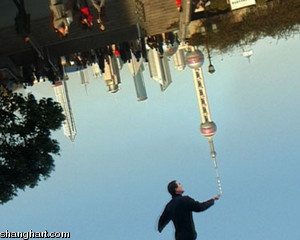
Class notes following visual artist Qiu Anxiong presentation in the classroom- dated 11.3.06, provided by NYU student Erica D Swallow. Thank you Erica for sharing your notes with us.
• “Jian Nan Cuo” (2005)
o Time: 13:10
o Birds on branches (flying onto and off of tree at times)
o Shot in black and white to mirror traditional Chinese painting that used black and white ink
o Constant beat is heard in the background (percussion/bongo)
o Heavy bass sound as if in a dungeon; haunting drone sounds
o Interestingly, he gives mention to the cast as: “Cast: Wind Cloud Tree Bird”
o He says that this piece is about Time:
• Modern people see time as a very fast thing
• We seldom look for natural development. We always need stories.
• This is a natural time flow, but in the film it seems very slow and much longer. Actually, however, it is just a normal progression of time.
• This is a basic Chinese philosophy used to look at the world, especially during the Song dynasty – One should try to blend in with the environment instead of taking a third person point of view. This is very typical of traditional Chinese art, as well. The artist will blend in with the environment.
• From a distance, you can’t see the movement of the trees as they gently sway in this video, but if really focus, you can see it. In this way, we should look at the natural progression of time in everyday life. From a distance, we may not see things moving, but if we put our soul into it, we can see how everything is moving and changing.
• “In the Sky” (2005) (This is the first animation that he ever made.)
o Music Tchaikovsky/Stockhausen
o Time: 8:18
o For this piece, he had no special plan. He did it out of pure feeling.
o All hand-painted
o He was influenced by an African artist, William Kentridge. Kentridge does not use complicated techniques. He uses simple elements and does not focus on a huge, complicated production. Anxiong admires this.
o He thinks Chinese animation was better before the 1990s. This is due to the current marketization and importing of ideas from foreign countries and companies, like Japan, for example.
o 1930-1940s: The first animation to ever be made in China was “Journey to the West” by two brothers.
o 1950-1980s: Ink animations develop in China
o “This work is not a story-telling work. Its like a dream of snapshots,” he explains.
o In one image, two heads on sticks protruding from a grassy hill are depicted, and one is taken away by a bird. When Sonia asked what this meant, he said that this signified the time upon creating the piece when his wife was gone and he missed her.
o He has no clear thoughts about the piece of art in theory, but reiterates that he made it just from his feelings.
• “Flying to the South” (May 2006)
o Time: 9:12
o Soundtrack of voices in background
o Flying books
o This piece was an installation at an Expo in May in Shanghai. It had statues installed along with the video, but the government shut the show down. The statues and film are prohibited to be shown together.
• Anxiong’s Ideas on the Point of Art
o Instead of looking at the history and progression of art as a form of expression to understand art as a media, we should look at the world. When we look at the world, we look at true history.
o We look at the world with a whole system of symbols. We have lost the instinct to see the world in a direct way for what it really is in essence. Instead, we see an expressive world, rather than a truthful one. We use too many symbols to define it.
o We only know part of existence. We don’t know all of it.
o Today we have so much knowledge. Knowledge has cut the world into pieces. We no longer have a world in its entirety. Our world is categorized and humanized.
o We need an original way of looking at the world: an origin. It is important to every culture to have this type of origin.
o Although China is developing into a very complex system, we still ask ourselves the same elementary questions about our origins. Still, we are puzzled.
o For example, we look at a computer and think it is easy to understand. We know what it does and we can use it. But we can’t see what is inside it and we do not know how it really functions. We look at our world in this way. We think we understand the world, but really we do not know its truths.
o Unfortunately, we look at our world from a point of knowledge and understanding, not from a participatory point of view. We distance ourselves from the world, and we no longer have a mutual relationship.
o He uses art to connect with the world in a more intimate way. This is his general understanding of art.
• “The Book of Mountains and Sea [1]” (2006)
o The song at the end, to him, was very “human”. It conveyed a different perspective than his own. He feels that it did not convey the same ideas and feelings of his art shown before it in the animation. It does not have the same sacred and objective feeling of his work. His friend from Chengdu wrote it after reading the book he wrote. The credits at the end mention “Jin Wang” and “Ou Bo” as the musicians credited in the film. I’m not sure which one created this song.
o He quotes Confucius from a story about Confucius and three of his students. They are all discussing the goals of the students. Confucius asks the first one what he wants to be. He says he wants to be a general. Confucius then asks the second student, who replies that he wants to be a secretary. When the third student is asked what he wishes for his, he says that he would like to go swimming in the river with his friends. The song is like the third student, an ordinary perspective. He thinks that if everybody had this perspective, maybe our society and world could reach its’ pinnacle. In this perspective, the ordinary becomes the ideal. The simplest goals bring the greatest successes.
o Some images discusses from the animation include:
• The explosion of New York City. It is not caused by an external force, such as a bomb. Instead, one may notice that it explodes from within. This symbolizes internal problems with society.
• The singular person that remains standing after the other terrorists fly away. Before class began, Anxiong told Eric and I that this guy does not represent anything in particular. Instead, he represents the many possibilities. He challenged us to think about it ourselves, expressing that it is up to the viewer to ponder over this matter. There are so many possible ways the story could end, and the viewer must consider these options. In my opinion, this is part of the beauty of this piece as it leaves us asking questions and challenging our views.
o The refrain from the song at the end is:
• “Who is sighing? Who is lamenting the parting of geese on autumnal journey?”