Showing posts with label eastlink. Show all posts

Wednesday, April 23, 2008

three openings this Saturday

Saturday openings:
-------------------------------------------------
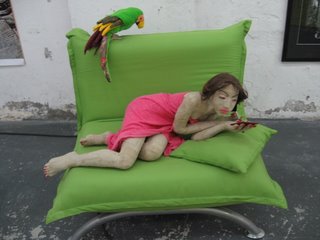
Zhao Qin
26 April - 17 May 2008

Eastlink Gallery
Floor 5, Building 6
50 Moganshan Lu

Opening: Saturday, April 26, 6pm
-------------------------------------------------

There is also an opening at Ophoto that day at M50.
-------------------------------------------------

And the most interesting one seems it will be:
Art Multiple
_ first presented art multiple exhibition in China

Art For Everybody
Time: April 26, 2008 – May 12, 2008
Opening: 19:30 April 26, 2008.
Place: Ke Center for the Contemporary Arts
Artists Participating:
Gao Mingyan, Gu Wenda, Hu Jieming, Liu Ding, Birdhead, Sun Ling, Yang Yong, Zhang Enli, Zhang Jianjun, Adad Hannah, Agathe de Bailliencourt, Ho Tzu Nyen, Josefina Posch, Sandrine Ilouquet, Susanne M.Winterling, Vibeke Jensen, Will Kwan, Zulkifle Mahmod, La Mas Bella, Ted Noten, Hannah Louise Lammb, Julia de Ville, Chang young chia, Vincent Leong, Miljohn Ruperto, Wu Gao Zhong, Jin Feng, Hipic

"Art Multiple 2008 exhibition" will be first presented in April, 2008 at Ke Center for Contemporary Arts. Exhibition will present 35 artists from 10 different countries and areas all around the world. Nearly 200 art works will be showed. Which includes artists' exhibited works, specially commissioned works for Art Multiple and multipes of contemporary art works collected by famous international art institutions.

Art Multiple concept refers to the art works with relatively bigger editions determined by artist . This concept of multiple gives possibility of reaching higher audience and appreciation as well as possibility of collecting work for relatively affordable price trying to have contemporary art get out of its small circle of privileged. Abroad art multiple concept developed early in 60's and till today there are many galleries and institutions specialized in presenting multiples
Ke Center for Contemporary Arts through exhibition in April introduces concept to China and establishes first Art Multiple Supermarket in Shanghai hoping to make art for everyone possible

In the period of boom of Chinese art market and price increase from sale to sale, where small group of artists sells work for million dollars, where still collecting is taken for most of the buyers as a short term investment, Multiple provides new possibility in art market and artistic expression, that art works can be affordable to larger group of people and that anyone can be collector

This new concept at the same time works as an educating tool for new collectors in China and new collecting strategies in general.

During exhibition period different lectures and workshop will be held related to Art Multiple concept.

Ke Center for the Contemporary Arts will invite specialists work in the field of contemporary art market research to give talks.

We hope to introduce contemporary art into a larger crowd and to cultivate new collectors and a new way of collection.

Multiple as a type of art making and art collecting is not new concept. Concept started developing with Duchamp's ready mades objects in early decades of twentieth century.

Duchamp developed the term readymade in 1915 to refer to found objects chosen by the artist as art. Produced object-such as his Fountain (1917), a urinal that he turned on its side, signed "R. Mutt," Duchamp asserted that there was no longer a fundamental difference between making art and naming art. By the early 1960s many of Duchamp's readymades had taken the form of authorized, limited edition, handcrafted replicas and were considered valuable works of art that seemed to contradict their original intention.

In the 1950s and 1960s the term multiple came to be applied to a new type of art object that, while intended to be produced in numerous copies, fell outside the parameters of such traditional forms as printmaking and cast sculpture. Often fabricated using the materials and techniques of mass production, these objects typically existed in very large, or even unlimited, editions. Unlike painting and sculpture, or even traditional fine art printmaking, the multiple engaged directly with the conditions of industrial production, mass communication, and an increasingly global economy.

For the artists of the international avant-garde known as Fluxus, the multiple presented a means to revive and reformulate the readymade's critique of aesthetic autonomy. Fluxus sought to dethrone "serious" culture by creating objects and performances demonstrating that, as Maciunas said, "Anything can be art and anyone can do it."

Joseph Beuys (1921-1986) also looked to the readymade as he sought to bring art and life into closer proximity. For Beuys, the readymade became part of a larger effort to reinvest artistic activity with metaphorical, ritual, and even spiritual significance.

Although they often differed in their choice of strategies, Beuys and Maciunas shared many of the same goals including using art as a means of realizing social and political change, recognizing the importance of collective action, and eliminating the boundary between art and life. The production of multiples played a key role these efforts, often acting as a mediator between the production of objects and a growing emphasis on artistic process and action unfolding in real time.

Beuys, for his part, referred to his multiples both as vehicles for the spreading of ideas and as anchors that encouraged people to make connections between objects and across media.

It is certainly true of both Beuys and Fluxus multiples that the significance of a group of objects is almost always greater than the sum of its parts. Efforts of both Beuys and Maciunas to transform the ways in which art is exhibited and distributed."

In 1990's, artists Sarah Lucas and Tracey Emin took over a disused shop in London's East End and, with other artists friends including Damien Hirst, sold T-shirts, mugs and other customised items as works of art. This artist-led approach to selling art directly to the public not only re-popularised the artists multiple, but was a key moment in the subsequent Young British Artist era, culminating in the Saatchi collected "Sensation" exhibition.

Art multiple concept is to make contemporary art accessible to more people from collecting art point of view to spreading artists ideas

Thursday, March 20, 2008

50 Moganshan lu (BizArt, Eastlink, ShanghArt, Island6)

For our Contemporary Art class on Thursday, March 5th we went to go visit the art center of Shanghai - 50 Moganshan lu. We visited three of the more well known art centers in Moganshan50 - BizArt, Eastlink and ShanghArt. Oh and I almost forgot to mention that we briefly visited Island6 which is near 50 Moganshan lu but tends to do more new media installations (LEDs and such).

We started out by visiting BizArt where we talked with one of the people in charge, we also watched a video about one of the first contemporary art exhibitions in China about 10 years ago. It was interesting to see that this occurred 10 years ago and it was definitely a neat exhibition. It started out by starting with everyone who attended the exhibition entering through a market that sold art created by the artists (various objects, most quite fun looking). The exhibition itself had some interesting pieces but I was most fascinated with the way it was presented to the public. I think that it was a great concept, having the market first as an entrance to the exhibition as well as making it well publicized to the public. There wasn't a specific exhibition in BizArt at the time but we learned a bit about its history through the video and the worker (They also had a net up for what looked like badminton, definitely looked like fun!). You could also tell that they didn't sell any of the work that they created, they didn't have the heat on in the building and overall it wasn't very extravagant (although it did work, it just contrasted with what we would see next at EastLink next). I also was able to ask the worker about the 1999 exhibition and he said that it was all self-funded, it's interesting to note that they've just moved away from this about 2 years ago which is awesome for them.

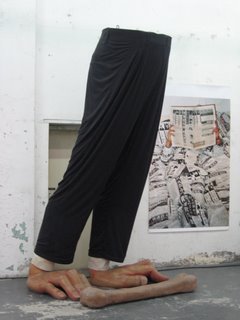
Next we went on to Eastlink which was nicer inside and the quality of the productions was very impressive. There was a varied set of pieces and they were all intriguing. (You could tell that this place sold the art, because of the quality of the art and the space itself). One of the pieces that I thought was really cool was the piece of all the people in the offices with bubbles in each room - I just thought that the way the piece came out looked awesome. There was also a fascination with boobs here, one of the artists had created this extremely exaggerated set of boobs that was in several places around the space (I wasn't quite sure what to make of them lol).

Then we headed onto ShanghArt which had some real high quality art. I thought that the pieces here were extremely well done, don't know if I really understood every message the artist was trying to get across but the pieces themselves I thought were beautiful. We also saw a preview to the opening of an exhibition where we saw some art that mixed some old Chinese history with new art styles which was interesting as well - although it wasn't my favorite.

On our way out we passed by Island6 and checked it out and I was intrigued as this place has to deal with more new media installations. They had some interesting pieces with LEDs used to create people, that would move across a picture in the background behind a painting/photo. They also had two games of Pong setup that used some interesting control devices (one used foot pedals) and another used a sort of a switch that you would push in the direction you wanted the bar to move. Definitely worth visiting again.

Overall, the places that we visited were impressive and I thought the art was pretty high quality. The place also seems to be teeming with other art places and art in general so I don't think you could visit everything going on at once in one go (It'd probably take a while to get to see everything), so at one thought that's really cool, but it would be easy to get overwhelmed there trying to see everything. Definitely worth your time to visit 50 Moganshan lu though!

Thursday, June 07, 2007

From Propaganda to Profit

------------------------
From Propaganda to Profit
June 2007

by Rebecca Catching and Anurag Viswanath

This spring at Moganshan Lu, Shanghai's main art district, Beijing Art
Now Shanghai christened their gallery opening with a rather
unconventional exhibition, "Shanghai Now." Viewers entered the
cavernous warehouse and stared blankly at canvases sheathed in money.
Gallery founders Huang Liaoyuan and Zhang Haoming had wrapped each
painting in shiny wrapping paper printed with faces of various
different currencies. In doing so, they sought to remind viewers to
look beyond the commercial value of art and contemplate its intrinsic
value.

Xu Beihong's 1939 work Put Down Your Whip sold at a recent auction in
Hong Kong for a record $9.2 million.

It's a relevant point in the context of the Chinese art market, which
some claim has begun to spin out of control. Last year, Sotheby's and
Christie's sold $190 million worth of Asian contemporary art—most of
it Chinese. Prices reached unprecedented heights, with 43-year-old
artist Liu Xiaodong dropping canvases for a whopping $2.7 million, and
Xu Beihong's The Slave and Lion smashing the record for a Chinese oil
painting at $6.9 million.

Twenty years ago Chinese artists would have had trouble obtaining a
passport, but now they are globetrotters. They have studios at home
and abroad, showcase their art around the world, and are getting very
rich in the process. Why this boom? According to Simon Groom, head of
exhibitions at the Tate Liverpool, the Chinese art explosion "reflects
the interest in China, driven by the growth of its economy, the
emergence of Chinese collectors and an eagerness in the West for new
speculative markets."

Tate Liverpool's current exhibition "The Real Thing: Contemporary Art
from China" features 26 works by 18 leading Chinese artists, including
Ai Weiwei, Gu Dexin, Zhou Tiehai and the Yangjiang group. The exhibit
has been billed as the "show of the year" and is evidence of the
growing influence of Chinese artists abroad. Indeed, many of China's
most exciting artists are now based abroad—for example Xu Bing and Cai
Guoqiang—which puts them in close proximity to their collectors, 90%
of whom are foreign.

Yet mainland Chinese collectors are starting to get into the Chinese
art game, too. Catering to their needs are hundreds of mainland
galleries and auction houses which are springing up, as well as
foreign institutions that are in the process of opening branches in
China, such as the Centre Pompidou and the Guggenheim.

Auction houses, both foreign and local, have begun to deal directly
with the top-tier Chinese artists, snatching up works while the paint
is still wet, rather than going through collectors and galleries. Some
artists have responded to the demand by using teams of assistants to
churn out paintings. For example, Shanghai-based artist Zhang Huan
employs close to 100 workers in a massive studio that would make Andy
Warhol's factory look like a cottage industry.

A Long March

Under Mao, art was meant to "serve the people," i.e., workers,
peasants and soldiers—social groups not known for their inclination
toward the arts. And the bureaucratic controls designed to oversee
Mao's utopian social-engineering projects quickly made art subservient
to politics.

Artists were disseminators of propaganda, celebrating revolutionary
zeal and socialist euphoria through patriotic paintings. Icons of this
era include Dong Xiwen's oil The Founding of the Nation (1953), Jin
Shangyi's painting Mao Zedong at the December Conference (1961), and
Wu Hufan's Atom Bomb (1965), which marked China's coming of age as a
nuclear power.

Woodblock prints and oils done in the Soviet socialist realism style
featured square-jawed men leading China's industrialization, and
robust women harvesting bumper crops of plump rockmelons, while folk
paintings known as nianhua, or New Year's paintings, depicted bouncing
baby boys riding atop golden fish adorned with communist slogans.

Under the oppressive Cultural Revolution, a new genre, a variation on
socialist realism described as "red, bright and luminous" (hong,
guang, liang), celebrated the accomplishments of the Cultural
Revolution with the use of theatrical illumination and garish colors.
The fall of the Gang of Four in 1976 brought new beginnings, as both
artists and art schools were rehabilitated.

Deng Xiaoping's "opening and reform" in 1978 and the preoccupation of
the state with economics allowed for expanded realm of individual
freedom and space. The officially sponsored "New Spring" art
exhibition in February 1979, followed by an exhibition by the Stars,
paved the way for the rise of the Contemporaries, which included
artists such as Wang Huaqing, Sun Weiman and Zhang Hongtu. The
establishment of Fine Arts in China (Zhongguo Meishu Bao) in 1985, a
Bejing-based weekly arts newspaper; the formalization of official
channels for sale of art by the New York-based Hefner Gallery in
1987-89; and the Chinese Nude Oils exhibition in 1989 were important
milestones which led to the culmination of what some consider the
Tiananmen of the art world: the highly controversial, socially
critical "China/Avant Garde" exhibition at the Chinese National Art
Gallery in February 1989.

Following Tiananmen, the art scene limped back to normalcy after a
brief hiatus. In the following decade, the first art galleries, such
as Red Gate Gallery and Courtyard Gallery in Bejing, and Shanghart and
Eastlink in Shanghai, began to pop up, with clients including
influential foreign collectors such as Uli Sigg and Pierre Huber.

In the years that followed art was no longer used to further the aims
of communism, rather communist imagery was used further the aims of
individual artists who made a fortune off of genres such as political
pop.

Artists such as Wang Guangyi and Xue Song, produced technicolor images
of Mao and graphic paintings of workers. While cynical realists such
as Liu Xiaodong, Yue Minjun and Zhang Xiaogang employed both
hysterical and forlorn human figures in everyday scenes, giving visual
expression to the moral vacuum left behind by communism.

Towards the late 90s, artists began really test the limits of their
freedom with exhibitions such as the "Fuck Off" biennale satellite
exhibition curated by Ai Weiwei at Eastlink in 2000, and Cang Xin's
performance piece To Add One Meter to an Unknown Mountain, where he
piled the summit of a mountain with the bodies of his friends—an
oblique reference to the terror induced by the Cultural Revolution.
Though artists experienced a palpable growth in artistic freedom
through out the 90s and onwards, plainclothes spies from the cultural
bureaus made their presence felt, asking to speak to artists, removing
works, shutting down exhibitions and occasionally holding artists in
prison.

In 2006, the Hei Shehui collective—literally "hey, society" and also a
pun on the Chinese word for mafia—organized the controversial "38 Solo
Exhibitions" in a former army barracks in Shanghai. The exhibition
featured Jin Feng's provocative performance piece An Appeal Without
Words, which comprised a group of actual peasants covered head to toe
in a layer of gold paint, brandishing empty placards—a reference to
their compromised status in appealing land disputes. Such incendiary
work caused the show's closure and landed two of the artists in jail.
New-art observer Geremie Barmé likens the situation to Miklos
Haraszti's Velvet Prison. In such an environment, the majority of
artists choose not to test the limits, and social critique often takes
a back seat to profit.

In some ways, profit poses a more pernicious threat to creativity than
government censorship, as galleries pressure artists to create works
to feed the market. "Now that [the art world] has become
commercialized, these commercial forces inform artists if something
has commercial value," opines controversial conceptual artist Xu Zhen.
Mr. Xu, who spends much of his time working at nonprofit experimental
art center BizArt, pays little attention to the market. Rather he
chooses to raise questions about transparency and China's growing
military ambitions—filming videos of himself driving remote control
tanks into China's neighboring countries and staging mockumentaries of
engineers lopping off the top of Mount Everest.

While the success stories, such as Zhang Xiaogang and Yue Minjun,
dominate the business pages of the Western press, many critics see
them as examples of how Chinese art has failed to innovate. Outside of
the works of a small group of exceptional conceptual artists, much of
what lines gallery walls is uninspiring and derivative. Pia Camilla
Copper, a Chinese contemporary art specialist at the Paris auction
house Artcurial, says, "The painters, sculptors and conceptual artists
from [China's top academies] are technically skilled, they only lack
imagination. A sort of Turner Prize should be created for Chinese art
to encourage young artists to break free from academic rules, the
scourge of the Chinese art academy, and innovate."

At the same time, experimental art is stifled by the lack of
institutional resources. Museums are underfunded, as are nonprofit art
centers such as Shanghai's BizArt and Yunnan's Lijiang Studio. Serious
art criticism is also compromised by corruption amongst journalists
and critics who offer coverage and praise for a fee.

Ms. Catching is the arts and entertainment editor of that's Shanghai,
and the Shanghai correspondent for Art Asia Pacific. Ms. Viswanath is
a free-lance journalist based in Bangalore.

Thursday, April 05, 2007

Moganshan Lu: a spoonful of labyrinth, a cup 'n a half of madness, and just a pinch of Escher.

Perhaps I should have added the word "artists" to my title, but I figured since I already had the word madness I was close enough. I'll admit up front that I'm a true philistine when it comes to the visual art world - the Mona Lisa could printed on the back of a cereal box and in all honesty I probably wouldn't notice it. That said, I'm going to recount my experiences and try to tackle the all important topic of artists and their relationship to the immediate art community based on my observations wandering around Moganshan Lu.

For any as of yet unacquainted, Moganshan Lu is a road in Shanghai that has concentrations of "art establishments." Notice I used the word establishments: they are all essentially a mixture of businesses, galleries and studios as far as I can tell.

These gallery and business owners are all admittedly quite different in their purposes and consequently vary in the the type of artwork they solicit. Yet interestingly enough, the most common opinion shared between all was the difficulty in cooperating with government regulations and subsequent restrictions bestowed on all art galleries.

These restrictions are generally put in place when decency critics consider a piece to be overtly sexual or political. Interestingly enough, I couldn't help but remember when the Eastlink gallery told us the story about a special Zhu Yu (朱昱)exhibit in which Zhu Yu eats a dead fetus. I'm not sure how that made it past the censors, and that's not necessarily my point. The simple fact that this was allowed to happen while many other more mild works on Moganshan Lu have often been censored serves to raise the question as to just how much "decency" regulation has stiffled the Shanghainese art scene in general. I recall a conversation the director at the first gallery told us about just how often local officials step in to intervene in a gallery's exhibits and the often complicated chain of bribes that must take place to either allow foreign artists to exhibit their work or ward off a trail of decency critics if at all possible. With the exception of some of the restrictions I'd say this wouldn't surprise me if it happened worldwide - people all over the world generally don't respond well initially to art that upsets a narrow interpretation of the world and what's right/wrong. I'm actually reminded of the virgin mary with elephant dung exhibit in the states which was ultimately removed from its gallery for being overly offensive. So I'm certainly not blaming the government here as decency filtering in all likelihood happens everywhere to some extent.

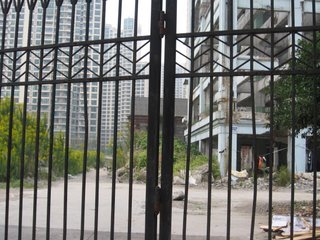
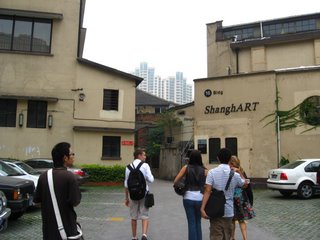
I also remember that however closely knit a given concentration of artists may be, sometimes gallery's futures as questionable as is the case with the Shanghart gallery - the building itself might be sold to build a highrise. The underlying tension between soaring skyscrapers and the much smaller local galleries can be felt best at the island 6 gallery/workshop. Skyscrapers surround the small building like a pack of hungry wolves - though I don't think moving would be a terrible prospect for any given gallery except for the fact that it would disrupt the fluidity of the local art community if a skyscraper suddenly shot up like a weed from the ground in-between galleries. Let me know what you guys think about this.

(This image was taken from here)

Tuesday, January 09, 2007

Body Talk

EASTLINK G a l l e r y
Press Release
Body Talk
Time:13 January – 10 March 2007
Address:50 Moganshan Lu, Bld 6, Fl 5

China has been a place for a long time where it has been not allowed to communicate.
This exhibition aim to display the power of our body as well as providing an opportunity to look at how our body
talks to us. The show, which began on 13 January, gathered painting, photographs and sculptures from
different Chinese artists.

The artists show how the body is portrayed at different moments through the artists’ imaginary which links
human figures to protest topics. While the exhibition itself mingled works of different origins, the picture that
emerges provided a variety of explanations for the use of the body, from performance-art, body- art to painting
language.

These works instigate a dynamic point of view with regards to how look and understand our body to engage the
viewer through a complex thought revealing different meanings.
The show includes famous pieces by Huang Yan, Yang Zhichiao, Wang Qiang… and features new talented
artists as Zheng Huan, Zheng Dagong, etc…

Thursday, October 19, 2006


Moganshan Lu (Road in English) is situated next to Suzhou Creek in north-central PuXi, Shanghai. A collection of art galleries featuring contemporary painters, Moganshan Road calls to mind a unique artistic vibe, something akin to Chelsea in New York. Of course, one is unable to not feel that it remains a bit peculiar, an artistic enclave among a sea of skyscrapers that tower in the distance. Of course, one has to come to expect these odd juxtapositions in Shanghai, and in terms of art, the galleries of Moganshan Road do not disappoint.
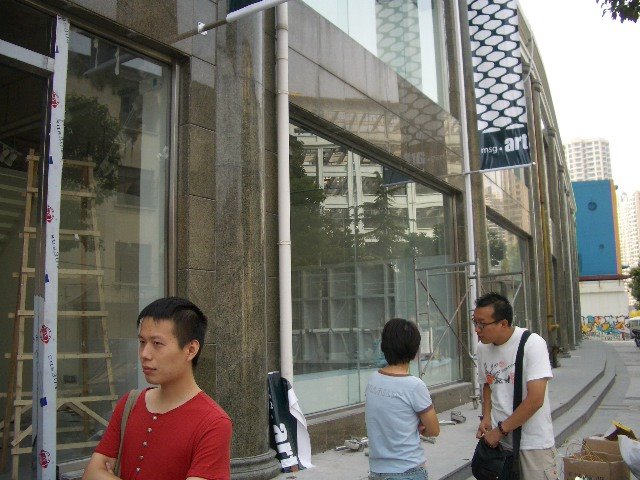
MSG Art, a gallery operating out of Los Angeles, has recently opened its doors at 87 Moganshan Road, featuring the works of Chi Peng, He Jie, and Zhong Shan. Perhaps the most exciting feature about the gallery is its hopes to open a cultural exchange among its artists, allowing for American and international artists to spend a month on site at the gallery exchanging ideas with local Chinese artists. http://www.msgart.com/
Another important gallery is that of BizArt, which is located on the fourth floor of 50 Moganshan Road, Building No. 7. Opening in 1998, BizArt is one of the only truly non-profit galleries in Shanghai. As China does not currently have a system in place for non-profit galleries, BizArt has to engage in a rather complicated system to move money around. The director is committed, however, to ensuring that BizArt remain untainted from cashing in on artists, or being supported by large real estate developers, as is Zendai. Although recently having run into some problems (which remain sensitive), the gallery continues to forge ahead with new artist exhibitions. The current exhibition, running from October 13th until October 20th, is ElectriCITY, featuring the work of Shi Qing. For more information, visit http://www.bizart.com/.
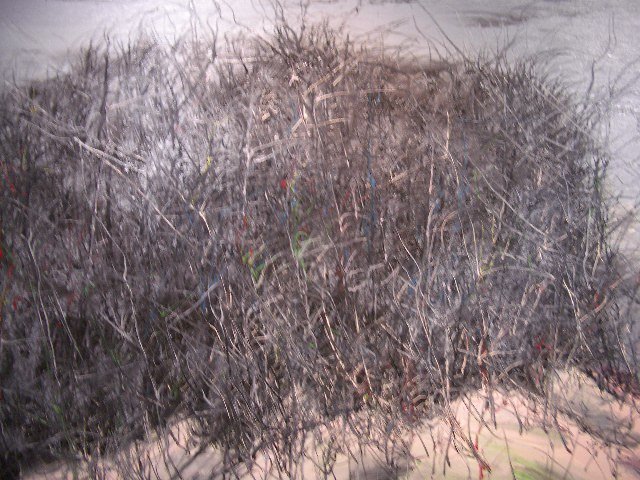
Yet another important gallery is that of Eastlink, located at 50 Moganshan Road, Building No. 6, fifth floor. Having opened in 1999, the gallery boasts 900 square meters of space, and is currently exhibiting “Extension Turn 2”, with works by a collection of international contemporary artists. One of the most striking currently on display is that of Johannes Speder, entitled “Mountain”. This work lies near the entrance to Eastlink, and occupies most of the front of the gallery. This captivating work lies across from another piece by He Yunchang entitled, “Beyond Mountains and the Sky”, a series of photographs detailing the artists attempt to use his own strength to push against the strength of an explosion. Eastlink is also featuring articles by seventeen different scientists in its catalogue, along with the twenty-seven participating artists. Eastlink also sells various antiques and past artwork in side rooms, to raise capital for its artistic endeavors. http://www.eastlinkgallery.cn/
Finally, one should not finish their visit to Moganshan without stopping at ShanghART, located on 50 Moganshan Road, Buildings 16 & 18. Currently, the works of Zeng Fanzhi were on display, displaying his completely unique approach to art, with various works on display. The new exhibit, by Pu Jie, has been set to open on October 18th, and runs until October 31st. One can find more at http://www.shanghart.com/.Although some might feel that Moganshan has a feel of a slightly contrived space, especially in high-rise Shanghai, there is no disputing that the galleries there have no qualms about taking risks and pushing boundaries in China. A visit to Moganshan will not disappoint, and with around 100 galleries that are constantly changing exhibits, the scene here is never static. Moganshan sets the pace for the rest of the Shanghai art scene, and for those who want to see things before the move to the Shanghai MoCA or Zendai, Moganshan is the place to be.

Saturday, October 14, 2006

Moganshan Art District

---- a secret place in the city


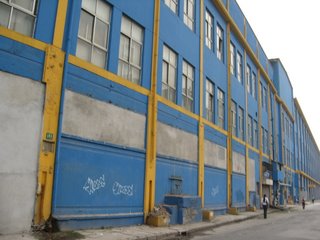
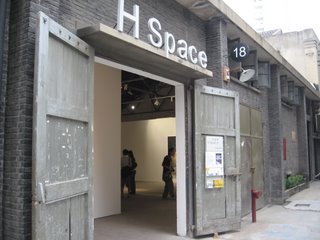
Nobody seems to know the place, even the cab driver. It's like a secret place in the city and this appeals to me very much. When we arrived at Moganshan Lu, this mysterious place begin to unveil itself: empty street, graffiti,wasted warehouse. But instead of being inanimate, it gives forth the smell of art. As we got closer, many art studioes and galleries appears.


Bizart

I like the name of "Bizart" very much. Davide gave us a very insightful lecture and explained the complication and something we don't know about art, like the forces of the government they have to face when organizing an exhibition. The following work is "a world can't be without electricity".


East link


East Link is a spacious place, and there are three rooms inside. They are pictures of experimental art of modern life, works reflected the Cultural Revolution, and a collection of wood furniture antiques respectively.


Shanghart Gallery


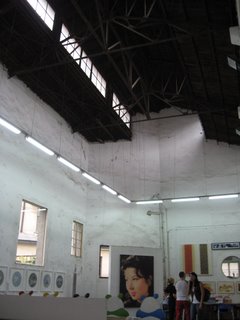
I think the Shanghart Gallery can be a representive of this art district. It is a typical warehouse with high ceilings, shabby walls. There are also many documentations of artists.


high ceilling, interesting floor:


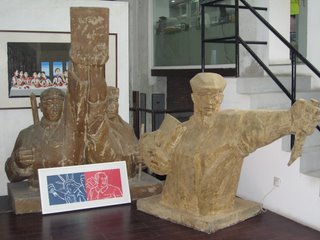
Three pieces of work:


very interesting works


M50, a secret place, produces a large quatity of art works. There are no noises, but quiet and full of art spirit. I enjoy the visits as well as the lectures very much.

Friday, October 13, 2006

M50 review

M50 is a very special art district where massed with many galleries and artists locating in large groups of depots. Regardless of the rubbishy street (old, dirty street, even the cab driver has not heard about) and the letter written by some person who used to live in the neighborhood to appeal that some land agent forced to occupied his house, M50 is a unique product of the new attitude and policy of the local government which reveals the contemporary art gradually blooming and merging into the culture and economy. Simple and crude houses can not conceal the gorgeous art works in them. The whole area permeates the breath of art and the ropey wall better stand out the solemn and quiet atmosphere. Modern signs, logos and old depots and all kinds of arts, numerous inconsonant things form the entire M50, just like you haven’t stop memorizing the works in one gallery and then step into another art world. Outside the M50, more and more galleries and workshops are under construction, as MSG gallery. In the lecture given by Davide, I fundamentally understand the association between the art gallery, exhibition, museum and the government. The conversation totally breaks up my view of foreign artists in China, which I used to think they are oversea communicators to find the connection between different culture background and they must have some privilege as an artist and with a considerable salary. Now I learned that it’s also or even harder than domestic artists to publicize their works or modern ideas and not so easy to make a profit. Now I’ll illustrate some works seen in M50 below.

This is a work from EastLink Gallery, there are losts of great works there, and many of them is photos of perform art. From the introduction book I learned that this gallery more focus on the association between science and art. Some of them are through accurate calculated, like the chair above, and this remind me the aim of MIT media lab, use kinds of modern technique to perform art. And the manager there is also big collector. There are so many interesting collections.Like this oneZeng Fanzhi is a very talent oil painter, from his works we can see he is pretty good at manifest lines, these clutter and delicate lines give us great imagination.Those are two pieces of his works.