Showing posts with label hangzhou. Show all posts

Thursday, March 19, 2009

Hello from Hangzhou

While I didn’t check out any galleries or studios this weekend, I did get a chance to see something that I think I’d be unlikely to see while exploring Shanghai’s art scene: nature (or something like it). Specifically, I saw big trees, green grass, and blue sky this weekend in Hangzhou – three things I have yet to see in this gray, hazy metropolis. Sure, I’m from Maine, where we have a lot of trees, but I wasn’t expecting every inch of this city to be paved over. I’ve seen a lot of places here where there’s plenty of room for a patch of grass or even a little bush, but instead it’s just a big empty space covered with pavement or dirty tiles.

Yet even in Hangzhou, where trees are more than 30 feet tall, the fields of surprisingly green grass were off-limits, and in a park the size of ECNU on the shore of the West Lake, there were something like 10 benches for 10,000 people. Although beautiful, the throng of people trying to enjoy the weather were forced to keep moving, walking on paving stones through this artificial and untouchable landscape.

In the end we decided to jump the fence and play a game of cards on the grass. Four thousand Chinese followed our example. I wish I had before and after pictures of this phenomenon, but all I have is a “before-the-police-arrived-to-kick-us-out” picture of everyone finally enjoying themselves, sitting on the grass. Just because it’s simple doesn’t mean we don’t need it. Does China hate nature? Probably not – but where has it gone?

Sunday, August 26, 2007

Bizart this Fall

9月SEPTEMBER 2007

2007皮埃.埃尔创作奖提名展
2007 Pierre Huber Creation Prize
Nominees Exhibition
Opening: September 4th, 2007, Tuesday 18:30
Press Conference: September 4th, 2007, Tuesday 19:00
Exhibition dates: September 5th to 10th, 2007, from 11:00 to 18:00

Organizer: China Art Academy
Co-organizer: New Media Art Department, China Art Academy
Venue: BizArt Art Center
Nominated artists:
Dong Dayuan, Jiang Zhuyun, Lu Yang, Shi Chuan, Wang Xin, Ma Xiaoxiao,
Sun Huiyuan, Xiao Yuankun


About Pierre Huber New Media Art Creation Prize and Fund

On September 7th, 2006, Mr. Pierre Huber met with the students of the
New Media Art Deparment of the China Art Academy and inquired about the
education situation.
In view of stimulating New Media Art Creation, education and diffusion,
as well as encouraging and supporting creative activities of the new
media art students, Mr. Pierre Huber founded the "Pierre Huber" New
Media Art Creation Prize and Fund.

The grant will finance a small management group in charge of
supervising the use of the fund, and formulate a regulation system.

Part of the grant will fund the "Pierre Huber New Media Art Creation
Prize" to support over the years the creativity of outstanding
students. Three prizes will be awarded to the students.
Fund will also be used to support students' creativity: students will
directly submit their project which will be examinated and subsidized
by the management group. At last, part of the grant will finance
studies of prominent new media art students with family difficulties.
Reward process will be composed of two phases: first, teachers will
nominate skillful students, who will participate to an exhibition. The
second phase will be the final selection by a jury made of renowned
curators and artists.
Jury will be composed of five members selected each year from a list,
members will change from a year to another.

Jury members list:
Beijing: Fei Dawei, Pili, Karen Smith, Wang Gongxin, Lu Jie
Shanghai: Zhang Qing, Zhou Tiehai, Xu Zhen, Yang Zhenzhong, Lorenz
Helbling, Chen Jieyang, Lin Shumin, Yang Fudong
Guangzhou: Huang Zhuan
Abroad: Hou Hanru (U.S.A., France, China), Hans Ulrich-Obrist (U.S.A.,
France), Barbara London (U.S.A.), Zheng Shengtian (Canada), Yves
Aupetitallot (France), Zhang Ga (U.S.A., China).

韩国艺术家朴芝恩和中国艺术家李平虎的展览
Exhibition of Jee Eun Park (Korea) and Li Pinghu (China)

Opening: September 14th, 2007, Friday (18:30)
Exhibition Dates: September 15th � September 28th, 2007 (11:00 � 18:00)

Exhibition of the artworks produced by Korean artist, Jee Eun Park,
during her residency in BizArt and the works produced by Chinese
artist, Li Pinghu, during his residency in Ssamzie Space, Seoul. The
exhibition will be held in September in BizArt for one week.

10月October 2007
仔细想想,昨天你究竟干嘛去了? -- 施勇个展
Let's think, where have you been yesterday? --Shi Yong's solo
exhibition

开幕时间:2007年10月12日,星期五 (18:30)
展览时间:2007年10月13日-10月22日 (11:00 � 18:00)

Opening: October 12nd, 2007, Friday (18:30)
Exhibition Dates: October 13rd �October 22nd, 2007 (11:00 � 18:00)

往事 � 被遗忘的时光
6位印尼艺术家阐释的印尼历史, 1930-1960
The Past - The Forgotten Time
Six Indonesian artists interpret Indonesian history, 1930 - 1960

Opening: October 25th, 2007, Thursday (18:30)
Exhibition Dates: October 26th � November 11st, 2007 (11:00 � 18:00)


Introduction:
This exhibition represents a variety of perspectives focusing on the
struggle of "Becoming Indonesia" during the period between 1930 and
1960. Personal stories mixed with formal facts to indicate how the
colonial situation became a major part in the attempt to formulate an
Indonesian identity. Beginning with the visual forms produced by these
artists, we learn to remember and reflect on the past and, together,
oppose forgetting.

Wednesday, March 14, 2007

Yang Fudong: No Snow on the Broken Bridge(ARTFORUM International, Best of 2006 Film)ShanghART Gallery H-Space

Yang Fudong: No Snow on the Broken Bridge(ARTFORUM International, Best
of 2006 Film)ShanghART Gallery H-Space
March 24 - April 30, 2007

Yang Fudong's film and video work is about the human condition. He
mostly portrays his own generation of individuals in their late 20's
and early 30's, young people who seem confused and appear to hover
between the past and present. Yang Fudong's work epitomizes how the
recent and rapid modernization of China has overthrown traditional
values and culture. He skillfully balances this dichotomy to create
works endowed with classic beauty and timelessness. His works
investigate the structure and formation of identity through myth,
personal memory and lived experience. Each of his films is a dramatic
existential experience and a challenge to take on. His work is
open-ended and inconclusive, therefore open to individual
interpretation. Yang Fudong seeks through multiple vignettes to offer
the poetics of place and existence: Whatever occurs, Yang Fudong's film
work and photography indicate that something remains untouched and
unmoved, and perhaps all the more valuable for that reason.

"Howering between classical Chinese brush-and-ink painting and shanghai
cinema of the 20s, fudong's enveloping eight-screen landscape No Snow
on the Broken Bridge populated by angst-ridden youth, springs eternal."

Yang Fudong was born in 1971 in Beijing. He trained as a painter in
China Academy of Fine Arts in Hangzhou. Starting in the late 1990's
Yang Fudong embarked on a career in the mediums of film and video. He
is among the most successful and influential young Chinese artists
today. Yang Fudong participated in the 50th Venice Biennale (2003),
First Moscow Biennale of Contemporary Art (2005), 1st International
Sharjah Biennale (2005), 1st Prague Biennale (2003) and 5th Shanghai
Biennale (2004), The 5th AsiaPacific Triennial of Contmeporary Art
(2006). He has had solo-shows at most acclaimed institutions such as
Kunsthalle Wien (2005), Stedelijk Museum (Amsterdam, 2005), Castello di
Rivoli (Torino, 2005), The Moore Space (Miami, 2003), and ARC/Musee
d'Art Moderne de la Ville de Paris (2003).
2007-03-13 12:51

Tuesday, January 30, 2007

Yang Fudong: No Snow on the Broken Bridge

Yang Fudong: No Snow on the Broken Bridge
ShanghART Gallery H-Space
March 2007

Yang Fudong's film and video work is about the human condition. He
mostly portrays his own generation of individuals in their late 20's
and early 30's, young people who seem confused and appear to hover
between the past and present. Yang Fudong's work epitomizes how the
recent and rapid modernization of China has overthrown traditional
values and culture. He skillfully balances this dichotomy to create
works endowed with classic beauty and timelessness. His works
investigate the structure and formation of identity through myth,
personal memory and lived experience. Each of his films is a dramatic
existential experience and a challenge to take on. His work is
open-ended and inconclusive, therefore open to individual
interpretation. Yang Fudong seeks through multiple vignettes to offer
the poetics of place and existence: Whatever occurs, Yang Fudong's film
work and photography indicate that something remains untouched and
unmoved, and perhaps all the more valuable for that reason.

"Howering between classical Chinese brush-and-ink painting and shanghai
cinema of the 20s, fudong's enveloping eight-screen landscape No Snow
on the Broken Bridge populated by angst-ridden youth, springs eternal."
ARTFORUM International, Best of 2006 Film 

Yang Fudong was born in 1971 in Beijing. He trained as a painter in
China Academy of Fine Arts in Hangzhou. Starting in the late 1990's
Yang Fudong embarked on a career in the mediums of film and video. He
is among the most successful and influential young Chinese artists
today. Yang Fudong participated in the 50th Venice Biennale (2003),
First Moscow Biennale of Contemporary Art (2005), 1st International
Sharjah Biennale (2005), 1st Prague Biennale (2003) and 5th Shanghai
Biennale (2004), The 5th AsiaPacific Triennial of Contmeporary Art
(2006). He has had solo-shows at most acclaimed institutions such as
Kunsthalle Wien (2005), Stedelijk Museum (Amsterdam, 2005), Castello di
Rivoli (Torino, 2005), The Moore Space (Miami, 2003), and ARC/Musee
d'Art Moderne de la Ville de Paris (2003).


Thursday, December 07, 2006

A thousand words: Yang Fudong talks about The Seven Intellectuals

A thousand words: Yang Fudong talks about The Seven Intellectuals
ArtForum, Sept, 2003 by Yang Fudong

In one of my earlier works, the photographic triptych The First Intellectual, I touched on a concept that still preoccupies me: One wants to accomplish big things, but in the end it doesn't happen. Every educated Chinese person is very ambitious, and obviously there are obstacles--obstacles coming either from "out there," meaning society or history, or from "inside," from within oneself. In this work you could see that "the first intellectual" has been wounded. He has blood running down his face and wants to respond, but he doesn't know at whom he should throw his brick; he doesn't know if the problem stems from himself or society. Ideals and the way they distinguish people, but also the way that they can unite people and encourage them to form bands, partnerships, brotherhoods--this was something I wanted to investigate in more depth, taking my time to do so. When I eventually completed An Estranged Paradise, I started defining this new, vast project, which will untold as five different films. Because I feel that this topic is extremely important to an understanding of China, both past and present, I wanted to articulate several temporalities together: one that is really ancient, the stories of "The Seven Sages of the Bamboo Grove"; another set during the '50s and '60s, when there was a profound questioning of the status and role of intellectuals (and so the films will have a clear '50s, '60s kind of New Cinema flavor); and, ultimately, one dealing with the concerns and ideals of today.

The Seven Sages of the Bamboo Grove were a group of Chinese scholars and poets who fled the troubles accompanying the transition between China's Wei and Jin dynasties during the mid-third century. They assembled in a bamboo grove, where they forgot all of their worldly troubles, losing themselves in pure thought and discussion. This sort of retreat was typical of the Taoist-oriented ch'ing-t'an ("pure conversation") movement, which advocated freedom of individual expression and hedonistic escape from extremely corrupt politics. Their ideal consisted of following their impulses and acting spontaneously, and being sensitive to the beauties of nature.

Advertisement

So the first film in this project stands for me like the beginning of a book, the preface; it's an introduction of the story and the fate of these "new" seven intellectuals. "The Seven Sages of the Bamboo Grove" doesn't exist as a book; there are legends, popular stories, hearsay knowledge, and, of course, what's interesting is also the distortion, the fact that the stories have continually been adapted to changing contexts and times and to the intentions of different storytellers. That's also something that I want to investigate, in light of contemporary China and its relationship to history--this state we're in, which can be described as a moment when we have to negotiate our past while imagining our present.

The first film shows the intellectuals traveling to and dwelling on Huangshan, a very famous mountain situated in the southern part of Anhui Province. The landscape, the nature, is just beautiful there. The peaks rise one on top of another, and the pines and cypresses are luxuriantly green. There are almost a hundred big and small peaks and ridges, and plenty of lakes, brooks, deep pools: It's a kind of dreamscape. I really like showing this sort of atmosphere--very calm, very beautiful, but with a strange, disturbing aspect, exactly like in a dream. Or like when you wake and you cannot accurately recall the dream. Still, a feeling lingers that you had a strange or even frightening dream, and you know if you try to describe it to someone else, that person just won't be able to relate; you can only keep it inside you. In our real life, it seems that where we are heading is always the opposite of where we want to go. It is the same with the dream. We are dreaming we are somewhere, but when we wake up, we find that we are somewhere else. Perhaps this reflects the perfection of the dream.

My new film investigates how this dreamlike environment affects relationships and discussions among the intellectuals--as well as their solitary meditations on individuality and liberty. We need to pursue something, and then we have our spiritual sustenance and belief. In the subsequent films, the intellectuals will be shown living in a building, in a metropolis--say, Shanghai; in a village in the countryside in the company of peasants and villagers; and on a deserted island where they'll start to invent a new world from scratch by defining new modalities of social life and interaction and a new distribution of labor. (Of course, the separation of material and immaterial labor and capital will be questioned.) And in the fifth and last part, eventually the intellectuals will return to the city--and so return to reality, confronting their contemporaries with their new experiences.

At the 50th Venice Biennale, Shanghai-based artist Yang Fudong presented The Seven Intellectuals M Bamboo Forest, 2003, the first part of his new filmic pentalogy, The Seven Intellectuals, an adaptation of the traditional Chinese stories known as "The Seven Sages of the Bamboo Grove." The first Installment (shot in 35 mm black and white) begins the series' exploration of the ambiguous position of intellectuals in contemporary China--their longing for individual freedom in the shifting context of an emerging capitalist economy. Yang, who was born in 1971 in Beijing and graduated from the China Academy of Fine Arts, Hangzhou, has shown an interest in the conundrums of idealism in his earlier works, such as the photographic triptych The First Intellectual, 2000, where he reflects on the difficulty of finding and adopting a rebellious and critical attitude in a society undergoing changes that are as rapid as they are profound. On other occasions, his approach has been poetic and nostalgic, showing stylistic references to Chinese films of the '30s and '40s, such as Yuan Muzhi's Street Angel (1937) and Fei Mu's Spring in a Small Town (1948). Yang's Internationally praised first feature film, An Estranged Paradise (2002), tells the story of Zhuzi, a young intellectual befallen by a strange illness, a restlessness that arrives with the rainy season and disappears with its end. In Yang's own words, the film stands as "a meditation on life," in which nature seems Intimately bound to psychology. It is a poignant convergence of mind and outside world that presages the first episode of The Seven Intellectuals.

Wednesday, December 06, 2006

"It’s all right" in Hangzhou-opening December 15

Organizer: China Academy of Art, New Media Department
Co-organizer: Shanghai BizArt Art Center
Opening: December 15th, 2006, from 17:00 to 20:00

Curators: Geng Jianyi, Fan Li, Shen Ligong, Yang Zhenzhong, Xu Zhen
Participating artists:

Chen Xiaoyun, Chu Yun, Cui Shaohan, Feng Chen, Fei Pingguo, Geng Jianyi, He An, Huang Kui, Jiang Zhuyun, Jin Feng, Jin Feng (lao), Kan Xuan, Li Wen, Liu Wei, Peng Yun, Shao Yi, Shen Ligong, Shi Qing, Shi Yong, Sun Huiyuan, Sun Xun, Wang Xiaofeng, Wang Xin, Wu Juehui, Xu Zhen, Yang Lu, Yang Qingqing, Yang Zhenzhong, Zhang Ding, Zhang Ruyu, Zhang Lehua, Zhang Liaoyuan, Zhang Moyi, Zhang Peili, Zhang Xutao, Zhang Qing, Zheng Guogu, Zhong Su, Zhu Yu, Zhu Yun

Venue opening hours: December 16th to 20th, 2006
Everyday from 10:00 a.m. to 17:00
Venue: Hu Qing Tang Museum of Traditional Chinese Medicine
No. 95, Da Jin Xiang, Qing He Fang, West Lake District, Hangzhou, Zhejiang Province
(Factory at the back of the group of ancient houses, at the feet of the mountain Wushan)
Website: http://www.nma.com.cn/nqnp/

The idea of organizing the contemporary art exhibition, "It’s all right", was suddenly decided as we found the perfect exhibition venue: an old factory of the Hu Qing Yu Tang Museum of Traditional Chinese Medicine about to be demolished in the town center. The new media art department of the China Art Academy and BizArt Art Center took this decision in July and maintained the same dynamic attitude since then: from the concept of the show to its accomplishment, although the whole process lasted six months only. This wouldn’t have been possible without the efforts of each of the participants. The main problem the exhibition has to face now is the unforeseeable elements. The new media art department of the China Art Academy and BizArt Art Center always focused on each artist’s progression in the production of their works. Each show include some risks: it is sometime uncertain for the artists themselves to know what the last shape of their works will be as they enter the exhibition room. The artworks projects were severely selected on the basis of various criteria of quality: the selection was sometime cruel to the point that it nearly violated art rules. This constitutes a particular aspect of this exhibition that can be seen before its opening. Here again, each artist showed their understanding and their responsibility sense when collaborating. This conscientious attitude exceeded all our expectations. Until now, the exhibition’s process and preparation was fully synchronized, which reveals the efforts of each of its participant.

Monday, November 06, 2006

Shanghart on Moganshan


For this week, I visited Shanghart on Moganshan Road for the solo exhibition by contemporary Chinese performance artist Yang Zhenzhong. Revisiting this elusive gallery again brings back memories of the first time. The distasteful cappuccino with drops of hardening black goo, the rumbling and cumbersome warehouse elevators, the cordial and welcoming foreign gallery owners and the storage and exhibition of many impressive works of modern art all return to my memory.

I arrived at Shanghart after striding through the familiar alleys lined with art galleries and walked into the spacious solo exhibition gallery to witness the photos and videos made by Yang Zhenzhong. Born in Xiaoshan in 1968, Yang Zhenzhong now lives and works in Shanghai. He graduated from the oil painting department of the China Fine Arts Academy in Hangzhou in 1993, and started working with video and photography in 1995. Yang Zhenzhong’s works have shown in all major biennales and triennials such as Venice (2003), Shanghai (2002), Guangzhou (2002), and Gwangju (2002). Yang’s solo exhibition in Shanghart is his first cooperation with the gallery.

Different artists have different preferences and perception. Yang emphasizes the focus and compliment of the subject in his artwork with the background. Using photography, Yang manipulates the background and the subject to portray ordinary people and daily life. Vibrant colors and entrancing settings enrich and accentuate the central characters in the photography and animation. Through the implementation of the environment and present objects and subjects, Yang illustrates contemporary China through a snapshot. As if fusing culture, modernity, psychology and existence in a single image, Yang reveals our world in one picture. As one of the audience, I felt perplexed but captivated by his photos. In his series titled Light and Easy, Yang has his characters upholding the immeasurable weight of urban and material society.

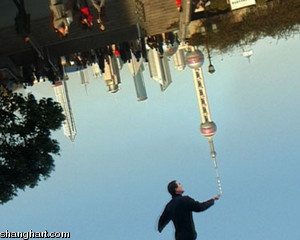
Fascinated by the photograph of a man lifting a reversed Pearl Tower and Pudong Financial District, my eyes refused to leave the picture. The complex combination of building colors contrast with the simple but effective dark sweater of the man. Visual contrast strengthens the contrast of the subject and setting. As if holding a feather, the man easily lifts the urban structure with his palm. Yang employs photography to scrutinize contemporary Chinese society. Yang emphasizes individuality over the intricate urban composition. As if the contemporary material and urban growth is a mere façade and holds little weight and impact, Yang accentuates the merit of the individual. Such an emphasis shows both his contemporary deviation from communist ideals and also his criticism of current modern Chinese dependence on material wealth and gain.

Using metaphorical imagery, Yang challenges contemporary normality through the splendor of contorted reality. As a picture is worth a thousand words, each viewer will no doubt interpret the images differently. Let us join our thoughts and share our experience to divulge our world beneath contemporary materialistic desires.

Tuesday, October 17, 2006

Yang Zhenzhong Solo-Exhibition

FOREPLAY--Yang Zhenzhong Solo-Exhibition

Nov. 5th 2006– Nov.29th 2006

Opening Reception: Nov. 4th, 5.00-7.00 pm

ShanghART Gallery & H-Space is proud to present a solo-exhibition with
works by Yang Zhenzhong (b. 1968).

Using innovative techniques Yang Zhenzhong expands the credo that
‘underneath each picture there is always another picture’ into
‘underneath each picture there is always a specific medium’. The
exhibition FOREPLAY focuses on these mediating devices that constitute
the imagery of Yang Zhenzhongs exceptional work, whether it is video,
photography or installation art.

Yang Zhenzhong involves his audience in explorations intended to
generate visual effects and stimulate feelings and thoughts to bring
about unforeseen experiences and multiple points of view. FOREPLAY
provides an ample chance to view a practice that resists any specific
style, medium or material.

The desire to challenge normative notions and fixed formats of social
behavior informs the practices of Yang Zhenzhong’s work. He is
pre-occupied with a tendency to invert the order of things and often
touches upon taboos such as death and out-dated social norms.
His approach is metaphorical rather than narrative: His videos often
start from witty ideas, employing pictorial repetition and rhythmic
coordination of sound, language and image. Yang Zhenzhong became famous
in 2000 with his half-hour video “(I Know) I Will Die” that features
short sequences in which a series of people speak the phrase "I will
die" to the camera. It is a disconcerting, soberly presented film that
confronts the viewer with existential questions. Yang Zhenzhong
recognizes that individual participation is the starting point for the
transformation of perception. Another landmark video includes “Let’s
Puff” which premiered at the fourth Shanghai Biennale (2002) and the
50th Venice Biennale (2003). The video starts from the interplay of two
images: a young woman puffing and exhaling in a busy street. Every time
the woman breathes, the image of the street moves away from the viewer.
The rhythm of the traffic and the angle of perception are altered with
the rhythm of the woman’s breath. Consequently, the image is not fixed,
but remains in a state of change. Yang Zhenzhong’s playful videos are
more than visual reflections; they are intelligent comments on the
design of contemporary society

With a sincere attitude, but in a playful manner, the artist explores
the contemporary preoccupation with questions of identity and
perception, and the ability of images to turn apathy into anticipation,
and ordinariness into desirability. He uses part fiction and part
reality that tangles both the euphoric enthusiasm and deep anxiety of
day-to-day experience. His work has lately been described as “an
extraordinary distillation of an artistic practice that couldn’t be
more preoccupied with the nature of what is real”.

Born in Xiaoshan in 1968, Yang Zhenzhong now lives and works in
Shanghai. He graduated from the oil painting department of the
ChinaFineArtsAcademy in Hangzhou in 1993 and began working with video
and photography in 1995. Yang Zhenzhong’s work has showed at major
international exhibitions, biennales and triennials. Recent exhibitions
include China Contemporary – Art, Architecture and Visual Culture,
Museum Boiman van Beuningen, Rotterdam, The Netherlands (2006), Yang
Zhenzhong Solo-Exhibition, IKON Gallery, Birmingham, UK (2006), and
China Power Station – Part I, Battersea Power Station – The Serpentine
Gallery, London, UK (2006).
2006-10-10 18:21