Showing posts with label photography. Show all posts

Sunday, June 07, 2009

Nostalgia for the Future by Juan I-Jong at epSITE Imaging Gallery

On a recent visit to Moganshan 50, I came across the exhibition “Nostalgia for the Future” at the epSITE Imaging Gallery, a retrospective look at Taiwan through the lense of Taiwanese photographer, Juan I-Jong.
An interesting title for an exhibition and very fitting. Juan does a great job of bringing the viewer into the action and makes one feel engaged with the people in his photographs.
Looking at the black and white photographs of Taiwan, I was instantly taken back to the 1970’s life of the island’s citizens. Moreover, I couldn’t help but think of my parents and see my parents in the stunning portrait photographs of young children, elders, and workers carrying on with their day-to-day lives. Looking at Juan's photographs, I was also moved to reminisce about my own experiences and summers spent in Taiwan, finding a personal nostalgia for Guanyin Mountain and Danshui, the Fisherman’s wharf, just north of downtown Taipei. Juan got the mood and feel of the atmosphere just right in these photos, as I remember them.

When I was reflecting on the photographs in “Nostalgia for the Future”, I was swept up in hopeful and calming thoughts for the future. Of all the hardships between the mainland and Taiwan in the past decades, I thought of the recent developments for freer trade and how big of a deal it was when China and Taiwan agreed to have direct flights between Shanghai and Taipei (for so long, you had to transfer flights via Hong Kong). “Nostalgia for the Future” seems to remind us of what’s going on on the other side of the Taiwan strait, and reminds us that these friendly faces staring back at you through the lense of Juan is a gesture of outreach and an unveiling of many tense and divided decades.

The EPSON gallery is a fresh space with spot-on lighting that made Juan's photos come alive. The EPSON gallery is definitely worth a visit if you get the chance.


(Photo courtesy of epSITE Imaging Gallery in Shanghai: http://www.epson.com.cn/epsite/shanghai/index.html)

The exhibition “Nostalgia for the Future” runs from April 10, 2009 To May 19, 2009.

Sunday, November 16, 2008

Exquisite Corpse at m97

The exquisite corpse, both an intriguing concept and combination of words, provides the idea that informs the exhibition of the same name currently at m97 Gallery. For those unfamiliar with the game of Exquisite Corpse or the ideology behind it, below I quote the curator’s statement:

“The Exquisite Corpse game began in France in 1925 around a table of poets and artists. In this improvisational game a player would write a phrase on a sheet of paper, fold the paper to cover part of it, and pass it on to the next player for their contribution. “The exquisite/corpse/will drink/the young/wine” was the poetic result of the first round played and hence the game’s name was born. While many initially condemned it as a frivolous game, others were quick to praise its significance for illuminating what Nicolas Calas deemed as the "unconscious reality in the personality of the group" or the group’s collective subconscious. Max Ernst identified these subconscious outcomes as the result of the process called "mental contagion." The game was quickly adapted to the visual realm of drawing and collage by assigning a section of the human body for each player to imagine.”

More familiar to most young people today is probably the visual version of the game, which I remember being played during math or science class, as it was easy to covertly pass a strip of folded paper to a nearby classmate. I’m not sure how much the game tapped into the subconscious of ten-year-old minds; we, however, found it thoroughly amusing to see the head of an alien on the body of a horse with the feet of a ballet dancer.
The intellectual, more ideological side to the game (I suppose it should henceforth be referred to as an “exercise”, not a game) is something I had never really considered before. The name alone, exquisite corpse, lends a mysterious tone of 19th century thought (at least in my mind). The combination of exquisite, evoking something extremely beautiful and delicate, and corpse, perhaps suggesting something not so much delicate as vulgar, together create something elegantly macabre, like something out of an Edgar Allen Poe story. This combination is not thoroughly paradoxical though, and it reminds us that even the most unlikely pairs can work in harmony under the right circumstances.

Just as paradoxical is the word that might come to mind when hearing the term exquisite corpse, I have realized that many people also think of contemporary China as paradoxical. Cities in China are paradoxical. Take Beijing as an example. Beijing, the imperial city, is the pride and joy China, home of the Forbidden City, the Summer Palace, and numerous famous temples. However, the Chinese are quick to forget about that history in the name of upward mobility. One of aspect of Beijing culture that doesn’t involve emperors but common people, is the style of neighborhood construct known as the hutong. Anyone who has been to Beijing, or seen older photographs of Beijing can visualize these low, curving blocks of houses divided by narrow, swooping alleyways. They are the epitome of the word community, as most people not only live in them but work nearby, and there are many people living in close proximity (which I imagine doesn’t lend itself too much privacy). However, in the wake of the recent Beijing Olympics, the government was all too quick to destroy much of this housing, early versions of which date back to the 13th century or so. About 15% of Beijing’s hutongs have been maintained for tourist purposes only. The paradox here is as follows: China takes a certain pride in its history, however, it fails to realize the value of such a structure that not so long ago dominated the city. The Beijing government wants the city to appear modern and prosperous, and decided to do so by destroying anything that wasn’t super modern, lest a Westerner’s conception of China actually be accurate. However, what people want to see when coming to China is, in fact, China. I can see incredibly modern buildings in New York, saving myself the 22-hour flight and visa application process. When I am in China, however, I would like to feel as though I am actually on a different continent. That said, there are definitely benefits to a modernized China, most of which are too complex and great to go into here. However, what China fails to achieve is balance, that harmonious blend between Eastern and Western (often things in China are dramatically polar, Eastern or Western, modern or ancient). More and more often, in dialogue about contemporary Chinese society some kind of binary will arise. As China grapples with its rich history and its desperate hunger to catapult itself into a future of modernity and prosperity, it remains caught up in (and set back by) much of its past.

To relate this back to the exhibition at m97 and the principle of exquisite corpse, I will reference Hong Lei’s photograph entitled “I Dreamt I was Hanging Upside Down While Listening to Emperor Song Hui Zong Playing Guqin with Chairman Mao” (2004). The photograph is a montage of bizarre images that cause a few double takes. The photograph depicts the following in a barren field: a man dressed in imperial clothing seated under a tree, apparently Emperor Song Hui Zong, playing the traditional Chinese instrument guqin. To his right sits a somewhat disproportionate Mao Zedong, whose profile is not entirely clear at first glance, but whose haircut is unmistakable. The ground is not only barren but appears to be the kind of overworked, nutrient-free soil so dry that the ground cracks and crumbles under foot. It is enhanced with obviously digital, copy-and-pasted emerald green shrubbery. To the left of the Emperor, looking more digitally imposed on the scene than either of his historical counterparts, is the artist, feet bound in rope, hanging upside down from an unseen source. A chair identical to the Chairman’s sits below the hanging man, suggesting that he was previously seated for the Emperor’s performance. Above the horizon line floats a small explosion, surrounded by the heavenly glow usually associated with the father of China, Mao Zedong. This photograph is almost an exquisite corpse game on the subject of Chinese history, juxtaposing several elements of Chinese politics and society from different eras. The way I see it, three eras are represented: the golden age of China’s dynastic years, the formation of the PRC and the Cultural Revolution, and the present. The artist chooses himself to represent the present, which I admire, as he is admitting that he can only speak for himself. Though the sentiments he expresses might be shared, but ultimately they are of his own opinion. And his opinion is clear- whether he his suggesting suicide by hanging (though he dangles from his feet, probably more torturous than suicidal) or he is simply evoking the feeling of blood rushing to one’s head from hanging upside down, the feeling isn’t good. His arms dangle at an unnatural 90-degree angle, and if he is turned right side up he appears to be putting his arms up in surrender. Is he surrendering himself to history, to China’s inescapable past (both the good and the bad) or is he surrendering himself to the future? Or do both just make him want to hang himself? There is a wide realm of interpretation in this photograph, much of it depending on how you view contemporary China. Physically, the emperor is entertaining Chairman Mao, not as a host but as a bard. I think this use of classical Chinese imagery suggests the employment of sacred Chinese history and culture as commodity, something that is prided in on the surface yet really exploited in the name of money. I get the feeling that, like Mao Zedong, contemporary China would rather forget the history that it somehow can’t escape. It seems as though China has jumped from ancient times to hypermodernity, which accounts for many of its current issues of identity. Mao sitting there, politely listening to classical Chinese music is akin to snap-happy tourists gawking at underdeveloped parts of old Shanghai or buying qipaos to take home to Florida. They are tokens of a bygone era, yet they are inextricable symbols of China, past and present. Symbols that China paradoxically seems equally eager to embrace and escape.

Sunday, January 20, 2008

FOTOFEST2008-CHINA

http://www.fotofest.org

FotoFest’s 12th edition of the International Biennial of Photography and Photo-related Art, presents work by 34 Chinese artists, March 7- April 20, 2008 in Houston, Texas. Photography from China 1934-2008 features ten newly commissioned and curated exhibitions, including two recently recovered archives from the 1930s and 1940s. The China programs are a cornerstone of FOTOFEST2008, the six-week. city-wide celebration of photo-based art.

In addition to these exhibitions, FOTOFEST2008 presents a symposium on twentieth century Chinese Photography with Chinese scholars GU Zheng, (Fudan University, Shanghai) and CAO Tai, (Guangdong Museum, Guangzhou) as well as a film program, New Cinema in China, with the Museum of Fine Arts, Houston (MFAH) and the University of California, Los Angeles (UCLA). Forty Chinese artists and curators will attend FOTOFEST2008, its acclaimed portfolio review for artists; the Fine Print Auction; professional workshops; and the special presentation by Hewlett-Packard (HP) of new printing technology for
art work.

The Museum of Fine Arts, Houston, the Menil Collection, Houston Center for Photography and the Holocaust Museum Houston are among 100 other organizations presenting exhibitions as part of FOTOFEST2008. Many of their exhibitions continue the China focus and the ancillary subject of Transformations as well as their own independent themes.

Photography from China 1934-2008, FotoFest’s exhibition program for FOTOFEST2008, reveals the diversity of roles and styles that have shaped photographic art over the past 74 years in China.

ETHNOGRAPHY, PHOTOJOURNALISM AND PROPAGANDA, 1934-1975
Reflecting a growing interest by the Chinese in the peoples and politics of China’s western border regions near Tibet, ZHUANG Xueben (1909-1984) began traveling to China’s far-western border regions in 1934. His work from 1934-1939 is one of the earliest and most serious photographic examinations of ethnic minorities in these regions. FOTOFEST2008 is the first time this work is being shown outside of China.

In 1937, at the age of 25, Sha Fei (1912-1950) had himself assigned to the Chinese Communist Party’s (CCP) 8th Route Army during the Second Sino-Japanese War (1937-1945). Sha Fei photographed combat and training with the Chinese forces allied with CHIANG Kai-shek, against the Japanese. He set up pictorial magazines to publicize the 8th Route Army and its work in rural villages, and he organized a mass media system that became a principal part of the CCP’s propaganda system for the next 20 years, through the 1970s. After Sha Fei’s controversial execution in 1950, his work was blacklisted until the late l980s when his family and colleagues succeeded in rehabilitating his name. FOTOFEST2008 exhibits the newly recovered work of Sha Fei for the first time outside of China.

Editors and photographers trained by Sha Fei during the war became leaders of major CCP pictorial news media and propaganda agencies, using photography as one of the primary media promoting Chairman MAO Zedong’s agenda during The Cultural Revolution (1966-1976). The exhibition curated by James and Vicky Chen, founders of 798 Gallery, one of Beijing’s most respected photography galleries, shows how photography was choreographed to promote the message of collective solidarity. The exhibit, commissioned by FotoFest, features three photographers working for news publications during The Cultural Revolution: WENG Nai Qiang, XIAO Zuang, and WANG Shi Long.

INDEPENDENT DOCUMENTARY PHOTOGRAPHY, 1985-2000
In the mid-1980s, a new generation of Chinese photographers began to produce strong personal bodies of photo-documentary work outside official media and news agencies. The first to gain international prominence was WU Jialin with his work on Yunnan province. A chance discovery of this work by FotoFest co-founder Frederick Baldwin at Marc Riboud’s Paris apartment led to his first exhibition in Western art world at FOTOFEST1996.

Two subsequent generations of photographers continue to develop independent approaches to documentary work. LU Nan’s, interest in the ethics of social interaction, led him to photograph the institutionalization of the mentally ill and underground Catholic communities in China. LI Lang’s early poetic work with the Yi People in central-western China has led to his current work exploring the human imprint on China’s landscape.

CONCEPTUAL AND STAGED WORK - NEW PHOTO, 1993-1998
In 1996, two Beijing artists, RongRong and LIU Zheng founded the influential New Photo magazine, an independent, underground publication that circulated in Beijing’s art circles. The magazine signaled a burgeoning Chinese interest in photography as a medium of contemporary art and marked an important turning point in the development of contemporary photography in China. FOTOFEST2008 presents this new exhibition for the first time outside of China, with 15 artists published in New Photo magazine. The exhibit is curated by ZHANG Li and organized by Three Shadows Photography Art Centre
in Beijing.

CONCEPTUAL AND STAGED WORK - CURRENT PERSPECTIVES, 1998-2008
Individual shows of 11 current, multi-disciplinary Chinese artists address issues of identity, memory, spirituality, gender, urbanism, and the complex relationships between the present and the past in contemporary China. Designed as a series of one-person exhibitions, these shows feature BAI Yiluo, CANG Xin, CHENG Lingyang, XING Danwen, LIU Lijie, LIU Ren, SUN Guojuan, WANG Chuan, WU Gaozhong, YAO Lu, and ZENG Han.

For more details on FOTOFEST2008 exhibitions and other programs please visit http://www.fotofest.org

Press contacts:
Vinod Hopson – 713.223.5522 x26, press3@fotofest.org
Janice Van Dyke Walden – 713.223.5522 x12, janice@vandykewalden.com

Thursday, March 22, 2007

3030 New Photography In China, by John Millichap

3030 New Photography In China, by John Millichap

Freelance journalist and founder of 3030 Press (an organization set up to produce high-quality English-language books about all aspects of contemporary creativity in China), John Millichap worked with professor of photography Gu Zheng and contemporary artist/author Ou Ning to bring 30 of China's contemporary photographers under 30 together in an energetic photographic survey titled “3030: New Photography in China.” All artists represented in the book are using photography as a medium to speak the language of the social and economic transformation that has occurred over the past few decades. “Together these works can be seen as an attempt to highlight the possibilities and anxieties of life in modern China, as well as a powerful new sense of creative identity,” explains Millichap. Each image in the book is representative of a new generation in China whose, according to Gu Zheng's theory of Chinese personal photography, “sensibilities and character are utterly distinct and for whom the power of the image is paramount.” Chinese society has undergone a major change marked by the embrace of consumerism since the mid-1990s and one glance at any given image in Millichap's book lets the viewer feel that behind the photograph lies a story affected by such transformation. Within the pages exists scenes of love and want, distraction and politics, but most apparent are the thrilling suggestions of a new China brimming with individuals whose voices ring loudly and uniquely through the photographic lens. We're especially fond of Cao Fei's series featuring Star Wars clad figures in everyday China scenes.

Whitney Rosenberg

Thursday, March 08, 2007

Pecha Kucha tonight!

See most of you tonight at the 5th Pecha Kucha fanfare! Here is the presenters' list.

Tuesday, December 12, 2006

From Art Basel Miami


as shot by Ai WeiWei

Saturday, December 09, 2006

Zeng Li's Archeology of Modern China

Zeng Li's Archeology of Modern China
by Christopher Phillips
http://www.shanghaigalleryofart.com/en/artists_detail.asp?id=48
During the past five years, regular visitors to contemporary art group exhibitions in China have often encountered groups of large color photographs showing the facades of apparently unremarkable Beijing apartment buildings. Compared to the exuberant paintings, installations, and video works around them, these sober, factual photographs typically stand apart because of their unassuming presentation and everyday subject matter. Although credited to "Zeng Li," few visitors would think to associate them with the celebrated Beijing stage designer of the same name, whose innovative decors for the People's Art Theater and collaborations with Zhang Yimou have won world-wide recognition. I was surprised to learn, not long ago, that the stage designer and the photographer are indeed the same person. And I was astonished to discover, when I paid my first visit to Zeng Li in Beijing, that the photographs I had seen in exhibitions were only the tip of the iceberg. In fact, during the past 10 years, Zeng Li has made thousands of photographs that portray the destruction of Beijing’s hutong dwellings, the changes in residential architecture of the past five decades, the wholesale reconstruction of China’s urban centers, and the traces of China’s industrial heritage. These photographs provide a meticulous record of the changes that have taken place in the everyday urban fabric of Beijing and other cities, as the hutong lanes, the standardized apartment buildings, and the sprawling factories of the recent past have given way to soaring residential towers and glittering shopping malls. When Zeng Li speaks of desire to create a lasting visual record of an urban environment that is rapidly disappearing, it is possible to glimpse an unexpected but authentic passion. Born in 1961, Zeng Li grew up in Liuzhou, in Guangxi province in China's far south. He remembers it as a place notable for the nearby mountains and also for the newly built factories situated in the region. His family lived on the outskirts of the city, in residential quarters belonging to a chemical factory. Zeng Li stayed in Liuzhou until he finished high school and left to attend the Central Drama Institute in Beijing, where he studied stage design. Since graduating in 1987, he has been associated with the Beijing People's Art Theater, earning acclaim as one of China’s leadng stage and costume designers. He attracted wide international attention in 1997 with his stage design for Zhang Yimou's production of "Turnadot" in Florence and then Beijing, and he collaborated again with the celebrated film director on a ballet version of "Raise the Red Lantern" in 2001. Because China’s creative community is unusually close-knit, Zeng Li has also been involved in projects with the leading artists and architects of his generation. He participated, for example, in the "Bunker" group exhibition that the artist Cai Guo Qiang organized in 2004 in a complex of former Taiwanese military bunkers on Kinmen (Quemoy) island. Zeng Li’s contribution, "Fight Theater," was a performance by 20 members of the Peking Opera. On a stage in front of a map of China and Taiwan, they carried out an ironic remix of battle scenes from historic Peking Opera productions. The visual richness of Zeng Li's stage design does not prepare you for the austerity and the quiet reserve of his photographs, which reveal a very different side of his artistic temperament. It was around 1997, he recalls, that he realized that photography could be used to register the dramatic changes that were sweeping through Beijing’s historic neighborhoods as a result of the capital’s ongoing modernization campaign. At that time, he kept a painting studio some distance northwest of central Beijing, in the part of Changping district where the Ming Tombs lie in a tranquil, orchard-filled valley cradled by the Tianshou mountains. His visits to that site, where 13 of the 16 Ming emperors were buried between 1409 and 1644, sparked his historical curiosity. At that time, he recalls, only one of the tombs had been restored, and the remainder lay mostly in ruins. When the Beijing municipal government announced a plan to restore all of the tombs and to develop the area as an international tourist attraction, Zeng Li felt that he should photograph the area before it was "destroyed" by renovation. He purchased a professional camera and made some of his first photographs there; the area has remained one of his long-term photographic subjects. Traveling regularly by bus and bicycle back and forth to his studio, Zeng Li says, he could not help but observe the accelerating pace with which many of Beijing's traditional residential neighborhoods were disappearing. Gradually he began to imagine the creation of a systematic photographic record of the old sections of Beijing that were slated for destruction. This urge became even more pressing in 2001, when Beijing was chosen to host the 2008 Olympics. Zeng Li realized that many of the historic yet badly dilapidated areas of the old city would almost certainly be demolished by the municipal government, in an effort to spruce up the city’s image for the benefit of foreign visitors and the world media. The debate over urban renewal in the central districts of the capital was hardly new. Ever since the founding the People’s Republic in 1949, Beijing has witnessed a continuing struggle between the forces of urban renovation and those of preservation. In 1949, the four central districts of Beijing’s old city were filled mainly by one-story residential buildings--mostly courtyard-style houses arrayed along the narrow lanes of densely packed neighborhoods called hutongs. As the population of Beijing grew, some hutongs were torn down and replaced with new, low-rise, six-story housing. Nevertheless, until the late 1980s the main official response to the challenge of Beijing’s swelling population was to build new, standardized residential complexes on the city’s peripheries. In the long run, however, this strategy did little to protect the hutongs. Because housing maintenance was given such a low priority by the municipal government, Beijing's courtyard dwellings gradually deteriorated to a dangerous degree. By the end of the 1980s, Beijing's hutongs had won a reputation as crumbling, unhealthy quarters, and city officials increasingly described them as a blight on the reputation of the nation’s capital. In 1990, the Beijing municipal government embarked on a program of sweeping changes in the central city, adopting an ambitious master plan that aimed at the renovation of 8.2 million square meters of courtyard housing occupied by 400,000 households. The actual situation of the hutongs could, of course, be interpreted quite differently depending on one's vantage point. To city officials, they appeared as embarrassing relics of an earlier, almost feudal age, that were wholly unsuited for the capital of a powerful modern China. Such observers could see only dilapidated buildings afflicted with crumbling walls, rotting columns, leaky roofs, poor drainage, primitive toilet facilities, inadequate heat and ventilation, and lack of sunlight. Combined with the desperate overcrowding of the courtyard dwellings, where three generations of a family might share a single room, these conditions led many of Beijing’s planners to conclude that the hutongs were a national disgrace, and worthy only of destruction. For the residents of the hutongs, however, these obvious disadvantages were to a large degree offset by the lively and intimate lifestyle that these areas afforded. Thanks to their narrow lanes, originally designed to offer protection from Beijing’s notorious dust storms, hutongs were hospitable to pedestrian traffic but not easily accessible to automobiles. The very crowdedness of the courtyard dwellings encouraged a vital, constantly flowing street life. While living conditions were difficult, these neighborhoods were hardly slums; the hutong social structure was remarkably stable, most residents were employed, and public services were readily available. Most crucially, families that had lived for generations in the same hutong inevitably developed a network of close, nuanced relationships with neighboring families. The real appeal of hutong life was this extraordinarily intimate human texture, a quality impossible to re-create in the standardized apartment buildings that were Beijing's only residential alternative. The announced goal of the Beijing “housing renewal” of the 1990s was to improve the quality of life of hutong dwellers. As it was implemented by the new private real-estate developers who came to dominate Beijing’s urban-renewal process, however, renovation often amounted to the permanent relocation of hutong dwellers, who bitterly realized that they could not afford the market-rate rents that would be introduced following rehabilitation projects. As Zeng Li's interest in making a visual record of the hutongs became known, he would often receive phone calls from hutong residents or from members of preservation groups alerting him that bulldozers had been summoned to knock down a certain area. He would hurry there with his large-format camera; some of his pictures show the demolition already in progress. Most of the hutong dwellers that he encountered while photographing encouraged his project, because they realized that buildings like theirs were rapidly disappearing all over Beijing. Yet other people, Zeng Li recalls, would stop and brusquely ask him, “Why are you making these pictures? There is nothing beautiful here.” By 2000, there were increasing of photographers recording the destruction of Beijing’s hutongs. Zeng Li stands apart as one of the few photographers to expand the scope of his project beyond the hutongs, to encompass the story of the wider changes that had taken place in the housing of the capital’s inhabitants since the 1960s. He began systematically to photograph the different types of residential buildings that characterized succeeding decades. These included examples of the spartan six-story walk-up buildings of the 1960s and ‘70s, a period when the nation had scant resources to devote to housing; the 12-story midrise buildings of the 1980s, which began to appear after the state decided to allow market forces to play a role in developing the housing sector; and the soaring, ornately decorated luxury towers that began to dominate Beijing's skyline during the economic boom of the 1990s. It is characteristic of Zeng Li’s approach that he did not set out to highlight the most architecturally important or innovative buildings, but to create a visual archive of the residential structures that were the most typical of their kind. His photographs usually employ a straight-on viewpoint and avoid unusual camera angles or dramatic compositions. They did not initially elicit great enthusiasm from Beijing’s artists, who were busy exploring more theatrical and conceptual approaches to photography. Instead Zeng Li found his most appreciative audience among Chinese architects, who quickly realized that his photographs cast a revealing light on a part of China’s everyday built environment that had largely escaped serious attention. Zeng Li’s visual revelation of the unheralded yet ubiquitous buildings in which millions spent lived their lives amounted to an alternative history of the recent course of architecture in China. Another facet of Zeng Li’s fascination with Beijing’s architectural environment can be found in his series of photographs of industrial chimneys and smokestacks. He regards these as compelling symbols of China’s determination, in the 1950s and ‘60s, to achieve industrial self-sufficiency as rapidly as possible. This goal prompted the construction of factories large and small throughout the country--even in Beijing, the nation’s capital. While a few of the smokestacks in Zeng Li's photographs belong to factories that are still in operation, most now serve only to mark sites where working factories once stood. As such they are monumental reminders of China’s historic shift from an agricultural to an industrial society. Just as the small factories that once dotted Beijing are now disappearing because of environmental concerns, so the giant iron and steel factories that arose during the same era are now being closed or relocated. Among Zeng Li’s most memorable photographs are those made on the grounds of the Shougang Iron and Steel Company, which once occupied the leading ranks of China’s state enterprises. Founded in 1919 in what were then the western suburbs of Beijing, the company grew rapidly after 1949 to become one of China’s largest and most famous steel-producing establishments, employing more than 100,000 workers. Recently, as a result of Beijing’s growing alarm about the enormous pollution created by Shougang’s operations, it has been decided that the company’s steel-making facilities, which lie only 18 kilometers from Tiananmen Square, will be completely relocated to Hebei province by 2010. There have even been recent official discussions of turning the vast, 2-million-square-meter Shougang complex into an art district similar to the 798 Factory in Beijing's Dashanzi section. For Zeng Li, the conviction that such industrial enterprises form a vital part of modern China’s history eventually led him to travel to Guizhou province, in the country’s southwest, to photograph the sprawling Shuicheng Iron and Steel Works. Prior to 1949, there was virtually no industry in this mountainous region, which despite its natural resources was one of China’s poorest provinces. With the advent of the People’s Republic and the strategic decision to locate new industrial facilities deep in the country’s interior, the central government provided financing for the establishment of coal mines, chemical plants, and metallurgical plants, as well as a railway meant to connect Guizhou to its neighboring provinces. By 1960, the first regional iron and steel facility opened in Guizhou’s capital, Guiyang. The metal works that was subsequently was built in Shuicheng was one of the country’s largest steel facilities to be constructed entirely with Chinese resources, without the foreign assistance that had been common before the Sino-Soviet rift of the early 1960. The Shuicheng factory remains active today despite pollution concerns. Zeng Li relates that he was able to obtain permission to photograph there with the help of the editors at the Workers Publishing House in Beijing. He told them of his keen desire to photograph China’s historic factories, and they wrote letters on his behalf to the local authorities. Zeng Li wryly relates that even though the editors realized that he would work in his usual non-dramatic photographic style, they may have secretly hoped that he would accidentally make some beautiful pictures that could be of use to their publishing house. Overall, Zeng Li’s photographs of depopulated industrial zones, abandoned factory buildings, and shut-down blast furnaces suggest his fascination with the aftermath of the China’s epic rise to the status of industrial superpower in the course of a short half century. He shares this fascination with the filmmaker Wang Bing, whose monumental nine-hour documentary West of the Tracks (2003) explores the present-day ruins of the vast industrial complex in Shenyang, in the northeastern province of Liaoning. It is important to realize that both the photographer and the filmmaker are portraying local examples of a process that is occurring not only in China but world-wide: the decline of the labor-intensive resource-depleting industrial system that originated in the 19th century in Europe and the U.S. and then spread to the rest of the world. Today this system is under pressure everywhere, as we enter a new age of high-tech, computer-guided production and global markets. Examples of this historic process can be found in the decaying factories of the “rustbelt” in the U.S. northeast; in Russia, where the once-powerful Soviet steel industry has almost entirely withered away; and in the Ruhr Valley of Germany, once the steel-producing capital of Europe. Seen in this light, Zeng Li’s photographic project seems remarkably close in spirit to that of the German husband-and-wife team Bernd and Hilla Becher. Since the late 1950s, the Bechers have created a remarkable visual record of the vanishing traces of Europe’s former industrial culture. In their precise, objective, and purposely “non-artistic” photographs, we see an amazing array of blast furnaces, cooling towers, lime kilns, mine heads, grain elevators, and workers’ houses--all part of a vast industrial world which existed from the 1830s to the 1960s. The photographs of the Bechers, like those of the earlier German “New Objectivity” portraitist August Sander, are well known to Zeng Li. His photographs, like theirs, serve to remind us as how quickly entire social worlds, inhabited by countless millions of people, can dissolve when a new economic and technological era suddenly makes its appearance. Looking back at his photographs of the past decade, Zeng Li acknowledges that his conception of his own project has steadily expanded. Starting with the historic structures of the Ming Tombs, he enlarged his view to include the everyday architecture of China’s cities and then its historic factories. Now, he says, he intends to take his camera to the countryside, to assemble a visual record of the momentous changes that are occurring as a powerful wave of 21st-century modernization takes hold in China’s traditional agricultural regions. These photographs, it is safe to predict, will take their place in the unrivaled historical panorama of China’s transformation that Zeng Li is quietly, patiently creating.

Wednesday, December 06, 2006

Zhao Bandi Solo-Exhibition: Dec. 16 – Jan. 20, 2006


Zhao Bandi Solo-Exhibition: Dec. 16 – Jan. 20, 2006
Opening Reception: Dec. 16, 5.00-7.00 pm 2006

ShanghART Gallery is proud to present solo-exhibition by Zhao Bandi (b. 1966). Zhao Bandi’s practice encompasses photography, video and performance with issues of concern to contemporary society.

Zhao Bandi has made his reputation with staged scenarios where he and his toy panda play out everyday situations. Sometimes these consist of scenes from the life of a single father. Other times, the panda assumes the role of partner and lover. The panda is treated and acts as a ‘real’ character with a voice of its own that appears as speech bubbles in the photos. The toy panda becomes a spokesperson, allowing the artist to touch upon challenging issues and messages with an appealing sense of humor.

Zhao Bandi was born in 1966 in Beijing, where he lives and works. He graduated from the Beijing Central Academy of Fine Arts in 1988. Since 1993, his works have been shown at international exhibitions, including the Sydney Biennale (1998), 48th Venice Biennale (1999), 1st Guangzhou Triennale (2002) and the 5th AsiaPacific Triennial of Contemporary Art (2006). His project “Zhao Bandi & Panda” has been on public display in Shanghai, Milan, London and elsewhere.

Monday, November 06, 2006

Shanghart on Moganshan


For this week, I visited Shanghart on Moganshan Road for the solo exhibition by contemporary Chinese performance artist Yang Zhenzhong. Revisiting this elusive gallery again brings back memories of the first time. The distasteful cappuccino with drops of hardening black goo, the rumbling and cumbersome warehouse elevators, the cordial and welcoming foreign gallery owners and the storage and exhibition of many impressive works of modern art all return to my memory.

I arrived at Shanghart after striding through the familiar alleys lined with art galleries and walked into the spacious solo exhibition gallery to witness the photos and videos made by Yang Zhenzhong. Born in Xiaoshan in 1968, Yang Zhenzhong now lives and works in Shanghai. He graduated from the oil painting department of the China Fine Arts Academy in Hangzhou in 1993, and started working with video and photography in 1995. Yang Zhenzhong’s works have shown in all major biennales and triennials such as Venice (2003), Shanghai (2002), Guangzhou (2002), and Gwangju (2002). Yang’s solo exhibition in Shanghart is his first cooperation with the gallery.

Different artists have different preferences and perception. Yang emphasizes the focus and compliment of the subject in his artwork with the background. Using photography, Yang manipulates the background and the subject to portray ordinary people and daily life. Vibrant colors and entrancing settings enrich and accentuate the central characters in the photography and animation. Through the implementation of the environment and present objects and subjects, Yang illustrates contemporary China through a snapshot. As if fusing culture, modernity, psychology and existence in a single image, Yang reveals our world in one picture. As one of the audience, I felt perplexed but captivated by his photos. In his series titled Light and Easy, Yang has his characters upholding the immeasurable weight of urban and material society.

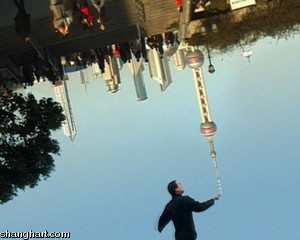
Fascinated by the photograph of a man lifting a reversed Pearl Tower and Pudong Financial District, my eyes refused to leave the picture. The complex combination of building colors contrast with the simple but effective dark sweater of the man. Visual contrast strengthens the contrast of the subject and setting. As if holding a feather, the man easily lifts the urban structure with his palm. Yang employs photography to scrutinize contemporary Chinese society. Yang emphasizes individuality over the intricate urban composition. As if the contemporary material and urban growth is a mere façade and holds little weight and impact, Yang accentuates the merit of the individual. Such an emphasis shows both his contemporary deviation from communist ideals and also his criticism of current modern Chinese dependence on material wealth and gain.

Using metaphorical imagery, Yang challenges contemporary normality through the splendor of contorted reality. As a picture is worth a thousand words, each viewer will no doubt interpret the images differently. Let us join our thoughts and share our experience to divulge our world beneath contemporary materialistic desires.

Friday, October 20, 2006

"Moving Memories" Zhang Nian Solo Show

Artist: Zhang Nian
Curator: Wang Lin
Organiser/Venue: ddmwarehouse
Exhibition Dates: Oct. 21st – Nov. 12th, 2006
Opening: Oct. 21st, 2006 (Sat.) 4 pm
Entry: Free

Zhang Nian made his name through the piece “Hatching” in the “China Avant-garde Exhibition 1989”. After that his Egg Series and many other artworks expressed the expectations, inconsonance, conflicts, negation and re-valuation from an individual towards the social values.
The upcoming “Moving Memories” show is not only the exposition of his new pieces, but a memoir of his Zhang Nian’s art creation as well. This series employs both visual and documeted historical records from the Opium War to contemporary China. Especially since the establishment of the People’s Republic of China in 1949, China has been experiencing a seemingly 10-year circle of historical signifigances, which have constituted some unique dynamic/moving social structures and common values. As an artist Zhang Nian portrays China from modern to contemporary eras through photography, painting and videos. One of the most outstanding features of Zhang Nian’s works is his glamorous presentation by using radiant lighting strokes, which do not only serve personal aesthetic preferences, but are also commonly seen in the propaganda posters in communist China. These strokes are embodied with special energy, that have been influencing Chinese as well as the wider world. They are both personal experiences and collective memories.

ddmwarehouse
713 Dong Daming Rd. 3F Shanghai, China 200080
Tel: +86 21 3501 3212 Fax: +86 21 3501 3340
Opening Hours: 11:00-19:00 Tues.-Sun. (no fee)
www.ddmwarehouse.org
info@ddmwarehouse.org

Wednesday, October 18, 2006

Harvest II : Annual Chinese Photography EXPO

Art Scene Warehouse
2/F, Bldg No.4, 50 Moganshan Road,
Shanghai, People's Republic Of China
Oct 22, 2006 To Nov 22, 2006

Detail: Art Scene Warehouse's big space is bringing together the works of 16 of China's best photography artists. Some of the photographers, who come from throughout China, are among China's most famous and internationally exhibited, while others are young, emerging photography artists. The show is being co-curated by Gu Zheng, one of China's most respected photography curators. Gu curated the Guangzhou Photography Triennial in 2005, one of China's most important photography shows, as well as an exhibition that toured 4 USA museums in 2005 and 2006.
The title "HARVEST" refers to the culmination of the 16 Chinese photographers' hard work, being reaped and sewn at Art Scene Warehouse for viewers to enjoy. HARVEST also refers to the current autumn season, when the fruits of labour are reaped in the fields, as the fruits of the artists' work will be gathered together for a big exposition at Art Scene Warehouse's exposition.

Tuesday, October 17, 2006

Yang Zhenzhong Solo-Exhibition

FOREPLAY--Yang Zhenzhong Solo-Exhibition

Nov. 5th 2006– Nov.29th 2006

Opening Reception: Nov. 4th, 5.00-7.00 pm

ShanghART Gallery & H-Space is proud to present a solo-exhibition with
works by Yang Zhenzhong (b. 1968).

Using innovative techniques Yang Zhenzhong expands the credo that
‘underneath each picture there is always another picture’ into
‘underneath each picture there is always a specific medium’. The
exhibition FOREPLAY focuses on these mediating devices that constitute
the imagery of Yang Zhenzhongs exceptional work, whether it is video,
photography or installation art.

Yang Zhenzhong involves his audience in explorations intended to
generate visual effects and stimulate feelings and thoughts to bring
about unforeseen experiences and multiple points of view. FOREPLAY
provides an ample chance to view a practice that resists any specific
style, medium or material.

The desire to challenge normative notions and fixed formats of social
behavior informs the practices of Yang Zhenzhong’s work. He is
pre-occupied with a tendency to invert the order of things and often
touches upon taboos such as death and out-dated social norms.
His approach is metaphorical rather than narrative: His videos often
start from witty ideas, employing pictorial repetition and rhythmic
coordination of sound, language and image. Yang Zhenzhong became famous
in 2000 with his half-hour video “(I Know) I Will Die” that features
short sequences in which a series of people speak the phrase "I will
die" to the camera. It is a disconcerting, soberly presented film that
confronts the viewer with existential questions. Yang Zhenzhong
recognizes that individual participation is the starting point for the
transformation of perception. Another landmark video includes “Let’s
Puff” which premiered at the fourth Shanghai Biennale (2002) and the
50th Venice Biennale (2003). The video starts from the interplay of two
images: a young woman puffing and exhaling in a busy street. Every time
the woman breathes, the image of the street moves away from the viewer.
The rhythm of the traffic and the angle of perception are altered with
the rhythm of the woman’s breath. Consequently, the image is not fixed,
but remains in a state of change. Yang Zhenzhong’s playful videos are
more than visual reflections; they are intelligent comments on the
design of contemporary society

With a sincere attitude, but in a playful manner, the artist explores
the contemporary preoccupation with questions of identity and
perception, and the ability of images to turn apathy into anticipation,
and ordinariness into desirability. He uses part fiction and part
reality that tangles both the euphoric enthusiasm and deep anxiety of
day-to-day experience. His work has lately been described as “an
extraordinary distillation of an artistic practice that couldn’t be
more preoccupied with the nature of what is real”.

Born in Xiaoshan in 1968, Yang Zhenzhong now lives and works in
Shanghai. He graduated from the oil painting department of the
ChinaFineArtsAcademy in Hangzhou in 1993 and began working with video
and photography in 1995. Yang Zhenzhong’s work has showed at major
international exhibitions, biennales and triennials. Recent exhibitions
include China Contemporary – Art, Architecture and Visual Culture,
Museum Boiman van Beuningen, Rotterdam, The Netherlands (2006), Yang
Zhenzhong Solo-Exhibition, IKON Gallery, Birmingham, UK (2006), and
China Power Station – Part I, Battersea Power Station – The Serpentine
Gallery, London, UK (2006).
2006-10-10 18:21

Monday, October 02, 2006

Pecha Kucha Night Vol.3

First , I want to thanks Defne to give me the chance to visit this party which involved with many foreign designers. It's my first time to take part in a foreigners' party. And I also want to thanks Alicia who went along with me that do not make me feel alone by surrounding with strangers. Because this party is a little noisy and I am busy with taking photos, I failed to take a note with the speech and even memorize some of the speakers' names. I will just talk about my feelings according to my memory and the photos.
This is the entrance wall, the irregular alining stone make this wall kinds of special, with a broad lense viewing it, it looks some majesty.This is the side wall painted with doodles, the doodles are belong to the underground culture, which is forbiding by the goverment(since it is started from the west, it's just the beginning in china, so it is not common to see it), so this wall appeared in this private( or maybe public) looks particular. And the most interesting thing is in the left wall of the picture, you can see that the doodles, the wall and the liana merged into a whole thing, it looks so natural.
these two pictures are from the stairway, although it is an under decorating building( some parts of it has not be installed), the signs are so attracting. I am believed that they must be prepared by the FAR. These detailed things showed how careful the organizer is and how design are close to the daily life.In the party, the workers are lighting up the candles of the Logo "FAR"

I want to illustrate some of my favorite works in that day's party.The first one I want to talk about is the works from a couple - Carte & Sharky.In this couple's work, I saw a new kind of art style, combining the traditional chinese painting with foreign line drawing, and they are combined so natural and harmonize. Couples like them who are both talented in art and from different nationality are not so commen, however, those who can combine their art styles and create a new one may be only are them. I am so appreciate them and even some kinds of envy them, they are so happy to merge their love into their art works. These are some of their works below:
From this picture we can see that the use of the chinese ink and the strong of the stroke of English character are harmoniously merged into each other, the random red/yellow is both exaggerate and natural. The ink marks and fine lines of the mansion are so close to each other but also form a contrast. From artists ' others work we also can see the use of ink and stroke make the person drawing using ink possible.The combing of west and east is so obvious in author's work. Boldly use of bright colors and chinese stroke of english character are also the traits.
The couple also use a progress to show how they usually create their drawlings. From the first picture we can see that their works did have some practical meanings. And usually use the bright color to display it, and use the dim ink painting to help people to imagine.

The next that I want to introducted is a Chinese designer, whose major is designing post as well as Logo, T-shirts and clothes. I am very sorry for forgeting his name. This is what he designed for a toy:This artist is very good at using black and white, which also the most classic and difficult- displaying colors, we also can see he use it on the clothes designing later.
these are the post that he designed for the Nike company, there are also a picture shows he designed a color for a Nike SB shoes( which I did not take it). Since one of my friends is a sneaker, I more or less know something about the Nike SB shoes. Nike company always choose a famous designer for a new shoes. So it must be some special spotlights in this artist.
These are the some design he made for fashion clothes. From the use of color and patterns , we can see he prefer to using the traditional picture and color to reveal the popular in that decades. It some kind of cater for the fashion of the trend in Nike and Addidas shoes.These pattern are also designed from his hand. We all know, sk8 is always the trends in the teenagers. Cause the picture is not very clear, I canot discuss it in detail.this is his one shot in designing clothes, which is very different from graphic design, so it is a challenge for him.

I was supposed to discuss another speaker john, since Alicia is one of his fans, I think she is much more powerful in the review. Here is one picture of John.
In retrospect to the whole party, I think it is very good way to show yourself in public. Everyone in this got satisfied, party is party, show is show. And I realise, communication is very important in design world, it is a way of learning as well as the initial phase of design. And it is also the key phase of the marketing in design. Oh, I remembered that there was a deputy of a oversea company, who displayed a group of chart to reveal the austerity environment in china.From the contrast among China, Europe, North American and the investigation of the chinese policy, the company use an easy understanding chart to illustrate the hard situation. Regardless of pollution and energying unreasonable comsuming, the main question in my head is why it is foreign country to survey the situation instead of our own company. Is that less powerful, or is the data is limited by the policy or the whole nation do not have a long sight focusing on this issue. Will the result be strong enough to alert the native people? It's maybe not close to the theme of the party, but what a designer would do to reveal the terrible social reality? Or may be it is the main obligation of the designer.

Tuesday, September 26, 2006

Pecha Kucha this Thursday.

FAR is organizing this event on the 28th of September before the October break kicks in.
Pecha Kucha Night presents around 15 participants from all walks of creative life, who show 20 slides for twenty seconds each.
Link

Thursday, September 21, 2006

Photography and Its Evolution as Fine Art Panel Discussion


Save Sunday, September 24, 4pm to go to this panel, which will be examining recent trends in the role of photography in China’s contemporary art scene! DA

Photography and Its Evolution as Fine Art
Panel Discussion

Meg Maggio, Pekin Fine Arts
John Batten, John Batten Gallery, Hong Kong
Gu Zheng, photographer and professor, Fudan University
Greg Girard, photographer, Shanghai

Over the last ten years, China has seen a veritable explosion of new photo-based contemporary artwork, which is now accepted – and well regarded as “art” – in major museums, art fairs, and gallery exhibitions. No longer relegated to a secondary position, the boundaries between photography as social documentary and photography as contemporary artwork are forever blurred; and, whether an artist currently works in photography and moves to painting,
or vice versa, seems less and less important.

RMB 50, includes a drink

Picture Credit: Sitting on the Wall - ShenZhen 1 by Weng Fen, 2002