For our Contemporary Art class on Thursday, March 5th we went to go visit the art center of Shanghai - 50 Moganshan lu. We visited three of the more well known art centers in Moganshan50 - BizArt, Eastlink and ShanghArt. Oh and I almost forgot to mention that we briefly visited Island6 which is near 50 Moganshan lu but tends to do more new media installations (LEDs and such).
We started out by visiting BizArt where we talked with one of the people in charge, we also watched a video about one of the first contemporary art exhibitions in China about 10 years ago. It was interesting to see that this occurred 10 years ago and it was definitely a neat exhibition. It started out by starting with everyone who attended the exhibition entering through a market that sold art created by the artists (various objects, most quite fun looking). The exhibition itself had some interesting pieces but I was most fascinated with the way it was presented to the public. I think that it was a great concept, having the market first as an entrance to the exhibition as well as making it well publicized to the public. There wasn't a specific exhibition in BizArt at the time but we learned a bit about its history through the video and the worker (They also had a net up for what looked like badminton, definitely looked like fun!). You could also tell that they didn't sell any of the work that they created, they didn't have the heat on in the building and overall it wasn't very extravagant (although it did work, it just contrasted with what we would see next at EastLink next). I also was able to ask the worker about the 1999 exhibition and he said that it was all self-funded, it's interesting to note that they've just moved away from this about 2 years ago which is awesome for them.
Next we went on to Eastlink which was nicer inside and the quality of the productions was very impressive. There was a varied set of pieces and they were all intriguing. (You could tell that this place sold the art, because of the quality of the art and the space itself). One of the pieces that I thought was really cool was the piece of all the people in the offices with bubbles in each room - I just thought that the way the piece came out looked awesome. There was also a fascination with boobs here, one of the artists had created this extremely exaggerated set of boobs that was in several places around the space (I wasn't quite sure what to make of them lol).
Then we headed onto ShanghArt which had some real high quality art. I thought that the pieces here were extremely well done, don't know if I really understood every message the artist was trying to get across but the pieces themselves I thought were beautiful. We also saw a preview to the opening of an exhibition where we saw some art that mixed some old Chinese history with new art styles which was interesting as well - although it wasn't my favorite.
On our way out we passed by Island6 and checked it out and I was intrigued as this place has to deal with more new media installations. They had some interesting pieces with LEDs used to create people, that would move across a picture in the background behind a painting/photo. They also had two games of Pong setup that used some interesting control devices (one used foot pedals) and another used a sort of a switch that you would push in the direction you wanted the bar to move. Definitely worth visiting again.
Overall, the places that we visited were impressive and I thought the art was pretty high quality. The place also seems to be teeming with other art places and art in general so I don't think you could visit everything going on at once in one go (It'd probably take a while to get to see everything), so at one thought that's really cool, but it would be easy to get overwhelmed there trying to see everything. Definitely worth your time to visit 50 Moganshan lu though!
Showing posts with label bizart. Show all posts
Showing posts with label bizart. Show all posts
Thursday, March 20, 2008


Friday, March 07, 2008


Sunday, August 26, 2007
Bizart this Fall
9月SEPTEMBER 2007
2007皮埃.埃尔创作奖提名展
2007 Pierre Huber Creation Prize
Nominees Exhibition
Opening: September 4th, 2007, Tuesday 18:30
Press Conference: September 4th, 2007, Tuesday 19:00
Exhibition dates: September 5th to 10th, 2007, from 11:00 to 18:00
Organizer: China Art Academy
Co-organizer: New Media Art Department, China Art Academy
Venue: BizArt Art Center
Nominated artists:
Dong Dayuan, Jiang Zhuyun, Lu Yang, Shi Chuan, Wang Xin, Ma Xiaoxiao,
Sun Huiyuan, Xiao Yuankun
About Pierre Huber New Media Art Creation Prize and Fund
On September 7th, 2006, Mr. Pierre Huber met with the students of the
New Media Art Deparment of the China Art Academy and inquired about the
education situation.
In view of stimulating New Media Art Creation, education and diffusion,
as well as encouraging and supporting creative activities of the new
media art students, Mr. Pierre Huber founded the "Pierre Huber" New
Media Art Creation Prize and Fund.
The grant will finance a small management group in charge of
supervising the use of the fund, and formulate a regulation system.
Part of the grant will fund the "Pierre Huber New Media Art Creation
Prize" to support over the years the creativity of outstanding
students. Three prizes will be awarded to the students.
Fund will also be used to support students' creativity: students will
directly submit their project which will be examinated and subsidized
by the management group. At last, part of the grant will finance
studies of prominent new media art students with family difficulties.
Reward process will be composed of two phases: first, teachers will
nominate skillful students, who will participate to an exhibition. The
second phase will be the final selection by a jury made of renowned
curators and artists.
Jury will be composed of five members selected each year from a list,
members will change from a year to another.
Jury members list:
Beijing: Fei Dawei, Pili, Karen Smith, Wang Gongxin, Lu Jie
Shanghai: Zhang Qing, Zhou Tiehai, Xu Zhen, Yang Zhenzhong, Lorenz
Helbling, Chen Jieyang, Lin Shumin, Yang Fudong
Guangzhou: Huang Zhuan
Abroad: Hou Hanru (U.S.A., France, China), Hans Ulrich-Obrist (U.S.A.,
France), Barbara London (U.S.A.), Zheng Shengtian (Canada), Yves
Aupetitallot (France), Zhang Ga (U.S.A., China).
韩国艺术家朴芝恩和中国艺术家李平虎的展览
Exhibition of Jee Eun Park (Korea) and Li Pinghu (China)
Opening: September 14th, 2007, Friday (18:30)
Exhibition Dates: September 15th � September 28th, 2007 (11:00 � 18:00)
Exhibition of the artworks produced by Korean artist, Jee Eun Park,
during her residency in BizArt and the works produced by Chinese
artist, Li Pinghu, during his residency in Ssamzie Space, Seoul. The
exhibition will be held in September in BizArt for one week.
10月October 2007
仔细想想,昨天你究竟干嘛去了? -- 施勇个展
Let's think, where have you been yesterday? --Shi Yong's solo
exhibition
开幕时间:2007年10月12日,星期五 (18:30)
展览时间:2007年10月13日-10月22日 (11:00 � 18:00)
Opening: October 12nd, 2007, Friday (18:30)
Exhibition Dates: October 13rd �October 22nd, 2007 (11:00 � 18:00)
往事 � 被遗忘的时光
6位印尼艺术家阐释的印尼历史, 1930-1960
The Past - The Forgotten Time
Six Indonesian artists interpret Indonesian history, 1930 - 1960
Opening: October 25th, 2007, Thursday (18:30)
Exhibition Dates: October 26th � November 11st, 2007 (11:00 � 18:00)
Introduction:
This exhibition represents a variety of perspectives focusing on the
struggle of "Becoming Indonesia" during the period between 1930 and
1960. Personal stories mixed with formal facts to indicate how the
colonial situation became a major part in the attempt to formulate an
Indonesian identity. Beginning with the visual forms produced by these
artists, we learn to remember and reflect on the past and, together,
oppose forgetting.
Wednesday, June 27, 2007
Welcome to Birdhead world again!
Welcome to Birdhead world again!
Birdhead 2006+2007
Song Tao & Ji Weiyu's solo exhibition
Opening: June 29th, 2007 Friday 18:30
Exihibition Dates: June 30th - July 20th, 2007 (11:00 - 18:00)
Lecture: June 29th, 2007 Friday 20:00
Venue: Shanghai BizArt Art Center, 4th Floor, Building 7th, Moganshan rd 50
Postcode: 200060
Tel: +8621 62775358
www.biz-art.com
Thursday, June 07, 2007
From Propaganda to Profit
------------------------
From Propaganda to Profit
June 2007
From Propaganda to Profit
June 2007
by Rebecca Catching and Anurag Viswanath
This spring at Moganshan Lu, Shanghai's main art district, Beijing Art
Now Shanghai christened their gallery opening with a rather
unconventional exhibition, "Shanghai Now." Viewers entered the
cavernous warehouse and stared blankly at canvases sheathed in money.
Gallery founders Huang Liaoyuan and Zhang Haoming had wrapped each
painting in shiny wrapping paper printed with faces of various
different currencies. In doing so, they sought to remind viewers to
look beyond the commercial value of art and contemplate its intrinsic
value.
Xu Beihong's 1939 work Put Down Your Whip sold at a recent auction in
Hong Kong for a record $9.2 million.
It's a relevant point in the context of the Chinese art market, which
some claim has begun to spin out of control. Last year, Sotheby's and
Christie's sold $190 million worth of Asian contemporary art—most of
it Chinese. Prices reached unprecedented heights, with 43-year-old
artist Liu Xiaodong dropping canvases for a whopping $2.7 million, and
Xu Beihong's The Slave and Lion smashing the record for a Chinese oil
painting at $6.9 million.
Twenty years ago Chinese artists would have had trouble obtaining a
passport, but now they are globetrotters. They have studios at home
and abroad, showcase their art around the world, and are getting very
rich in the process. Why this boom? According to Simon Groom, head of
exhibitions at the Tate Liverpool, the Chinese art explosion "reflects
the interest in China, driven by the growth of its economy, the
emergence of Chinese collectors and an eagerness in the West for new
speculative markets."
Tate Liverpool's current exhibition "The Real Thing: Contemporary Art
from China" features 26 works by 18 leading Chinese artists, including
Ai Weiwei, Gu Dexin, Zhou Tiehai and the Yangjiang group. The exhibit
has been billed as the "show of the year" and is evidence of the
growing influence of Chinese artists abroad. Indeed, many of China's
most exciting artists are now based abroad—for example Xu Bing and Cai
Guoqiang—which puts them in close proximity to their collectors, 90%
of whom are foreign.
Yet mainland Chinese collectors are starting to get into the Chinese
art game, too. Catering to their needs are hundreds of mainland
galleries and auction houses which are springing up, as well as
foreign institutions that are in the process of opening branches in
China, such as the Centre Pompidou and the Guggenheim.
Auction houses, both foreign and local, have begun to deal directly
with the top-tier Chinese artists, snatching up works while the paint
is still wet, rather than going through collectors and galleries. Some
artists have responded to the demand by using teams of assistants to
churn out paintings. For example, Shanghai-based artist Zhang Huan
employs close to 100 workers in a massive studio that would make Andy
Warhol's factory look like a cottage industry.
A Long March
Under Mao, art was meant to "serve the people," i.e., workers,
peasants and soldiers—social groups not known for their inclination
toward the arts. And the bureaucratic controls designed to oversee
Mao's utopian social-engineering projects quickly made art subservient
to politics.
Artists were disseminators of propaganda, celebrating revolutionary
zeal and socialist euphoria through patriotic paintings. Icons of this
era include Dong Xiwen's oil The Founding of the Nation (1953), Jin
Shangyi's painting Mao Zedong at the December Conference (1961), and
Wu Hufan's Atom Bomb (1965), which marked China's coming of age as a
nuclear power.
Woodblock prints and oils done in the Soviet socialist realism style
featured square-jawed men leading China's industrialization, and
robust women harvesting bumper crops of plump rockmelons, while folk
paintings known as nianhua, or New Year's paintings, depicted bouncing
baby boys riding atop golden fish adorned with communist slogans.
Under the oppressive Cultural Revolution, a new genre, a variation on
socialist realism described as "red, bright and luminous" (hong,
guang, liang), celebrated the accomplishments of the Cultural
Revolution with the use of theatrical illumination and garish colors.
The fall of the Gang of Four in 1976 brought new beginnings, as both
artists and art schools were rehabilitated.
Deng Xiaoping's "opening and reform" in 1978 and the preoccupation of
the state with economics allowed for expanded realm of individual
freedom and space. The officially sponsored "New Spring" art
exhibition in February 1979, followed by an exhibition by the Stars,
paved the way for the rise of the Contemporaries, which included
artists such as Wang Huaqing, Sun Weiman and Zhang Hongtu. The
establishment of Fine Arts in China (Zhongguo Meishu Bao) in 1985, a
Bejing-based weekly arts newspaper; the formalization of official
channels for sale of art by the New York-based Hefner Gallery in
1987-89; and the Chinese Nude Oils exhibition in 1989 were important
milestones which led to the culmination of what some consider the
Tiananmen of the art world: the highly controversial, socially
critical "China/Avant Garde" exhibition at the Chinese National Art
Gallery in February 1989.
Following Tiananmen, the art scene limped back to normalcy after a
brief hiatus. In the following decade, the first art galleries, such
as Red Gate Gallery and Courtyard Gallery in Bejing, and Shanghart and
Eastlink in Shanghai, began to pop up, with clients including
influential foreign collectors such as Uli Sigg and Pierre Huber.
In the years that followed art was no longer used to further the aims
of communism, rather communist imagery was used further the aims of
individual artists who made a fortune off of genres such as political
pop.
Artists such as Wang Guangyi and Xue Song, produced technicolor images
of Mao and graphic paintings of workers. While cynical realists such
as Liu Xiaodong, Yue Minjun and Zhang Xiaogang employed both
hysterical and forlorn human figures in everyday scenes, giving visual
expression to the moral vacuum left behind by communism.
Towards the late 90s, artists began really test the limits of their
freedom with exhibitions such as the "Fuck Off" biennale satellite
exhibition curated by Ai Weiwei at Eastlink in 2000, and Cang Xin's
performance piece To Add One Meter to an Unknown Mountain, where he
piled the summit of a mountain with the bodies of his friends—an
oblique reference to the terror induced by the Cultural Revolution.
Though artists experienced a palpable growth in artistic freedom
through out the 90s and onwards, plainclothes spies from the cultural
bureaus made their presence felt, asking to speak to artists, removing
works, shutting down exhibitions and occasionally holding artists in
prison.
In 2006, the Hei Shehui collective—literally "hey, society" and also a
pun on the Chinese word for mafia—organized the controversial "38 Solo
Exhibitions" in a former army barracks in Shanghai. The exhibition
featured Jin Feng's provocative performance piece An Appeal Without
Words, which comprised a group of actual peasants covered head to toe
in a layer of gold paint, brandishing empty placards—a reference to
their compromised status in appealing land disputes. Such incendiary
work caused the show's closure and landed two of the artists in jail.
New-art observer Geremie Barmé likens the situation to Miklos
Haraszti's Velvet Prison. In such an environment, the majority of
artists choose not to test the limits, and social critique often takes
a back seat to profit.
In some ways, profit poses a more pernicious threat to creativity than
government censorship, as galleries pressure artists to create works
to feed the market. "Now that [the art world] has become
commercialized, these commercial forces inform artists if something
has commercial value," opines controversial conceptual artist Xu Zhen.
Mr. Xu, who spends much of his time working at nonprofit experimental
art center BizArt, pays little attention to the market. Rather he
chooses to raise questions about transparency and China's growing
military ambitions—filming videos of himself driving remote control
tanks into China's neighboring countries and staging mockumentaries of
engineers lopping off the top of Mount Everest.
While the success stories, such as Zhang Xiaogang and Yue Minjun,
dominate the business pages of the Western press, many critics see
them as examples of how Chinese art has failed to innovate. Outside of
the works of a small group of exceptional conceptual artists, much of
what lines gallery walls is uninspiring and derivative. Pia Camilla
Copper, a Chinese contemporary art specialist at the Paris auction
house Artcurial, says, "The painters, sculptors and conceptual artists
from [China's top academies] are technically skilled, they only lack
imagination. A sort of Turner Prize should be created for Chinese art
to encourage young artists to break free from academic rules, the
scourge of the Chinese art academy, and innovate."
At the same time, experimental art is stifled by the lack of
institutional resources. Museums are underfunded, as are nonprofit art
centers such as Shanghai's BizArt and Yunnan's Lijiang Studio. Serious
art criticism is also compromised by corruption amongst journalists
and critics who offer coverage and praise for a fee.
Ms. Catching is the arts and entertainment editor of that's Shanghai,
and the Shanghai correspondent for Art Asia Pacific. Ms. Viswanath is
a free-lance journalist based in Bangalore.
Thursday, May 24, 2007
Becoming Eurotrash
I was momentarily jolted out of the mindlessness of our usual wednesday lecture yesterday by the guest lecturer introducing us to Shi Yong. Since there's always a high chance that A.) people are skipping the class or B.) no one is paying attention, I thought it might be fruitful for me to share this information with everyone else so that should you fall into category A or B, you can still share a piece of enlightenment. I'll be concise: I think Shi Yong's faux-commercialization is brilliant.
*ahem*

(Note: original image available here). So you're probably wondering who Shi Yong is and what gender he or she might be. Ok, no problem. I have you covered there. You can blame his audience for the gender discrepency as I'll attempt to explain from my understanding. Shi Yong is a Shanghai based artist, and a certifiably male (though you can't necessarily tell by looking at his eurotrash outfit as I'll explain later). From what I can see, I would say he has introduced a fake consumerist grapple over his own image - and subsequently marketed that image by incorporating it into most if not all of his future projects. Here's where the brilliant component comes in (at least I think so): considering that Shi Yong allowed westerners to critique his art by their own sense of aesthetics, he has effectively created a sort of consumer loop in feeding it back out to them. If Europeans find Shi Yong's pieces amusing for their outlandish fashion statements and/or marketing, they have only themselves to blame because they voted on his current outfit.
And about that Eurotrash outfit...


(Note: the original images for the above and to the right available here). Ah post-colonialism and the old world! What the hell were people thinking (specifically in Vienna from 1997-1998) when they chose his outfit? The cat's out of the bag at this point, as Shi Yong has taken his newfound image and run with it as far as he can. And my oh my how far he's gone! Even with my precursory glance there appear to be some really wonderful permutations of this European-bastardized faux-commercial image. Take the image to the right for example. The idea is nothing particularly new - we're all aware that we're slaves to our jobs and that our place in society strangles us by the limitations imposed by collectivization. That's nothing new, but what separates Shi Yong from the many others who have attempted to address this topic is his blatantly artificial image. His implementation is simply suitable for the subject by using a viewer-influenced and obviously artificial image. Rather than rehash the same painting repeatedly into ad-infinium as do some other Chinese painters who shall remain anonymous, Shi Yong purposefully molds his own molded image into new wonderfully urban mutations. This is the first time I've been really intruiged by a Chinese artist for the underlying social "message" as well as aesthetic value of the work itself, and I look forward to finding more satirical Shi Yong pieces in the future. In the meantime, if I hopefully convinced anyone else to check him out, a mini-biography is available at Shanghart, and the Bizart Shi Yong gallery is available here.
Thursday, April 05, 2007
Class Photos
These are long overdue...
From the class trip to 50 Moganshan Lu two weeks ago.
Here we are at BizArt...

with whatever his name was...
Sorry you're blurry in this picture, Walter. I think there was a smudge on my lens. Though it's hard to tell at 500px.
Here we are at ShanghART...

This Lorenz Helbling character looks like he wants absolutely nothing to do with us. I don't blame him...
at Gu Wenda's Studio...

If you study the compositions of the 3 photographs, Wenda Gu is the only one of these three important people to leave no negative space between himself and the class.
From the class trip to 50 Moganshan Lu two weeks ago.
Here we are at BizArt...
with whatever his name was...
Sorry you're blurry in this picture, Walter. I think there was a smudge on my lens. Though it's hard to tell at 500px.
Here we are at ShanghART...
This Lorenz Helbling character looks like he wants absolutely nothing to do with us. I don't blame him...
at Gu Wenda's Studio...
If you study the compositions of the 3 photographs, Wenda Gu is the only one of these three important people to leave no negative space between himself and the class.
Wednesday, December 06, 2006
"It’s all right" in Hangzhou-opening December 15
Organizer: China Academy of Art, New Media Department
Co-organizer: Shanghai BizArt Art Center
Opening: December 15th, 2006, from 17:00 to 20:00
Curators: Geng Jianyi, Fan Li, Shen Ligong, Yang Zhenzhong, Xu Zhen
Participating artists:
Chen Xiaoyun, Chu Yun, Cui Shaohan, Feng Chen, Fei Pingguo, Geng Jianyi, He An, Huang Kui, Jiang Zhuyun, Jin Feng, Jin Feng (lao), Kan Xuan, Li Wen, Liu Wei, Peng Yun, Shao Yi, Shen Ligong, Shi Qing, Shi Yong, Sun Huiyuan, Sun Xun, Wang Xiaofeng, Wang Xin, Wu Juehui, Xu Zhen, Yang Lu, Yang Qingqing, Yang Zhenzhong, Zhang Ding, Zhang Ruyu, Zhang Lehua, Zhang Liaoyuan, Zhang Moyi, Zhang Peili, Zhang Xutao, Zhang Qing, Zheng Guogu, Zhong Su, Zhu Yu, Zhu Yun
Venue opening hours: December 16th to 20th, 2006
Everyday from 10:00 a.m. to 17:00
Venue: Hu Qing Tang Museum of Traditional Chinese Medicine
No. 95, Da Jin Xiang, Qing He Fang, West Lake District, Hangzhou, Zhejiang Province
(Factory at the back of the group of ancient houses, at the feet of the mountain Wushan)
Website: http://www.nma.com.cn/nqnp/
The idea of organizing the contemporary art exhibition, "It’s all right", was suddenly decided as we found the perfect exhibition venue: an old factory of the Hu Qing Yu Tang Museum of Traditional Chinese Medicine about to be demolished in the town center. The new media art department of the China Art Academy and BizArt Art Center took this decision in July and maintained the same dynamic attitude since then: from the concept of the show to its accomplishment, although the whole process lasted six months only. This wouldn’t have been possible without the efforts of each of the participants. The main problem the exhibition has to face now is the unforeseeable elements. The new media art department of the China Art Academy and BizArt Art Center always focused on each artist’s progression in the production of their works. Each show include some risks: it is sometime uncertain for the artists themselves to know what the last shape of their works will be as they enter the exhibition room. The artworks projects were severely selected on the basis of various criteria of quality: the selection was sometime cruel to the point that it nearly violated art rules. This constitutes a particular aspect of this exhibition that can be seen before its opening. Here again, each artist showed their understanding and their responsibility sense when collaborating. This conscientious attitude exceeded all our expectations. Until now, the exhibition’s process and preparation was fully synchronized, which reveals the efforts of each of its participant.
Thursday, November 23, 2006
Museums vs. Chinese Art Market
The current state of contemporary museums in Shanghai is a complex web of funding and weaving of resources to attempt to provide a feasible museum to the public. With the emerging interest in the collection of Asian art, galleries and collectors have often times made quick assertions about the perceived value of contemporary Chinese art. In Shanghai alone, dozens of museums and galleries have emerged with the goal of not only advancing artistic ideas, but pushing, and literally selling these ideas to the rest of the world. In this new emerging world of Asian art questions begin to arise as to whether or not contemporary museums and galleries in Shanghai are taking the ethical steps necessary to provide the proper reciprocal benefits to the artistic community, as well as valuing art for its creativity, and not simply its capitalistic market worth.
Currently in China today, the government lacks a cohesive plan that would allow for non-profit organizations to feasibly exist. As a result, this situation makes the various museums and galleries come up with creative means to sustain and fund their artistic ventures. Unlike in the United States, where a system of donations allows a tax benefit and unlike in Europe, where the governments provide cultural budgets to stimulate the arts, a void exists in China to the extent that neither of these two forces are present. With the lack of government support and philanthropic tradition, Chinese galleries and museums have resorted to various means of raising capital, such as finding corporate sponsors, selling the art being displayed, providing professional services like graphic and concept design, and in some cases receiving donations from private individuals.
As a result, many galleries have been forced to find a business solution to allow for the continued existence of their organization. In the case of BizArt, which opened in 1996, an innovative solution had to be found. According to the director of BizArt, David Quadrio, “BizArt is a self-supported and not-for-profit art center that combines artistic and commercial pursuits with the ultimate goal of advancing contemporary art in Shanghai and beyond. The name ‘BizArt’ refers to our straddling the duel roles of business and art, and the ‘bizarre’ nature of our existence.” Although BizArt advocates its non-for-profit status in the pursuit of artistic creativity and development, the harsh reality is that BizArt needs to receive revenue to survive. This gray area, or as BizArt would say, “bizarre” nature of its existence, points to the conflicts that exist within its not-for-profit status and its need to create revenue through business endeavors such as graphic and concept design. Despite this juxtaposition of values, BizArt recognizes the growing imbalance of the cost of Chinese art in relation to funding allocated to artists and creative organizations. BizArt acknowledges this growing hyper-inflation of Chinese art, and strives to reinvest in the artistic community by the creation of Arthub. Arthub supports a process of creative contemporary art free of pressures resulting from the hyper-inflated contemporary Chinese art market.
Another contemporary art space in Shanghai, the Shanghai Museum of Contemporary Art, better known as the Shanghai MoCA, has experienced many of the effects of commercialization due to the lack of a philanthropic tradition. Opened in 2005 from the support of Samuel Kung, who contributed US$1.5 million, the museum quickly needed to find a way to bring in extra revenue that would allow for its continued existence. Endorsed by the Shanghai Municipal Government, the MoCA has become a notable tourist attraction in the heart of Shanghai. Despite its not-for-profit status, the MoCA contains a restaurant, as well as holds private functions. Thus the MoCA’s status of non-for-profit is tainted by its need to bring in income. A perfect example arises from personal experience when we visited the MoCA, the staff members were preparing to move a famous clay pot exhibit by Ai WeiWei to make space for a Ferrari that was to be shown at a private party later that evening. In addition, an AirFrance model for their new first class seating was blocking Miao Xiaochun’s “Last Judgment” exhibit, which already had poor visibility and viewing space. These two examples force us to question what is the priority of the MoCA - is it to make money, or display contemporary art? The MoCA claims to be the first not-for-profit contemporary art museum, but what line is to be drawn between where art ends and profit begins?
Likewise, the Zendai Museum of Contemporary Art brings to mind similar ethical questions. The Zendai is funded by the Zheng Da Property Group, which is the largest single property developer in Pudong. Although the Zendai is willing to take chances and exhibit edgy, more controversial pieces of art, the fact is that Zendai is entirely funded by a single organization, thereby creating a potential conflict of interests. In addition, the future plans are to create a center for contemporary art, called The Himalaya Center, which includes a five-star hotel, commercial space, and office space for creative businesses. The Zendai therefore represents the current commercialization of contemporary art, and the current hyper-inflation that threatens artistic creativity. Despite being free from having to look for outside contributors to fund its space, the relationship between Zendai and the parent corporation is in need of scrutiny. The fact remains that Zheng Da is a developer in Shanghai, and the Zendai may not be free to take truly creative measures in displaying art. It may instead be forced to display art that would appeal to the hyper-inflated art market and bring in tourism money to create a profit for the parent sponsor.
In our examination of these three major players in the Shanghai art world, there is a lack of definite boundaries between art for its intrinsic value, and art for its commercial value. There lacks a sanctity in the use of an art space such as the MoCA or Zendai, as compared to museums in America and Europe, which believe that art should be displayed for intellectual and cultural value. Understandably, the realm that these art spaces exist within is inextricably bound to the need to attain financial viability due to lack of proper societal contributions. However, these museums and galleries should strive to limit the influence of the commercial art market to maintain their integrity as public art spaces. As the Shanghai art scene develops and expands, one can only hope that the true spirit of art will be preserved from an ever growing capitalist influence.
Friday, November 17, 2006
luchunsheng premiere
> Tomorrow Lu Chunshens new video premiers in the Paradise cinema, if
> you have time, please come, most welcome.
----------------
History of chemistry 2
Excessively restrained mountaineering enthusiasts
Premiere of Lu Chunsheng’s film
Premiere: November 18th, 2006, Saturday (19:00-22:00)
Venue: Paradise Theatre, 308, AnFu Road, by Hua Shan Road
(Seats are limited) first come, first seated
Exhibition Dates: November 19th- 24th, 2006 (2 showings per day 13:00/
15:00)
Venue: Shanghai BizArt Art Center, Moganshan Rd 50, Building 7th, 4th
Floor. 200060
Tel: +8621 62775358
Contact: Li Xuehui xuehui@biz-art.com
Alexia Dehaene guanchaoqun@yahoo.com.cn
The “company” moves with enormous difficulty. “He” is at the edge of
bankruptcy "mountaineering enthusiasts” from three “companies” have
been tracking A…..
A, who has already left the “company” ,is holding a pivotal “contract”
for a large business transaction.
In order to obtain this “contract” for themselves, at “the last
moment”, the tide could be transferred to some areas of the city which
were surveyed time and again by the “mountaineering enthusiasts””.
Thereupon a new “climate” formed ……
This “climate” would compel A to g to the Highlands ……
This unfinished “contract” which has the “power of prediction” would
ultimately be taken to the mare liberum and be traded on a gambling
ship………
Subsequently the “company” gradually reduced the heavy
burden caused by the debt.
Finally, the project to exploit future terrain went into action and
grew vast and mighty……
As the story goes,A is the descendant of John Dee. ……
Thursday, October 26, 2006
History of chemistry 2 by Lu Chunsheng
History of chemistry 2
Excessively restrained mountaineering fancier
Premiere of Lu Chunsheng’s film
Premiere: November 18th, 2006, Saturday (19:00-22:00)
Venue: Paradise Theatre, 308, AnFu Road, by Hua Shan Road
Please dial +8621 62775358 to book your seat.
Exhibition Dates: November 19th- 24th, 2006
Venue: Shanghai BizArt Art Center, Moganshan Rd 50, Building 7th, 4th Floor. 200060
The “company” circuilates with enormous difficulty. “He” is at the edge of bankruptcy
“mountaineering fancier” from three “companies” have been tracing A…..
A , who left the “company” already , is holding a pivotal “contract”about a big trade.
In order to obtain this “contract”, at “the last moment”, the tide could be transferred to some areas of the city which were surveyed time and again by the “mountaineering fancier””.
Thereupon the new “climate” formed ……
This “climate” would compel A to the highland ……
This unfinished “contract” which had the “power of prediction” would be taken to the mare liberum ultimately, and trade on a gambling ship……
Afterward, the “company” got rid of the heavy burden caused by debt crisis gradually.
Finally, the exploiting project about the future terrain started to came to action and became vast and mighty ……
As the story goes,A is the descendant of John Dee. ……
Thursday, October 19, 2006
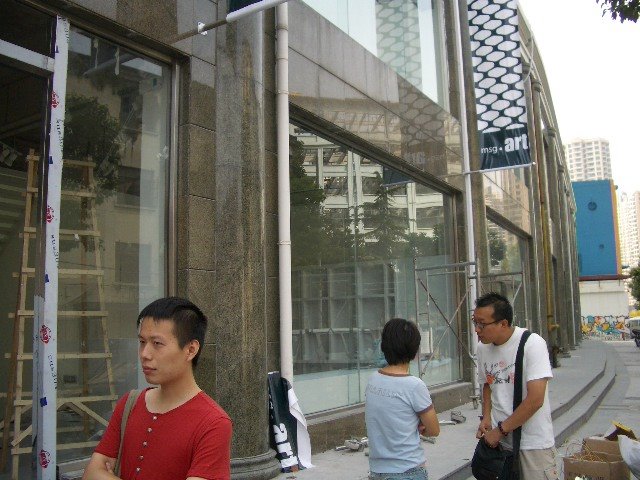
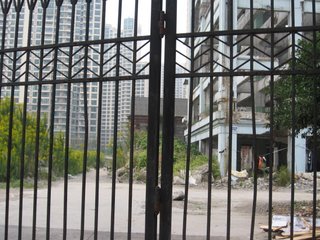
Moganshan Lu (Road in English) is situated next to Suzhou Creek in north-central PuXi, Shanghai. A collection of art galleries featuring contemporary painters, Moganshan Road calls to mind a unique artistic vibe, something akin to Chelsea in New York. Of course, one is unable to not feel that it remains a bit peculiar, an artistic enclave among a sea of skyscrapers that tower in the distance. Of course, one has to come to expect these odd juxtapositions in Shanghai, and in terms of art, the galleries of Moganshan Road do not disappoint.
MSG Art, a gallery operating out of Los Angeles, has recently opened its doors at 87 Moganshan Road, featuring the works of Chi Peng, He Jie, and Zhong Shan. Perhaps the most exciting feature about the gallery is its hopes to open a cultural exchange among its artists, allowing for American and international artists to spend a month on site at the gallery exchanging ideas with local Chinese artists. http://www.msgart.com/
Another important gallery is that of BizArt, which is located on the fourth floor of 50 Moganshan Road, Building No. 7. Opening in 1998, BizArt is one of the only truly non-profit galleries in Shanghai. As China does not currently have a system in place for non-profit galleries, BizArt has to engage in a rather complicated system to move money around. The director is committed, however, to ensuring that BizArt remain untainted from cashing in on artists, or being supported by large real estate developers, as is Zendai. Although recently having run into some problems (which remain sensitive), the gallery continues to forge ahead with new artist exhibitions. The current exhibition, running from October 13th until October 20th, is ElectriCITY, featuring the work of Shi Qing. For more information, visit http://www.bizart.com/.
 Yet another important gallery is that of Eastlink, located at 50 Moganshan Road, Building No. 6, fifth floor. Having opened in 1999, the gallery boasts 900 square meters of space, and is currently exhibiting “Extension Turn 2”, with works by a collection of international contemporary artists. One of the most striking currently on display is that of Johannes Speder, entitled “Mountain”. This work lies near the entrance to Eastlink, and occupies most of the front of the gallery. This captivating work lies across from another piece by He Yunchang entitled, “Beyond Mountains and the Sky”, a series of photographs detailing the artists attempt to use his own strength to push against the strength of an explosion. Eastlink is also featuring articles by seventeen different scientists in its catalogue, along with the twenty-seven participating artists. Eastlink also sells various antiques and past artwork in side rooms, to raise capital for its artistic endeavors. http://www.eastlinkgallery.cn/
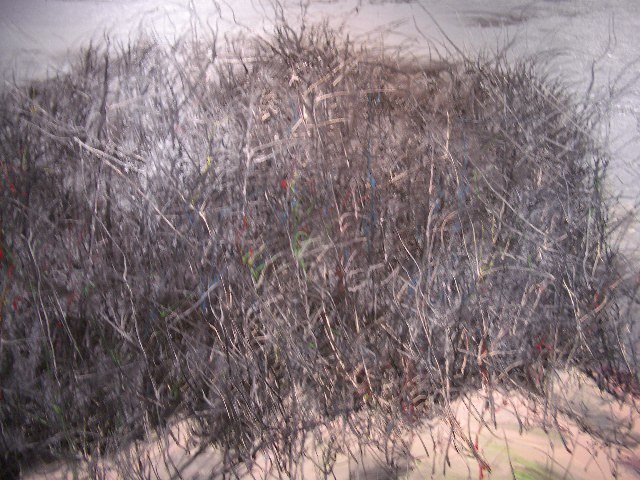 Finally, one should not finish their visit to Moganshan without stopping at ShanghART, located on 50 Moganshan Road, Buildings 16 & 18. Currently, the works of Zeng Fanzhi were on display, displaying his completely unique approach to art, with various works on display. The new exhibit, by Pu Jie, has been set to open on October 18th, and runs until October 31st. One can find more at http://www.shanghart.com/.Although some might feel that Moganshan has a feel of a slightly contrived space, especially in high-rise Shanghai, there is no disputing that the galleries there have no qualms about taking risks and pushing boundaries in China. A visit to Moganshan will not disappoint, and with around 100 galleries that are constantly changing exhibits, the scene here is never static. Moganshan sets the pace for the rest of the Shanghai art scene, and for those who want to see things before the move to the Shanghai MoCA or Zendai, Moganshan is the place to be.
Saturday, October 14, 2006
Moganshan Art District
---- a secret place in the city
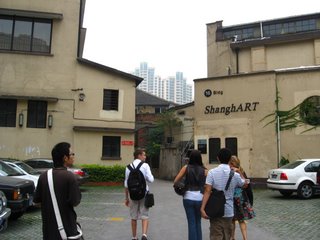 I think the Shanghart Gallery can be a representive of this art district. It is a typical warehouse with high ceilings, shabby walls. There are also many documentations of artists.
high ceilling, interesting floor:
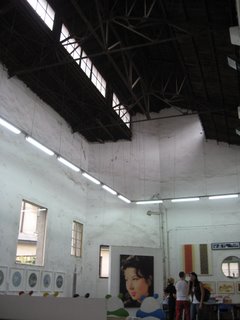
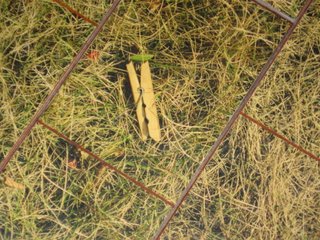
Three pieces of work:
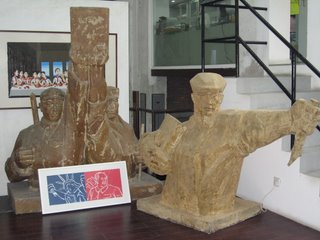
very interesting works
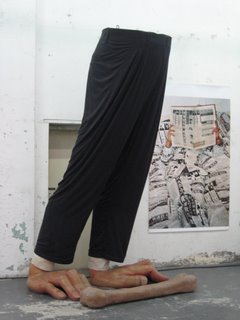
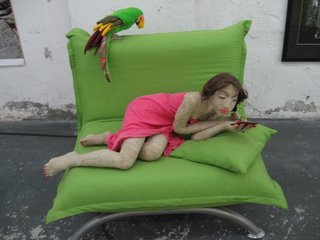
M50, a secret place, produces a large quatity of art works. There are no noises, but quiet and full of art spirit. I enjoy the visits as well as the lectures very much.
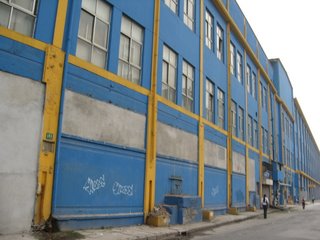
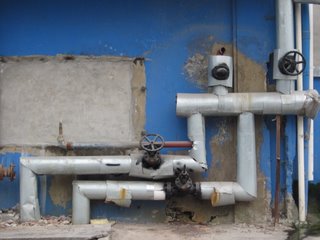
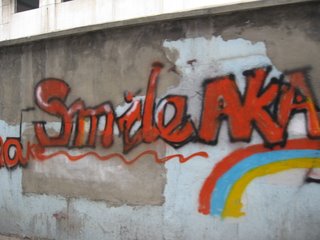
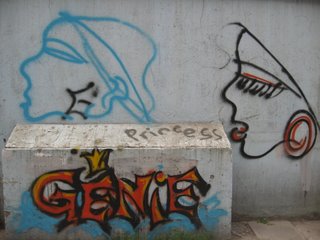
Nobody seems to know the place, even the cab driver. It's like a secret place in the city and this appeals to me very much. When we arrived at Moganshan Lu, this mysterious place begin to unveil itself: empty street, graffiti,wasted warehouse. But instead of being inanimate, it gives forth the smell of art. As we got closer, many art studioes and galleries appears.
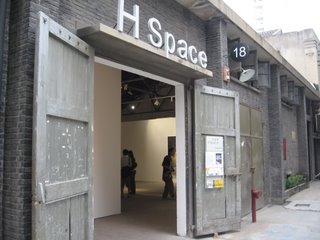


Bizart
I like the name of "Bizart" very much. Davide gave us a very insightful lecture and explained the complication and something we don't know about art, like the forces of the government they have to face when organizing an exhibition. The following work is "a world can't be without electricity".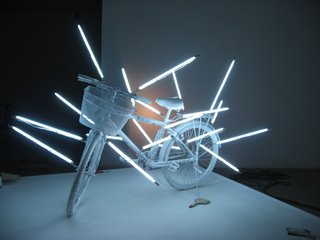
East link
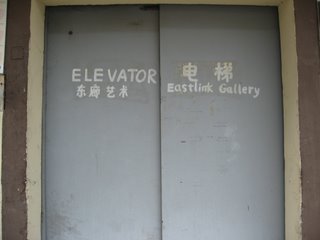
East Link is a spacious place, and there are three rooms inside. They are pictures of experimental art of modern life, works reflected the Cultural Revolution, and a collection of wood furniture antiques respectively.


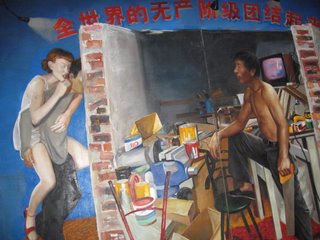

Shanghart Gallery
 I think the Shanghart Gallery can be a representive of this art district. It is a typical warehouse with high ceilings, shabby walls. There are also many documentations of artists.
high ceilling, interesting floor:
Three pieces of work:
very interesting works
M50, a secret place, produces a large quatity of art works. There are no noises, but quiet and full of art spirit. I enjoy the visits as well as the lectures very much.
Subscribe to:
Posts (Atom)